Coffee Beans Market Size, Share & Industry Analysis, By Product Type (Arabica and Robusta), By Form (Green Coffee Beans and Roasted Coffee Beans), By Nature (Organic and Conventional), By End-Use (Food & Beverages, Pharmaceutical, and Cosmetics), and Regional Forecast, 2026–2034
 Download Free Sample
(Offer valid till 30th Sep 2026)

Coffee Beans Market Size and Future Outlook
 Listen to Audio Version
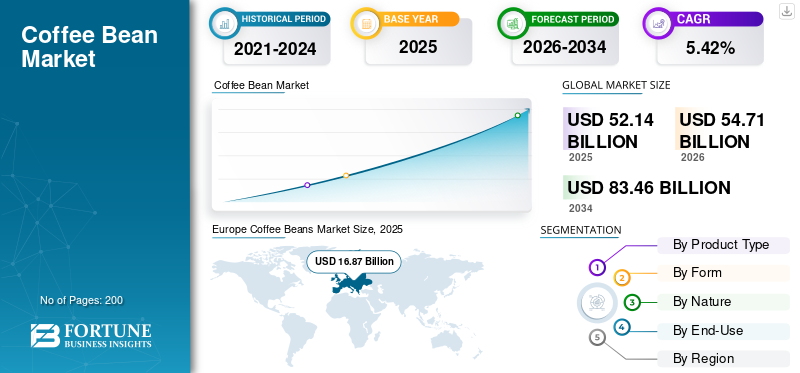
The global coffee beans market size was valued at USD 52.14 billion in 2025 and is projected to grow from USD 54.71 billion in 2026 to USD 83.46 billion by 2034, exhibiting a CAGR of 5.42% during the forecast period. Europe dominated the coffee beans market with a market share of 32.36% in 2025.
Coffee bean demand is increasing globally, driven by consumers’ preference for high-quality, traceable, and single-origin beans. The premiumization trend, the upward trend in specialty coffee consumption, and rapid urbanization are further contributing to the industry growth. Furthermore, increasing café culture among younger consumers and expanding coffee culture into traditionally tea-drinking nations such as China and India is likely to drive the global market growth.
Key market players such as Starbucks Coffee Company, JDE Peet's Coffee and Tea, Keurig Dr Pepper, Unilever Plc., and others are changing the industry landscape through their continuous growth strategies, including mergers & acquisitions, new product development, and geographical expansion.
Download Free sample to learn more about this report.
Coffee Beans Market Key Takeaways
 Market Size & Forecast
- 2025 Market Size: USD 52.14 billion
- 2026 Market Size: USD 54.71 billion
- 2034 Forecast Market Size: USD 83.46 billion
- CAGR: 5.42% from 2026–2034
 Market Share
- Europe dominated the coffee beans market with a 32.36% share in 2025.
- The arabica segment dominated the market, accounting for USD 33.66 billion in 2025.
- The roasted coffee beans segment led the market, reaching USD 48.70 billion in 2025.
 Key Regional Highlights
Europe
Europe accounted for USD 16.87 billion in 2025 and is projected to expand at a CAGR of 3.73% during the forecast period.
North America
North America reached USD 13.32 billion in 2025 and is expected to grow at a CAGR of 4.74% from 2026–2034.
Asia Pacific
Asia Pacific was valued at USD 14.57 billion in 2025 and is projected to record a CAGR of 8.12% during the forecast period.
U.S.
The market was valued at USD 11.15 billion in 2025 and is expected to expand at a CAGR of 4.54% over the forecast period.
Japan
The coffee beans market reached USD 3.35 billion in 2025, reflecting strong consumer demand for coffee products.
Read More

Coffee Beans Market Trends
Emerging Adoption of Beans in Cosmetics Applications to Shape the Industry
The cosmetics industry is one of the key sectors shaping the global coffee bean market growth. The rising popularity of sustainable ingredients, natural and plant-based alternatives to chemicals, and clean-labeled ingredients in cosmetics and personal care products is strongly impacting product demand growth, especially in Europe and Asia Pacific. Thus, several industry-specific research centers are involved in R&D activities to develop new ingredients from coffee beans. It will support key players in the cosmetics industry in adopting and developing new products from coffee beans. For instance, in January 2023, the Circular Bio-based Europe-funded Prolific project developed polyphenols from coffee beans for a skin care product. Furthermore, increased new product development in the cosmetics industry using coffee beans is likely to drive global coffee bean market growth in the near future.
- In May 2025, Croda International Plc., one of the cosmetics ingredients manufacturing companies, introduced Phytessence™ Green Coffee EC, a botanical ingredient extracted from unroasted robusta coffee seeds for skincare product manufacturers.
MARKET DYNAMICS
Market Drivers
Download Free sample to learn more about this report.
Increasing Café Culture Among Millennials to Drive Market Growth
The rapid expansion of café culture across both developed and emerging economies is a primary driver of the global coffee beans market growth. The proliferation of specialty coffee shops, international café chains, independent artisanal cafés, and premium quick-service restaurants has significantly increased demand for high-quality Arabica and Robusta beans. Urbanization, rising disposable incomes, and changing lifestyles, particularly among millennials and Gen Z consumers, are accelerating out-of-home coffee consumption. Additionally, cafés serve as social and professional hubs, reinforcing frequent consumption patterns and premiumization trends. Furthermore, key players such as Starbucks Coffee Company and others are expanding their business operations into Tier-2 and Tier-3 countries. This structural shift toward experiential coffee consumption is sustaining steady volume growth and supporting higher average selling prices across major markets.
- According to Starbucks, the company has operated 479 outlets across India since December 2024 and aims to open 58 new stores by the end of March 2025. Further, the company planned to open 1,000 outlets across Tier-2 & Tier-3 cities by the end of 2028 under its strategic growth plan.
Market Restraints
High Pricing, Production Constraints, and Limited Geographic Supply Restricting Market Expansion
The global market is highly exposed to climatic risks, as coffee cultivation is sensitive to temperature fluctuations, rainfall variability, and extreme weather changes. Climate change in major coffee-producing countries such as Brazil, Vietnam, and Colombia is posing challenges, including droughts, frost events, pests, and diseases, that are disrupting yields and tightening supply. These production uncertainties contribute to pronounced volatility in green coffee prices, impacting procurement costs for roasters and beverage manufacturers. In parallel, rising input costs, including fertilizers, labor, and transportation, are further pressuring margins. This price instability limits long-term contract visibility, increases retail price fluctuations, and restrains consumption growth in price-sensitive markets. Furthermore, the increasing popularity of substitutes such as ground coffee, instant coffee, and ready-to-drink coffee will hamper market growth.
- According to the International Coffee Organization, the Composite Indicator Price (I-CIP) averaged price of green coffee beans increased to USD 3.05 per lb in December 2025, up 1.69% from December 2024. However, the December 2024 price was USD 2.99 per lb, up 10.7% from November 2024.
Market Opportunities
Increasing New Product Development and Value-Added Offerings Reshaping Market Dynamics
Producers and roasters are increasingly focusing on differentiated offerings such as single-origin beans, specialty and micro-lot coffees, organic and sustainably certified variants, and customized roast profiles. In addition, the development of ready-to-brew formats, cold-brew-specific beans, and functional coffee blends enriched with health-oriented ingredients is expanding the occasions for consumption. These innovations align with evolving consumer preferences for traceability, quality, and experiential value, enabling brands to command premium pricing and strengthen customer loyalty. As a result, new product development is expected to drive both volume expansion and margin growth over the forecast period.
- In July 2025, Laird Superfood, Inc., one of the key functional coffee companies, launched Perform Whole Bean Coffee and Perform Decaf Coffee. The whole-bean and decaf coffees are infused with functional ingredients, including chaga, lion's mane, maitake, and cordyceps, which promote energy, focus, and overall balance.
COFFEE BEANS MARKET SEGMENTATION ANALYSIS
By Product Type
Arabica Coffee Held the Highest Market Share Due to Its Flavor and Taste
On the basis of product type, the global market is segmented into Arabica and Robusta.
The arabica segment dominated the market in 2025, accounting for USD 33.66 billion, driven by its superior flavor profile, lower bitterness, and rising demand for specialty coffee. Arabica beans are widely used across specialty cafés, branded coffee chains, and high-end retail offerings, making them the preferred choice for both on-trade and off-trade channels. Broad acceptance and premium positioning across multiple consumption occasions are expected to drive the sustained growth of the Arabica segment.
The Robusta segment is projected to grow at the fastest CAGR of 4.89% during 2026–2034. Robusta beans are increasingly used in instant coffee, espresso blends, ready-to-drink beverages, and mass-market formulations, particularly in price-sensitive regions. Furthermore, the higher caffeine content in the variety further attracts a youth and busy-scheduled consumer group. Emerging affordability, versatility, and expanding industrial use, rather than premium, will drive the segment’s demand growth.
By Form
Roasted Coffee Beans Led Market Due to Their Direct Usability
Based on the form, the market is segmented into green coffee beans and roasted coffee beans.
The roasted coffee beans segment led the global coffee beans market share in 2025, reaching USD 48.70 billion. The segment dominated the global market due to its direct usability, convenience, and strong alignment with consumer and foodservice demand. Roasted coffee beans are widely consumed across cafés, restaurants, offices, and households, making them the preferred form in both on-trade and off-trade channels.
The green beans segment is expected to grow at the fastest CAGR of 7.35% over the forecast period. The growth segment is driven by upstream demand, customization flexibility, and premiumization rather than immediate consumer demand.
By Nature
Affordability Pricing and High Volume Consumption Boosted Conventional Segment Growth
By nature, the market is categorized into conventional and organic.
The conventional segment held the largest share of the market in 2025, valued at USD 47.70 billion. Conventional coffee beans are widely used in commercial cafés, instant coffee manufacturing, and mass-market retail products, making them the preferred choice for both on- and off-trade channels. Broad availability and competitive pricing across multiple applications are expected to sustain the segment’s dominant position.
The organic segment is projected to grow at the fastest CAGR of 6.24% over the forecast period. The segment is driven by increasing consumer awareness of health, sustainability, and environmentally responsible farming practices.
By End-Use
To know how our report can help streamline your business, Speak to Analyst
Food Service and Household Coffee Consumption Fueled Food & Beverages Segment Growth
Based on end-use, the market is segmented into food & beverages, pharmaceutical, and cosmetics.
The food & beverages segment accounted for the largest share in 2025, valued at USD 49.28 billion. Increasing coffee consumption in Western countries, paired with the café and foodservice industry in Asian markets such as China and India, is driving demand for brew-style coffee beans. Increasing new product development by key players to meet consumer demand for restaurant-style coffee consumption at home is further contributing to segment growth. Thus, the segment is anticipated to remain dominant by 2034.
The cosmetics segment is projected to witness the fastest CAGR of 8.67% over the forecast period. The increasing adoption of coffee-infused personal care and skincare products is driving demand for green coffee beans. Additionally, key cosmetic ingredient producers are developing new ingredients to meet the demand of cosmetics manufacturers, further contributing to product demand in the segment.
Coffee Beans Market Regional Outlook
Regionally, the report covers the global market analysis across North America, Europe, Asia Pacific, South America, and the Middle East & Africa.
Europe
Europe Coffee Beans Market Size, 2025 (USD Billion)
To get more information on the regional analysis of this market, Download Free sample
Europe dominated the market in both value and volume consumption of the product, accounting for USD 16.87 billion in 2025, and is projected to expand at a CAGR of 3.73% over the forecast period, with high imports for domestic consumption. Germany is one of the leading countries in importing green coffee beans worldwide. Additionally, increased adoption of cosmetics & personal care products will drive demand in the near future.
France Coffee Beans Market
France accounted for approximately USD 2.62 billion in 2025, driven by a large household consumption base, stable pricing, and inbound tourism, along with a shift in the food service industry, which is driving coffee bean sales in hotels, cafés, restaurants, and experiential venues across the country.
North America
North America accounted for USD 13.32 billion in 2025 and is projected to grow at a CAGR of 4.74% during 2026-2034. High per-capita coffee drinking in the U.S. and Canada, coupled with strong premium and specialty pricing, supports growth in coffee bean demand in the region.
U.S. Coffee Beans Market
The U.S. market was valued at approximately USD 11.15 billion in 2025 and is expected to expand at a CAGR of 4.54% during the forecast period. The country dominates regional value due to very high per-capita consumption, strong specialty coffee penetration, and premium pricing across retail and foodservice. Additionally, increasing the number of artisanal brands developing region-specific coffee beans will change the market landscape in the coming years.
Asia Pacific
The Asia Pacific market reached USD 14.57 billion in 2025 and is projected to grow at an 8.12% CAGR over the forecast period. Rapid urbanization, rising middle-class income, and the emergence of Western beverage consumption habits are expected to drive the market growth in the region. Coffee culture in Asian countries such as China, India, and Indonesia is emerging, driven by Gen-Z and millennial purchasing habits, the influence of social media, and premium-category beverage options, which are driving regional market growth.
China Coffee Beans Market
China was valued at USD 2.97 billion in 2025, driven by increasing café culture among the youth consumer group, coupled with the influence of Western lifestyles, which are changing market dynamics in the country. Rapid growth in coffee drinking across urban centers, explosive café-chain expansion, and increasing import of premium beans drive the strongest value growth in the country.
Japan Coffee Beans Market
Japan reached USD 3.35 billion in 2025, supported by rising on-the-go beverage premiums and growing household coffee consumption. The rising popularity of coffee-based RTD beverages, coupled with growing demand for natural and botanical-infused cosmetic products, is likely to drive the market.
South America and Middle East & Africa
South America accounted for USD 5.48 billion in 2025 and is projected to grow at a CAGR of 4.37% over the forecast period. The influence of social media and changing beverage purchasing habits among youth will drive market growth. Stable availability of raw materials and price stability are expected to influence market growth.
The Middle East & Africa market was valued at USD 2.97 billion in 2025 and is projected to grow at a CAGR of 5.41% over the forecast period. Premium café expansion and trade hub activity in GCC countries support growth. At the same time, lower per capita consumption in Africa constrains the regional share.
South Africa Coffee Beans Market
The South Africa market was valued at approximately USD 0.65 billion in 2025 and is projected to grow at a CAGR of 4.79% during 2026–2034. The market is driven by stable household and product demand, with foodservice supporting market growth.
COMPETITIVE LANDSCAPE
Key Industry Players
Key Players Focus on Geographical Expansion for Strategic Growth
The global coffee beans market share is fragmented, with a number of regional players and a few key international players. Key market players such as Starbucks Coffee Company, JDE Peet's Coffee and Tea, Keurig Dr Pepper, Unilever Plc., Caribou Coffee, and others are reshaping the industry landscape through their ongoing growth strategies. Key international players are focusing on expanding their cafés and sales footprints in emerging nations and on expanding their product offerings, which will change the industry landscape in the near future.
Key Players in the Coffee Beans Market
|
Rank |
Company Name |
|
1 |
Starbucks Coffee Company |
|
2 |
JDE Peet's Coffee and Tea |
|
3 |
Keurig Dr Pepper |
|
4 |
Unilever Plc. |
|
5 |
Caribou Coffee |
List of Key Coffee Bean Companies Profiled
- Starbucks Coffee Company (U.S.)
- JDE Peet's Coffee and Tea (Netherlands)
- Luigi Lavazza S.p.A. (Italy)
- Hawaii Coffee Company (U.S.)
- Keurig Dr Pepper (U.S.)
- Caribou Coffee (U.S.)
- The Eight O'Clock Coffee Company (U.S.)
- Kicking Horse Coffee Co. Ltd. (Canada)
- Tata Coffee (India)
- Unilever Plc. (U.K.)
KEY INDUSTRY DEVELOPMENTS
- January 2026: Starbucks Coffee Company, a global leading coffee company, launched its new blonde roast whole bean coffee, available across 22 markets in Latin America and the Caribbean
- October 2025: Seven Café, one of the business wings of the retail chain Seven-Eleven, launched Seven Café Hydrogen Roasted Coffee. The company collaborated with UCC Ueshima Coffee Co., Ltd., in Japan. The company offers new coffee beans across its 7-Eleven stores in Japan.
- April 2025: Starbucks India, one of the key coffee chains, opened its 50th drive-thru store in Bengaluru’s Electronic City to offer more exclusive services to its consumers.
- December 2024: The Coffee Bean & Tea Leaf, one of the key specialty coffee manufacturers, signed a strategic partnership with Ekaagra Ostalaritza Pvt Ltd. to develop and expand the brand across India, with an ambitious plan to launch 250 cafés over the next five years.
- August 2024: Nguyen Coffee Supply, one of the key Vietnamese coffee companies in the U.S., expanded its packaged coffee bean offerings in H-E-B stores. The H-E-B stores offer the company’s products, including Saigon (Arabica & Robusta Dark Roast blend), Hanoi (100% Robusta Dark Roast), and Loyalty (Arabica & Robusta Medium Roast blend) across the country.
REPORT COVERAGE
The market report analyzes the market in depth and highlights key aspects, including global coffee beans market trends, supply chain, market dynamics, prominent companies, investment in research and development, and end-use. In addition, the research report provides insights into the global market and highlights significant industry developments.
Request for Customization to gain extensive market insights.
Report Scope & Segmentation
| ATTRIBUTE | DETAILS |
| Study Period | 2021-2034 |
| Base Year | 2025 |
| Estimated Year | 2026 |
| Forecast Period | 2026-2034 |
| Historical Period | 2021-2024 |
| Growth Rate | CAGR of 5.42% from 2026 to 2034 |
| Unit | Value (USD Billion) |
| Segmentation |
By Product Type
|
|
By Form
|
|
|
By Nature
|
|
|
By End-Use
|
|
|
By Region
|
Frequently Asked Questions
Fortune Business Insights says that the global market was USD 52.14 billion in 2025 and is anticipated to reach USD 83.46 billion by 2034.
At a CAGR of 5.42%, the global market will exhibit steady growth over the forecast period.
By product type, the arabica segment dominated the market in 2025.
Europe held the largest market share in 2025.
Increasing cafe culture among millennials to drive the market growth.
Starbucks Coffee Company, JDE Peet's Coffee and Tea, Keurig Dr Pepper, Unilever Plc., Caribou Coffee, among others, are the leading companies in the market.
Emerging adoption of beans in cosmetics applications is shaping the industry.



- 2021-2034
- 2025
- 2021-2024
- 200
-
(Offer valid till 30th Sep 2026)
Get 30-60 hrs Free Customization
Expand Regional and Country Coverage, Segments Analysis, Company Profiles, Competitive Benchmarking, and End-user Insights.




















Related Reports
-
US +1 833 909 2966 ( Toll Free )
-
Get In Touch With Us