Decaf Coffee Market Size, Share & Industry Analysis, By Species (Arabica, Robusta, and Others), By Product Type (Ground Coffee, Instant Coffee, Ready-to-Drink, and Concentrate), By Decaffeination Method (Solvent-Based, Swiss Water Process, and Others), By Category (Roasted and Raw), By Distribution Channel (Food Service and Retail [Supermarkets/Hypermarkets, Specialty Stores, Online Retail Stores, and Others]), and Regional Forecast, 2026-2034
 Download Free Sample
(Offer valid till 15th Oct 2026)

Decaf Coffee Market Size and Future Outlook
 Listen to Audio Version
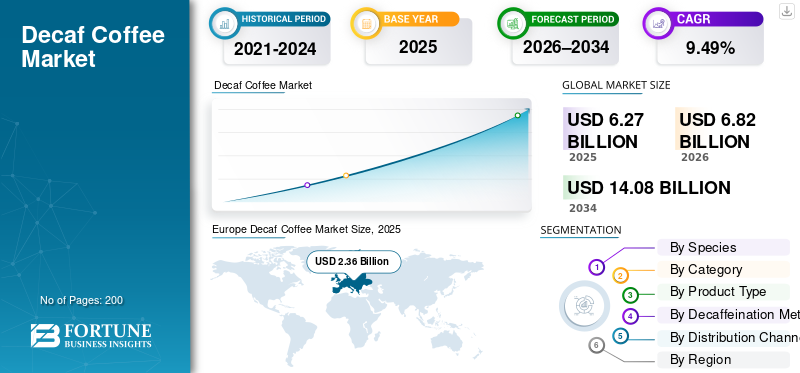
The global decaf coffee market size was valued at USD 6.27 billion in 2025. The market is projected to grow from USD 6.82 billion in 2026 to USD 14.08 billion by 2034, exhibiting a CAGR of 9.49% during the forecast period. Europe dominated the decaf coffee market with a market share of 37.63% in 2025.
Decaffeinated coffee is produced by removing most of the caffeine content from green coffee beans while preserving flavor compounds. The growth of the market is structurally driven by rising health awareness and increasing caffeine sensitivity among aging populations. The growing consumption of coffee in the evening and night occasions and expanding premium decaf offerings across retail and foodservice channels are additional factors bolstering industry expansion. Improvements in decaffeination technologies have significantly reduced historical taste penalties, accelerating consumer base acceptance across both developed and emerging markets. The global market features dynamic supply chains reliant on green coffee imports from major producers such as Brazil and Vietnam.
The global industry is moderately consolidated, with major players including Nestlé S.A., JDE Peet’s, The Kraft Heinz Company, Starbucks Corporation, and Lavazza Group dominating the competitive landscape.
Download Free sample to learn more about this report.
Decaf Coffee Market KEY TAKEAWAYS
 Global Market Size & Forecast
- 2025 Market Size: USD 6.27 billion
- 2026 Market Size: USD 6.82 billion
- 2034 Forecast Market Size: USD 14.08 billion
- CAGR: 9.49% from 2026–2034
 Market Share
- Europe dominated the market with a 37.63% share in 2025.
- Arabica led the market with USD 4.63 billion in 2025.
- Retail dominated the market with USD 3.99 billion in 2025.
 Key Regional Highlights
Europe
Europe reached USD 2.36 billion in 2025 and is projected to reach USD 5.00 billion by 2034.
Asia Pacific
Asia Pacific is the fastest-growing region with a 12.52% CAGR.
North America
North America reached USD 2.02 billion in 2025, supported by mature coffee consumption.
U.S.
The U.S. market reached USD 1.65 billion in 2025 and is projected to grow at a 7.67% CAGR.
Japan
Japan is expected to witness growth alongside rising health awareness and premium coffee demand.
Read More

Decaf Coffee Market Trends
Premiumization through Natural and Chemical-Free Decaffeination to Shape the Industry
The adoption of the Swiss Water Process and CO₂-based decaffeination process is accelerating, supported by clean-label demand. Regular coffee organizations, such as the International Coffee Organization (ICO), highlight increasing consumer willingness to pay premiums for naturally processed decaf coffee that preserves origin characteristics and flavor integrity. Specialty cafés and premium retail brands are actively expanding single-origin and organic decaf portfolios. Moreover, cold brew decaf options are gaining traction amid rising global product demand.
- According to the USDA Economic Research Service (ERS), consumer behavior studies show that about 35–40% of U.S. coffee consumers are willing to pay a price premium of 10–25% for products positioned as health-oriented or reduced-stimulant, including decaffeinated and low-caffeine beverages, particularly among consumers aged 35 and above.
Download Free sample to learn more about this report.
MARKET DYNAMICS
Market Drivers
Growing Health Awareness and Caffeine Reduction Initiatives to Drive Market Consumption
The surging health awareness and formal caffeine reduction initiatives are structurally reshaping global beverage consumption patterns, directly supporting sustained growth in the market. Excessive caffeine consumption is associated with sleep disturbances, anxiety, elevated blood pressure, and cardiovascular sensitivity, particularly among pregnant women, elderly populations, and individuals with underlying health conditions. As a result, consumers are actively seeking coffee alternatives that deliver familiar taste and ritual without physiological side effects.
- The ACOG (American College of Obstetricians and Gynecologists) recommends that pregnant women should limit caffeine to less than 200 mg per day.
Market Restraints
Higher Processing Costs and Price Premiums May Restrict Market Growth
Higher processing costs and resulting price premiums remain key restraints limiting the full-scale penetration of decaf coffee, particularly in price-sensitive and emerging markets. Unlike conventional coffee, this product requires additional processing stages to remove caffeine while preserving flavor and aroma, significantly increasing production complexity, capital investment, and operating costs across the value chain. Collectively, higher processing costs, elevated retail prices, and logistical complexity act as a structural restraint on the global decaf coffee market growth. While premium consumers in developed regions continue to absorb price premiums, widespread adoption in cost-sensitive markets remains constrained, putting a restraint on the overall market growth despite strong underlying health-driven demand.
Market Opportunities
Growth of Ready-to-Drink (RTD) and On-the-Go Decaf Formats to Create New Revenue Streams
The rapid expansion of ready-to-drink (RTD) and on-the-go decaf coffee formats is emerging as a significant growth lever for the global market, creating new revenue streams beyond traditional at-home brewing. Changing consumer lifestyles, urbanization, and longer working hours are driving the demand for convenient, portable beverages that align with health and wellness priorities. Decaf RTD coffee addresses this need by offering caffeine-moderated consumption without compromising the habitual coffee experience, making it particularly attractive for afternoon, evening, and multi-serve daily consumption occasions.
- For instance, in December 2026, Nolo launched the U.K.'s first functional decaf cold brew oat latte, featuring prebiotic benefits from a proprietary blend of Jerusalem artichoke and citrus fiber.
SEGMENTATION ANALYSIS
By Species
Arabica Segment Dominated the Market Due to Superior Flavor Profile
By species, the market is segmented into Arabica, Robusta, and others.
The Arabica segment led the global market in 2025 and was valued at USD 4.63 billion. The leading share is driven by its smoother taste, lower bitterness, and dominance in premium and specialty coffee offerings. Their naturally lower caffeine levels compared to Robusta enable more effective decaffeination while preserving exceptional flavor, body, and appeal in formats such as whole beans, grounds, and capsules.
The Robusta segment is projected to grow at a CAGR of 7.95% during the forecast period.
To know how our report can help streamline your business, Speak to Analyst
By Category
Roasted Segment Accounted for the Majority Share Owing to Strong Consumer Preference
By category, the market is segmented into roasted and raw.
The roasted segment held the major global decaf coffee market share with a value of USD 5.25 billion in 2025. The dominance is driven by the higher consumer preference for ready-to-brew formats. Roasted decaf appeals to health-conscious buyers who want reduced caffeine without sacrificing taste, supported by innovations in roasting technology and premium product expansions.
The raw segment is expected to grow at a CAGR of 7.94% over the analysis period, supported by specialty roasters and private-label sourcing.
By Product Type
Ground Coffee Segment Led the Market with Robust Consumption in Households
Based on product type, the market is subdivided into ground coffee, instant coffee, ready-to-drink, and concentrate.
The ground coffee segment dominated the market in 2025, accounting for USD 2.90 billion, supported by strong household consumption and café usage. This coffee type saves time for busy consumers by allowing immediate use in drip machines, French presses, or pour-overs without extra equipment, making it ideal for households and offices.
The ready-to-drink segment is expected to grow at the fastest CAGR of 10.85% over the forecast period, driven by convenience, urban lifestyles, and expanding cold-brew offerings.
By Decaffeination Method
Solvent-Based Segment Maintained Dominance due to Scalability and Cost Advantage
By decaffeination method, the market is segmented into solvent-based, Swiss Water Process, and others.
The solvent-based segment led the market in 2025 with a value of USD 3.45 billion due to cost efficiency and scalability. This dominance stems from its cost advantages, processing efficiency, and established infrastructure, enabling competitive pricing in price-sensitive markets.
The Swiss Water Process segment is projected to grow at a CAGR of 11.92% over the forecast period. The segmental expansion is driven by clean-label demand and premiumization trends. Swiss Water decaffeinated coffee appeals to premium segments, avoiding chemical processes.
By Distribution Channel
Retail Channels Led the Market Owing to Expansion of E-commerce Sector
By distribution channel, the market is segmented into food service and retail.
The retail segment dominated in 2025 with a valuation of USD 3.99 billion driven by supermarket penetration and e-commerce growth. Grocery stores serve as a primary distribution channel for decaf coffee accessibility worldwide.
The food service segment is projected to grow at a CAGR of 10.96% over the analysis period, supported by café chains, hotels, and specialty coffee shops expanding decaf menus.
Decaf Coffee Market Regional Outlook
Regionally, the report covers the market analysis across North America, Europe, Asia Pacific, South America, and the Middle East and Africa.
Europe
Europe Decaf Coffee Market Size, 2025 (USD Billion)
To get more information on the regional analysis of this market, Download Free sample
Europe dominated the global market in 2025 with a value of USD 2.36 billion and is projected to reach USD 5.00 billion by 2034, growing at a CAGR of 8.78% over 2026 to 2034. The region benefits from high per-capita coffee consumption, strong decaf acceptance, and premium specialty coffee culture.
Germany Decaf Coffee Market
Germany accounted for a value of approximately USD 0.48 billion in 2025, supported by strong retail penetration and health-driven consumer preferences.
Asia Pacific
Asia Pacific is the fastest-growing regional market, which is expected to grow at a CAGR of 12.52% over the forecast period. The market was valued at USD 1,236.72 billion in 2025. Growth is driven by rising urbanization, café culture expansion, and increasing health awareness. Asia Pacific shows rapid market growth driven by urban health consciousness in countries such as China.
China Decaf Coffee Market
China accounted for approximately USD 0.16 billion in 2025. The market is anticipated to grow at a CAGR of 15.79% over the analysis period, supported by rapid café expansion and premium RTD coffee adoption.
India Decaf Coffee Market
The India market was valued at USD 0.06 billion in 2025 and is projected to grow at a CAGR of 16.82% over the forecast period. The market growth is driven by young urban consumers and wellness-focused beverage trends in the country.
North America
The North America market has strong growth due to high consumer awareness of caffeine's health effects. The regional market was valued at USD 2.02 billion in 2025, driven by mature coffee consumption patterns and strong specialty coffee penetration.
U.S. Decaf Coffee Market
The U.S. market accounted for USD 1.65 billion in 2025. The market is poised to grow at a CAGR of 7.67% over the forecast period, supported by premium decaf offerings and strong retail distribution.
South America and the Middle East & Africa
In 2025, the South America market reached a value of USD 0.41 billion, while the Middle East & Africa accounted for USD 0.25 billion, supported by rising café culture and increasing disposable incomes.
UAE Decaf Coffee Market
The UAE market was valued at approximately USD 0.06 billion in 2025 and is anticipated to grow at a CAGR of 9.19% over the analysis period. The market expansion is driven by premium cafés, hospitality expansion, and wellness-oriented consumers.
COMPETITIVE LANDSCAPE
Key Industry Players
Leading Companies Emphasize RTD Innovations and Specialty Blends to Consolidate Market Positions
The global decaf coffee market is moderately consolidated, with competition centered on sourcing quality beans, advanced decaffeination technologies, brand positioning, and global distribution. Leading players are investing in Swiss Water and CO₂-based decaffeination, specialty blends, and RTD innovations.
Key Players in the Decaf Coffee Market
|
Rank |
Company Name |
|
1 |
Nestlé S.A. |
|
2 |
JDE Peet’s |
|
3 |
The Kraft Heinz Company |
|
4 |
Starbucks Corporation |
|
5 |
Lavazza Group |
List of Key Decaf Coffee Companies Profiled
- Nestlé S.A. (Switzerland)
- JDE Peet’s (Netherlands)
- The Kraft Heinz Company (U.S.)
- Starbucks Corporation (U.S.)
- Luigi Lavazza S.p.A. (Italy)
- Tchibo GmbH (Germany)
- Illycaffè S.p.A. (Italy)
- Strauss Group Ltd. (Israel)
- UCC Holdings Co., Ltd. (Japan)
- Massimo Zanetti Beverage Group (Italy)
KEY INDUSTRY DEVELOPMENTS
- January 2026: Frequent Coffee, a San Diego-based specialty roaster, expanded its decaf lineup with innovative coffees from Colombia and Nicaragua. These feature rare methods such as yeast inoculation, carbonic maceration, mucilage ethyl acetate (EA), thermal shock, Swiss Water, and sugarcane EA decaffeination.
- January 2026: Nespresso launched a limited-edition French Lavender & Vanilla Decaffeinated coffee pod for its Vertuo system, targeting the growing demand for flavored decaf options in the U.K. This decaf pod uses 100% Arabica beans sourced from Brazil and Colombia, roasted with a split-roast technique, medium-dark for sweetness and longer for velvety texture, then infused with vanilla and subtle French lavender notes post-roasting.
- December 2025: Holistic Roasters, a Demeter-certified coffee roaster, partnered with Swiss Water Decaffeinated Coffee Inc. to launch the world's first Biodynamic® decaf coffee. This collaboration introduces Biodynamic Décaf, using beans regeneratively grown in Honduras by the Demeter-certified 18 Conejo Farming Collective, emphasizing soil vitality and toxin-free practices.
- November 2025: Dekáf Coffee Roasters launched sample bundles to let coffee drinkers test their decaf, low-caffeine, and cold brew options without full commitment. These packs bundle existing products such as ground, whole bean, and cold brew samples across their lineup. The initiative targets growing demand for balanced, wellness-focused coffee amid rising interest in moderation.
- June 2025: Pact Coffee launched a specialty-grade decaf pod, targeting the growing demand for high-quality caffeine-free options in the U.K. market. The pod is a decaffeinated version of Pact's award-winning Bourbon Cream Espresso, scoring 84 out of 100 with professional tasters, exceeding the specialty-grade threshold of 80 points.
REPORT COVERAGE
The global decaf coffee market report analyzes the market in depth and highlights crucial aspects such as global market trends, market dynamics, prominent companies, investment in research and development, and end-use. Besides this, the report also provides insights into the global market analysis and highlights significant industry developments.
Request for Customization to gain extensive market insights.
Report Scope & Segmentation
|
ATTRIBUTE |
DETAILS |
|
Study Period |
2021-2034 |
|
Base Year |
2025 |
|
Estimated Year |
2026 |
|
Forecast Period |
2026-2034 |
|
Historical Period |
2021-2024 |
|
Growth Rate |
CAGR of 9.49% from 2026 to 2034 |
|
Unit |
Value (USD Billion) |
|
Segmentation |
By Species
|
|
By Category · Roasted · Raw |
|
|
By Product Type · Ground Coffee · Instant Coffee · Ready-to-Drink · Concentrate |
|
|
By Decaffeination Method
|
|
|
By Distribution Channel · Food Service · Retail o Supermarkets/Hypermarkets o Specialty Stores o Online Retail Stores o Others |
|
|
By Region · North America (By Species, Category, Product Type, Decaffeination Method, Distribution Channel, and Country) • U.S. (By Species) • Canada (By Species) • Mexico (By Species) · Europe (By Species, Category, Product Type, Decaffeination Method, Distribution Channel, and Country) • U.K. (By Species) • Germany (By Species) • France (By Species) • Italy (By Species) • Spain (By Species) • Rest of Europe (By Species) · Asia Pacific (By Species, Category, Product Type, Decaffeination Method, Distribution Channel, and Country) • China (By Species) • Japan (By Species) • India (By Species) • Australia (By Species) • Rest of Asia Pacific (By Species) · South America (By Species, Category, Product Type, Decaffeination Method, Distribution Channel, and Country) • Brazil (By Species) • Argentina (By Species) • Rest of South America (By Species) · Middle East & Africa (By Species, Category, Product Type, Decaffeination Method, Distribution Channel, and Country) • South Africa (By Species) • UAE (By Species) • Rest of the Middle East & Africa (By Species) |
Frequently Asked Questions
Fortune Business Insights says that the global market was valued at USD 6.27 billion in 2025 and is anticipated to reach USD 14.08 billion by 2034.
The global market is poised to exhibit steady growth at a CAGR of 9.49% over the forecast period.
By product type, the ground coffee segment led the market in 2025.
Europe held the largest market share in 2025.
The growing health awareness and caffeine reduction initiatives are key factors driving market growth.
Nestle S.A., JDE Peet’s, The Kraft Heinz Company, Starbucks Corporation, and Lavazza Group are the leading companies in the market.
Premiumization through natural and chemical-free decaffeination is a key trend in the market.


- 2021-2034
- 2025
- 2021-2024
- 200
-
(Offer valid till 15th Oct 2026)
Get 30-60 hrs Free Customization
Expand Regional and Country Coverage, Segments Analysis, Company Profiles, Competitive Benchmarking, and End-user Insights.









Related Reports
-
US +1 833 909 2966 ( Toll Free )
-
Get In Touch With Us