Health and Wellness Market Size, Share & Industry Analysis, By Category (Products {Fitness Equipment & Devices, Personal Care & Beauty Products, Food & Beverage, and Others} and Services {Spa & Salon, Health & Fitness Club, Online Health & Wellness Services, Weight Loss & Slimming Centers, and Others}), By End User (Up to 20 Years, Between 20 to 40 Years, and Above 40 Years), and Regional Forecast, 2026-2034
 Download Free Sample
(Offer valid till 30th Sep 2026)

Health and Wellness Market Size and Future Outlook
 Listen to Audio Version
The global health and wellness market size was valued at USD 7.3 billion in 2025. The market is projected to grow from USD 7.84 billion in 2026 to USD 12.98 billion by 2034, exhibiting a CAGR of 6.5% during the forecast period. North America dominated the global health and wellness market with a market share of 33.89% in 2025.
Consumers prioritize preventive healthcare products and fitness equipment for their physical and mental health & well-being. The growing awareness of maintaining health and improving lifestyles of the households is driving the demand for these products. In addition, consistent World Health Organization (WHO) and other health ministries’ promotions of better nutrition, physical fitness, and mental well-being are positively contributing to the market growth. Furthermore, the increasing prevalence of chronic diseases and population aging drives the demand for wellness tourism, immunity, and other healthcare solutions, favoring the worldwide industry growth. According to the survey data published by the U.S. Department of Health and Human Services, in 2024, around 129 million American citizens are suffering from at least 1 major chronic disease.
Key players operating in the global market include Unilever PLC, L’Oréal S.A., The Procter & Gamble Company, Nestlé S.A., and Johnson & Johnson Services, Inc. These players consistently implement R&D activities to provide better quality healthcare products and wellness services.
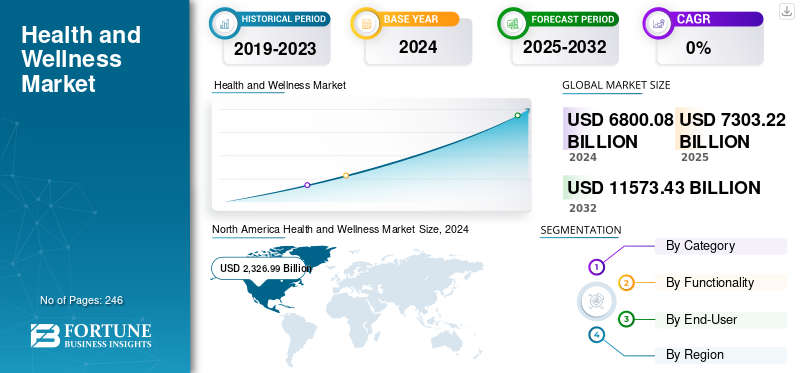
Download Free sample to learn more about this report.
Health and Wellness MARKET KEY TAKEAWAYS
 Market Size & Forecast
- 2025 Market Size: USD 7.3 billion
- 2026 Market Size: USD 7.84 billion
- 2034 Forecast Market Size: USD 12.98 billion
- CAGR: 6.5% from 2026–2034
 Market Share
- North America dominated the health and wellness market with a 33.89% share in 2025.
- Services segment is expected to hold a 52.42% market share in 2026.
- Nutrition & weight management segment is projected to account for 30.87% of the market in 2026.
 Key Regional Highlights
North American
Valued at USD 2.48 billion in 2025 and projected to reach USD 2.63 billion in 2026.
Europe
Accounted for USD 1.88 billion in 2025 and is expected to reach USD 1.99 billion in 2026.
Asia Pacific
Reached USD 2.21 billion in 2025 and is projected to grow to USD 2.43 billion in 2026
U.S.
The market is projected to reach USD 2.16 billion in 2026.
Japan
Market value not specified; growth is supported by increasing demand for health and wellness products.
Read More

MARKET DYNAMICS
MARKET DRIVERS
Emergence of Health Monitoring Devices and Telehealth Platforms to Drive Market Growth
Emergence of health and wellness monitoring devices, including wearable devices and wellness apps & telehealth platforms, enhances the wellbeing industry by promoting remote healthcare consultation, virtual classes, and physical exercises. Advancements in the development of AI-based healthcare devices and platforms accelerate the services revenues. In addition, the growing number of healthcare professionals offering personalized recommendations and gut health recovery solutions to their customers is favoring the health and wellness market growth.
MARKET RESTRAINTS
High Cost of Premium Wellness Products and Services to Restrain Market Growth
Advanced fitness products and spa treatments & other mindful services are sold at high prices. The higher cost of premium-based wellness products and services is limiting their demand among worldwide consumers. In addition, the rising number of wellness clubs offering luxury wellness services that are sold at premium prices also restrains the market growth. Furthermore, consistent food manufacturing brands’ promotion of nutrition-rich food at premium prices limits its demand among price-sensitive consumers.
MARKET OPPORTUNITIES
Increasing International Tourists’ Spending on Wellness Services to Augment Market Growth
An increasing number of international tourists and their spending on health and wellness optimizing services such as spa services, body detoxification, and sleep wellness, is favoring the wellness services revenues across many countries. Furthermore, the growing number of travelers who prefer preventive healthcare solutions and science-based leisure-oriented wellness services is skyrocketing the market growth. According to the World Tourism Barometer, UN Tourism, around 1.4 billion tourists were recorded across the world in 2024, 11% up over 2023.
MARKET CHALLENGES
Proliferation of Companies with Unverified Wellness Claims to Challenge Key Players’ Business Revenue Growth
The proliferation of companies with their unverified/unreliable wellness claims, including enhanced immunity, anti-aging effects, detoxification, and others, poses challenges to the authenticated businesses in their expansion activities. Furthermore, increased consumer skepticism and confusion about such unverified claims is expected to reduce consumer demand for the mindfulness services, challenging industry growth.
HEALTH AND WELLNESS MARKET TRENDS
Corporate Wellness is a Prominent Industry Trend
An increasing number of consumers including corporate firms and government offices prioritizing team member welfare and implementing team member wellness-related activities, improving team member physical and mental well-being, is favoring the global market growth. In addition, the growing corporate firms’ adoption of digital mental health platforms, including virtual therapy, stress-management apps, mindfulness tools, and team member assistance programs (EAPs) to conduct team member wellness activities, favors services revenues across many countries.
Download Free sample to learn more about this report.
Segmentation Analysis
By Category
High Spending on Wellness Services for Enhanced Health Benefits Leads to Dominance of Services Segment
By category, the market is bifurcated into products and services. The services segment held a leading global market share of 52.42% in 2026. Its major share is attributed to high worldwide consumer healthcare services spending including yoga, mindfulness, gym, and others. Furthermore, the growing number of healthcare clubs offering premium-based eye care and other wellness services is also accelerating the services segment at the fastest rate of 7.18% during the forecast period of 2025-2032.
The services segment is further sub-segmented into wellness tourism, spa services, workplace wellness, physical activity services, and others. The physical activity services segment exhibited a leading share of 27.68% within the service segment in 2024. The segment’s leading share is due to the wider base of gyms, fitness centers, and boutique studios generating considerable revenues from the physical activity services. In addition, the emergence of gym culture and increasing trend of availing hybrid memberships are favoring the revenue growth of this segment.
Wellness tourism sub-segment within the services segment is projected to grow at the fastest CAGR of 8.35% during 2025-2032. This growth is attributed to the rising number of international travelers enrolling for wellness tourism services, including medical-adjacent rejuvenation, covering mental and spiritual aspects of the services. Furthermore, the rising number of working professionals prioritizing vacations centered on detox therapies, meditation, and nature immersion travel services is accelerating the segmental revenue growth.
To know how our report can help streamline your business, Speak to Analyst
Increasing consumers’ accessibility to the health and wellness monitoring & improving products/devices, and consistent advancements in the development of innovative wellness products are mainly driving the products segmental growth. The products segment is sub-segmented into fitness equipment & devices, personal care & beauty products, food & beverage, and others, based on type. Personal care & beauty products sub-segment exhibited a leading share of 34.21% within the products segment in 2024. Its leading share is attributed to the rising demand for functional cosmetics and anti-aging skincare items globally. In addition, advancements in the development of natural ingredients or plant-based skincare and body massaging products positively contribute to the future segmental development.
The food & Beverage sub-segment is projected to grow at the fastest rate of 7.12% during 2025-2032. Its fastest growth is attributed to the rising consumer demand for personalized food & nutritional products and nutritional guidance-related consultations. Furthermore, consistent food manufacturers’ investments in the R&D activities of immunity and gut health-improving food items are driving the segment’s growth.
Based on distribution channel, the products segment is further sub-segmented into supermarkets & hypermarkets, specialty stores, drug stores, online channels, and others.
The supermarkets & hypermarkets segment is projected to hold a leading global market share of 31.61% by 2024. The segment’s leading share is attributed to the better consumers’ accessibility to the wide range of affordable and premium-quality, branded products, which generate considerable product revenues from supermarkets.
The rising adoption of online shopping of healthcare goods and increasing consumer spending on fitness platforms mainly accelerate online channels at a fastest CAGR of 7.74% during 2025-2032. Furthermore, increasing demand for the subscription-based services of innovative skin care products to enhance beautification favors the segment’s growth.
By Functionality
Obese Individuals’ Spending on Weight-Loss Products to Favor Nutrition & Weight Management Segment at Fastest CAGR
Based on functionality, the market is segmented into nutrition & weight management, immunity, heart & gut health, bone health, skin health, and others. The nutrition & weight management segment exhibited a leading market share of 30.87% in 2026. Its leading share is attributed to the high consumer spending on nutritional and weight loss food & beverage items and related services such as dietary supplements, functional foods, beverages, metabolic health & personalized nutrition programs, and others. In addition, the increasing prevalence of obesity and the rising number of obese individuals enrolling for weight-loss programs skyrockets the nutrition & weight management segmental growth at a fastest CAGR of 8.35% during 2025-2032.
The rising number of spa and salon clinics offering luxury massage therapies is mainly driving the spa services segmental growth at a considerable rate. Furthermore, the expanding hospitality settings and the increasing number of airport passengers preferring luxury spa services are favoring the segment’s growth.
By End-User
Wide Demographic Weight and Spending on Healthcare Solutions Drives Dominance of 20-40 Years Segment
Based on end-user, the market is segmented into, upto 20 years, 20-40 years, and above 40 years. Wider demographic weight and considerable younger generations’ spending on fitness, nutrition, and wellness travel-related solutions mainly result in the 20-40 years segment to hold a leading global market share of 43.24% in 2026. Furthermore, an increasing number of younger working professionals spending on mindfulness activities to reduce stress from their long working hours drives the 20-40 years’ segment’s growth at a fastest CAGR of 7.35% during 2025-2032.
An increasing number of aged individuals spending on anti-aging skincare solutions, including facial massage, body relaxing, and yoga services, accelerates above 40 years’ segment. In addition, the growing prevalence of bone & joint pain and gut & digestive health issues among aged consumers and their spending on solutions treating such healthcare concerns drive the segment’s revenue growth.
Health and Wellness Market Regional Outlook
By geography, the market is categorized into North America, Europe, Asia Pacific, South America, and Middle East & Africa.
North America Health and Wellness Market Size, 2025 (USD Billion)
To get more information on the regional analysis of this market, Download Free sample
North America
The North America region captured 33.89% of the global market in 2025, generating USD 2.48 Billion in revenue, and is projected to reach USD 2.63 Billion in 2026. The region’s leading share is attributed to advanced wellness center infrastructure and robust consumer demand for fitness equipment & devices across the U.S. and Canada. In addition, the increasing prevalence of obesity and aging increases the demand for weight management and anti-aging wellness services, driving the market growth across Canada and Mexico. According to the Global Obesity Observatory, the adult obesity percentage in Mexico augmented from 72% of the total adult population in 2021 to 75% in 2022.
The U.S. market size reached USD 2.16 billion in 2026. High consumer spending on wellness services, including meditation, yoga, and fitness classes, coupled with increasing health consciousness among households, mainly generates market revenues across the U.S. In addition, an increasing number of spa clinics offering luxury spa treatment services favors market growth across the country.
Asia Pacific
In 2025, Asia Pacific generated USD 2.21 Billion, contributing 30.30% to global market revenue, and is projected to grow to USD 2.43 Billion in 2026. The region’s market is projected to grow at a fastest rate of 8.89% during the forecast period of 2025 to 2032. A rising number of middle-income households and their disposable spending on health-benefiting & nutritional products mainly drive market growth across China, India, and Southeast Asia. In addition, the increasing demand for plant-sourced, bio-based health supplements and other energy drinks positively contributes to the market growth across the region.
Europe
Europe maintained a strong presence in the global market, reaching USD 1.88 Billion in 2025, accounting for 25.77% share, and is expected to reach USD 1.99 Billion in 2026. The rising number of international travelers preferring luxury hospitality services, spas, salons, and other wellness services, is driving the market growth across the Western European region. Furthermore, the growing health consciousness and increasing consumer spending on fitness equipment are favoring market growth across Russia and the Eastern European region.
South America and Middle East & Africa
Over the global market forecast period, the market in the South America and Middle East & Africa regions is expected to witness a moderate growth rate from 2025 to 2032.Middle East & Africa recorded a market size of USD .3 Billion in 2025, capturing 4.13% of the global market share, and is projected to reach USD .33 Billion in 2026. Increasing urbanization and growing number of middle-income households in Brazil, Argentina, and Colombia are mainly driving the South American market growth.
The expansion of hospitality & wellness infrastructure facilities, along with the rising number of international travelers seeking luxury hospitality services in the UAE, Saudi Arabia, Qatar, and South Africa, is driving services demand in these countries.The South America market was valued at USD 0.43 Billion in 2025, capturing 5.91% of global revenue, and is estimated to reach USD 0.46 Billion in 2026.
COMPETITIVE LANDSCAPE
Key Industry Players:
Consistent Focus on R&D Investment and Distribution Network Expansion to Help Key Players Build Market Position
The global market is competitive with leading players including Unilever PLC, L’Oréal S.A., The Procter & Gamble Company, Nestlé S.A., and Johnson & Johnson Services, Inc. These players significantly focus on conducting R&D investments to development innovative products. Furthermore, they emphasis on broadening products or services distribution network to strengthen business expansion. For instance, at CES 2025, L’Oréal S.A. launched “Cell BioPrint,” a skin-health AI device capable of predicting skin issues using proteomics and lab-on-a-chip technology.
LIST OF KEY HEALTH AND WELLNESS COMPANIES PROFILED:
- Unilever PLC (U.K.)
- L’Oréal S.A. (France)
- The Procter & Gamble Company (U.S.)
- Nestle S.A. (U.S.)
- Johnson & Johnson Services, Inc. (U.S.)
- Abbott Laboratories (U.S.)
- Danone S.A. (France)
- Estee Lauder Companies, Inc. (U.S.)
- The Colgate-Palmolive Company (U.S.)
- Bayer AG (Germany)
KEY INDUSTRY DEVELOPMENTS
- November 2025: Tika, a life-admin app, established a partnership with WithU Training, a physical and mental well-being platform, to strengthen its presence in the workplace wellness solutions portfolio.
- November 2025: Indian Hotels Company (IHCL), an Indian hospitality company, acquired a 51% stake in Sparsh Infratech Private Limited, owning the Atmantan brand, a luxury wellness center located at Mulshi, Pune, India. The acquisition was aimed at building its expertise in wellness platform promotions.
- October 2025: Fitpass partnered with Amazon India to offer subscription-based wellness services through the Amazon platform across India.
- May 2025: Givaudan launched Zensera, a patented technology-based stress management balm made of lemon extract. The product is available in the U.S. market.
- January 2025: Vagaro, a global spa, salon, and fitness software provider, established a strategic acquisition of Schedulicity, a business management software provider for wellness businesses. The acquisition was aimed at increasing its services portfolio in the wellness industry.
REPORT COVERAGE
The global health and wellness market analysis provides an in-depth study of market insights, size, and forecast by all the market segments included in the report. In addition, the report on the market outlooks market dynamics, and market trends expected to drive the market in the forecast period. It offers information on the technological advancements, new product launches, key industry developments, and details on partnerships, mergers & acquisitions. The research report also encompasses a detailed competitive landscape with information on the market share and profiles of key operating players.
Request for Customization to gain extensive market insights.
Report Scope & Segmentation
| ATTRIBUTE | DETAIL |
| Study Period | 2021-2034 |
| Base Year | 2025 |
| Forecast Period | 2026-2034 |
| Historical Period | 2021-2024 |
| Growth Rate | CAGR of 6.5% from 2026-2034 |
| Unit | Value (USD Billion) |
| Segmentation |
By Category
By Functionality
By Geography
By Geography
|
Frequently Asked Questions
Fortune Business Insights says that the global market value stood at USD 7.3 billion in 2025 and is projected to reach USD 12.98 billion by 2034.
In 2025, the market value stood at USD 2.48 billion.
The global market forecasted is forecasted to grow at a CAGR of 6.5% during 2026-2034.
By category, the services segment exhibited a leading global market share throughout the forecast period of 2026-2034.
The emergence of health monitoring devices and telehealth platforms is set to drive the global market.
Unilever PLC, L’Oréal S.A., The Procter & Gamble Company, Nestlé S.A., and Johnson & Johnson Services, Inc. are among the prominent players in the market.
North America dominated the market in 2025.
The increasing international tourists’ spending on wellness services is expected to favor the adoption rate of these services.



- 2021-2034
- 2025
- 2021-2024
- 246
-
(Offer valid till 30th Sep 2026)
Get 30-60 hrs Free Customization
Expand Regional and Country Coverage, Segments Analysis, Company Profiles, Competitive Benchmarking, and End-user Insights.



















Related Reports
-
US +1 833 909 2966 ( Toll Free )
-
Get In Touch With Us