Auxiliary Engine Market Size, Share & Industry Analysis, By Fuel Type (Conventional Diesel Engines, Gas-Diesel Dual-Fuel Engines, Methanol-Capable Engines, Ammonia-Capable Engines, and Other Fuel-Capable Engines), By Power Output (Below 500 kW, 500 kW-1,000 kW, 1,001 kW-2,000 kW, 2,001 kW-5,000 kW, and Above 5,000 kW), By Installation Type (Newbuild Installation and Replacement & Repowering), By Application (Cargo Vessels, Passenger Vessels, Offshore Vessels, Fishing Vessels, Tugboats & Workboats, Government & Defense Vessels, and Specialized Vessels), and Regional Forecast, 2026-2034
 Download Free Sample
Auxiliary Engine Market Size and Future Outlook
 Listen to Audio Version
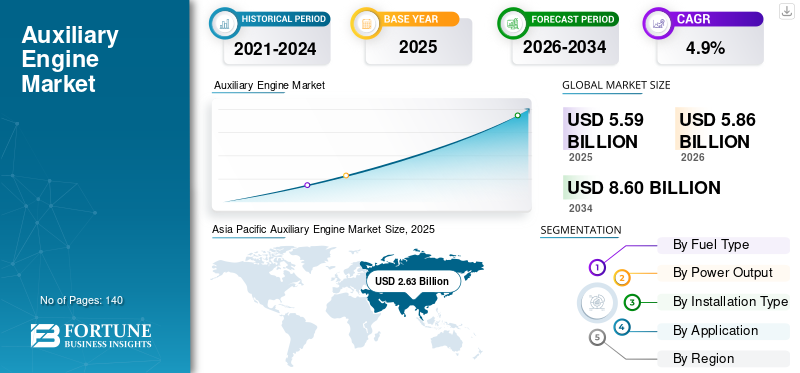
The auxiliary engine market size was valued at USD 5.59 billion in 2025. The market is projected to grow from USD 5.86 billion in 2026 to USD 8.60 billion by 2034, exhibiting a CAGR of 4.9% during the forecast period. Asia Pacific dominated the auxiliary engine market with a market share of 47.04% in 2025.
The market comprises manufacturing and commercial sale of marine auxiliary engines and complete engine-generator sets used to provide electrical and mechanical power aboard cargo vessels, passenger ships, offshore vessels, fishing vessels, tugboats, workboats, and government and defense vessels. These commercial vessel engines include conventional diesel, gas-diesel dual-fuel, methanol-capable, ammonia-capable, and other alternative-fuel systems supplied for newbuild installations, vessel replacement, and repowering applications. Auxiliary engines and marine diesel generators support onboard lighting, navigation and communication equipment, cargo-handling systems, pumps, ventilation, refrigeration, accommodation services, control systems, and other essential shipboard machinery. Growing maritime trade, commercial fleet expansion, shipbuilding activity, offshore energy development, naval modernization, and replacement of aging vessel engines are supporting global demand for heavy-duty engine solutions and offshore support equipment. Increasing adoption of electronic fuel injection, common-rail systems, exhaust after-treatment, digital engine monitoring, predictive maintenance, automated load management, and hybrid power management systems is enabling operators to improve fuel efficiency, reduce emissions, optimize engine loading, and comply with increasingly stringent marine environmental regulations. Development of energy-efficient auxiliary systems is also helping vessel operators reduce operating costs and improve onboard power reliability.
- For instance, in May 2025, MAN Energy Solutions completed the Type Approval Test of its L35/44DF dual-fuel engine for auxiliary generator-set and electric-propulsion applications, covering methane-capable and methanol-ready variants operating at 720 rpm and 750 rpm.
Wärtsilä Corporation, MAN Energy Solutions SE, Caterpillar Inc., Yanmar Holdings Co., Ltd., and Rolls-Royce Power Systems AG are among the major companies operating in the market.
Download Free sample to learn more about this report.
auxiliary engine market KEY TAKEAWAYS
 Global Market Size & Forecast
- 2025 Market Size: USD 5.59 Billion
- 2026 Market Size: USD 5.86 Billion
- 2034 Forecast Market Size: USD 8.60 Billion
- CAGR: 4.9% from 2026-2034
 Market Share
- Asia Pacific dominated the market with a revenue share of 47.04% in 2025.
- Conventional diesel engines held the largest market share by fuel type in 2025.
- The 1,001 kW–2,000 kW segment held the largest market share by power output in 2025.
 Key Regional Highlights
North America
North America accounted for USD 0.84 billion in revenue in 2025, supported by vessel replacement and offshore energy activity.
Europe
Europe is expected to witness steady growth, driven by fleet renewal, offshore wind activity, and low-emission marine power systems.
Asia Pacific
Asia Pacific dominated the market with revenue of over USD 2.63 billion in 2025.
U.S.
The market is estimated at around USD 0.53 billion in 2026, supported by commercial and government vessel fleets.
Japan
The market is estimated at around USD 0.49 billion in 2026, supported by shipbuilding and demand for advanced marine engines.
Read More

auxiliary engine market TRENDS
Growing Adoption of Alternative-Fuel and Digitally Controlled Auxiliary Engines is Accelerating Market Expansion
Demand for auxiliary engines is increasingly being influenced by the adoption of dual-fuel, methanol-capable, ammonia-ready, and digitally controlled engine technologies across cargo vessels, passenger ships, offshore vessels, tugboats, workboats, and government fleets. As shipowners face stricter emission limits and decarbonization targets, engine manufacturers are expanding fuel-flexible generator-set portfolios that can operate on conventional marine fuels, LNG, methanol, biofuels, and other low-carbon alternatives. The market is also witnessing increasing deployment of common-rail fuel injection, electronic engine controls, selective catalytic reduction systems, exhaust gas recirculation, automated load management, and hybrid power integration. These technologies help improve combustion efficiency, reduce fuel consumption, lower nitrogen oxide and greenhouse gas emissions, and maintain stable onboard power under variable operating loads. Digital engine monitoring, remote diagnostics, condition-based maintenance, and predictive analytics are further enabling vessel operators to reduce unplanned downtime, optimize maintenance intervals, and improve lifecycle performance. The transition toward fuel-flexible and electronically managed auxiliary engines is strengthening demand for modern marine generator sets suitable for both newbuild and vessel-repowering applications.
- For instance, in February 2025, MAN Energy Solutions announced that its MAN 7L21/31DF-M dual-fuel methanol GenSet successfully completed its type-approval test in China, receiving approval from major classification societies and supporting commercial deployment of methanol-capable auxiliary power systems.
MARKET DYNAMICS
MARKET DRIVERS
Download Free sample to learn more about this report.
Expansion of Global Commercial Shipbuilding and Growth of Operating Vessel Fleet Drives Market Growth
The auxiliary engine market growth is being driven by growth in the global commercial vessel fleet and rising electrical load of modern ships. Cargo vessels, passenger ships, offshore support vessels, fishing vessels, tugboats, naval ships, and specialized marine vessels require continuous auxiliary power for navigation, communication, cargo handling, pumps, refrigeration, ventilation, accommodation facilities, safety equipment, automation systems, and onboard electronics. New-generation vessels are also incorporating more electrically operated equipment, advanced control systems, emissions-management technologies, and hotel-load applications, increasing the required capacity and number of auxiliary generator sets installed per vessel. Expansion of container shipping, LNG transportation, offshore energy activity, cruise operations, fishing fleet modernization, and government maritime programs is therefore generating steady demand for new auxiliary engines. In addition, the aging installed fleet is supporting replacement and repowering demand as operators seek to improve fuel efficiency, reliability, power availability, and compliance with evolving marine regulations.
- For instance, in April 2026, Wärtsilä increased the power output of its Wärtsilä 25 Ammonia engine platform to support more efficient ammonia-fueled vessel designs and reliable onboard power-generation applications.
|
Rank |
Market Driver |
Expected Impact on Market Growth |
Estimated Gross Market Growth Contribution (USD Billion) |
Impact: 2026–2028 |
Impact: 2029–2031 |
Impact: 2032–2034 |
|
1 |
Growth of global commercial shipbuilding and growth of the operating vessel fleet |
High |
0.95 |
High |
High |
High |
|
2 |
Replacement and repowering of aging marine auxiliary engines and generator sets |
High |
0.78 |
Medium |
High |
High |
|
3 |
Tightening marine-emission regulations and ship decarbonization requirements |
High |
0.70 |
High |
High |
High |
|
4 |
Expansion of offshore oil, gas, offshore wind, and specialized vessel activity |
Medium-High |
0.55 |
Medium |
High |
High |
|
5 |
Rising onboard electricity demand and adoption of diesel-electric, hybrid, and digitally controlled vessel systems |
Medium |
0.46 |
Medium |
High |
High |
|
6 |
Others (naval modernization, fishing-fleet renewal, port development, coastal shipping, digital monitoring, fuel-efficiency improvements, etc.) |
Low |
0.28 |
Low |
Medium |
Medium |
|
|
Total Gross Growth Contribution |
|
3.72 |
|
|
|
MARKET RESTRAINTS
Uncertainty Regarding Alternative-fuel Availability, Pricing, Safety Requirements, and Bunkering Infrastructure Hampers Market Development
The growth of the market is constrained by the high acquisition, integration, certification, and lifecycle costs associated with advanced marine auxiliary engines and generator sets. Dual-fuel, methanol-capable, and ammonia-ready engines require specialized fuel-supply systems, storage arrangements, ventilation, leak detection, control systems, exhaust treatment, and additional safety equipment, increasing vessel construction and retrofit expenditure. Shipowners must also account for classification approval, crew training, port compatibility, maintenance capability, and fuel availability before selecting a new engine platform. The challenge is particularly significant for smaller vessel operators and aging fleets, where the remaining vessel life may not justify substantial repowering investment. Uncertainty regarding the future availability and pricing of LNG, green methanol, ammonia, biofuels, and other low-carbon fuels can delay procurement decisions and encourage continued use of conventional diesel engines. Complex retrofit requirements, limited engine-room space, extended vessel downtime, and differences in regional emission regulations further restrict the adoption of advanced auxiliary engine technologies.
|
Rank |
Market Restraint |
Expected Impact on Market Growth |
Estimated Reduction in Market Size (USD Billion) |
Impact: 2026–2028 |
Impact: 2029–2031 |
Impact: 2032–2034 |
|
1 |
High acquisition, installation, integration, and lifecycle costs of advanced auxiliary engine systems |
High |
0.34 |
High |
High |
Medium |
|
2 |
Uncertainty regarding alternative-fuel availability, pricing, safety requirements, and bunkering infrastructure |
Medium-High |
0.28 |
High |
High |
Medium |
|
3 |
Cyclical shipbuilding demand, volatile freight conditions, and complex vessel retrofit and certification requirements |
Medium |
0.22 |
Medium |
Medium |
Medium |
|
4 |
Others (supply-chain disruptions, skilled-service shortages, extended approval cycles, engine-room space limitations, financing constraints, etc.) |
Low |
0.14 |
Low |
Low |
Low |
|
|
Total Market Reduction |
|
0.98 |
|
|
|
MARKET OPPORTUNITIES
Expansion of Vessel Repowering and Auxiliary Engine Retrofit Programs Creates Significant Market Opportunities
A major opportunity emerging within the market is the growing need to replace, modernize, and convert auxiliary engines installed across the aging global vessel fleet. Many cargo ships, passenger vessels, offshore support vessels, fishing vessels, tugboats, and government vessels continue to operate older generator sets with comparatively high fuel consumption, emissions, maintenance requirements, and downtime risk. This is creating opportunities for manufacturers and service providers offering replacement engines, fuel-conversion kits, upgraded control systems, exhaust after-treatment, hybrid integration, and digitally enabled auxiliary power solutions. Repowering enables vessel owners to extend asset life, improve fuel efficiency, enhance operational reliability, and comply with evolving emission requirements without investing in entirely new vessels.
- For instance, in May 2025, Volvo Penta unveiled its electric IPS marine propulsion range, supported by fixed- and variable-speed marine generator sets that can provide primary onboard electricity or extend battery operation in hybrid-electric vessel configurations.
MARKET CHALLENGES
Fuel-Transition Uncertainty, Complex Vessel Integration, and Long Qualification Cycles Affects Market Growth
One of the major challenges affecting the market is the difficulty of selecting auxiliary engine technologies amid uncertainty over future marine fuels, emission regulations, vessel operating profiles, and fuel-infrastructure availability. Shipowners must choose among conventional diesel, LNG dual-fuel, methanol-capable, ammonia-ready, biofuel-compatible, hybrid, and other emerging power configurations, while considering fuel pricing, storage requirements, safety systems, crew training, and port availability. Incorrect technology selection can expose operators to stranded assets, costly future conversions, or limited vessel deployment flexibility. Engine integration is also complicated by restricted engine-room space, electrical-system compatibility, cooling requirements, exhaust routing, vibration control, classification approval, and vessel downtime during retrofit projects. In addition, marine auxiliary engines must undergo extensive type approval, emission certification, reliability testing, and customer qualification before commercial adoption. These factors lengthen sales cycles, increase engineering costs, and make demand forecasting difficult for manufacturers.
Segmentation Analysis
By Fuel Type
Conventional Diesel Engines Segment Led Market Owing to its Extensive Installed Base and Reliable Marine Performance
By fuel type, the market is segmented into conventional diesel engines, gas-diesel dual-fuel engines, methanol-capable engines, ammonia-capable engines, and other fuel-capable engines.
Conventional diesel engines held the largest auxiliary engine market share in 2025, driven by their extensive use across cargo vessels, fishing vessels, tugboats, workboats, offshore support vessels, passenger ships, and government fleets. Compared to emerging alternative-fuel systems, diesel auxiliary engines offer wider fuel availability, established maintenance infrastructure, lower initial installation costs, proven operational reliability, and extensive classification approval. The segment also benefits from a large existing vessel fleet, strong replacement demand, globally available spare parts, and widespread technical familiarity among ship operators and service personnel. Their ability to provide stable onboard electricity under variable operating loads, harsh marine conditions, and extended sailing schedules continues to support segment leadership.
- For instance, in November 2025, Anglo Belgian Corporation showcased its Evolve 12EV23 “Alix” engine, D36 engine series, dual-fuel methanol engines, and BeHydro dual-fuel and 100% hydrogen engines at Europort, highlighting the industry’s continued transition from conventional diesel platforms toward fuel-flexible marine engine technologies.
Ammonia-capable engines segment is predicted to witness highest CAGR of 18.9% over the forecast period, driven by increasing investment in zero-carbon marine fuels, tightening greenhouse gas regulations, and growing demand for future-ready vessel power systems. Rising development of ammonia combustion technologies, pilot-fuel injection, emission-control systems, fuel-handling equipment, and safety solutions is supporting the commercialization of ammonia-compatible auxiliary engines.
To know how our report can help streamline your business, Speak to Analyst
By Power Output
1,001 kW–2,000 kW Segment Dominates Due to its Broad Suitability Across Commercial and Specialized Vessels
By power output, the market is segmented into below 500 kW, 500 kW–1,000 kW, 1,001 kW–2,000 kW, 2,001 kW–5,000 kW, and above 5,000 kW.
The 1,001 kW–2,000 kW segment held the largest market share in 2025, driven by its extensive use across cargo vessels, offshore support vessels, passenger ships, fishing vessels, tugboats, workboats, and government vessels requiring reliable medium-capacity onboard power generation. Engines within this range offer an effective balance between fuel efficiency, installation space, electrical output, maintenance requirements, and operating flexibility. The segment also benefits from widespread compatibility with multi-generator configurations, allowing vessel operators to optimize engine loading, provide redundancy, and maintain stable power supply under varying operational conditions. Its broad applicability across newbuild and replacement projects, established product availability, and suitability for essential shipboard systems continue to support its market leadership.
Above 5,000 kW segment is expected to witness highest growth rate of 5.9% over the forecast period, driven by rising demand from large container ships, LNG carriers, cruise vessels, offshore production units, naval vessels, and other high-capacity marine platforms.
By Installation Type
Newbuild Installation Segment Leads Due to Strong Commercial Shipbuilding and Fleet Expansion
By installation type, the market is segmented into newbuild installation and replacement and repowering.
Newbuild installation held the largest market share in 2025, driven by continued construction of cargo vessels, passenger ships, offshore support vessels, fishing vessels, tugboats, workboats, naval vessels, and other specialized marine platforms. Auxiliary engines are installed during vessel construction to supply electricity for navigation, communication, cargo handling, refrigeration, pumps, ventilation, safety systems, accommodation services, and onboard automation. The segment benefits from expanding commercial shipbuilding activity, fleet renewal programs, offshore energy development, naval modernization, and rising orders for alternative-fuel vessels. Integration during the design and construction stage also allows shipyards to optimize engine-room layout, electrical architecture, cooling systems, exhaust treatment, fuel storage, and automation, more efficiently than during retrofit projects.
Replacement and repowering segment is expected to notice highest CAGR of 5.4% over the forecast period, driven by the aging global vessel fleet and rising pressure to improve fuel efficiency, reliability, emissions performance, and onboard power availability.
By Application
Cargo Vessels Segment’s Dominance is Driven by Large Fleet Size and Continuous Onboard Power Requirements
By application, the market is segmented into cargo vessels, passenger vessels, offshore vessels, fishing vessels, tugboats and workboats, government and defense vessels, and other specialized vessels.
Cargo vessels held the largest market share in 2025, driven by the extensive global fleet of container ships, bulk carriers, tankers, LNG carriers, and general cargo vessels requiring continuous auxiliary power during navigation, cargo operations, port stays, and emergency conditions. These vessels depend on auxiliary engines to operate pumps, refrigeration systems, cargo-handling equipment, navigation and communication systems, ventilation, lighting, automation, and accommodation services. Compared to other vessel categories, cargo ships account for a larger installed base and substantial newbuild demand due to global merchandise trade, fleet renewal, port expansion, and increasing transport of energy products and raw materials.
Offshore vessels segment is predicted to showcase the highest growth rate of 6.0% over the forecast period, driven by increasing offshore oil and gas activity, offshore wind development, subsea construction, and demand for platform supply, anchor-handling, drilling-support, and service-operation vessels.
auxiliary engine market Regional Outlook
By geography, the market is categorized into Europe, North America, Asia Pacific, South America, and the Middle East & Africa.
North America
Asia Pacific Auxiliary Engine Market Size, 2025 (USD Billion)
To get more information on the regional analysis of this market, Download Free sample
North America market accounted for USD 0.84 billion in revenue in 2025, supported by growing demand from cargo vessels, offshore support vessels, passenger ferries, fishing fleets, tugboats, workboats, and government and defense vessels. Regional growth is strongly influenced by vessel replacement, engine repowering, offshore energy activity, inland and coastal shipping, and modernization of aging marine fleets. The region also benefits from established ship repair facilities, marine engine distribution networks, classification expertise, and demand for reliable auxiliary generator sets across commercial and government applications. Increasing adoption of dual-fuel engines, digital monitoring, exhaust after-treatment, and hybrid-compatible power systems is further supporting regional market development.
U.S. Auxiliary Engine Market
The U.S. is expected to dominate the regional market with an estimated revenue of about USD 0.53 billion in 2026, driven by its large commercial and government vessel fleet, extensive coastline, offshore energy operations, inland waterways, naval procurement, and established shipbuilding and repair industry. Auxiliary engine demand remains particularly strong across offshore support vessels, tugboats, ferries, fishing vessels, cargo ships, naval vessels, and specialized workboats. Replacement of aging generator sets, stricter marine emission requirements, and increasing onboard electricity demand for navigation, communication, pumps, cargo systems, accommodation services, and vessel automation are further supporting market growth.
Europe
Europe market is expected to witness steady growth during the forecast period, supported by commercial fleet renewal, passenger vessel construction, offshore wind activity, naval modernization, and demand for advanced low-emission marine power systems. Demand is closely linked to Germany’s marine equipment industry, the U.K.’s naval and offshore sectors, France’s defense and passenger vessel programs, Italy’s shipbuilding base, the Nordic region’s leadership in low-emission vessels, and BENELUX’s major ports and maritime service ecosystem. Europe remains a technology-intensive market for dual-fuel, methanol-capable, ammonia-ready, digitally controlled, and hybrid-integrated auxiliary engines. Tightening emission regulations, decarbonization targets, high fuel costs, and increasing investment in alternative-fuel vessels continue to influence regional procurement and product-development strategies.
U.K. Auxiliary Engine Market
The U.K. market in 2026 is estimated at around USD 0.17 billion, representing roughly 2.8% of global sales.
Germany Auxiliary Engine Market
Germany’s market is projected to reach approximately USD 0.23 billion in 2026, equivalent to around 3.9% of global revenue.
Asia Pacific
Asia Pacific market will continue to dominate the market. It accounted for over USD 2.63 billion in 2025, supported by the region’s leading shipbuilding capacity, large commercial vessel fleet, expanding maritime trade, offshore energy development, fishing activity, and naval modernization programs. China represents the largest regional market due to its extensive shipbuilding industry, large merchant fleet, growing naval capabilities, and strong production of cargo vessels, offshore vessels, fishing vessels, and specialized marine platforms. South Korea and Japan remain important value-intensive markets, supported by technologically advanced shipyards, established marine engine manufacturers, and increasing construction of LNG carriers, container ships, tankers, and alternative-fuel vessels. Southeast Asia is also witnessing rising auxiliary engine demand from coastal shipping, offshore support operations, fishing fleets, ferries, tugboats, and workboats.
China Auxiliary Engine Market
China’s market is projected to remain dominant across Asia Pacific region, with 2026 revenues estimated at around USD 0.94 billion, representing roughly 16.1% of global sales.
Japan Auxiliary Engine Market
The Japan market in 2026 is estimated at around USD 0.49 billion, accounting for roughly 8.4% of the global sales.
India Auxiliary Engine Market
The India market in 2026 is estimated at around USD 0.22 billion, accounting for roughly 3.8% of global sales.
Middle East & Africa
The Middle East & Africa market is supported by expanding offshore oil and gas activity, port development, coastal shipping, naval modernization, fishing operations, and investment in marine transport infrastructure across GCC countries, Israel, South Africa, North Africa, and other regional markets. Demand is closely linked to offshore support vessels, tugboats, workboats, patrol vessels, ferries, fishing vessels, and specialized marine platforms requiring reliable onboard power generation under demanding operating conditions. GCC countries remain important regional contributors due to offshore energy projects, fleet expansion, port modernization, maritime logistics investment, and government programs aimed at strengthening domestic shipbuilding and marine-service capabilities.
GCC Auxiliary Engine Market
The GCC market is projected to reach around USD 0.18 billion in 2026, representing roughly 3.1% of the global sales.
South America
The South America market is supported by offshore oil and gas development, coastal shipping, fishing activity, port expansion, naval procurement, and modernization of commercial and specialized vessel fleets across Brazil, Argentina, Chile, Colombia, Peru, and other regional economies. Demand is mainly associated with offshore support vessels, fishing vessels, tugboats, workboats, patrol vessels, ferries, cargo vessels, and other marine platforms requiring dependable onboard electricity for navigation, communication, pumps, cargo systems, refrigeration, safety equipment, and accommodation services. Brazil leads the regional market due to its large coastline, offshore energy industry, established shipbuilding and repair capabilities, commercial fleet, and continued investment in ports and maritime logistics.
Brazil Auxiliary Engine Market
The Brazil market is projected to reach around USD 0.18 billion in 2026, representing roughly 3.1% of the global sales.
COMPETITIVE LANDSCAPE
Key Industry Players
Competition in Market is Driven by Engine Portfolio Breadth, Fuel Flexibility, and Global Lifecycle Support
The auxiliary engine market is moderately concentrated, with competitive positioning shaped by marine engine production capacity, power-output coverage, fuel compatibility, product reliability, classification approvals, geographic presence, shipyard relationships, and after-sales service capabilities. Leading companies including Wärtsilä Corporation, MAN Energy Solutions SE, Caterpillar Inc., and Yanmar Holdings Co., Ltd. maintain strong market positions through broad conventional diesel, dual-fuel, methanol-capable, alternative-fuel-ready, and marine generator-set portfolios serving commercial, offshore, passenger, fishing, government, and defense vessels.
Competitive differentiation is increasingly influenced by the ability to deliver fuel-efficient and application-specific auxiliary engines while maintaining low emissions, rapid load response, high availability, compact installation, and reliable operation under demanding marine conditions. Companies are investing in electronic fuel injection, common-rail technology, digital engine controls, remote monitoring, predictive maintenance, exhaust after-treatment, hybrid integration, and future-fuel conversion capabilities.
- For instance, in March 2025, Bergen Engines secured a contract to supply its B33:45L8P engine for Hardhaus AS’s new Møgsterfjord purse seiner and trawler, with the vessel designed to improve fuel efficiency and long-term operating performance.
LIST OF KEY AUXILIARY ENGINE COMPANIES PROFILED
- Wärtsilä Corporation (Finland)
- MAN Energy Solutions SE (Germany)
- Caterpillar Inc. (U.S.)
- Yanmar Holdings Co., Ltd. (Japan)
- Rolls-Royce Power Systems AG (Germany)
- Cummins Inc. (U.S.)
- Daihatsu Diesel Mfg. Co., Ltd. (Japan)
- Mitsubishi Heavy Industries, Ltd. (Japan)
- HD Hyundai Heavy Industries Co., Ltd. (South Korea)
- Kawasaki Heavy Industries, Ltd. (Japan)
KEY INDUSTRY DEVELOPMENTS
- January 2026: Yanmar obtained ship-classification certification from ClassNK for its hydrogen-fueled four-stroke high-speed marine engine, supporting future deployment in vessel propulsion and onboard power-generation applications.
- October 2025: Kawasaki Heavy Industries, Yanmar Power Solutions, and Japan Engine Corporation successfully completed land-based operation of marine hydrogen engines, including Yanmar’s 800 kW and Kawasaki’s 2,600 kW medium-speed four-stroke engines intended for auxiliary and electric-propulsion applications.
- October 2025: Bergen Engines secured a contract to supply its B33:45L9P engine for the world’s largest stun-and-bleed aquaculture vessel, emphasizing fuel efficiency, extended maintenance intervals, and reliable performance in specialized marine operations.
- March 2025: Cummins received DNV Approval in Principle for its methanol-ready QSK60 IMO II and IMO III marine engines, validating a retrofittable methanol dual-fuel solution covering outputs from 1,491 kW to 2,013 kW.
- March 2025: Wärtsilä was selected to supply Wärtsilä 20 engines for South American vessels targeting a 25% reduction in emissions, with the compact engines suitable for both generator-set and main-engine applications.
REPORT COVERAGE
The auxiliary engine market analysis includes a comprehensive assessment of market size and forecasts across all segments covered in the report. It provides detailed insights into market dynamics and trends expected to influence growth during the forecast period. The study examines conventional diesel, gas-diesel dual-fuel, methanol-capable, ammonia-capable, and other fuel-capable engines, power-output categories, newbuild installation, replacement and repowering activity, and demand across cargo, passenger, offshore, fishing, tugboat, workboat, government, defense, and specialized vessels. Additionally, it analyzes commercial shipbuilding activity, fleet renewal, vessel electrification, alternative-fuel adoption, emission regulations, digital engine monitoring, hybrid integration, repowering programs, technology investments, partnerships, contracts, mergers and acquisitions, and key industry developments. The report also provides an in-depth competitive landscape, including market shares and profiles of major operating players.
Request for Customization to gain extensive market insights.
Report Scope & Segmentation
| ATTRIBUTE | DETAILS |
| Study Period | 2021-2034 |
| Base Year | 2025 |
| Estimated Year | 2026 |
| Forecast Period | 2026-2034 |
| Historical Period | 2021-2024 |
| Growth Rate | CAGR of 4.9% from 2026-2034 |
| Unit | Value (USD Billion) |
| Segmentation | By Fuel Type, Power Output, Installation Type, Application and Region |
| By Fuel Type |
|
| By Power Output |
|
| By Installation Type |
|
| By Application |
|
| By Region |
|
Frequently Asked Questions
According to Fortune Business Insights, the global market value is expected to stand at USD 5.86 billion in 2026 and is projected to reach USD 8.60 billion by 2034.
In 2025, Asia Pacifics market value stood at USD 2.63 billion.
The market is expected to grow at a CAGR of 4.9% during the forecast period (2026-2034).
By application, cargo vessels segment leads the market.
Commercial shipbuilding, fleet expansion, rising onboard power demand, offshore activity, naval modernization, and engine replacement are driving market growth.
Wärtsilä Corporation, MAN Energy Solutions SE, Caterpillar Inc., Yanmar Holdings Co., Ltd., and Rolls-Royce Power Systems AG are among the top players in the market.
Asia Pacific held the largest market share in 2025.



- 2021-2034
- 2025
- 2021-2024
- 140
Get 30-60 hrs Free Customization
Expand Regional and Country Coverage, Segments Analysis, Company Profiles, Competitive Benchmarking, and End-user Insights.















Related Reports
-
US +1 833 909 2966 ( Toll Free )
-
Get In Touch With Us