 Download Free Sample



Get a Quote
Receive a tailored pricing based on your needs.
- Choose license type
- Multiple user options
- Custom scope & coverage
- Fast turnaround
"Designing Growth Strategies is in our DNA"
 Listen to Audio Version
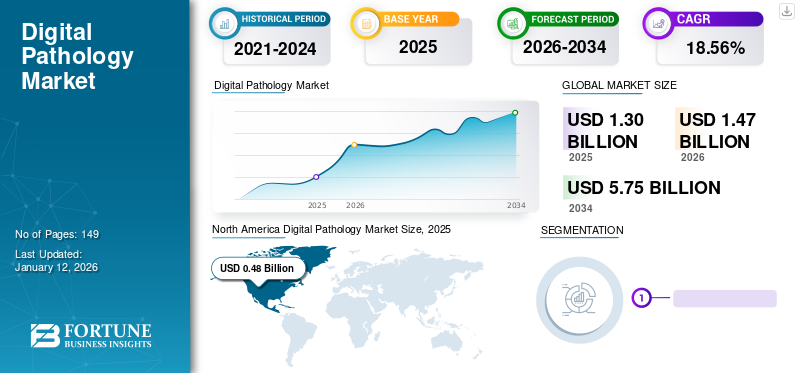
The global digital pathology market size was valued at USD 1.3 billion in 2025 and is projected to grow from USD 1.47 billion in 2026 to USD 5.75 billion by 2034, exhibiting a CAGR of 18.56% during the forecast period. North America dominated the market with a share of 36.74% in 2025. Moreover, the U.S. digital pathology market size is projected to grow significantly, reaching an estimated value of USD 1.30 billion by 2032, driven by growing digitization in pathology workflow.
The digital pathology market is evolving from a slide-digitization niche into an integrated diagnostic and research infrastructure segment. Adoption depends on more than scanner purchases. Laboratories must coordinate image acquisition, workflow software, storage, network capacity, pathologist review, and information-system integration. The commercial opportunity therefore extends across hardware, software, data management, and analytical services.
Clinical diagnosis remains a central application, particularly in pathology departments seeking remote consultation, standardized image review, and improved case coordination. Pharmaceutical research adds a distinct demand stream. Digital slides support biomarker assessment, translational studies, toxicologic pathology, and drug development workflows. These research settings may adopt new tools faster than regulated diagnostic laboratories, although requirements differ by use case.
Image-analysis tools can assist with quantification, tumor-region identification, cell detection, and selected grading tasks. Their value depends on validation, data quality, clinical relevance, and integration into established workflows. Algorithms trained on narrow datasets may perform inconsistently across staining protocols, scanner models, tissue types, and patient populations.
Market growth also depends on operational economics. High-throughput scanners require capital investment, while image files create persistent storage and cybersecurity obligations. Laboratories must assess total cost of ownership, including service contracts, software licensing, implementation, staff training, and system maintenance. Benefits such as reduced slide handling or faster consultation need to be measured against local baseline workflows.
Digital pathology is a field that utilizes digital tools to collect, interpret, analyze, and share information. Digital slides are created from either a whole slide scanning device from previously prepared devices or directly with a digital microscope. The digital slide is then further used for analysis through high-throughput algorithms, shared over the Air (OTA), or stored for future use.
The rising prevalence of chronic diseases and increasing hospital admissions for treatment are supporting the demand for pathology tests. Furthermore, rising workload is anticipated to drive adoption of digital tools in the traditional pathology ecosystem. Moreover, the rising applications of these devices in modern medicine and growing awareness of novel diagnostics are expected to increase the patient pool for diagnosis and support market growth.
The COVID-19 pandemic accelerated the market progress due to a considerable rise in the digitization of pathological systems. The market’s growth was also attributed to the significant spike in the adoption of these devices, favorable regulations for emergency use cases, and decline in in-person visits to pathologists and physicians. The global market witnessed a growth rate of 31.2% in 2020 as compared to 11.6% in 2019. Frequent lockdowns and social distancing rules were enforced by governments to control the spread of the Coronavirus, which led to a significant reduction in the number of in-person patient consultations.
However, in 2021, the patient volume bounced back to its pre-pandemic levels owing to higher vaccination coverage among the general population. The market was estimated to witness a strong growth rate in 2022, and might record a significant CAGR during the forecast period due to strong adoption of these products and services.
Download Free sample to learn more about this report.
 Global Market Size & Forecast
 Market Share
 Key Regional Highlights
North America
North America held a 36.74% share, reaching USD 0.48 billion in 2025.
Europe
Europe accounted for 25.47% of the market, valued at USD 0.33 billion in 2025.
Asia Pacific
Asia Pacific held a 21.80% share and reached USD 0.28 billion in 2025.
U.S.
The market is projected to reach USD 0.50 billion in 2026.
Japan
The market is projected to reach USD 0.09 billion in 2026.
Read More

Integration of Artificial Intelligence Will Transform Market
Increasing adoption of Artificial Intelligence-based digital tools by key consumers owing to a higher demand for workflow management is a key trend in the global market. The rising focus of major companies involved in patenting innovative technology on offering a customized platform for key stakeholders provides them with a competitive advantage in the market. Additionally, key manufacturers involved in developing solutions using machine learning and AI are expected to support the increasing demand for advanced pathology solutions, thereby fueling market growth.
The digital pathology market is shifting from standalone slide scanners toward integrated platforms combining image acquisition, workflow management, analytics, and secure data access. Buyers increasingly evaluate how these components operate together, rather than comparing scanner specifications in isolation. Integration with laboratory information systems and electronic health records is becoming an important procurement consideration.
Artificial intelligence is reshaping software differentiation. Image-analysis tools increasingly support tasks such as cell counting, tissue classification, tumor quantification, and biomarker assessment. Commercial value depends on the intended clinical use, validation evidence, and ability to perform across diverse specimens and laboratory conditions. Human oversight remains essential where algorithms inform diagnostic decisions.
Cloud-based deployment is gaining attention as laboratories seek scalable storage, remote consultation, and centralized access to image libraries. Hybrid architectures remain relevant where data residency, cybersecurity policies, network limitations, or local computing requirements restrict full cloud adoption. Vendors must balance scalability with dependable access and long-term data governance.
Furthermore, several companies are focusing on getting regulatory approvals for AI-integrated medical devices to launch products on the market and enhance operations in pathology.
Moreover, strategic initiatives to develop and standardize sharing platforms to enable seamless transfer of data across the industry are anticipated to support the adoption of Artificial Intelligence in pathology and, subsequently, the growth of the market.
Download Free sample to learn more about this report.
Rising Burden of Chronic Disorders to Drive Market Progress
Higher incidence of chronic diseases and subsequent increase in the number of tests are estimated to support the product adoption. Increasing product adoption, along with rising efforts of market players to cater to the growing need for diagnostics, is anticipated to drive the growth of the market.
Demand for digital pathology is increasing as laboratories seek more flexible diagnostic workflows and better access to specialist expertise. Whole-slide imaging allows tissue specimens to be reviewed remotely, supporting consultation across hospital networks and geographically dispersed pathology teams. This capability becomes valuable where specialist capacity is limited or workloads fluctuate.
Growing cancer diagnostic volumes also support investment. Pathology departments need reliable processes for reviewing complex specimens, coordinating multidisciplinary teams, and managing rising case volumes. Digital workflows can improve slide retrieval and facilitate second opinions, although actual time savings depend on implementation quality and case complexity.
Pharmaceutical research provides another demand source. Digital slides support tissue assessment, biomarker studies, preclinical toxicology, and translational research. Centralized image repositories help research teams compare specimens across sites and preserve review records. These capabilities can reduce logistical friction in distributed studies.
Moreover, increasing applications of these platforms, such as in predictive analysis, are expected to augment market growth.
Such product launches will support the increasing demand for these systems with added benefits of machine learning.
Moreover, increasing approval for digital tools is expected to boost the adoption of these devices, thereby augmenting the market growth. Additionally, increasing research programs funded by governments to support innovation in digital tools in pathology is anticipated to drive market growth.
Growing Digitization in Pathology Workflow to Propel Market Progress
The increasing demand for digitization in pathology has given rise to competition among key players in the market. This factor combined with the rising need for drug discovery through the use of high through-put algorithms in the market, has prompted major players to invest in developing novel tools to streamline their workload and customize their solutions.
Rising investments by domestic companies and industry stakeholders to launch novel tools, along with the rising number of product launches to cater to the increasing demand for digitalizing diagnostic tools, is anticipated to support the growth of the market.
High Upfront Costs for Installation of Devices to Hamper Market Growth
Although incorporating and utilizing these systems in modern medicine has its benefits and applications in pathology, digitization of tools incurs a high upfront cost for installation and training to use those systems to regularize the workflow. Digital devices are expensive and require software to analyze, share, and store the data, which may either incur individual costs or be part of an end-to-end full-system product offering.
High implementation costs remain a major barrier to digital pathology adoption. Whole-slide scanners, image-management software, computing infrastructure, and long-term storage require substantial investment. Laboratories must also budget for validation, maintenance, cybersecurity, staff training, and integration with existing laboratory information systems. These costs can be difficult to justify where case volumes are low or capital budgets are constrained.
Technical interoperability creates another challenge. Scanner platforms, image formats, viewers, and analytical tools may differ in compatibility and performance. Integrating systems from multiple vendors can require additional configuration and testing. Poor interoperability can fragment workflows, limit data exchange, and increase dependence on specific suppliers.
Furthermore, small and even mid-sized pathology laboratories can hardly afford whole slide images (WSI) due to the huge price of high-throughput scanners. On average, WSI cost about USD 237,000 per piece worldwide as of 2020.
In recent years, an increasing number of pathologists are retiring as compared to the number of pathologists joining the workforce. This factor has directly affected the market due to an acute shortage of pathologists. Thus, the high cost of these pathology tools and their installation has decreased the number of consumers adopting and training for these systems, thereby affecting the market adversely.
The digital pathology market offers opportunities in laboratories that need remote consultation, scalable diagnostic capacity, and more consistent image-based workflows. Regional hospital networks can centralize specialist review while retaining specimen preparation locally. Reference laboratories may use shared digital infrastructure to coordinate workloads, support second opinions, and improve access to subspecialty expertise.
Artificial intelligence creates opportunities for targeted workflow automation. Tools that quantify biomarkers, identify tissue regions, or measure cellular features can reduce repetitive manual work in suitable applications. Commercial success will depend on validated performance, clear clinical boundaries, and integration with pathologist review. Developers that demonstrate reliable results across scanners, stains, and patient populations may achieve stronger adoption.
Pharmaceutical research represents another attractive segment. Digital slide analysis can support preclinical toxicology, translational research, biomarker assessment, and multicenter studies. Vendors can differentiate through image annotation, quantitative analysis, auditability, and secure collaboration. Research deployments may also provide a route to test workflows before pursuing more demanding clinical diagnostic applications.
Cloud and managed services create opportunities for laboratories lacking substantial internal information technology resources. Secure hosting, archiving, system maintenance, and remote access can reduce the need for local infrastructure. Providers must still address data residency, cybersecurity, connectivity, and predictable long-term costs.
Emerging markets may benefit from regional diagnostic hubs and telepathology networks, particularly where specialist access is uneven. Partnerships among hospitals, technology vendors, and academic institutions can support implementation and training.
The digital pathology market is segmented by product, application, and end-user. These categories reflect different purchasing decisions and deployment requirements. Product segmentation identifies the technology infrastructure; application segmentation captures the purpose of image use; and end-user segmentation reveals who funds, operates, and benefits from digital workflows
Digital Pathology Hardware to Witness Robust Adoption Owing to Strong Demand for Timely Pathology Outcomes
Based on product, the market is segmented into hardware, software, and storage systems.
Hardware
Hardware provides the foundation for converting glass slides into digital images. Purchasing decisions depend on throughput, image quality, automation, specimen types, and integration with laboratory operations. Scanner capacity alone does not determine suitability. Laboratories must assess the complete process, including slide preparation, loading, image quality control, file transfer, and review.
The hardware segment is projected to dominate the market with a share of 58.10% in 2026. The rise in the number of laboratories performing in vitro tests and the increasing need for timely outcomes are responsible for the growing demand for hardware products, which is anticipated to drive the segment’s growth.
The hardware segment is further sub-segmented into scanners, tissue microarrayers, and others. The growing demand for digital databases to store specimens across the globe is anticipated to boost the segment’s growth during the forecast period.
Whole-slide imaging scanners are central to clinical and research deployments. Their capabilities vary by scanning speed, resolution, objective configuration, slide capacity, focus management, and support for different tissue preparations. High-throughput laboratories may prioritize automated loading and batch processing. Smaller facilities may favor compact systems that support consultation or selected diagnostic workflows.
Scanner economics depend on utilization. A high-capacity instrument may offer an attractive cost per slide when volumes are substantial, but underused capacity can weaken returns. Procurement teams should evaluate peak workloads, service availability, redundancy, and the effect of scanner downtime on laboratory turnaround.
The scanner segment is expected to register the fastest growth rate during the forecast timeline due to increasing collaborations between industry players for launches and distribution.
Tissue microarray instruments support research by arranging selected tissue cores from multiple donor blocks into a recipient block. The resulting slides allow researchers to assess many specimens under comparable staining and imaging conditions. Although tissue microarray equipment is not a substitute for whole-slide scanning, it complements digital pathology workflows used in biomarker studies and translational research.
Demand is linked to pharmaceutical research, academic pathology, and laboratory programs that require standardized tissue comparisons. The commercial value depends on core placement accuracy, sample tracking, reproducibility, and compatibility with downstream staining and image analysis. Digital registration and annotation can strengthen the utility of tissue microarrays by linking image features to specimen metadata.
Software
Software connects image acquisition with review, analysis, reporting, and long-term management. Its role is increasingly strategic because laboratories need more than image viewing. They require secure access, case organization, diagnostic context, auditability, and compatibility with existing systems.
The software segment is anticipated to grow steadily during the forecast period due to increasing demand for Artificial Intelligence (AI)-based algorithms in the market owing to their rising applications in pathology data processing and assisted analysis. The software segment is further sub-segmented into pathology management, digital microscopy viewers, image analyzers, and others.
The increasing prevalence of infectious diseases has fueled the demand for in-vitro diagnostic tests, resulting in a higher workload for pathologists. Software, such as microscopy viewers, image analyzers, and others can assist pathologists in disease diagnosis, thereby reducing workload and enhancing the quality of diagnosis.
Pathology management software coordinates cases, images, users, review status, annotations, and reporting processes. Depending on the platform, it may integrate with laboratory information systems, specimen tracking, and quality-management tools.
Demand is strongest where multiple sites or departments share diagnostic responsibilities. Centralized case allocation can improve workload visibility and simplify consultation. However, the software must reflect local sign-out procedures, access permissions, and reporting rules. Poorly configured workflows can introduce extra steps rather than improve efficiency.
Digital microscopy viewers enable pathologists and researchers to navigate high-resolution images, adjust magnification, annotate tissue, and collaborate remotely. Performance depends on rendering speed, image navigation, display quality, and network conditions.
Clinical users need dependable review across representative diagnostic cases. Research teams may place greater emphasis on annotation, measurement, and shared interpretation. Viewers must also preserve access to metadata and maintain a clear connection between the digital image and the original specimen.
Furthermore, the growing number of regulatory approvals and the launch of these products by key players are some of the factors propelling the segment growth.
Storage Systems
Digital pathology generates large image files that must remain secure, searchable, and accessible. Storage infrastructure may include local servers, network-attached systems, private cloud environments, public cloud services, or hybrid configurations.
Selection depends on image volume, retention policy, access frequency, data sensitivity, and network reliability. Frequently reviewed cases may require rapid access, while older slides can move to lower-cost archival tiers if retrieval remains practical. Backup and disaster recovery must protect both images and associated metadata.
Storage costs extend beyond initial capacity. Replication, cybersecurity, migration, data transfer, and ongoing administration can become substantial expenses. Laboratories should model growth in slide volume and retention duration before choosing an architecture.
The storage systems segment is anticipated to grow at a steady pace throughout the forecast period due to the high demand for storing key data to share and analyze it in the future and access the data remotely in an instant. Furthermore, the introduction of novel digital tools by leading companies is fueling the product adoption in the market.
Image analyzers apply computational methods to identify, classify, or quantify features within tissue images. Applications include cell counting, tumor-region measurement, immunohistochemistry scoring, and selected biomarker assessments. Some tools use artificial intelligence models, while others rely on rule-based image processing.
Commercial evaluation should focus on the specific intended use. A model validated for one tissue type, stain, or scanner may not perform equally well in another setting. Differences in preparation, staining, and patient populations can alter results.
To know how our report can help streamline your business, Speak to Analyst
Drug Discovery Segment’s Growth Attributed to Due to Strong Demand for Potential Pipeline Drugs
Based on application, the market is segmented into disease diagnosis, drug discovery, and others.
Drug Discovery
Drug discovery and development create demand for digital pathology across preclinical studies, toxicologic pathology, biomarker research, and translational medicine. Pharmaceutical companies and contract research organizations use digital images to review tissue findings across distributed research teams.
Centralized image repositories can support consistent review and preserve records for later analysis. Quantitative image tools may also help researchers assess treatment effects, tissue responses, and biomarker patterns. These applications require reproducible image acquisition and reliable links between images, study metadata, and experimental results.
Research settings may allow more flexible experimentation than routine clinical diagnostics. Even so, regulated studies require appropriate documentation, controlled access, and validated processes. Vendors compete through analytical capabilities, data integration, audit trails, and compatibility with research systems.
The drug discovery segment is anticipated to record the highest CAGR during the forecast period owing to the increasing demand for potential pipeline drugs for treating life-threatening diseases. Moreover, several applications of pathology tools are emerging in drug discovery, such as high-throughput screening.
Disease Diagnosis
The disease diagnosis segment is expected to account for 54.96% of the market share in 2026 owing to the increasing burden of pathological tests among the patient population and rising awareness of early diagnosis to anticipate the risk of a disease and take preventive action. Moreover, growing collaborations among companies to improve the diagnosis of life-threatening diseases is also supporting the growth of the market.
Disease diagnosis is a core application because digital slides can support primary review, consultation, quality assurance, and multidisciplinary case discussions. Adoption depends on clinical validation, regulatory requirements, and workflow acceptance. Laboratories need confidence that image quality supports the intended diagnostic tasks and that reporting systems preserve traceability.
Cancer pathology is an important use case because tissue assessment often involves specialist interpretation, biomarker evaluation, and coordination across care teams. Digital access can make it easier to share complex cases. Yet diagnostic benefits depend on the quality of specimen preparation, scanning, and review protocols.
In addition, several companies are launching software to address challenges with manual molecular testing workflows, with the aim of helping streamline routine diagnostics testing for standardization and faster results.
Therefore, the rising applications of digital tools in drug discovery and disease diagnosis, such as high-throughput screening, deep learning, and cancer diagnostics, among others, are anticipated to drive the growth of the segment.
Digital workflows may also support workload management. Cases can be routed to appropriate specialists, and archived images can be retrieved without moving glass slides between sites. However, laboratories must account for implementation costs, scanner capacity, network performance, and staff adaptation.
Artificial intelligence may assist selected diagnostic tasks, including quantification and identification of regions of interest. Its contribution should be assessed by intended use and clinical evidence. Algorithms should not be treated as interchangeable across tissue types or clinical questions.
Hospitals & Clinics Segment Leads Due to Wide Adoption of Digital Pathology Services and Rising Patient Admissions
Based on end-user, the global market is segmented into hospitals & clinics, clinical laboratories, and others.
Hospitals & Clinics
The hospitals & clinics segment is anticipated to hold a dominant market share of 62.18% in 2026. The dominance of the segment is attributed to the increasing number of patient admissions and pathology services offered by major hospitals. Moreover, initiatives to introduce advanced products through partnerships with key hospitals and higher adoption of digital tools due to increased patient footfall are anticipated to drive the segment's growth.
Hospitals and integrated healthcare networks adopt digital pathology to support diagnosis, specialist consultation, and coordinated care. Their investment decisions often involve several departments, including pathology, information technology, procurement, and clinical leadership.
Large networks can distribute specialist workloads across sites and improve access to subspecialty expertise. However, implementation must account for legacy systems, clinical governance, cybersecurity, and the transition from established glass-slide workflows.
Leading hospitals in the U.S., the U.K., and other developed countries have installed pathology tools and systems to enhance the workflow, which has been pivotal in attracting a large patient pool.
Clinical Laboratories
The clinical laboratories segment is also anticipated to grow during the analysis period due to the increasing number of laboratories developing databases by digitizing slides using digital tools. Moreover, key digital solution providers are collaborating with each other to expand their product portfolios by offering customized solutions. These factors are estimated to foster the growth of the segment.
Clinical laboratories are important buyers because they process routine diagnostic volumes and may operate centralized services for multiple healthcare providers. High-throughput facilities can benefit from automated scanning, case routing, and centralized image storage. Adoption economics depend on volume, staffing, service reliability, and workflow redesign. Laboratories need to compare digital operating costs with existing processes, including slide transport, physical archiving, consultation delays, and quality-control activities.
Accreditation, validation, and integration with laboratory information systems are central considerations. Buyers also assess scanner redundancy, service contracts, and business continuity. These factors can influence vendor selection as much as headline scanner specifications.
Some of the key industry players are also introducing novel digital pathology solutions to enhance workflows for clinical laboratories.
Furthermore, higher adoption of telepathology during the pandemic for remote diagnostics also provided an opportunity to clinical laboratories to improve awareness of such products among key consumers.
Geographically the market is studied across North America, Europe, Asia Pacific, Latin America, and the Middle East & Africa.
North America Digital Pathology Market Size, 2025 (USD Billion)
To get more information on the regional analysis of this market, Download Free sample
The growing incidence of chronic diseases, such as cardio-diabetic disorders, and an increasing geriatric population, which is at a higher risk of developing such disorders, are expected to increase the demand for pathology tests. The growing burden of tests, coupled with the rising demand for streamlining workload, is anticipated to improve the adoption of digital tools among pathologists in the region. The U.S. market is projected to reach USD 0.5 billion by 2026. The North America market generated USD 0.48 billion in 2025, representing 36.74% of the global market landscape, and is expected to reach USD 0.54 billion in 2026.
North America’s digital pathology market benefits from established healthcare infrastructure, substantial diagnostic workloads, and strong pharmaceutical research activity. Adoption is supported by hospital networks, reference laboratories, and research organizations seeking remote review and image-based analysis. Procurement decisions emphasize regulatory readiness, interoperability, cybersecurity, and evidence of workflow value. Uneven budgets and integration costs can still slow deployment, particularly among smaller laboratories and independent pathology practices nationwide.
Moreover, market players are increasing their emphasis on inorganic growth strategies, such as partnerships and collaborations to launch innovative digital tools to manage workflow and cater to the rising demand for customized solutions. These are the major factors responsible for driving the growth of the North American market.
United States Digital Pathology Market
The United States market is shaped by large health systems, specialized reference laboratories, and pharmaceutical research demand. Buyers assess scanner throughput, software integration, storage costs, and clinical validation together. Artificial intelligence tools attract interest for quantification and workflow support, but deployment depends on intended-use evidence and governance. Reimbursement, institutional procurement cycles, and legacy laboratory systems influence adoption speed and the business case for scaled implementation.
Europe holds the second position in terms of market share. Surge in the number of patients preferring digital tools over traditional pathology and strategic developments, such as patenting of proprietary technology by key industry players is boosting the regional market growth. Moreover, the growing adoption of technologically advanced products in the region, increasing regulatory approvals, and product launches are some of the factors driving the market expansion.
Europe’s digital pathology market reflects strong research capabilities, diverse healthcare systems, and interest in connected diagnostic services. Adoption varies with national procurement, reimbursement arrangements, data-protection requirements, and local laboratory capacity. Vendors must support interoperability and clear data governance across institutional settings. Academic hospitals and pharmaceutical research centers provide important demand, while fragmented purchasing and differing implementation pathways can lengthen sales cycles and complicate region-wide deployment.
Europe contributed 25.47% to the global market in 2025, with a valuation of USD 0.33 billion, and is projected to reach USD 0.37 billion in 2026.
Germany Digital Pathology Market
The Germany market is projected to reach USD 0.11 billion by 2026. Germany’s market is influenced by advanced hospital infrastructure, established pathology services, and a strong life-sciences research base. Adoption decisions often require careful evaluation of data security, workflow integration, and clinical validation. Hospitals and laboratories may deploy digital systems for consultation, research, or selected diagnostic pathways before expanding use. Vendor support, interoperability with laboratory systems, and clear operating-cost evidence remain important factors in procurement and scale-up.
United Kingdom Digital Pathology Market
The UK market is projected to reach USD 0.05 billion by 2026. The United Kingdom market is shaped by centralized health-service priorities, diagnostic capacity pressures, and pathology networks. Digital platforms can support cross-site review and specialist collaboration, but implementation requires alignment with procurement, clinical governance, and information-security policies. Research institutions also create demand for image analysis and shared slide repositories. Adoption depends on sustainable funding, workflow redesign, training, and evidence that systems improve service delivery without adding complexity.
Asia Pacific digital pathology market is expected to register the highest growth rate during the forecast period. Rising number of healthcare chains partnering with key companies to manage the increasing volume of tests in diagnostic laboratories is estimated to augment the regional market growth. Moreover, increasing investments by public and private institutions, along with a growing healthcare infrastructure is accelerating the adoption of digital tools and solutions among key stakeholders.
Asia-Pacific presents varied adoption conditions, from advanced research hospitals to health systems building digital infrastructure. Demand is influenced by cancer diagnostic needs, laboratory modernization, pharmaceutical research, and specialist workforce distribution. Large institutions may invest in integrated platforms, while smaller providers often face capital and connectivity constraints. Local partnerships, scalable storage, training, and support for regional regulatory requirements can determine how effectively suppliers expand across diverse markets.
Moreover, the increasing patient population is driving the market growth in Asian countries. India market is projected to reach USD 0.05 billion by 2026. Asia Pacific accounted for USD 0.28 billion in 2025, representing 21.80% of the global market share, and is projected to reach USD 0.32 billion in 2026.
Japan Digital Pathology Market
The Japan market is projected to reach USD 0.09 billion by 2026. Japan’s digital pathology market is supported by advanced healthcare technology, an aging population, and strong medical research capabilities. Hospitals and laboratories assess image quality, system reliability, and integration with established clinical workflows. Digital review can aid specialist collaboration and research, but adoption requires validation and staff training. Vendors must demonstrate practical benefits, dependable technical support, and secure handling of sensitive medical images within institutional governance.
China Digital Pathology Market
The China market is projected to reach USD 0.07 billion by 2026. China’s market is influenced by hospital digitization, substantial diagnostic demand, domestic technology development, and pharmaceutical research. Adoption varies between major urban institutions and less-resourced facilities. Buyers consider scanner capacity, software localization, data governance, and integration with hospital systems. Domestic vendors may compete through local support and pricing, while international suppliers offer established platforms and specialized capabilities. Regulatory compliance and implementation capacity remain important determinants of deployment.
In 2025, Middle East & Africa held 7.33% of the global market, reaching a valuation of USD 0.09 billion, and is projected to grow to USD 0.1 billion in 2026. The Middle East and Africa market varies widely in healthcare investment, connectivity, and specialist pathology capacity. Leading hospitals and research centers may adopt digital systems for consultation and advanced diagnostics, while smaller facilities face infrastructure and funding barriers. Scalable deployment, training, secure data management, and reliable local support will influence adoption. Partnerships with specialist centers can help extend access to expertise.
Latin America contributed approximately USD 0.11 billion to the global market in 2025, accounting for an 8.66% share, and is expected to reach USD 0.13 billion in 2026. Latin America’s digital pathology market is developing unevenly, reflecting differences in healthcare investment, specialist availability, and digital infrastructure. Private hospital groups, reference laboratories, and research centers may lead adoption. High equipment costs, connectivity limitations, and constrained budgets can delay wider deployment. Vendors can support growth through regional service partners, flexible infrastructure models, training, and evidence that digital workflows improve consultation, quality management, or research coordination.
Latin America and the Middle East & Africa regions are developing steadily in the global market. The increasing influx of patients owing to growing medical tourism and rising adoption of digitization are estimated to drive the regional market’s growth. Moreover, factors such as increasing spending on healthcare by patients and rising applications of digital tools, such as remote review of cases, virtual education, decreased response time, and improved workflow, are some key reasons expected to enhance the market growth in these regions.
Broad Product Portfolios and Rising Inorganic Business Activities by Key Players Will Spur Market Competition
F. Hoffmann-La Roche Ltd., Koninklijke Philips N.V., Leica Biosystems Nussloch GmbH, and 3DHISTECH Ltd. accounted for the highest market share in 2023. The dominance of these companies is attributed to their strong portfolio of digital tools and rising research & development investments to launch technologically advanced tools. Moreover, strategic collaborations with key service providers and a well-established distribution channel are the other key factors driving the market. The prominent companies operating in the market are focused on introducing technologically advanced products to gain a competitive advantage over other firms.
Competition in the digital pathology market spans scanner manufacturers, software developers, artificial intelligence specialists, and infrastructure providers. Market positioning depends on image quality, workflow integration, regulatory readiness, service reliability, and the ability to support large image repositories. Few suppliers control every layer, creating opportunities for partnerships and interoperable platforms.
Established participants include Leica Biosystems, Hamamatsu Photonics, Roche, Evident, and 3DHISTECH. Their capabilities span whole-slide imaging, laboratory workflows, and related pathology technologies. Philips has developed digital pathology solutions for clinical environments, while Roche combines diagnostic expertise with digital and computational pathology capabilities. Vendor positioning differs by geography, clinical application, research focus, and installed infrastructure.
Software competition is increasingly important. Sectra provides enterprise imaging capabilities that include pathology, while Proscia focuses on pathology image management and computational workflows. These platforms compete through image access, case organization, analytical integration, and compatibility with laboratory systems. Their value depends on reliable performance across routine operations, not simply the number of available features.
Moreover, several companies, such as PaigeAI, Inc, PathAi, Aiforia, and others are focusing on providing customized solutions in the market to integrate and analyze data from various devices.
Emerging companies specialize in image analysis and artificial intelligence. Paige develops computational pathology technologies, while Aiforia offers artificial intelligence-based image analysis for clinical and research applications. Such firms seek differentiation through specific analytical tasks, including tissue classification and biomarker quantification. Their commercial prospects depend on validation evidence, integration with existing platforms, and performance across diverse specimens and laboratory settings.
Partnerships increasingly connect scanner manufacturers, software providers, cloud infrastructure companies, pharmaceutical researchers, and healthcare networks. These arrangements can reduce integration burdens and broaden access to analytical tools. However, unclear responsibilities for maintenance, data portability, and algorithm updates may create long-term operational risks.
The global market research report provides a detailed analysis of the market. It focuses on key aspects, such as leading companies, products, applications, and end-users. Additionally, it offers insights into the latest digital pathology market trends and highlights key industry developments. In addition to the above-mentioned factors, the report encompasses several factors that have contributed to the market's growth in recent years.
|
ATTRIBUTE |
DETAILS |
|
Study Period |
2021-2034 |
|
Base Year |
2025 |
|
Forecast Period |
2026-2034 |
|
Historical Period |
2021-2024 |
|
Growth Rate |
CAGR of 18.56% from 2026-2034 |
|
Unit |
Value (USD billion) |
|
Segmentation |
By Product
|
|
By Application
|
|
|
By End-user
|
|
|
By Geography
|
Fortune Business Insights says that the global market stood at USD 1.3 billion in 2025 and is projected to reach USD 5.75 billion by 2034.
In 2025, the market size in North America stood at USD 0.48 billion.
The market is set to record a CAGR of 18.56% during the forecast period.
By product, the hardware segment will lead the market.
Increasing prevalence of chronic diseases and rising applications of digital tools in diagnostics are the key factors driving the market.
F. Hoffmann La Roche Ltd, Koninklijke Philips N.V., Leica Biosystems Nussloch GmbH, and 3DHISTECH Ltd. are the top players in the market.

Get 30-60 hrs Free Customization
Expand Regional and Country Coverage, Segments Analysis, Company Profiles, Competitive Benchmarking, and End-user Insights.













.webp)






Related Reports
Get In Touch With Us
US +1 833 909 2966 ( Toll Free )
Receive a tailored pricing based on your needs.
Discuss your questions with our industry experts.
Have questions? Get quick answers before you purchase.

