Energy Harvesting System Market Size, Share & Industry Analysis, By Energy Source (Thermal, Vibration & Kinetic Energy, Solar, and Others), By Component (Transducers, Power Management, Storage Devices, and Others), By Application (Building & Home Automation, Industrial, Consumer Electronics, and Others), and Regional Forecast, 2026-2034
 Download Free Sample
KEY MARKET INSIGHTS
 Listen to Audio Version
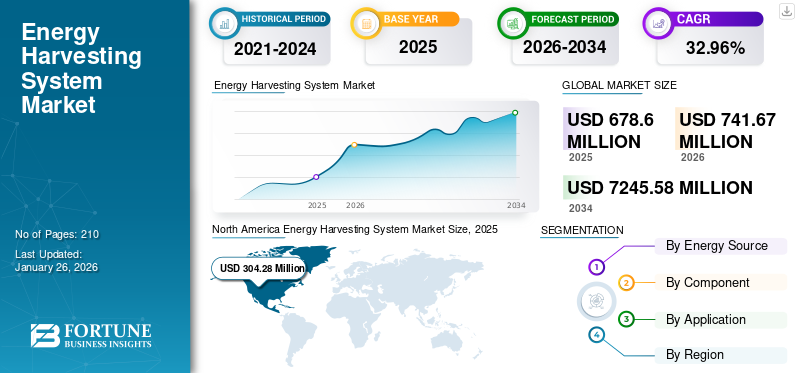
The global energy harvesting system market size was valued at USD 678.6 million in 2025. It is projected to be worth USD 741.67 million in 2026 and expected to reach USD 7,245.58 million by 2034, exhibiting a CAGR of 32.96% during the forecast period of 2026-2034.
An energy harvesting system is a technology that captures and converts ambient energy from the environment into usable electrical energy to power electronic devices, often eliminating the need for traditional batteries or power sources. It's also known as energy scavenging or microenergy harvesting. This system typically includes a harvester (transducer), energy storage, and power management components.
- In January 2024, Researchers at MIT announced the development of a self-powered sensor that automatically harvests the magnetic energy, allowing these sensors to operate in remote locations without batteries. The development of such new technologies is expected to further boost the adoption of energy harvesting systems across numerous applications and contribute to market growth.
The market is experiencing growth due to several factors, including increasing demand for energy-efficient and sustainable solutions, the rise of IoT and wireless sensor networks, and advancements in related technologies. Key drivers include the need for low-maintenance power in remote locations, integration with building automation, and government incentives for clean energy.
Asahi Kasei Microdevices (AKM) is a prominent player in the energy harvesting system market, particularly known for its low-power, high-efficiency power management ICs (PMICs). Their technology enables the operation of electronic devices by capturing small amounts of ambient energy such as indoor light or body heat, reducing reliance on traditional batteries and enabling smaller, more efficient IoT devices.
Download Free sample to learn more about this report.
MARKET DYNAMICS
MARKET DRIVERS
Rising Demand for Sustainable Energy Solutions to Boost Market Growth
The rising global emphasis on sustainability and energy efficiency is one of the key market drivers propelling the energy harvesting market. As governments and corporations work toward carbon neutrality and greener technologies, energy harvesting systems offer an attractive solution by converting ambient energy sources such as solar, thermal, vibration, and RF energy into usable electrical power. This technology enables self-sustaining, low-power electronics without relying on conventional batteries, which require frequent replacements and generate waste.
- In September 2023, Sony Semiconductor Solutions Corporation (SSS) announced the development of an energy harvesting module that utilizes electromagnetic wave noise energy generated by lighting in commercial and residential areas to power low-consumption communications equipment and IoT sensors. Such technology development fosters the adoption of the product in low-energy consumption devices and is expected to positively impact overall market growth.
Furthermore, with the increasing need for continuous, maintenance-free power sources, energy harvesting directly addresses the need by powering remote and wireless devices, significantly reducing operational and maintenance costs.
Rapid Expansion of Industrial Automation and Wireless Sensor Networks to Propel Market Demand
The growing adoption of industrial automation and the increasing deployment of wireless sensor networks (WSNs) are major catalysts for the energy harvesting market. In industries such as oil & gas, manufacturing, mining, and logistics, real time monitoring of machinery, equipment health, and environmental parameters has led to the widespread use of WSNs and smart sensing technologies.
- In April 2025, Miromico and Panasonic announced a collaboration for the technological development of efficient micro energy harvesting for industrial applications. Moreover, Miromico launched the miro Insight Lux sensor solution, which monitors for indoor quality systems powered by Amorton solar cells developed by Panasonic Corporation.
However, powering many sensors across remote or hazardous environments poses logistical and cost challenges, especially when relying on conventional batteries. Energy harvesting eliminates this issue by enabling autonomous power generation from ambient sources such as machine vibration, heat differentials, and light. Moreover, with smart factories gaining prominence, these facilities require continuous data feeds, and energy harvesting is increasingly being recognized as a critical enabler of long-term and cost-effective industrial IoT deployment, fostering energy harvesting system market growth over the forecast period.
MARKET RESTRAINTS
Limited Energy Output and High Initial Costs to Restrain Market Demand
The market faces restraints mainly due to the high initial cost of the technology development, integration, and deployment. Many energy harvesting systems require advanced materials, custom designs, and sophisticated power management circuits, which can increase upfront investment. Additionally, the energy output from ambient sources is often low and inconsistent, limiting the application of energy harvesting to low-power devices only. For high-energy applications, conventional power sources are still preferred. These economic and technical limitations can hinder adoption, especially in future cost-sensitive markets.
MARKET OPPORTUNITIES
Rising Adoption of Wearables and Biomedical Devices to Create Lucrative Opportunities For Market Players
Advancements in energy harvesting technologies significantly drive the increasing adoption of wearable and biomedical devices. These technologies allow devices to power themselves by capturing ambient energy, reducing reliance on traditional batteries, and enabling more comfortable, long-lasting, and self-sustaining systems. Energy harvesting enables wearable devices to draw power from body heat, motion, solar energy, and radiofrequency signals.
- In February 2024, the Pennsylvania State University developed a Dual-energy harvesting device for wireless medical implants. The device simultaneously uses magnetic field and ultrasound sources to convert energy into electricity for power implants.
The development of self-powered, multifunctional wearable devices is a key area of research and development, with potential applications in healthcare, entertainment, and other fields. Hence, the growing adoption of wearable and biomedical devices and the demand for more sustainable and convenient power solutions will create huge demand for energy harvesting technologies in the coming years.
MARKET CHALLENGES
Complex Integration of Energy Harvesting Systems to Create Challenges for Market Players
Integrating energy harvesting systems into existing products or infrastructure presents significant design and compatibility challenges. Each application, such as industrial, consumer electronics, or healthcare, requires customized energy management solutions, making the mass deployment of energy harvesting systems complex.
The absence of widely accepted protocols and compatibility issues across different industries and technologies hinders the development of interoperable solutions. Integrating energy harvesting systems with existing infrastructure, sensor networks, and communication standards can be costly and complex, requiring specialized engineering and potentially causing delays. Furthermore, the variability of energy sources such as solar, thermal, and vibration necessitates diverse harvesting methods, adding another layer of complexity for manufacturers. These factors collectively increase the barriers to entry and adoption for market players, impacting the overall growth and scalability of the energy harvesting market.
ENERGY HARVESTING SYSTEM MARKET TRENDS
Rising Development of Smart Infrastructure to Propel Market Growth.
Smart infrastructure significantly impacts the energy harvesting market by driving demand for efficient, self-reliant power sources for IoT devices and smart systems. This trend is driven by the increasing adoption of IoT and the need for sustainable, low-maintenance power solutions in smart cities, industrial IoT (IIoT), and other applications.
- For instance, in April 2025, E-peas unveiled PMICs and ICs designed to power self-sufficient IoT systems. The company aims to eliminate the need for disposable batteries to promote environmental sustainability and reduce electronic waste.
Energy harvesting technologies are becoming crucial for powering these smart devices, especially in remote or inaccessible locations, and reducing reliance on traditional batteries and grid-based power.
Download Free sample to learn more about this report.
IMPACT OF TARIFFS ON THE MARKET
Tariffs can significantly impact the global market by increasing costs, disrupting supply chains, and reshaping market dynamics. These trade barriers can lead to higher component prices, slowing the adoption of energy harvesting technologies and potentially hindering innovation. Conversely, tariffs can encourage domestic production and investment in advanced solutions, creating new global opportunities.
Tariffs on raw materials and components, such as semiconductor components, are expected to increase energy harvesting systems' costs. Increased production costs and supply chain disruptions can translate into higher end-user prices for energy harvesting systems, potentially slowing down adoption, particularly in price-sensitive markets. Companies may relocate production facilities or diversify their sourcing to mitigate the risks associated with tariffs, leading to a reshaping of the global manufacturing landscapes.
SEGMENTATION ANALYSIS
By Energy Source
Rising Demand for Low-Maintenance Devices to Boost Vibration & Kinetic Energy Segment Growth
Based on energy source, the energy harvesting system market is segmented into thermal, vibration & kinetic energy, solar, and others. The vibration & kinetic energy segment is projected to dominate the market with a share of 43.98% in 2026, driven by the increasing need for self-powered, low-maintenance devices and the expansion of IoT and wireless sensor networks. This demand is further fueled by the growing need for sustainable energy solutions and the decreasing reliance on traditional power sources across various industries.
The solar segment is expected to grow at a significant rate, due to its widespread availability, efficiency in converting light into usable power, and increasing applications in various sectors such as building automation, consumer electronics, and industrial automation.
- In December 2024, Korea Advanced Institute of Science & Technology (KAIST) Energy launched technology to convert kinetic energy into electricity. The technology claims 10 times higher output and sustains current for more than 100 seconds compared to existing technologies. Hence, such technological developments will result in positive market growth over the forecast period.
Thermal energy harvesting focuses on converting heat into electrical energy. This is typically achieved using thermoelectric generators (TEGs) that exploit the temperature difference between two materials to produce a voltage. This technology is gaining traction in applications such as wearable devices, industrial waste heat recovery, and building automation.
By Component
High Adoption of Transducers in Numerous Applications to Support Segment Growth
Based on component, the market is segmented into transducers, power management, storage devices, and others. The transducer segment is expected to dominate the market with a share of 46.69% in 2026 as it's the core component that converts ambient energy into usable electrical energy. This growth is further driven by the increasing use of transducers in various applications, including consumer electronics, building automation, and transportation.
These components capture, convert, manage, and store energy from ambient sources such as light, vibration, or heat. Transducers convert ambient energy into electrical energy, power management circuits regulate and optimize energy flow, and storage devices store the harvested energy for later use.
By Application
To know how our report can help streamline your business, Speak to Analyst
Increasing Adoption of Industrial IIoT to Boost Market Growth
Based on application, the market is broadly categorized into building & home automation, industrial, consumer electronics, and others. The industrial segment is expected to dominate the market with a share of 33.30% in 2026 due to the increasing adoption of industrial IoT (IIoT) and the need for energy-efficient solutions in industrial applications. These applications often require powering various devices and sensors in manufacturing, process control, and asset tracking, making energy harvesting a viable solution.
The building & home automation segment includes applications such as wireless sensor networks for lighting control, HVAC systems, and security monitoring, often leveraging energy harvesting from solar, thermal, or kinetic sources. Moreover, the increasing demand for energy-efficient and sustainable solutions, the growth of IoT and wireless sensor networks, and advancements in low-power electronics are key factors driving the expansion of the energy harvesting market across these segments.
ENERGY HARVESTING SYSTEM MARKET REGIONAL OUTLOOK
The market has been studied geographically across four main regions: North America, Europe, Asia Pacific, and the Rest of the World.
North America
North America Energy Harvesting System Market Size, 2025 (USD Million)
To get more information on the regional analysis of this market, Download Free sample
North America contributed approximately USD 304.28 million to the global market in 2025, accounting for 44.84% share, and is expected to reach USD 331.1 million in 2026. North America is the dominating region market owing to the strong government support, increasing adoption of IoT, wireless sensors, and investments in smart infrastructure are driving growth in the region. North America dominated the global market in 2025, with a market size of USD 304.28 Million. Through incentives, policies, and investments, North American governments actively promote clean energy solutions and energy harvesting technologies. This support is crucial in accelerating market growth. Increased investment in smart cities, smart grids, and other smart infrastructure projects also contributes to the growth of the energy harvesting market in the region. These projects often utilize energy harvesting systems to power various sensors and devices. The U.S. market is projected to reach USD 299.59 Million by 2026.
- In September 2023, Nanoprecise, a Canada-based company, launched the world's first light energy harvesting predictive maintenance sensor named MachineDoctor LUX to support sustainability for industrial monitoring.
U.S.
Investments in EHS Drive Market Growth in the Country
The demand for Energy Harvesting Systems (EHS) in the U.S. is experiencing substantial growth, driven by the increasing adoption of IoT devices, smart building technologies, and a focus on sustainable energy solutions. Government incentives and policies promoting clean energy solutions and the growing awareness of environmental sustainability are accelerating the adoption of EHS. Moreover, the U.S. also benefits from technological leadership and strong R&D investments in energy harvesting technologies. This leads to developing more efficient and reliable energy harvesting systems, further fueling market growth.
- In December 2024, WePower Technologies launched the Gemns Energy Harvesting Generator product range. This technology is expected to replace traditional batteries by offering maintenance-free energy solutions for many IoT applications.
The presence of prominent market players in the country is expected to foster market growth in the coming years.
Europe
High Adoption of Sustainable Technologies to Boost Market Growth
In 2025, the Europe market stood at USD 185.41 million, representing 27.32% of global demand, and is projected to grow to USD 203.5 million in 2026. In Europe, the market is experiencing strong growth, driven by increasing demand for sustainable energy solutions and the expansion of IoT and wireless sensor networks. Government initiatives, coupled with a strong focus on energy efficiency and climate neutrality, further fuel this growth. European governments actively promote renewable and energy-efficient technologies through various policies and incentives. The energy harvesting market is expected to experience substantial growth as several market players in the region are engaged in sustainable technological development. The UK market is projected to reach USD 36.7 million by 2026, while the Germany market is projected to reach USD 53.87 million by 2026.
- In January 2024, EnOcean, a Germany-based company, launched the world’s first energy-harvesting Bluetooth switch module named “PTM216B Bluetooth switch module,” which converts energy from sunlight, kinetic energy, and thermal energy into electrical energy or radio waves. Such regional developments are expected to boost market growth over the forecast period.
Asia Pacific
Increasing Investments in Renewable Energy to Drive Market Growth
The Asia Pacific region captured 25.89% of the global market in 2025, generating USD 175.69 million in revenue, and is projected to reach USD 193.13 million in 2026. The Asia Pacific region is experiencing a surge in demand for energy harvesting systems, driven by rapid industrialization, growing IoT adoption, and increasing investments in renewable energy. Growth is particularly notable in countries such as China, India, and Japan, where manufacturing, automation, and urbanization are accelerating adoption. The market is expected to grow significantly, fueled by the need for energy-efficient devices and sustainable solutions. The Japan market is projected to reach USD 39.67 million by 2026, and the China market is projected to reach
China
Developments & Advancements in Energy Storage Technologies to Drive Market Growth
The energy harvesting market in China is experiencing robust growth, driven by increasing demand for sustainable and energy-efficient solutions, particularly in the Internet of Things (IoT) and wireless sensor networks. This growth is further fueled by advancements in low-power electronics and energy storage technologies, alongside supportive government policies promoting renewable energy and reducing greenhouse gas emissions.
Rest of the World
Rising Government push for Sustainable energy to Drive Market Growth
Energy harvesting systems in the Middle East & Africa and Latin America are experiencing gradual growth due to increasing demand for sustainable energy and the rise of Internet of Things (IoT) devices. The market is driven by factors such as the need for reliable power in remote areas, the push for sustainable energy solutions, and advancements in low-power electronics. Key applications include building and home automation, industrial sectors, and transportation.
COMPETITIVE LANDSCAPE
KEY INDUSTRY PLAYERS
Key Players are Engaged in Product Innovation to Increase their Market Share
The energy harvesting system market is competitive and characterized by several key players focused on product innovation, strategic partnerships, and market expansion to boost their market share. Leading companies include Sony Semiconductor Solutions Corporation, Analog Devices Inc., STMicroelectronics, Texas Instruments, and Microchip Technology. For instance, in January 2024, Atmosic unveiled the Multiprotocol ATM34/e Series, which would deliver battery-free support and longer battery life with application in sustainable smart home end devices. The market is driven by the increasing demand for IoT devices, wearable electronics, and smart technologies across various sectors such as building automation, consumer electronics, and industrial applications.
List of the Key Energy Harvesting System Market Companies Profiled
- STMicroelectronics (Switzerland)
- Microchip Technology Inc. (U.S.)
- Texas Instruments Incorporated (U.S.)
- Analog Devices, Inc. (U.S.)
- Infineon Technologies AG (Germany)
- Renesas Electronics Corporation (Japan)
- EnOcean GmbH (Germany)
- ABB (Switzerland)
- Honeywell International Inc. (U.S.)
- Qorvo, Inc. (U.S.)
- Asahi Kasei Microdevices (Japan)
- Fraunhofer IIS (Germany)
- Kinetron (Netherlands)
- Ambient Photonics (U.S.)
- Powercast (U.S.)
- Sony Semiconductor Solutions Corporation (Japan)
KEY INDUSTRY DEVELOPMENTS
- In May 2025, Asahi Kasei Microdevices launched Power Management ICs used in energy harvesting, which optimize charge and discharge of rechargeable batteries used in IoT sensors, remote control devices, and Bluetooth trackers.
- In December 2024, NGK Partner and Epishine partnered to exchange technological expertise on advanced energy harvesting solutions. The strategic partnership aims to enhance the energy harvesting ecosystem by combining Epishine’s solar cells with NGK’s EnerCera battery technology.
- In February 2024, EnOcean announced plans to unveil the EMDC energy-harvesting motion and activity sensor series, indicating advancements in smart building technologies. These sensors deliver critical data for monitoring room occupancy, human activity, and light intensity.
- In February 2023, Asahi Kasei Microdevices launched a DC-DC step-up converter for energy-efficient harvesting applications. The DC-DC step-up converter facilitates low power consumption to boost low voltages, offering a solution for battery-free and remote operations in IoT and asset monitoring.
- In January 2023, WePower launched its energy harvesting generator product lineup at CES 2023, including the Gemns G100 Integrated RF Switch, the Gemns G200 EHG, and the Gemns G300 EHG. These systems utilize oscillating and permanent magnets to harvest kinetic energy through electromagnetic induction.
Investment Analysis and Opportunities
The developing economies present a significant investment opportunity to the energy harvesting system market:
- In March 2024, e-peas secured an investment of USD 18.9 million led by Otium Capital to enhance the company's position in energy harvesting PMIC and highlight its developments in advancing sustainable electronics.
- In June 2023, EIT InnoEnergy announced an investment in iON-ENERGY, a startup developing technology for harvesting electrostatic energy. The company also developed E-box technology, which converts energy in the Earth’s atmosphere into electricity to help its patent di-electric cells.
REPORT COVERAGE
The global energy harvesting system market research report delivers a detailed insight into the market. It focuses on key aspects, such as leading companies. Besides, the report offers regional insights and global market trends & technology, and highlights key industry developments. In addition to the factors above, the report encompasses several factors and challenges that contributed to the growth and downfall of the market in recent years.
Request for Customization to gain extensive market insights.
Report Scope and Segmentation
|
ATTRIBUTE |
DETAILS |
|
Study Period |
2021-2034 |
|
Base Year |
2025 |
|
Estimated Year |
2026 |
|
Forecast Period |
2026-2034 |
|
Historical Period |
2021-2024 |
|
Growth Rate |
CAGR of 32.96% from 2026 to 2034 |
|
Unit |
Value (USD Million) |
|
Segmentation |
By Energy Source
|
|
By Component
|
|
|
By Application
|
|
|
By Region
|
Frequently Asked Questions
As per the Fortune Business Insights study, the market size was USD 678.6 million in 2025.
The market will likely grow at a CAGR of 32.96% over the forecast period (2026-2034).
By application, the industrial segment is expected to lead the market over the forecast period.
The market size of North America stood at USD 304.28 million in 2025.
Rising demand for sustainable energy solutions is a key factor driving market growth.
Some of the top players in the market are Sony Semiconductor Solutions Corporation, Analog Devices Inc., STMicroelectronics, Texas Instruments, and Microchip Technology, among others.
The global market size is expected to reach USD 1,501.95 million by 2032.



- 2021-2034
- 2025
- 2021-2024
- 210
Get 30-60 hrs Free Customization
Expand Regional and Country Coverage, Segments Analysis, Company Profiles, Competitive Benchmarking, and End-user Insights.



















Related Reports
-
US +1 833 909 2966 ( Toll Free )
-
Get In Touch With Us