ENT Scopes Market Size, Share & Industry Analysis, By Product (Laryngoscope, Nasopharyngoscope, Sinuscopes, Otoscopes, and Others), By Type (Flexible Scopes and Rigid Scopes), By Usage (Reusable and Disposable), By End User (Hospitals and ASCs, ENT Clinics, and Others), and Regional Forecast, 2026-2034
 Download Free Sample
ENT Scopes Market Size and Future Outlook
 Listen to Audio Version
The global ENT scopes market size was valued at USD 1.67 billion in 2025 and is projected to grow from USD 1.81 billion in 2026 to USD 3.24 billion by 2034, exhibiting a CAGR of 7.57% during the forecast period. North America dominated the ENT scopes market with a market share of 37.13% in 2025.
ENT scopes are commonly used for rhinolaryngoscopy, transnasal examinations, functional endoscopic sinus surgery, biopsies, and other minimally invasive procedures. Healthcare providers increasingly use endoscopic visualization for the diagnosis and treatment of disorders affecting the ear, nasal cavity, sinuses, pharynx, larynx, and salivary glands. The market is also witnessing a shift from conventional optical scopes toward high-definition video systems, slim-diameter flexible scopes, portable imaging platforms, and single-use endoscopes. Growing adoption of office-based ENT examinations and minimally invasive surgical procedures is encouraging manufacturers to expand their reusable and disposable scope portfolios, thereby strengthening the global market growth.
- For instance, in October 2025, Olympus launched the E-SteriScope single-use flexible video rhinolaryngoscope in the Europe, Middle East & Africa region. The product expanded the company’s ENT endoscopy portfolio and provided healthcare facilities with greater flexibility to select between reusable and single-use scopes based on procedure and workflow requirements.
Key players, such as Olympus Corporation, KARL STORZ SE & Co. KG, HOYA Corporation, and Stryker Corporation, are actively participating in new product launches, strategic collaborations, acquisitions, and investment initiatives to expand market presence.
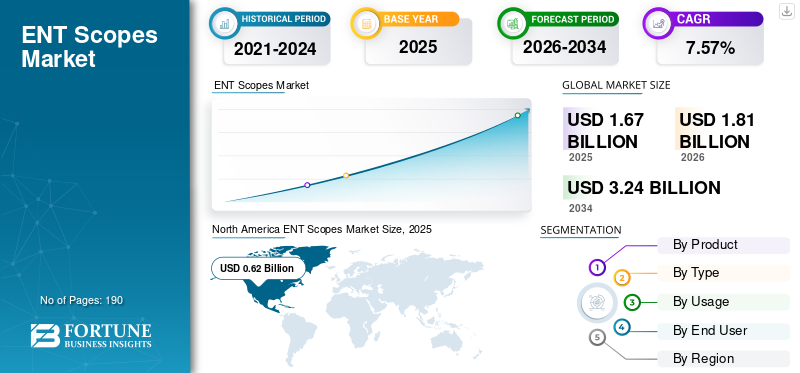
Download Free sample to learn more about this report.
ENT Scopes Market Key Takeaways
 Global Market Size & Forecast
- 2025 Market Size: USD 1.67 billion
- 2026 Market Size: USD 1.81 billion
- 2034 Forecast Market Size: USD 3.24 billion
- CAGR: 7.57% from 2026–2034
 Market Share
- North America dominated the ENT scopes market with a 37.13% share in 2025.
- Nasopharyngoscope segment is projected to grow at a CAGR of 9.00% from 2026–2034.
- Disposable segment is projected to grow at the fastest CAGR of 12.17% from 2026–2034.
 Key Regional Highlights
North America
North America maintained its leading position with a market size of USD 0.62 billion in 2025, supported by strong demand for advanced ENT diagnostic technologies.
Europe
Europe is projected to grow at a CAGR of 6.60% and reach USD 0.52 billion in 2026, making it the second-highest-growing region.
Asia Pacific
Asia Pacific is estimated to reach USD 0.49 billion in 2026, supported by expanding healthcare infrastructure and increasing adoption of ENT diagnostic devices.
U.S.
The U.S. market is estimated at USD 0.61 billion in 2026, accounting for approximately 33.88% of global revenues.
Japan
The Japanese market is estimated at USD 0.11 billion in 2026, representing approximately 6.04% of global revenues.
Read More

ENT SCOPES MARKET TRENDS
Growing Adoption of Single-use ENT Scopes to Reduce Cross-contamination Risks is a Key Market Trend
Healthcare providers are increasingly adopting single-use ENT scopes to reduce the infection risks associated with inadequately cleaned or damaged reusable devices. These scopes are supplied sterile and discarded after each procedure, eliminating the need for cleaning, disinfection, repair, and storage between patients. Their ready-to-use design also improves scope availability and allows clinicians to conduct examinations across outpatient clinics, emergency departments, and inpatient settings without waiting for reprocessing. Moreover, improvements in imaging quality, portability, and device ergonomics are making disposable scopes suitable for a wider range of diagnostic and airway-visualization procedures. These benefits are encouraging hospitals and specialty clinics to incorporate single-use devices alongside reusable systems, thereby emerging as a key global market trend.
- For instance, in July 2025, FUJIFILM Pharmaceuticals U.S.A., Inc. received orphan drug designation from the U.S. FDA for FF-10832, an investigational liposomal formulation of gemcitabine, for the treatment of biliary tract cancer. The development reflects growing pharmaceutical investment in advanced drug-delivery technologies for rare cancers, including gallbladder cancer.
MARKET DYNAMICS
MARKET DRIVERS
Download Free sample to learn more about this report.
Rising ENT Disease Burden and Diagnostic Needs to Drive Market Growth
The increasing prevalence of ear infections, hearing disorders, chronic sinus conditions, nasal obstruction, voice disorders, and throat-related diseases is creating a greater need for timely ENT examination and diagnosis. ENT scopes allow physicians to directly visualize the ear canal, nasal cavity, sinuses, pharynx, and larynx, helping them identify abnormalities, assess disease severity, obtain tissue samples, and determine suitable treatment. The World Health Organization reports that more than 1.5 billion people globally live with some degree of hearing loss, including around 430 million people with disabling hearing loss. Moreover, over 80% of global ear and hearing-care needs remain unmet, indicating significant potential for the expansion of diagnostic infrastructure and specialist services. As patient referrals and screening volumes increase, hospitals and ENT clinics are expected to invest in rigid, flexible, and video endoscopes, thereby driving the global ENT scopes market growth.
- For instance, in June 2024, KARL STORZ received U.S. FDA clearance and European MDR certification for Solo+, a single-use ear-tube placement device developed for patients with chronic middle-ear infections. The company stated that the product would expand its ENT portfolio and support more efficient treatment across alternative care settings, reflecting manufacturers’ efforts to address the growing burden of common ENT conditions.
|
Rank |
Market Drivers |
Expected Impact on Market Growth |
Estimated Gross Market Growth Contribution (USD Billion) |
Impact: 2026-2028 |
Impact: 2029-2031 |
Impact: 2032-2034 |
|
1 |
Rising ENT disease burden and diagnostic need |
High |
0.48 |
High |
High |
High |
|
2 |
Expansion of outpatient and clinic-based ENT procedures. |
High |
0.38 |
Medium |
High |
High |
|
3 |
Technology-led replacement of the reusable installed base |
High |
0.32 |
High |
High |
Medium |
|
4 |
Rapid adoption of disposable flexible rhinolaryngoscopes. |
Medium-High |
0.27 |
Medium |
High |
High |
|
5 |
Healthcare infrastructure and specialist capacity expansion in emerging markets |
Medium |
0.23 |
Medium |
Medium |
High |
|
6 |
Others |
Low |
0.15 |
Low |
Low |
Low |
|
Total Gross Growth Contribution |
1.83 |
MARKET RESTRAINTS
High Ownership and Reprocessing Costs of Reusable ENT Scopes to Limit Market Expansion
Reusable ENT scopes require substantial investment in the endoscope, video processor, imaging monitor, storage cabinets, and automated reprocessing equipment. Healthcare facilities also incur recurring expenses for disinfectants, protective equipment, trained personnel, maintenance, microbiological monitoring, and scope repairs. Frequent handling and repeated cleaning cycles may damage the camera chip, control wires, insertion tube, and other delicate components, leading to costly repairs and temporary device unavailability. These expenses increase the total cost per examination, particularly in small hospitals and ENT clinics with low procedure volumes, where fixed costs are distributed across fewer patients. Therefore, budget constraints and the high total cost of ownership may delay the replacement or adoption of advanced reusable ENT scope systems, restraining market growth.
- For instance, a 2024 study published in Frontiers in Surgery estimated the cost of reusable rhinolaryngoscopy at USD 54.6 per procedure, including USD 14.6 for capital equipment, USD 32.0 for repairs, and USD 8.1 for reprocessing. The study also reported that manual reprocessing required an average of 14 minutes per procedure, highlighting the financial and operational burden associated with maintaining reusable ENT scopes.
|
Rank |
Market Restraints |
Expected Impact on Market Growth |
Estimated Reduction in Market Size (USD Billion) |
Impact: 2026-2028 |
Impact: 2029-2031 |
Impact: 2032-2034 |
|
1 |
High acquisition, repair, and reprocessing costs for reusable systems |
High |
0.18 |
High |
High |
Medium |
|
2 |
Fragmented procurement and price sensitivity |
Medium-High |
0.10 |
High |
Medium |
Medium |
|
3 |
Regulatory and quality-system compliance burden |
Medium |
0.07 |
Medium |
Medium |
Low |
|
4 |
Others |
Low |
0.05 |
Low |
Low |
Low |
|
Total Market Reduction |
0.40 |
MARKET OPPORTUNITIES
Expansion of Portable and Office-based ENT Visualization Solutions to Create Growth Opportunities
The increasing availability of compact and portable visualization systems is creating significant growth opportunities for the global market. Traditional endoscopy systems are generally concentrated in hospitals and dedicated procedure rooms due to their large equipment footprint and supporting infrastructure requirements. In contrast, portable ENT scopes with integrated or compact display units can be used in physician offices, outpatient clinics, emergency departments, inpatient wards, and bedside consultations. These systems enable faster examinations, reduce patient referrals to hospital-based endoscopy departments, and support the decentralization of routine ENT diagnosis. The integration of digital documentation, high-quality imaging, and single-use scopes can further simplify workflows and make ENT visualization more accessible to smaller clinics and healthcare facilities. Therefore, manufacturers offering affordable, portable, and easy-to-operate systems can expand their presence across outpatient and alternative care settings.
- For instance, in December 2025, Ambu introduced the SureSight Mobile video laryngoscope, featuring an integrated screen for mobile use during emergent and unplanned procedures across different clinical settings. The launch reflects the growing development of portable visualization devices that allow clinicians to perform procedures without depending on fixed imaging towers.
MARKET CHALLENGES
Balancing Infection Control, Lifecycle Costs, and Sustainability Between Reusable and Single-use ENT Scopes is a Key Market Challenge
Healthcare providers face difficulty in selecting between reusable and single-use ENT scopes, as each option presents different clinical, financial, and environmental trade-offs. Single-use scopes can reduce cross-contamination risks, eliminate reprocessing requirements, and improve immediate device availability. However, their repeated procurement, packaging, transportation, and disposal can increase operating expenses and medical waste, particularly in high-volume ENT departments. Reusable scopes may offer lower long-term costs and environmental impact when used frequently, but they require significant investment in reprocessing infrastructure, trained personnel, maintenance, and repairs. These competing factors make it difficult for hospitals and ENT clinics to establish a standardized procurement strategy, creating an operational and sustainability challenge for the global market.
- For instance, environmental sustainability guidance published by ENT UK in 2024 stated that reusable nasoendoscopes are generally more environmentally friendly and cost-effective over the long term than single-use devices. The guidance estimated that a reusable scope could achieve a lower carbon footprint after approximately six uses, highlighting the challenge of balancing infection-control convenience against waste generation and lifecycle sustainability.
Segmentation Analysis
By Product
Laryngoscope Dominated Market as It Enhances Glottic Visualization
Based on the product, the market is categorized into laryngoscope, nasopharyngoscope, sinuscopes, otoscopes, and others.
The laryngoscope segment dominated the ENT scopes market share in 2025, owing to its extensive use in airway assessment, endotracheal intubation, laryngeal examination, and the management of routine and difficult airways. These devices are required across operating rooms, intensive care units, emergency departments, and ENT procedure settings, resulting in a broader procedure base than scopes designed for specific anatomical areas. The increasing transition from direct to video laryngoscopy also improves glottic visualization, supports clinical documentation, and enables the care team to view the procedure simultaneously. Consequently, the combination of high procedure volumes, emergency use, and growing adoption of video-based systems generated strong demand for laryngoscopes.
- For instance, in May 2026, Olympus Corporation launched the Vathin E-SteriScope in Canada. The single-use flexible video rhinolaryngoscope is used in otorhinolaryngological procedures.
The nasopharyngoscope segment is expected to grow at a CAGR of 9.0% over the forecast period.
To know how our report can help streamline your business, Speak to Analyst
By Type
Greater Anatomical Accessibility and Procedure Versatility Boosted Flexible Scopes’ Dominance
Based on type, the market is segmented into flexible scopes and rigid scopes.
In 2025, flexible scopes dominated the market, as their steerable insertion tubes allow clinicians to navigate the curved and narrow anatomy of the nasal cavity, pharynx, and larynx with limited patient discomfort. They can be used for transnasal examinations in awake patients and support screening, diagnosis, stroboscopy, swallowing assessment, and selected therapeutic procedures. Their slim diameter and compatibility with video processors make them suitable for hospitals and office-based ENT practices. This ability to support multiple clinical applications through a single scope platform increases equipment utilization and encourages healthcare providers to prefer flexible scopes over rigid devices for routine examinations.
- For instance, in October 2024, PENTAX Medical (Europe, Middle East & Africa) partnered with SPIGGLE & THEIS Medizintechnik to distribute its ENT endoscopy portfolio in Germany. The portfolio includes the flexible VNL-J10 video naso-pharyngo-laryngoscope series, which supports diagnostic, therapeutic, FEES, and stroboscopy procedures.
The rigid scopes segment is projected to grow at a 6.12% CAGR during the forecast period.
By Usage
Favorable Economics in High-volume Facilities Fueled Reusable Scopes’ Dominance
Based on usage, the market is segmented into reusable and disposable.
In 2025, reusable scopes dominated the market due to their long service life and favorable per-procedure economics when used across a high number of examinations. Hospitals with established endoscope-processing departments can distribute acquisition, maintenance, and reprocessing costs across repeated procedures, making reusable systems financially efficient over time. These devices also generally provide advanced imaging, strong maneuverability, and compatibility with existing processors, light sources, and documentation systems. As a result, large healthcare facilities continue to rely on reusable scopes for routine diagnostic and surgical workloads despite the growing availability of disposable alternatives.
- For instance, in September 2025, Olympus launched the VISERA S imaging platform in the U.S. for ENT and urological applications. The system is compatible with a broad range of flexible and rigid endoscopes, including diagnostic and therapeutic video rhinolaryngoscopes, and combines multiple imaging modes within one platform. Olympus stated that this compatibility could improve cost efficiency while providing enhanced image quality and workflow integration, demonstrating why healthcare facilities continue to invest in reusable scope-based visualization systems.
The disposable segment is projected to grow at a 12.17% CAGR during the forecast period.
By End User
High Procedure Volumes and Advanced Infrastructure Boosted Hospitals and ASCs’ Dominance
Based on the end user, the market is segmented into hospitals and ASCs, ENT clinics, and others.
In 2025, hospitals and ASCs dominated the market, as they performed a large share of diagnostic endoscopy, airway management, sinus surgery, laryngeal procedures, biopsies, and other minimally invasive ENT interventions. These facilities possess operating rooms, imaging systems, anaesthesia support, reprocessing infrastructure, and trained clinical teams required to use advanced ENT scopes. Their higher patient throughput also supports investment in multiple reusable scopes, video processors, navigation systems, and integrated operating-room technologies. Furthermore, the continued shift of suitable ENT procedures toward outpatient surgery is increasing scope utilization across ASCs while hospitals remain essential for increasing cases.
- For instance, in March 2025, KARL STORZ announced that it had installed 20 integrated operating theatres across Star Médica hospitals in Mexico, with additional installations planned over the following three years. The project included advanced OR integration and software solutions, reflecting continued hospital investment in endoscopic visualization and surgical infrastructure.
The ENT clinics segment is projected to grow at a CAGR of 8.40% over the forecast period.
ENT Scopes Market Regional Outlook
By geography, the market is categorized into Europe, North America, Asia Pacific, Latin America, and the Middle East & Africa.
North America
North America ENT Scopes Market Size, 2025 (USD Billion)
To get more information on the regional analysis of this market, Download Free sample
North America led the market with USD 0.59 billion in 2024 and maintained its dominance in 2025 with USD 0.62 billion. The advanced hospital infrastructure, high ENT procedure volumes, and rapid adoption of video, single-use, and office-based scopes drive market growth.
U.S. ENT Scopes Market
Given North America's substantial contribution and the U.S. dominance in the region, the U.S. market is estimated at around USD 0.61 billion in 2026, accounting for roughly 33.88% of global revenues.
Europe
Europe is projected to grow at 6.60% CAGR in the coming years, the second-highest among all regions, and reach a valuation of USD 0.52 billion in 2026. Growth is supported by established ENT care services, an aging population, and increasing use of minimally invasive and outpatient procedures. Hospitals are also upgrading visualization systems to improve diagnostic accuracy and procedural efficiency.
U.K. ENT Scopes Market
The U.K. market is estimated at USD 0.10 billion in 2026, accounting for roughly 5.31% of global revenues.
Germany ENT Scopes Market
Germany's market is projected to reach approximately USD 0.11 billion in 2026, equivalent to around 6.16% of global revenues.
Asia Pacific
Asia Pacific dominated the market in 2025 and is estimated to reach USD 0.49 billion in 2026. A large patient population, rising ENT disease diagnoses, expanding hospital networks, and improving access to specialist care are increasing scope utilization. Growing healthcare investment and adoption of advanced endoscopy systems further support regional growth.
Japan ENT Scopes Market
The Japanese market in 2026 is estimated at around USD 0.11 billion, accounting for approximately 6.04% of global revenues.
China's ENT Scopes Market
China's market is projected to be among the largest globally, with 2026 revenues estimated at around USD 0.16 billion, accounting for approximately 8.87% of global sales.
India ENT Scopes Market
The Indian market is estimated at around USD 0.06 billion in 2026, accounting for roughly 3.49% of global revenues.
Latin America and Middle East & Africa
The Latin America region is expected to witness moderate growth in this market during the forecast period and is estimated to reach a valuation of USD 0.08 billion in 2026. Countries in the region are improving diagnostic infrastructure, establishing new specialty clinics, and modernizing public and private hospitals. Significant unmet ear and hearing-care needs are also creating demand for accessible ENT examination equipment. In the Middle East & Africa, the GCC is set to reach USD 0.03 billion in 2026.
South Africa ENT Scopes Market
The South African market is projected to reach approximately USD 0.01 billion in 2026, accounting for roughly 0.72% of global revenues.
COMPETITIVE LANDSCAPE
Key Industry Players
Product Approvals and Strategic Partnerships among Key Companies to Intensify Market Competition
The strong presence of global endoscopy manufacturers, airway-management companies, and specialized ENT device suppliers characterizes the global ENT scopes market. Companies are focusing on strengthening their product portfolios through advanced video-imaging systems, single-use scope launches, pediatric product expansion, regulatory approvals, distribution partnerships, and geographic expansion. The growing competition between reusable and disposable scopes is encouraging manufacturers to improve visualization quality, portability, patient comfort, infection control, and overall cost efficiency. These competitive strategies are helping companies address the requirements of hospitals, ambulatory surgical centres, ENT clinics, and office-based care settings while expanding their eligible customer base.
- For instance, in April 2025, KARL STORZ launched the Slimline C-MAC S single-use video laryngoscope with a narrower blade profile for airway visualization. The product combines a reusable electronic imager with disposable blades. It is compatible with the company’s existing C-MAC monitors, demonstrating how product innovation and platform compatibility are supporting portfolio expansion in the ENT and airway-visualization market.
Major players such as Olympus Corporation, KARL STORZ SE & Co. KG, Stryker Corporation, and Ambu A/S are competing through product innovation, imaging-system upgrades, single-use technology, strategic partnerships, and geographic expansion. Companies with broad reusable and disposable product portfolios, established hospital relationships, strong distribution networks, and integrated visualization platforms are expected to maintain a competitive position in the market.
LIST OF KEY ENT SCOPE COMPANIES PROFILED
- Olympus Corporation (Japan)
- KARL STORZ SE & Co. KG (Germany)
- HOYA Corporation (Japan)
- Stryker Corporation (U.S.)
- Ambu A/S (Denmark)
- FUJIFILM Corporation (Japan)
- Richard Wolf GmbH (Germany)
- Baxter International Inc. (U.S.)
- HEINE Optotechnik GmbH & Co. KG (Germany)
- Rudolf Riester GmbH. (Germany)
KEY INDUSTRY DEVELOPMENTS
- June 2026: Medtronic launched the new McGRATH MAC+ video laryngoscope, delivering the next clinician-inspired innovation in video laryngoscopy. The development intends to support the clinical need to intubate with first-pass success.
- July 2025: Verathon launched GlideScope ClearFit, a video laryngoscope designed to deliver airway management capabilities with cost efficiency. The product combines one reusable video baton with an industry-leading selection of six single-use covers, including Mac, Miller, and Hyperangle style options, to address a wide range of patient types and clinical settings.
- March 2025: Rudolf Riester GmbH partnered with UNICEF (United Nations Children's Fund) for the product areas of laryngoscopes, fever thermometers, otoscopes, ophthalmoscopes, manual blood pressure measurement, and other products.
- February 2025: JEDMED Corporation collaborated with Otologic Technologies to deliver the world's first AI-enabled digital otoscope. The development aimed to improve diagnostic precision and patient
REPORT COVERAGE
The ENT scopes market report provides a detailed assessment of all market segments, highlighting key drivers, trends, opportunities, restraints, and challenges shaping industry growth. It also covers technological advancements in ENT scopes, major industry developments, market share analysis, and comprehensive profiles of leading companies. The report also evaluates drug class trends, age group, branded and generic adoption, age group dynamics, and distribution channel performance across key regions. It includes global market analysis, including pipeline developments, regulatory approvals, product launches, pricing and reimbursement trends, and competitive strategies adopted by leading pharmaceutical companies. The study also highlights regional growth patterns across North America, Europe, Asia Pacific, Latin America, and the Middle East & Africa, along with key factors supporting adoption in each region.
Request for Customization to gain extensive market insights.
Report Scope and Segmentation
| ATTRIBUTE | DETAILS |
| Study Period | 2021-2034 |
| Base Year | 2025 |
| Estimated Year | 2026 |
| Forecast Period | 2026-2034 |
| Historical Period | 2021-2024 |
| Growth Rate | CAGR of 7.57% from 2026 to 2034 |
| Unit | Value (USD Billion) |
| Segmentation | By Product, Type, Usage, End User, and Region |
| By Product |
|
| By Type |
|
| By Usage |
|
| By End User |
|
| By Region |
|
Research Methodology
1. Bottom Up Approaches
Approach 1: Revenues and Market Share of Major ENT Scope Players
- Collection of ENT scope-related revenues from annual reports, regulatory filings, investor presentations, earnings disclosures, company websites, product catalogues, and distributor documents.
- Analysis of product portfolios of Olympus, KARL STORZ, PENTAX Medical, Stryker, Ambu, FUJIFILM, Richard Wolf, Welch Allyn, HEINE, XION, and other relevant manufacturers.
- Mapping of company offerings across laryngoscopes, nasopharyngoscopes, sinuscopes, otoscopes, and other ENT-specific scopes.
- Estimation of ENT scope revenue within broader endoscopy, visualization, surgical-device, and diagnostic-instrument business segments.
- Assessment of company exposure across flexible versus rigid scopes and reusable versus disposable scopes.
- Evaluation of geographic presence, manufacturing footprint, distributor network, hospital penetration, ENT clinic coverage, and installed base.
- Estimation of company-level revenue using unit sales, product mix, manufacturer ASP, replacement demand, and disposable-scope utilization.
- Adjustment for OEM, private-label, and distributor sales to prevent double counting.
- Summation and triangulation of company-level revenues to derive the global and regional ENT scopes market.
Approach 2: ENT Procedure Volume and Scope-Consumption Analysis
- Collection of country-level volumes for laryngoscopy, nasopharyngoscopy, nasal endoscopy, sinus endoscopy, otoscopy, and ENT surgical procedures.
- Estimation of the proportion of procedures performed using flexible scopes versus rigid scopes.
- Separation of procedures performed with reusable devices from those performed using disposable or single-use scopes.
- Assessment of ENT procedures performed across hospitals, ASCs, ENT clinics, emergency departments, and other professional healthcare settings.
- Estimation of reusable-scope utilization based on annual procedures per scope, reprocessing turnaround, backup-scope requirements, and operating capacity.
- Estimation of disposable-scope demand based on procedure volume, single-use penetration, scopes consumed per procedure, and manufacturer selling price.
- Mapping of procedure growth to chronic sinusitis, voice disorders, hearing conditions, upper-airway disorders, and other ENT disease burdens.
- Adjustment for repeat examinations, incomplete procedures, scope wastage, and variation in physician practice patterns.
- Calculation of market value by multiplying estimated device consumption by manufacturer-level ASP.
Approach 3: Installed Base, Replacement Cycle, and Facility Procurement Analysis
- Collection of the number of hospitals, ASCs, ENT clinics, ENT departments, outpatient centres, and other relevant healthcare facilities by country.
- Estimation of the average number of laryngoscopes, nasopharyngoscopes, sinuscopes, and otoscopes installed per facility.
- Segmentation of the installed base across flexible scopes, rigid scopes, reusable scopes, and disposable-scope-compatible systems.
- Assessment of the number of ENT specialists, examination rooms, operating rooms, and procedure rooms supported by each facility.
- Estimation of annual replacement demand based on device life, usage intensity, accidental damage, image-quality deterioration, technological obsolescence, and reprocessing frequency.
- Estimation of new-installation demand arising from hospital expansion, new ENT clinics, additional procedure rooms, and modernization of ENT departments.
- Assessment of annual disposable-scope procurement per facility based on procedure throughput and infection-control policies.
- Application of manufacturer-level ASPs by product, usage type, facility type, region, and country.
- Calculation of reusable-device revenue from replacement demand and new installations.
- Calculation of total market revenue by combining reusable-scope procurement and disposable-scope consumption.
2. Top Down Approaches
Approach 1: Analysis of Parent Market of Endoscopy Devices
- Assessment of the broader endoscopy, medical visualization, ENT diagnostic-device, and minimally invasive surgical-equipment markets using company segment revenues and official institutional data.
- Estimation of country-level expenditure on medical devices, endoscopy equipment, ENT departments, surgical visualization, and hospital diagnostic infrastructure.
- Analysis of the proportion of broader endoscopy and visualization expenditure attributable specifically to ENT applications.
- Allocation of the ENT portion based on procedure volumes, ENT specialist density, hospital infrastructure, company product portfolios, and public procurement activity.
- Removal of non-scope products, including endoscopy towers, standalone processors, monitors, camera heads, light sources, navigation systems, powered instruments, and surgical microscopes.
- Removal of airway-management laryngoscopes, bronchoscopes, gastrointestinal scopes, and other non-ENT endoscopes.
- Estimation of the share attributable to laryngoscopes, nasopharyngoscopes, sinuscopes, otoscopes, and other ENT-specific scopes.
- Allocation of market value across flexible and rigid scopes, reusable and disposable scopes, and the finalized end-user categories.
- Estimation of country markets using healthcare expenditure, ENT procedure intensity, device import activity, hospital density, and medical-technology adoption.
- Aggregation of country-level values to regional and global market estimates.
- Comparison of the top-down estimate with the three bottom-up approaches to identify overestimation or underestimation.
3. List of Key Sources
- Regulatory and institutional sources: FDA, European Commission, PMDA, NMPA, CDSCO, TGA, WHO, OECD, World Bank, and Eurostat.
- Company sources: annual reports, investor presentations, filings, product catalogs, and press releases.
- Industry and clinical associations related to ENT, endoscopy, and medical devices.
- Market validation inputs: product approvals, launches, tenders, procurement activity, installed base, replacement cycles, and procedure volumes.
4. Primary Interviews
Supply Side Interviews: 60%
- Key respondents: ENT scope manufacturer executives, Product and portfolio managers, Regional sales managers, Medical-device distributors, OEM and private-label suppliers, Hospital-channel sales representatives, Procurement and tender specialists, Manufacturing and supply-chain personnel.
Demand Side Interviews: 40%
- Key Respondents: Otolaryngologists and ENT surgeons, Hospital procurement managers, ASC administrators, ENT clinic owners and managers, Biomedical engineering teams, Infection-prevention personnel, Operating-room managers, Public-sector procurement officials.
Frequently Asked Questions
According to Fortune Business Insights, the global market value stood at USD 1.67 billion in 2025 and is projected to reach USD 3.24 billion by 2034.
In 2025, the market value in North America stood at USD 0.62 billion.
The market is expected to grow at a CAGR of 7.57% over the forecast period of 2026-2034.
By product, the laryngoscope segment led the market.
Rising ENT disease burden and diagnostic needs are driving market growth.
Olympus Corporation, KARL STORZ SE & Co. KG, and Stryker Corporation are among the major market players.
North America dominated the market in 2025.



- 2021-2034
- 2025
- 2021-2024
- 190
Get 30-60 hrs Free Customization
Expand Regional and Country Coverage, Segments Analysis, Company Profiles, Competitive Benchmarking, and End-user Insights.













.webp)






Related Reports
-
US +1 833 909 2966 ( Toll Free )
-
Get In Touch With Us