Hydrogen Sulfide Market Size, Share & Industry Analysis, By Form (Gas, Liquefied, and Others), By End-Use Industry (Oil & Gas, Chemicals, Semiconductors & Electronics, and Others), and Regional Forecast, 2026-2034
 Download Free Sample
Hydrogen Sulfide Market Size and Future Outlook
 Listen to Audio Version
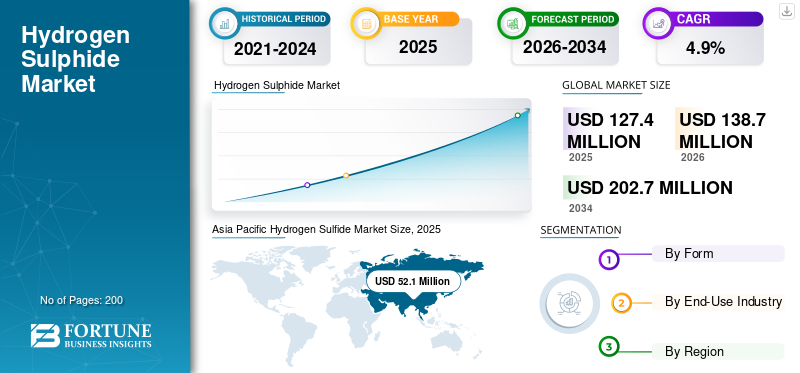
The global hydrogen sulfide market size was valued at USD 127.4 million in 2025. The market is projected to grow from USD 138.7 million in 2026 to USD 202.7 million by 2034, exhibiting a CAGR of 4.9% during the forecast period. Asia Pacific dominated the hydrogen sulfide market with a market share of 40.89% in 2025.
Hydrogen sulfide (H2S) is a sulfur-based gas mainly used as a process intermediate in oil and gas processing, petroleum refining, sulfur recovery, and selected chemical manufacturing activities. Demand for the product is closely linked to sour gas treatment, refinery desulfurization, and sulfur handling operations, where process safety, emission control, and operational efficiency are very important. The market is supported by steady activity across energy and industrial sectors rather than by direct end-use consumption. Globally, growth remains moderate, as demand is driven more by ongoing processing requirements, regulatory pressure, and sulfur recovery needs than by rapid standalone expansion.
The market is dominated by a small group of integrated energy, gas processing, and chemical producers with large-scale assets and established sulfur-handling and recovery technologies. Major players such as Air Liquide, Air Products Inc., Zibo Dijia Special Gas Co., Ltd., Advanced Specialty Gases, and Merck KGaA, along with regional producers, focus on safe handling systems, regulatory compliance, and consistent operational support. As a result, the market is moderately consolidated and characterized by stable industrial demand, high entry barriers, and controlled processing capacity.
Download Free sample to learn more about this report.
Hydrogen Sulfide Market Takeaways
 Global Market Size & Forecast
- 2025 Market Size: USD 127.4 million
- 2026 Market Size: USD 138.7 million
- 2034 Forecast Market Size: USD 202.7 million
- CAGR: 4.9% from 2026–2034
 Market Share
- Asia Pacific dominated the hydrogen sulfide market with a 40.89% share in 2025.
- The liquefied segment is projected to grow at a 5.5% CAGR during the forecast period.
- The semiconductors & electronics segment is expected to expand at a 5.5% CAGR over the forecast period.
 Key Regional Highlights
North America
North America remained a significant regional market, reaching USD 31.1 million in 2025.
Europe
Europe attained a market valuation of USD 24.1 million in 2025 and is projected to witness moderate growth during the forecast period.
Asia Pacific
Asia Pacific led the global market in 2025 with a valuation of USD 52.1 million and is projected to reach USD 57.3 million by 2026.
U.S.
The market was valued at USD 26.2 million in 2025, accounting for approximately 84.3% of North American market revenue.
Japan
The market is expected to witness steady growth during the forecast period, supported by increasing demand from the semiconductor and electronics industries.
Read More

HYDROGEN SULFIDE MARKET TRENDS
Rising Use of Advanced Gas Monitoring and Safety Systems is Shaping Market Development
A notable trend shaping the market is the increasing use of advanced gas monitoring, leak detection, and safety systems across refineries, gas processing plants, and other industrial operations. This shift is mainly driven by the need to improve hydrogen sulfide handling safety, reduce workplace risks, and improve control over hazardous gas streams. Companies are increasingly investing in advanced detection and response technologies to improve operational reliability and meet stricter safety standards. This trend is gradually making H2S handling more technology-focused and safety-driven across industrial operations.
- According to OSHA, workplace exposure to the product must not exceed 20 parts per million (ppm) at the ceiling level, supporting the growing need for gas monitoring and safety systems.
MARKET DYNAMICS
MARKET DRIVERS
Download Free sample to learn more about this report.
Rising Demand for Sulfur Recovery and Refining Operations to Boost Industry Expansion
Product demand is primarily driven by its role in sulfur recovery, oil and gas processing, and petroleum refining operations. The gas is commonly generated and handled during sour gas treatment and refinery desulfurization processes, where removing sulfur compounds is necessary to meet fuel quality and environmental standards. As refining activity and natural gas processing continue across major industrial regions, the need for effective hydrogen sulfide handling and sulfur recovery remains steady. This creates a consistent demand base for product -related processing activities, as ongoing refinery throughput and gas treatment activity directly support its industrial relevance.
- According to the U.S. Energy Information Administration, U.S. refinery sulfur production capacity stood at 39,872 short tons per day as of January 1, 2025, reflecting the large-scale of sulfur recovery activity tied to H2S handling in refining operations.
MARKET RESTRAINTS
High Dependence on Refining Activity Creates Product Demand Volatility
Product demand is restrained by its strong dependence on refining activity, natural gas processing, and other hydrocarbon-related operations that are often cyclical and sensitive to broader energy market conditions. Any slowdown in refinery throughput, lower oil and gas production, or weaker industrial activity can reduce the need for sour gas treatment, desulfurization, and sulfur recovery processes, thereby affecting the hydrogen sulfide market growth. Unlike widely traded industrial chemicals with broader end-use diversity, the product is closely tied to process-industry cycles, making the market more vulnerable during periods of energy market weakness, operational cutbacks, or economic uncertainty.
MARKET OPPORTUNITIES
Expansion of Sour Gas Processing and Refinery Upgrades Supports Market Demand
Product demand is expected to benefit from the expansion of sour gas processing capacity and refinery upgrade projects in major energy-producing regions. As the development of sulfur-rich natural gas resources increases and refiners process more complex crude oil grades, the need for product treatment, removal, and recovery is likely to increase. In addition, investments in cleaner fuel production and better sulfur management systems are creating new opportunities across refining and gas processing operations. These developments are expected to support long-term market growth by increasing the scale and operational importance of hydrogen sulfide-related industrial processing.
- According to the U.S. Energy Information Administration, global refining capacity reached 103.5 million barrels per day in 2023, supporting future demand for product treatment and sulfur recovery systems.
MARKET CHALLENGES
Managing Toxicity and Corrosion Increases Operational Complexity in the Market
The market participants face a major challenge in managing the toxic and corrosive nature of the gas across processing, storage, and treatment operations. The strict safety systems, continuous monitoring, and specialized equipment increase operational costs and production complexity of the product. Companies must also maintain strong containment measures and worker protection standards to avoid leaks, accidents, and regulatory issues. This creates an ongoing operational burden across the value chain and increases the importance of reliable infrastructure, process discipline, and effective safety management in product-related industrial operations.
Segmentation Analysis
By Form
Widespread Industrial Handling Boosted the Gas Segment Growth
Based on form, the market is segmented into gas, liquefied, and others.
The gas segment accounted for a dominant hydrogen sulfide market share in 2025, as the product is primarily generated, handled, and processed in gaseous form across oil and gas operations, refineries, sulfur recovery units, and industrial processing facilities. Its use in gas treatment and desulfurization systems makes direct gaseous handling the most practical and established form in industrial operations. Since the product is mainly managed as part of continuous process streams rather than as a standalone packaged product, the gas segment remains the most structurally important form in the market.
To know how our report can help streamline your business, Speak to Analyst
The liquefied segment is expected to grow at a 5.5% CAGR over the forecast period.
By End-Use Industry
Ongoing Hydrocarbon Processing Activity Positions Oil & Gas as the Primary Demand Anchor
In terms of end-use industry, the market is categorized into oil & gas, chemicals, semiconductors & electronics, and others.
The oil & gas segment accounted for the largest share in 2025. The segment leads demand as the product is mainly generated and handled during sour gas treatment, petroleum refining, and sulfur recovery operations. These processes require continuous H2S removal, monitoring, and treatment to maintain safe operations and meet environmental standards. As hydrocarbon processing activities remain large in scale and operationally essential, the oil &gas industry creates a steady demand base for hydrogen sulfide-related handling and treatment. This makes oil and gas the most structurally important end-use industry in the market.
The semiconductors & electronics segment is expected to grow at a 5.5% CAGR over the forecast period.
Hydrogen Sulfide Market Regional Outlook
By geography, the market is categorized into North America, Europe, Asia Pacific, Latin America, and the Middle East & Africa.
Asia Pacific Hydrogen Sulfide Market Size, 2025 (USD Million)
To get more information on the regional analysis of this market, Download Free sample
Asia Pacific held the dominant position in 2025, valued at USD 52.1 million, and is expected to retain its leading position, reaching USD 57.3 million by 2026. The region’s leadership is driven by its large oil refining base, expanding natural gas processing activity, and strong presence of sulfur recovery and chemical processing operations. High industrial activity across refining, gas treatment, and downstream chemicals supports sustained H2S handling and treatment demand, particularly in large-scale processing environments where operational continuity, safety, and emission control are critical.
China Hydrogen Sulfide Market
Based on Asia Pacific’s strong contribution and China’s large-scale refining and gas processing base, the market was valued at USD 22.7 million in 2025, accounting for approximately 43.6% of global revenues. Demand is supported by extensive refinery throughput, sour gas treatment needs, sulfur recovery activity, and a well-established downstream chemicals industry, which together sustain H2S handling and treatment requirements nationwide.
India Hydrogen Sulfide Market
The Indian market in 2025 stood at around USD 9.7 million. Growth is supported by expanding refining activity, rising natural gas processing needs, increasing sulfur recovery requirements, and gradual growth in industrial and chemical processing capacity serving energy and downstream applications across the country.
North America
North America captured a significant regional market, reaching USD 31.1 million in 2025. Demand is supported by mature oil refining, natural gas processing, and sulfur recovery operations across the region. The market benefits from established industrial infrastructure, strict safety and environmental regulations, and steady requirements from refining and downstream chemical processing. However, growth remains moderate as the region’s core industrial base is mature and expansion is relatively limited.
U.S. Hydrogen Sulfide Market
The U.S. market stood at USD 26.2 million in 2025, representing approximately 84.3% of global revenues. Demand is driven by large-scale oil refining, natural gas processing, sulfur recovery operations, and related chemical processing activities. These industries require effective hydrogen sulfide treatment, monitoring, and handling across major industrial facilities to maintain safe and efficient operations.
Europe
Europe is projected to record moderate growth over the forecast period. The market reached a valuation of USD 24.1 million in 2025. The region is supported by advanced refining infrastructure, established gas treatment systems, and a strong focus on process safety and emission management. Continued activity in oil refining, sulfur recovery, and downstream chemical processing sustains steady demand for hydrogen sulfide handling and treatment across European markets.
Germany Hydrogen Sulfide Market
Germany’s market reached approximately USD 6.7 million in 2025, equivalent to around 27.8% of the global market. Demand is supported by strong refining and chemical processing activity, along with the continued need for H2S treatment, sulfur recovery, and safe industrial handling.
U.K. Hydrogen Sulfide Market
The U.K.’s market in 2025 stood at USD 5.1 million, accounting for roughly 21.4% of global revenues. Demand is concentrated in refining, gas processing, and selected chemical industry applications, where H2S treatment, sulfur recovery, and safe handling remain important for maintaining regulatory compliance and operational safety.
Latin America and the Middle East & Africa
The Latin America and Middle East & Africa regions are expected to witness moderate growth during the forecast period. The Latin America market reached USD 11.6 million in 2025, supported by refining activity, natural gas processing, and rising sulfur recovery requirements in key industrial centers. In the Middle East & Africa, demand is driven by large-scale hydrocarbon processing, sour gas treatment, and ongoing investment in energy infrastructure across major producing countries. The MEA market reached USD 8.6 million in 2025.
GCC Hydrogen Sulfide Market
The GCC market accounted for around USD 3.9 million in 2025, representing approximately 45.1% of regional revenues. Demand is supported by crude oil and gas processing operations, strong refining activity, and continued sulfur recovery needs, which sustain H2S treatment and industrial handling requirements.
COMPETITIVE LANDSCAPE
Key Industry Players
Major Players Focus on Advanced Treatment Technologies to Support Long-Term Market Positioning
The market is moderately consolidated and operationally sensitive, as strict safety requirements, hazardous handling conditions, and specialized treatment infrastructure create significant barriers to entry. These factors limit new participation and concentrate activity among a small group of integrated energy, gas processing, refining, and chemical companies with established operational expertise.
Leading players such as Air Liquide, Air Products Inc., Zibo Dijia Special Gas Co., Ltd., Advanced Specialty Gases, and Merck KGaA, focus primarily on optimizing existing operations and strengthening sulfur recovery and gas treatment capabilities rather than pursuing aggressive standalone expansion. Recent activities across these companies highlight a strategic emphasis on operational efficiency, regulatory compliance, and gradual investment in safer and more advanced treatment technologies to support long-term market positioning.
LIST OF KEY HYDROGEN SULFIDE COMPANIES PROFILED
- Air Liquide (France)
- Air Products Inc. (U.S.)
- Gruppo SIAD (Italy)
- Chengdu Taiyu Industrial Gases Co., Ltd. (China)
- Zibo Dijia Special Gas Co., Ltd. (China)
- EFC Gases & Advanced Materials (U.S.)
- SHIKOKU CHEMICALS CORPORATION (Japan)
- Advanced Specialty Gases (U.S.)
- SUMITOMO SEIKA CHEMICALS CO., LTD. (Japan)
- Merck KGaA (Germany)
REPORT COVERAGE
The global hydrogen sulfide market analysis provides an in-depth study of market size & forecast by all the market segments included in the report. It includes details on market dynamics and trends expected to drive the market during the forecast period. It offers information on technological advancements, new product launches, key industry developments, and partnerships, mergers & acquisitions. The market research report also includes a detailed competitive landscape, including market share and profiles of key players.
Request for Customization to gain extensive market insights.
Report Scope & Segmentation
| ATTRIBUTE | DETAILS |
| Study Period | 2021-2034 |
| Base Year | 2025 |
| Estimated Year | 2026 |
| Forecast Period | 2026-2034 |
| Historical Period | 2021-2024 |
| Growth Rate | CAGR of 4.9% from 2026 to 2034 |
| Unit | Value (USD Million) and Volume (Kiloton) |
| Segmentation | By Form, End-Use Industry, and Region |
| By Form |
|
| By End-Use Industry |
|
| By Geography |
|
Frequently Asked Questions
Fortune Business Insights says that the global market size was valued at USD 127.4 million in 2025 and is projected to reach USD 202.7 billion by 2034.
Recording a CAGR of 4.9%, the market is slated to exhibit steady growth during the forecast period.
By end-use industry, the oil & gas segment led in 2025.
Asia Pacific held the highest market share in 2025.
Rising demand for sulfur recovery is the key factor driving market growth.



- 2021-2034
- 2025
- 2021-2024
- 200
Get 30-60 hrs Free Customization
Expand Regional and Country Coverage, Segments Analysis, Company Profiles, Competitive Benchmarking, and End-user Insights.


















Related Reports
-
US +1 833 909 2966 ( Toll Free )
-
Get In Touch With Us