Oncology Biosimilars Market Size, Share & Industry Analysis, By Drug Class (Anti-HER2 Monoclonal Antibodies, Anti-VEGF Monoclonal Antibodies, Anti-CD20, and Immune Checkpoint Inhibitors), By Product (Trastuzumab, Bevacizumab, Rituximab, Pertuzumab, and Pembrolizumab), By Application (Breast Cancer, Lung Cancer, Colorectal Cancer, Non-Hodgkin's Lymphoma, and Melanoma), By Age Group (Pediatric and Adults), By Route of Administration (Intravenous and Subcutaneous), By Distribution Channel (Hospital Pharmacies, Specialty Pharmacies, and Retail Pharmacies), and Regional Forecast, 2026-2034
 Download Free Sample
Oncology Biosimilars Market Size and Future Outlook
 Listen to Audio Version
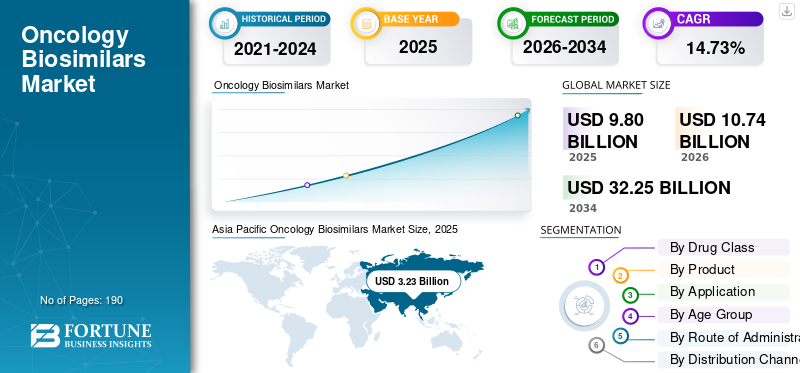
The global oncology biosimilars market size was valued at USD 9.80 billion in 2025. The market is projected to grow from USD 10.74 billion in 2026 to USD 32.25 billion by 2034, exhibiting a CAGR of 14.73% during the forecast period. Asia Pacific dominated the oncology biosimilars market with a market share of 32.95% in 2025.
The global market is growing as the rising cancer burden and high cost of reference biologic medicines continue to increase the demand for affordable treatment options worldwide. Biosimilars of leading oncology therapies are helping hospitals and healthcare systems provide broader access to targeted therapies, monoclonal antibodies, and immunotherapies while reducing the overall financial burden of cancer treatment. The market is also witnessing increasing regulatory approvals, greater acceptance among oncologists, and expanding commercialization of biosimilars across developed and emerging countries. These factors are encouraging pharmaceutical companies to invest in oncology biosimilar development and introduce cost effective alternatives to high-priced reference biologics, thereby strengthening market growth.
- In January 2026, Zydus Lifesciences launched Tishtha, a nivolumab biosimilar, in India for the treatment of multiple cancers. The product was introduced in 40 mg and 100 mg strengths at approximately one-fourth of the cost of the reference drug, supporting wider access to immune-oncology treatment.
Furthermore, key players, such as Celltrion, Inc., Amgen Inc., Pfizer Inc., and Biocon Biologics Limited, are actively participating in new product launches, strategic collaborations, acquisitions, and investment initiatives to expand market presence.
Download Free sample to learn more about this report.
Oncology Biosimilars Market Key Takeaways
 Global Market Size & Forecast
- 2025 Market Size: USD 9.80 billion
- 2026 Market Size: USD 10.74 billion
- 2034 Forecast Market Size: USD 32.25 billion
- CAGR: 14.73% from 2026-2034
 Market Share
- Asia Pacific market held a 32.95% share in 2025, valued at USD 3.23 billion, driven by rising cancer cases and demand for affordable biologics.
- The anti-HER2 monoclonal antibodies market dominated in 2025, driven by extensive use of trastuzumab and pertuzumab biosimilars in breast and gastric cancers.
- The rituximab market dominated in 2025, supported by extensive use in major hematological cancers and multiple approved biosimilars.
 Key Regional Highlights
North America
The market reached USD 2.48 billion in 2025, driven by high biologic cancer therapy use and strong reimbursement coverage.
Asia Pacific
The market reached USD 3.23 billion in 2025, driven by rising cancer cases and demand for affordable treatments.
Europe
The market is projected to reach USD 3.50 billion in 2026, supported by strong physician acceptance and cost-containment policies.
U.S.
The market is estimated at USD 2.55 billion in 2026, driven by strong biosimilar adoption and reimbursement coverage.
Japan
The market is estimated at USD 0.77 billion in 2026, supported by growing demand for affordable oncology treatments.
Read More

ONCOLOGY BIOSIMILARS MARKET TRENDS
Growing Shift Toward Cost-effective Biosimilar-based Cancer Treatment is Observed as a Prominent Trend
The global market is witnessing a growing shift toward cost-effective biosimilar-based cancer treatment as the high price of reference biologics continues to create a significant financial burden for patients and healthcare systems. Biosimilars provide comparable quality, safety, and clinical effectiveness to reference biologics while supporting lower treatment expenditure and wider patient access. Hospitals, payers, and government procurement agencies are increasingly adopting biosimilars to manage oncology budgets and treat a larger number of patients. Moreover, the upcoming loss of exclusivity for major immuno-oncology biologics is encouraging manufacturers to develop biosimilars for high-value therapies such as pembrolizumab and nivolumab. These factors are increasing price competition and strengthening the use of affordable biologic alternatives across cancer treatment settings.
- In January 2026, Biocon Biologics introduced three oncology biosimilar assets targeting trastuzumab/hyaluronidase, nivolumab, and pembrolizumab. These biologic products would broaden the availability of important oncology therapies through cost-effective biosimilar alternatives.
MARKET DYNAMICS
MARKET DRIVERS
Download Free sample to learn more about this report.
Rising Global Cancer Burden Expands the Eligible Treatment Pool and Drives Market Growth
The global market is growing as the increasing incidence of cancer expands the number of patients requiring long-term biological treatment. Rising cases of breast cancer, lung cancer, colorectal cancer, lymphoma, and other malignancies are increasing the use of biologics such as trastuzumab, bevacizumab, and rituximab across different treatment stages. As the eligible treatment population increases, healthcare systems are expected to adopt lower-cost biosimilars to provide biologic therapies to a larger number of patients while controlling oncology expenditure. This is encouraging manufacturers to expand their oncology biosimilar pipelines and obtain approvals across multiple cancer indications, thereby supporting market growth.
- In January 2026, Shanghai Henlius Biotech received approval from the U.S. FDA for a Biologics License Application (BLA) for HLX04, its proposed bevacizumab biosimilar. The pharmaceutical company is seeking approval for multiple solid tumors, including metastatic colorectal cancer, non-squamous non-small cell lung cancer, glioblastoma, renal cell carcinoma, cervical cancer, and ovarian cancer.
|
Rank |
Market Driver |
Overall Impact Rank |
CAGR Contribution (2026-2034) |
Impact: 2026-2028 |
Impact: 2029-2031 |
Impact: 2032-2034 |
|
1 |
Rising global cancer burden expands the eligible treatment pool |
High |
5.23% |
High |
High |
High |
|
2 |
Expansion of the approved biosimilar portfolio increases competitive supply. |
High |
4.20% |
Medium |
High |
High |
|
3 |
Price discounts support payer-driven switching and treatment access |
High |
3.60% |
High |
High |
Medium |
|
4 |
Institutional reimbursement and procurement frameworks normalize biosimilar use. |
Medium-High |
3.10% |
Medium |
High |
High |
|
5 |
Loss of exclusivity for checkpoint inhibitors opens a second growth phase |
Medium |
2.50% |
Medium |
Medium |
High |
|
6 |
Others |
Low |
1.40% |
Low |
Low |
Low |
|
Total Gross Growth Contribution |
20.03% |
MARKET RESTRAINTS
Aggressive Price Erosion and Margin Compression to Restrict Market Growth
The global market faces significant pricing pressure as multiple manufacturers compete for hospital contracts, reimbursement coverage, and tender-based procurement opportunities. The growing availability of biosimilars for trastuzumab, bevacizumab, and rituximab has resulted in substantial reductions in average selling prices, limiting revenue growth despite increasing treatment volumes. Continued price reductions, combined with high development, manufacturing, regulatory, and commercialization costs, can compress manufacturer margins and discourage smaller companies from entering or remaining in the market. Therefore, aggressive price competition may support patient access but restrict manufacturer-level value growth and weaken the long-term commercial sustainability of the market.
- In July 2025, a Biosimilars Review & Report article highlighted that the trastuzumab biosimilars Herzuma and Ontruzant were struggling to remain competitive in the U.S. market, holding only around 1% and 3% market shares, respectively. Ontruzant was positioned at the lowest end of the average selling-price range, yet it continued to record limited uptake. This demonstrates that aggressive discounting does not always generate sufficient sales volume and can significantly weaken manufacturer revenues, margins, and the long-term commercial sustainability of oncology biosimilars.
|
Rank |
Market Restraint |
Expected Impact on Market Growth |
Negative CAGR Contribution (2026-2034) |
Impact: 2026-2028 |
Impact: 2029-2031 |
Impact: 2032-2034 |
|
1 |
Aggressive price erosion limits manufacturer-level value growth |
High |
2.10% |
High |
High |
Medium |
|
2 |
Complex biologic manufacturing raises entry barriers and supply risk |
Medium-High |
1.40% |
High |
Medium |
Medium |
|
3 |
Patent and settlement timing can delay commercial entry |
Medium |
1.05% |
Medium |
Medium |
Low |
|
4 |
Others |
Low |
0.75% |
Low |
Low |
Low |
|
Total Market Reduction |
5.30% |
MARKET OPPORTUNITIES
Upcoming Patent Expiries of Blockbuster Checkpoint Inhibitors to Create a Major Revenue Opportunity
One of the key factors driving the global oncology biosimilars market growth is the development of biosimilars for immune checkpoint inhibitors such as pembrolizumab and nivolumab. These therapies are widely used across lung cancer, melanoma, breast cancer, head and neck cancer, and several other solid and hematological malignancies, creating a large addressable treatment population. Compared with established trastuzumab, bevacizumab, and rituximab biosimilars, checkpoint inhibitor biosimilars can open a considerably larger and less mature revenue pool. Companies that achieve early regulatory approval, establish large-scale manufacturing, and secure commercialization partnerships are therefore expected to gain a strong first-mover advantage in this emerging segment.
- In June 2026, Samsung Bioepis announced positive preliminary Phase 1 and Phase 3 results for SB27, its proposed pembrolizumab biosimilar to Keytruda. The Phase 1 study demonstrated pharmacokinetic equivalence, while the Phase 3 study reported an equivalent objective response rate, supporting the company’s progress toward entering the high-value checkpoint inhibitor biosimilars segment.
MARKET CHALLENGES
High Clinical Development Costs to Limit Entry into Checkpoint Inhibitor Biosimilars
The development of checkpoint inhibitor biosimilars requires substantial investment in analytical characterization, process development, clinical pharmacokinetic studies, immunogenicity assessment, and confirmatory efficacy trials. Products such as pembrolizumab and nivolumab have complex molecular structures and are used across multiple cancer indications, making similarity assessment and regulatory approval pathway more demanding. Manufacturers must also establish high-quality biologics production facilities and maintain consistent product quality across commercial batches. These factors may discourage smaller biosimilar developers, restrict the number of market participants, and make checkpoint inhibitor biosimilar development concentrated among financially strong companies with advanced manufacturing and regulatory capabilities.
- In August 2024, Xbrane Biopharma reported that out-licensing its nivolumab biosimilar candidate, Xdivane, had been more difficult than expected due to the high projected cost of Phase I and Phase III clinical trials. The company also stated that it would be unable, independently or through partners, to finance a full Phase III program if required by the FDA, potentially restricting development to markets outside the U.S. This demonstrates how high clinical development costs and regulatory requirements can delay partnerships and limit market entry for checkpoint inhibitor biosimilars.
Segmentation Analysis
By Drug Class
Broad Clinical Use of HER2-targeted Therapies to Support Anti-HER2 Monoclonal Antibodies Segment’ Dominance
Based on drug class, the market is categorized into Anti-HER2 monoclonal antibodies, anti-VEGF monoclonal antibodies, anti-CD20 monoclonal antibodies, immune checkpoint inhibitor biosimilars, other therapeutic monoclonal antibodies, and others.
The anti-HER2 monoclonal antibodies segment dominated the market in 2025 due to the extensive use of trastuzumab and pertuzumab biosimilars in HER2-positive breast and gastric cancers. These therapies are administered across early-stage, metastatic, neoadjuvant, and adjuvant treatment settings, creating a large and recurring treatment volume. The availability of several approved trastuzumab biosimilars has also increased physician familiarity and encouraged hospitals to switch from expensive reference biologics. Moreover, established treatment guidelines and combination regimens involving anti-HER2 therapies have strengthened their routine use in oncology practice. Therefore, broad indication coverage, longer treatment duration, and strong biosimilar availability supported the segment’s leading share.
- In April 2024, Accord BioPharma received U.S. FDA approval for HERCESSI, a trastuzumab biosimilar indicated for several forms of HER2-overexpressing breast and gastric cancer. The approval further expanded the availability of anti-HER2 biosimilars in the U.S. market.
The immune checkpoint inhibitor biosimilars segment is expected to grow at a CAGR of 103.89% over the global oncology biosimilars market forecast period.
To know how our report can help streamline your business, Speak to Analyst
By Product
Wide Indication Coverage and Established Clinical Use to Drive Rituximab Segment Dominance
Based on product, the market is segmented into trastuzumab, bevacizumab, rituximab, pertuzumab, pembrolizumab, nivolumab, ipilimumab, and others.
In 2025, the rituximab segment dominated the market due to its extensive use in major hematological cancers, particularly non-Hodgkin’s lymphoma and chronic lymphocytic leukemia. Rituximab is commonly administered alone or in combination with chemotherapy, resulting in significant treatment volumes across first-line, maintenance, and relapsed-disease settings. Its earlier entry into the biosimilar market has enabled physicians and hospitals to gain considerable clinical experience with product switching. The presence of multiple approved rituximab biosimilars has further improved product availability and created strong price-based competition. These factors have increased adoption across hospital oncology and hematology departments, supporting the segment’s dominant position.
- In July 2024, Dr. Reddy’s Laboratories received a positive opinion from the EMA’s CHMP for ITUXREDI, its proposed rituximab biosimilar. The product was recommended for indications including non-Hodgkin’s lymphoma and chronic lymphocytic leukemia.
The ipilimumab segment is projected to grow at a CAGR of 121.37% during the forecast period.
By Application
High Disease Burden and Extensive HER2-targeted Treatment to Maintain Breast Cancer Segment’s Leadership
Based on application, the market is segmented into breast cancer, lung cancer, colorectal cancer, non-Hodgkin’s lymphoma, chronic lymphocytic leukemia, gastric & gastroesophageal junction cancer, melanoma, and others.
In 2025, the breast cancer segment dominated the oncology biosimilars market share due to the large number of diagnosed patients and the substantial use of HER2-targeted biological therapies. HER2-positive disease accounts for an important proportion of breast cancer cases and commonly requires trastuzumab-based treatment across early and metastatic stages. Patients may receive these therapies before surgery, after surgery, or during advanced disease, resulting in multiple treatment cycles and high drug utilization. The increasing availability of trastuzumab and pertuzumab biosimilars has also enabled healthcare systems to provide targeted treatment to a larger patient population. Consequently, the combination of high disease incidence, established treatment protocols, and broad biosimilar availability supported the segment’s leading share.
- In December 2024, China’s NMPA accepted Henlius’ application for HLX11, a proposed pertuzumab biosimilar, for HER2-positive early, metastatic, and locally recurrent breast cancer. The filing reflected continued biosimilar development focused on the high-volume breast cancer treatment segment.
The melanoma segment is projected to grow at a CAGR of 104.09% during the forecast period.
By Age Group
Larger Diagnosed and Treated Patient Population to Support Adults Segment Dominance
Based on the age group, the market is segmented into pediatric and adults.
The adults segment dominated the market share in 2025 as most cancers treated with oncology biosimilars occur primarily among adult and older populations. The segment accounts for a substantial proportion of cancer diagnoses and commonly requires biological therapies during treatment. Adults also have greater access to screening, molecular testing, oncology specialists, and hospital-based infusion services compared with pediatric patients. Therefore, the significantly larger eligible treatment population resulted in higher biosimilar consumption among adults.
- In January 2025, the American Cancer Society estimated approximately 2.04 million new cancer diagnoses in the U.S. during 2025 and highlighted the increasing cancer incidence among young and middle-aged adults. The large adult cancer population continues to generate substantial demand for affordable biological treatments.
The pediatric segment is projected to grow at a CAGR of 18.08% during the forecast period.
By Route of Administration
Established Hospital Infusion Protocols to Sustain Intravenous Route Dominance
Based on the route of administration, the market is segmented into intravenous, subcutaneous, and others.
In 2025, the intravenous segment dominated the market because most established oncology biosimilars are administered intravenously. Intravenous administration allows clinicians to provide weight- or body-surface-area-based dosing and closely monitor patients for infusion-related reactions. These products are also frequently administered alongside intravenous chemotherapy, making them compatible with existing hospital oncology workflows. Hospitals already possess infusion chairs, trained nursing staff, sterile preparation facilities, and monitoring systems required for their administration. As a result, the widespread availability of infusion infrastructure and established treatment protocols supported the dominance of the intravenous segment.
- In March 2024, Dr. Reddy’s Laboratories launched Versavo, its bevacizumab biosimilar, in the U.K. in 100 mg and 400 mg single-use vial presentations. The launch expanded the availability of infusion-based biosimilar treatment for several solid cancers.
The subcutaneous segment is projected to grow at a CAGR of 27.26% over the forecast period.
By Distribution Channel
Centralized Procurement and Administration to Keep Hospital Pharmacies Dominant
Based on the distribution channel, the market is segmented into hospital pharmacies, specialty pharmacies, drug stores & retail pharmacies, and online pharmacies.
In 2025, the hospital pharmacies segment dominated the market as oncology biosimilars are mainly physician-administered products. They also require controlled procurement, cold-chain storage, sterile preparation, and supervised infusion. Hospital pharmacists also evaluate formulary inclusion, negotiate purchasing agreements, manage product substitutions, and coordinate medicine availability with oncology departments. Large hospitals purchase significant volumes of trastuzumab, bevacizumab, and rituximab biosimilars, allowing them to obtain competitive prices and generate procurement savings. These operational and financial factors concentrated oncology biosimilar sales within hospital pharmacies.
- A March 2026 JAMA study covering 66,139 patients across 1,541 hospitals found that biosimilar utilization reached 93% for bevacizumab, 87% for trastuzumab, and 84% for rituximab by 2024. The study linked declining hospital acquisition prices and higher hospital margins with rapid biosimilar adoption.
The online pharmacies segment is projected to grow at a CAGR of 21.75% over the forecast period.
Oncology Biosimilars Market Regional Outlook
By region, the market is categorized into Europe, North America, Asia Pacific, Latin America, and the Middle East & Africa.
Asia Pacific
Asia Pacific Oncology Biosimilars Market Size, 2025 (USD Billion)
To get more information on the regional analysis of this market, Download Free sample
Asia Pacific dominated the market in 2025 and is estimated to reach USD 3.58 billion by 2026. The market is expanding due to the rising cancer population, growing treatment access, increasing demand for affordable alternatives to reference biologics, expanding domestic biologics manufacturing, and improving regulatory systems.
Japan Oncology Biosimilars Market
The Japanese market size in 2026 is estimated at around USD 0.77 billion, accounting for approximately 7.16% of the global market.
China's Oncology Biosimilars Market
China's market is projected to be among the largest worldwide, with 2026 revenues estimated at around USD 1.17 billion, accounting for approximately 10.92% of global sales.
India Oncology Biosimilars Market
The Indian market is estimated to be valued at around USD 0.50 billion in 2026, accounting for roughly 4.65% of global revenue.
Europe
Europe is projected to grow at a CAGR of 11.37% over the forecast period, the second-highest among all regions, and is expected to reach a valuation of USD 3.50 billion in 2026. Europe’s established biosimilar regulatory framework, strong physician acceptance, and cost-containment policies are supporting market growth. EMA initiatives to simplify biosimilar development are also expected to encourage more product launches and strengthen competition.
U.K. Oncology Biosimilars Market
The U.K. market is estimated to be valued at USD 0.62 billion by 2026, accounting for roughly 5.77% of the global market.
Germany Oncology Biosimilars Market
Germany's market value is projected to reach approximately USD 0.81 billion by 2026, equivalent to around 7.54% of the global market.
North America
North America was valued at USD 2.16 billion in 2024 and continued to grow, reaching USD 2.48 billionin 2025. The market is growing due to the high use of biologic cancer therapies, strong reimbursement coverage, and increasing FDA approvals of oncology biosimilars. Hospitals and payers are adopting biosimilars to reduce treatment costs and expand access to expensive monoclonal antibody biosimilars.
U.S. Oncology Biosimilars Market
Given North America's substantial contribution and the U.S. dominance in the region, the U.S. market is estimated at around USD 2.55 billion in 2026, accounting for roughly 23.74% of the global market.
Latin America and the Middle East & Africa
Latin America and the Middle East & Africa regions are expected to witness growth in this market during the forecast period. However, Latin America is estimated to reach a valuation of USD 0.52 billion by 2026. Rising cancer incidence and constrained public healthcare budgets are increasing demand for lower-cost oncology biosimilars. Government initiatives to improve access to essential cancer medicines and strengthen regional biosimilar regulations are supporting market penetration. In the Middle East & Africa, the GCC market is set to reach USD 0.16 billion by 2026.
South Africa Oncology Biosimilars Market
The South African market is projected to reach approximately USD 0.09 billion by 2026, accounting for roughly 0.80% of global revenue.
COMPETITIVE LANDSCAPE
Key Industry Players
Portfolio Expansion and Commercialization Strategies Strengthen Market Position
The strong presence of global biosimilar manufacturers and regional biopharmaceutical companies characterizes the global oncology biosimilars market. Companies are focusing on strengthening their oncology portfolios through regulatory approvals, new product launches, clinical pipeline development, licensing agreements, and commercialization partnerships. Manufacturers are also expanding patient-support programs and geographic distribution to improve access to trastuzumab, bevacizumab, rituximab, pertuzumab, and emerging checkpoint inhibitor biosimilars. These strategies are increasing product availability and strengthening competition across developed and emerging markets.
- In June 2025, Biocon Biologics collaborated with the National Cancer Society Malaysia to launch a patient assistance program for underserved cancer patients. Under the program, Biocon Biologics agreed to provide oncology biosimilars, including trastuzumab and bevacizumab, while the organization manages patient enrollment and medicine distribution.
Major players such as Celltrion, Amgen, Pfizer, Biocon Biologics, and Samsung Bioepis are actively competing through portfolio expansion, regulatory filings, partnerships, and regional launches. Companies with broad oncology portfolios, large-scale biologics manufacturing capabilities, established commercialization networks, and strong hospital access are expected to maintain a leading position in the market.
LIST OF KEY ONCOLOGY BIOSIMILARS COMPANIES PROFILED
- Celltrion, Inc. (South Korea)
- Amgen Inc. (U.S.)
- Pfizer Inc. (U.S.)
- Biocon Biologics Limited (India)
- Samsung Bioepis Co., Ltd. (South Korea)
- Sandoz Group AG (Switzerland)
- Shanghai Henlius Biotech, Inc. (China)
- Teva Pharmaceutical Industries Ltd. (Israel)
- Organon & Co. (U.S.)
- Accord Healthcare Limited (U.K.)
- Fresenius Kabi AG (Germany)
- Amneal Pharmaceuticals, Inc. (U.S.)
- Reddy’s Laboratories Ltd. (India)
KEY INDUSTRY DEVELOPMENTS
- December 2025: Zydus Lifesciences Limited collaborated with Formycon AG for the exclusive licensing and supply of checkpoint inhibitor FYB206, a biosimilar of Keytruda (Pembrolizumab) in the U.S. and Canadian markets.
- November 2025: Sandoz signed a global license agreement with EirGenix Inc. to commercialize a proposed biosimilar of oncology medicine pertuzumab.
- September 2025: Alkem Laboratories Ltd. launched Pertuza injection 420mg/14mL, a pertuzumab biosimilar, in India for the treatment of HER2-positive breast cancer. The biosimilar demonstrated equivalence in efficacy, safety, and immunogenicity to the reference product of the innovator.
- September 2025: Shanghai Henlius Biotech, Inc. (2696.HK) announced the Investigational New Drug (IND) application for its HLX17, a proposed pembrolizumab biosimilar. The product received approval from the U.S. FDA as an adjuvant therapy for certain resected solid tumors.
- June 2025: Alvotech collaborated with Dr. Reddy’s Laboratories Ltd. to co-develop, manufacture, and commercialize a biosimilar candidate to Keytruda (pembrolizumab) for the global markets. The collaboration combines Dr. Reddy’s and Alvotech’s proven capabilities in biosimilars, thereby speeding up the development process and extending the global reach for this biosimilar candidate.
REPORT COVERAGE
The market report provides a detailed assessment of all market segments, highlighting key drivers, trends, opportunities, restraints, and challenges shaping industry growth. It also covers technological advancements, major industry developments, market share analysis, and comprehensive profiles of leading companies. The report also evaluates drug class trends, age group, branded and generic adoption, and distribution channel performance across key regions. The report includes market analysis, including pipeline developments, regulatory approvals, product launches, pricing and reimbursement trends, and competitive strategies adopted by leading pharmaceutical companies. The study also highlights regional growth patterns across North America, Europe, Asia Pacific, Latin America, and the Middle East & Africa, along with key factors supporting adoption in each region.
Request for Customization to gain extensive market insights.
Report Scope & Segmentation
| ATTRIBUTE | DETAILS |
| Study Period | 2021-2034 |
| Base Year | 2025 |
| Estimated Year | 2026 |
| Forecast Period | 2026-2034 |
| Historical Period | 2021-2024 |
| Growth Rate | CAGR of 14.73% from 2026 to 2034 |
| Unit | Value (USD Billion) |
| Segmentation | By Drug Class, Product, Application, Age Group, Route of Administration, Distribution Channel, and Region |
| By Drug Class |
|
| By Product |
|
| By Application |
|
| By Age Group |
|
| By Route of Administration |
|
| By Distribution Channel |
|
| By Region |
|
Research Methodology:
1. Bottom Up Approaches
Approach 1: Revenues and Market Share of Major Oncology Biosimilar Players
- Collection of oncology-biosimilar-specific revenues from annual reports, SEC filings, investor presentations, earnings transcripts, regulatory disclosures, and company product portfolios.
- Analysis of leading companies such as Celltrion, Amgen, Pfizer, Biocon Biologics, Samsung Bioepis, Sandoz, Shanghai Henlius Biotech, Teva, Organon, Accord Healthcare, Fresenius Kabi/mAbxience, Amneal, Dr. Reddy’s, Innovent Biologics, and Zydus Lifesciences.
- Estimation of company revenues based on oncology biosimilar portfolio breadth, product launch timing, geographic availability, tender participation, institutional access, and commercialization partnerships.
- Allocation of only oncology-attributable revenue for multi-indication molecules such as rituximab, excluding autoimmune and other non-oncology applications.
- Adjustment of developer, manufacturer, licensing, royalty, supply, and commercialization revenues to prevent double counting across partner companies.
- Triangulation of company-level revenues with product-level sales, country-level biosimilar penetration, and procurement data to derive the global market estimate.
Approach 2: Product-Level Sales Analysis
- Identification of commercially launched branded and unbranded oncology biosimilars across trastuzumab, bevacizumab, rituximab, pertuzumab, and other eligible therapeutic oncology molecules.
- Collection of product-level sales, treatment volumes, vial utilization, dosage strength, treatment duration, patient weight assumptions, and average annual treatment cycles.
- Product mapping for key brands such as Kanjinti, Ogivri, Herzuma, Ontruzant, Trazimera, Mvasi, Zirabev, Vegzelma, Alymsys, Truxima, Ruxience, Riabni, and other country-specific biosimilars.
- Summation of product-level revenues across key countries and regions for the estimation of the global oncology biosimilars market.
- Mapping of upcoming pertuzumab, pembrolizumab, nivolumab, ipilimumab, and other pipeline biosimilars to forecast-year commercialization opportunities, without including revenue before actual launch.
- Assessment of expected indication expansion, geographic rollout, competitive entry, biosimilar switching, and price erosion for each reference molecule.
Approach 3: Epidemiology and Eligible-Patient Model
- Assessment of diagnosed and treated patient populations for breast cancer, lung cancer, colorectal cancer, non-Hodgkin’s lymphoma, chronic lymphocytic leukemia, gastric and gastroesophageal junction cancer, melanoma, and other eligible cancers.
- Mapping of treated patients to biomarker and target eligibility, including HER2-positive, VEGF-addressable, CD20-positive, PD-1/PD-L1-responsive, and CTLA-4-related patient groups.
- Estimation of treatment-line distribution across neoadjuvant, adjuvant, first-line, metastatic, relapsed, refractory, and maintenance treatment settings.
- Application of biologic-treatment utilization, biosimilar availability, treatment-naïve adoption, originator-to-biosimilar switching, and biosimilar-to-biosimilar switching rates.
- Calculation of average doses, treatment cycles, vials per patient, therapy duration, and manufacturer-level annual treatment cost.
- Multiplication of treated and biosimilar-eligible patient volumes by annual revenue per patient (at manufacturer’s prices), across major countries and regions.
- Aggregation of country-level patient-based estimates to estimate the regional and global market values.
2. Top Down Approaches
Approach 1: Analysis of Parent Market
- Analysis of the global oncology biologics and therapeutic monoclonal antibody market as the parent addressable market.
- Estimation of the proportion of reference-biologic sales exposed to biosimilar competition based on patent expiry, regulatory approval, product launch, and country-level market access.
- Application of factors such as molecule-specific biosimilar volume penetration, price discounts, net price erosion, tender outcomes, and originator contracting effects.
- Separation of oncology revenue from non-oncology indications for multi-indication reference products.
- Comparison of the top-down estimate with company-revenue, product-level, patient-based, and country-procurement models to finalize the market size.
3. List of Key Sources
- Annual reports, SEC filings, investor presentations, earnings transcripts, and product-specific sales disclosures
- Company websites, product portfolios, press releases, licensing agreements, commercialization partnerships, and manufacturing updates
- S. FDA, Purple Book, prescribing information, approval databases, and interchangeability listings
- European Medicines Agency, European Commission, and national European regulatory authorities
- PMDA and Ministry of Health, Labor and Welfare, Japan
- NMPA and Center for Drug Evaluation, China
- CDSCO and Department of Biotechnology, India
- Therapeutic Goods Administration and Pharmaceutical Benefits Scheme, Australia
- WHO, International Agency for Research on Cancer, Global Cancer Observatory, National Cancer Institute, and European Cancer Information System
- National and regional cancer registries
- CMS, national reimbursement databases, health technology assessment agencies, and oncology formularies
- Government tender portals, hospital procurement databases, and volume-based procurement records
- NCCN, ESMO, ASCO, national oncology guidelines, peer-reviewed publications, and clinical trial registries
- Product labels, dosage schedules, treatment protocols, and pharmacoeconomic studies
4. Primary Interviews
Supply Side Interviews: 60%
- Key Respondents:
- Biosimilar manufacturers and developers
- Business development and alliance-management executives
- Commercial, marketing, product, and sales managers
- Regulatory affairs and market-access professionals
- Manufacturing, quality assurance, and supply-chain executives
- Specialty distributors, wholesalers, and tender-participation teams
- Contract manufacturing and fill-finish partners
Demand Side Interviews: 40%
- Key Respondents:
- Medical oncologists and hematologists
- Hospital pharmacists and oncology pharmacy directors
- Cancer-center procurement and formulary managers
- Ambulatory infusion-center administrators
- Payers, reimbursement specialists, and health technology assessment experts
- Public procurement and hospital tender authorities
- Oncology nurses and treatment-pathway coordinators
Frequently Asked Questions
According to Fortune Business Insights, the global market value stood at USD 9.80 billion in 2025 and is projected to reach USD 32.25 billion by 2034.
In 2025, Asia Pacific’s market value stood at USD 3.23 billion.
The market is expected to grow at a CAGR of 14.73% over the forecast period.
By drug class, the Anti-HER2 monoclonal antibodies segment is expected to lead the market.
Rising global cancer burden expands the eligible treatment pool, driving market growth.
Celltrion, Inc., Amgen Inc., Pfizer Inc., and Biocon Biologics Limited are among the major players in the global market.
Asia Pacific dominated the market share in 2025.



- 2021-2034
- 2025
- 2021-2024
- 190
Get 30-60 hrs Free Customization
Expand Regional and Country Coverage, Segments Analysis, Company Profiles, Competitive Benchmarking, and End-user Insights.













.webp)






-
US +1 833 909 2966 ( Toll Free )
-
Get In Touch With Us