Power Tools Market Size, Share & Industry Analysis, By Mode of Operation (Electric, Pneumatic, and Others), By Tool Type (Drilling & Fastening Tools, Material Removal Tools, Sawing and Cutting Tools, Demolition Tools, and Others), By Application (Do-It-Yourself (DIY) and Industrial), By Mobility Type (Corded Power Tools and Cordless Power Tools), and Regional Forecast, 2026-2034
 Download Free Sample
Power Tools Market Size & Overview
 Listen to Audio Version
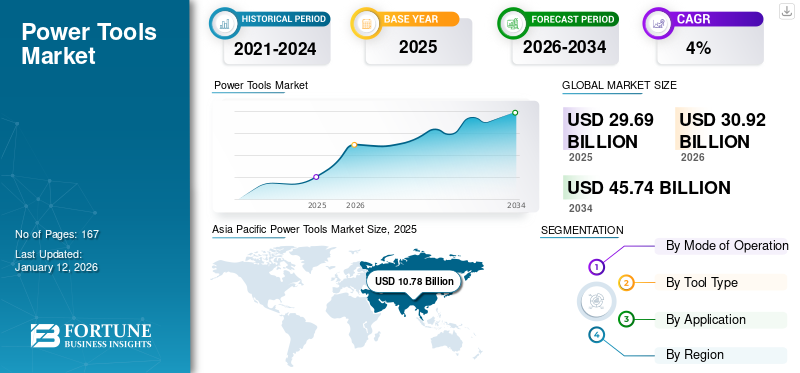
The global power tools market size was valued at USD 29.57 billion in 2025 and is projected to grow from USD 30.79 billion in 2026 to USD 45.19 billion by 2034, exhibiting a CAGR of 4.9% during the forecast period. Asia Pacific dominated the power tools market with a market share of 36.40% in 2025.
Power tools are advanced handheld or stationary equipment designed to perform drilling, fastening, cutting, grinding, polishing, demolition, routing, and other material-processing operations with reduced manual effort. The market includes electric, pneumatic, and hydraulic tools available across corded and cordless configurations for different industrial and household requirements. These tools integrate motors, batteries, gears, electronic controls, safety mechanisms, ergonomic housings, and application-specific accessories to support efficient and reliable operations. The increasing adoption of battery powered cordless technologies, brushless motors, smart controls, and high-performance battery systems is gradually transforming the industry.
Power tools support a wide range of applications across construction, automotive, manufacturing, aerospace, metalworking, woodworking, maintenance, repair, and do-it-yourself activities. Industrial users are increasingly focusing on improving operational efficiency, reducing physical workload, and adopting portable tools that can support diverse job-site conditions. At the same time, rising home improvement and renovation activities are supporting demand from DIY consumers. However, factors such as battery replacement costs, product maintenance requirements, workplace safety concerns, and competition from low-cost alternatives continue to influence market growth and adoption across certain customer groups.
The major companies include Atlas Copco AB, Emerson Electric Co., Enerpac Tool Group, Hilti Corporation, Ingersoll Rand, and Koki Holdings Co. Ltd. These players are engaged in developing high-performance power tools that address industrial, professional, and DIY requirements. Additionally, key players are focusing on expanding their market footprint through product launches, strategic collaborations, acquisitions, mergers, distribution agreements, and partnerships.
Download Free sample to learn more about this report.
Power Tools Market Trends
Growing Adoption of Unified Battery Platforms and Cross-Compatible Cordless Tool Ecosystems to be a Significant Market Trend
The market is witnessing a growing shift toward unified battery platforms that allow professionals to operate multiple tools using a common battery and charging system. Manufacturers are increasingly expanding cordless ecosystems across drilling, fastening, cutting, grinding, demolition, measuring, and trade-specific applications. This approach reduces the need to maintain separate batteries and chargers for individual tools, simplifies equipment management, and enables users to add new tools without replacing the entire supporting system.
Cross-compatible battery platforms are also encouraging power tool companies to collaborate with complementary equipment manufacturers and broaden the number of products operating within a shared ecosystem. The trend is particularly visible among professional contractors, workshops, maintenance teams, and industrial users that operate multiple tools and require greater flexibility across jobsites. As battery power, runtime, charging capability, and platform compatibility continue to improve, unified cordless systems are becoming an important product-development and customer-retention strategy for leading manufacturers.
- For instance, in January 2025, Bosch Power Tools expanded its AMPShare battery alliance by adding MESTO and Leister, increasing the platform to 33 global partner brands and enabling professionals to operate a broader range of tools across multiple trades using a common 18V battery system.
MARKET DYNAMICS
Market Drivers
Download Free sample to learn more about this report.
Expansion of Construction, Infrastructure, and Renovation Activities is Driving Demand for Power Tools
The continued expansion of construction, infrastructure development, and renovation activities is one of the major factors driving the power tools market growth. Residential construction, commercial projects, transportation infrastructure, industrial facilities, and repair and maintenance work require a wide range of drilling, fastening, cutting, grinding, demolition, and material removal tools. Contractors and construction professionals rely on power tools to complete repetitive and labor-intensive operations within shorter project schedules while maintaining consistent performance across different job-site conditions.
Demand is particularly strong across concrete drilling, structural fastening, metal cutting, surface preparation, interior finishing, electrical installation, plumbing, woodworking, and demolition applications. Large infrastructure projects also require durable professional-grade tools capable of handling continuous workloads and demanding materials. In addition, aging residential and commercial buildings are generating recurring demand for refurbishment, retrofitting, maintenance, and replacement activities, supporting both new tool purchases and recurring accessory consumption.
The growth of construction activity in emerging economies, together with public infrastructure expenditure and building modernization in developed markets, is expected to sustain demand for electric, pneumatic, and hydraulic power tools. Industrial contractors are also adopting application-specific tools to reduce manual effort, improve job-site execution, and address skilled-labor shortages across construction and maintenance operations.
- For instance, in February 2026, the U.S. Census Bureau reported that the value of public construction reached USD 516.8 billion in 2025, increasing by 3.6% compared with 2024, reflecting continued spending across public infrastructure and institutional construction applications that support demand for professional power tools.
|
Rank |
Market Drivers |
Overall Impact Rank |
CAGR Contribution (2026-2034) |
Impact 2026-2028 |
Impact 2029-2031 |
Impact 2032-2034 |
|
1 |
Expansion of construction, infrastructure development, and building renovation activities |
High |
+2.3% |
High |
High |
High |
|
2 |
Rising use of power tools across industrial manufacturing, automotive servicing, and maintenance operations |
High |
+1.7% |
High |
High |
Medium |
|
3 |
Increasing adoption of cordless tools, brushless motors, and high-performance battery technologies |
Medium-High |
+1.5% |
Medium |
High |
High |
|
4 |
Growth of DIY, home improvement, furniture assembly, and household repair activities |
Medium |
+1.2% |
Medium |
Medium |
High |
|
5 |
Development of connected, ergonomic, safer, and application-specific professional tools |
Medium-Low |
+1.0% |
Low |
Medium |
High |
|
6 |
Others (rental fleet expansion, replacement demand, e-commerce distribution, expanding trade workforce, product portfolio diversification, etc.) |
Low |
+1.0% |
Low |
Low |
Medium |
|
Total Positive Growth Contribution |
+8.7% |
Market Restraints
Fluctuating Raw Material Prices and Supply Chain Disruptions are Increasing Manufacturing Costs
The market is affected by volatility in the prices and availability of steel, aluminum, copper, motors, bearings, electronic controllers, semiconductors, and specialized plastics used in tool manufacturing. Rising input costs can increase production expenses and place pressure on manufacturer margins, particularly across price-sensitive power tool categories where companies have limited flexibility to transfer higher costs to customers.
Supply chains disruptions can further delay the availability of critical components used in electric, pneumatic, and hydraulic power tools. Manufacturers may experience longer procurement lead times, higher freight expenses, production interruptions, and difficulty maintaining consistent inventory levels across regional distribution networks. These challenges can result in delayed product deliveries, increased selling prices, and reduced affordability for small contractors, workshops, and DIY consumers.
The restraint is particularly significant for manufacturers operating complex global sourcing and production networks. Dependence on imported components and raw materials can expose companies to tariffs, logistics bottlenecks, currency fluctuations, and geopolitical uncertainty. Although leading manufacturers are diversifying suppliers, rebalancing manufacturing networks, and implementing cost-control measures, sustained input cost volatility may continue to constrain profitability and slow market expansion.
|
Rank |
Market Restraints |
Overall Impact Rank |
Negative CAGR Contribution (2026-2034) |
Impact 2026-2028 |
Impact 2029-2031 |
Impact 2032-2034 |
|
1 |
Fluctuating prices of steel, aluminum, copper, motors, electronics, and other manufacturing inputs |
High |
-1.2% |
High |
High |
Medium |
|
2 |
Strong price competition from low-cost, counterfeit, and unorganized power tool suppliers |
Medium-High |
-1.0% |
High |
Medium |
Medium |
|
3 |
Cyclical construction activity and sensitivity of industrial tool purchases to capital expenditure conditions |
Medium |
-0.9% |
Medium |
Medium |
Low |
|
4 |
Others (workplace safety concerns, maintenance expenses, noise and vibration exposure, regulatory compliance, product durability issues, etc.) |
Low |
-0.7% |
Low |
Low |
Low |
|
Total Negative Growth Impact |
-3.8% |
Market Opportunities
Growing Adoption of Connected Tool Management Solutions is Creating New Growth Opportunities
The increasing digitalization of construction sites, workshops, and industrial maintenance operations is creating new growth opportunities for the market. Contractors and industrial users are increasingly seeking connected solutions that provide real time and greater visibility into tool location, utilization, maintenance status, and battery condition across large equipment fleets. This is encouraging manufacturers to integrate power tools with Bluetooth connectivity, cloud-based platforms, sensors, and asset management software.
Connected tool management solutions can help companies reduce tool loss, improve equipment allocation, schedule maintenance, monitor battery fleets, and limit unplanned downtime. The opportunity is particularly strong across large construction projects, infrastructure sites, manufacturing facilities, utilities, and rental operations where managing numerous tools across multiple locations can be difficult. Manufacturers can capitalize on this demand by offering connected tools, digital subscriptions, fleet management services, and integrated hardware-software ecosystems. The expansion of these solutions also allows power tool companies to generate recurring service revenue beyond conventional product sales. As customers increasingly prioritize equipment visibility, operational continuity, and lifecycle management, demand for digitally enabled power tool fleets is expected to increase across professional and industrial applications.
- For instance, in October 2025, Hilti expanded its Nuron platform with more than 60 heavy-duty products and integrated the platform with its ON!Track asset management software, enabling contractors to gain visibility into tool and battery fleets and reduce unplanned downtime.
SEGMENTATION ANALYSIS
By Mode of Operation
Electric Segment Held Largest Share Due to Wide Product Availability and Strong Adoption Across Professional and DIY Applications
Based on mode of operation, the market is divided into electric, pneumatic, and others (hydraulic).
Electric segment accounted for the largest power tools market share in 2025, driven by its broad availability across drilling, fastening, cutting, grinding, sanding, routing, and demolition applications. Electric power tools are widely adopted across construction, manufacturing, automotive repair, woodworking, metalworking, maintenance, and DIY activities, as they are available in both corded and cordless configurations. Compared with pneumatic and hydraulic tools, electric power tools require less supporting infrastructure, offer greater operating flexibility, and are suitable for a wider range of professional and household applications. The continued development of brushless motors, electronic controls, ergonomic designs, and high-performance battery systems is further strengthening their adoption across different user groups.
- For instance, in September 2025, DEWALT introduced its first cordless 4-inch angle grinder, designed to provide compact maneuverability while maintaining the power required for professional grinding and cutting applications.
Pneumatic segment is expected to witness the second-highest growth, with a CAGR of 4.4% during the forecast period, driven by increasing demand for durable, lightweight, and high power-to-weight tools across automotive assembly, metal fabrication, industrial maintenance, construction, and manufacturing facilities.
To know how our report can help streamline your business, Speak to Analyst
By Tool Type
Drilling & Fastening Tools Segment Dominated Due to Widespread Use Across Construction and Assembly Operations
Based on tool type, the market is divided into drilling & fastening tools, material removal tools, sawing and cutting tools, demolition tools, and others (routing tools).
Drilling & fastening tools segment accounted for the largest market share in 2025, driven by its extensive use across construction, manufacturing, automotive assembly, woodworking, electrical installation, maintenance, and DIY applications. Drills, impact drivers, impact wrenches, screwdrivers, and fastening systems are commonly used for creating holes, installing fixtures, assembling components, and performing repair activities. Compared with specialized cutting and demolition equipment, drilling and fastening tools have a broader application base and are frequently purchased by professional contractors, industrial users, workshops, and households.
- For instance, in September 2025, DEWALT introduced a new range of cordless angle grinders, including 4-inch and 4.5-inch models, designed for grinding, cutting, surface preparation, and metalworking applications.
Material removal tools segment is expected to witness the highest growth, with a CAGR of 5.5% during the forecast period, driven by increasing demand for grinding, sanding, polishing, surface finishing, rust removal, and weld preparation tools across automotive workshops, metal fabrication facilities, manufacturing plants, and industrial maintenance operations.
By Application
Industrial Segment Led Market Due to Extensive Use Across Manufacturing, Construction, Automotive, and Maintenance Operations
Based on application, the market is divided into do-it-yourself (DIY) and industrial.
Industrial segment held the largest market share in 2025, driven by the extensive use of power tools across manufacturing, automotive, construction, energy, shipbuilding, metal fabrication, and maintenance operations. Industrial users require drilling, fastening, cutting, grinding, demolition, and material removal tools capable of supporting continuous workloads, demanding materials, and repetitive operations. Professional-grade power tools are widely preferred in these applications due to their higher durability, stronger performance, enhanced safety features, and compatibility with specialized accessories.
- For instance, in February 2025, Ingersoll Rand highlighted its W7153 IQV20 DXS cordless impact wrench and H3111 cordless heat gun for professional automotive service, repair, and industrial maintenance applications.
Do-it-yourself (DIY) segment is expected to witness the highest growth, with a CAGR of 5.4% during the forecast period, driven by increasing participation in home renovation, furniture assembly, woodworking, gardening, household repair, and small-scale improvement projects among residential consumers.
By Mobility Type
Continuous Power Supply and Strong Performance in Heavy-Duty Applications Led to Corded Power Tools Segmental Dominance
Based on mobility type, the market is divided into corded power tools and cordless power tools.
Corded power tools segment held the largest market share in 2025, driven by their continuous power availability, consistent torque output, and suitability for prolonged and heavy-duty operations. These tools are widely used across manufacturing plants, metal fabrication facilities, construction sites, automotive workshops, and woodworking operations where uninterrupted performance is required. Compared with cordless tools, corded power tools are not affected by battery runtime, charging requirements, or battery degradation, making them suitable for stationary and high-intensity applications.
- For instance, in January 2025, Bosch Power Tools announced plans to introduce more than 30 cordless tools, batteries, and chargers during the year, while expanding its 18V portfolio across cutting, demolition, fastening, and other professional applications.
Cordless power tools segment is expected to witness the highest growth, with a CAGR of 5.7% during the forecast period, driven by increasing demand for portable, flexible, and easy-to-operate tools across construction sites, maintenance activities, automotive repair, household renovation, and remote working environments.
POWER TOOLS MARKET REGIONAL OUTLOOK
By geography, the market is categorized into North America, Europe, Asia Pacific, Latin America, and the Middle East & Africa.
Asia Pacific
Asia Pacific Power Tools Market Size, 2025 (USD Billion)
To get more information on the regional analysis of this market, Download Free sample
Asia Pacific will continue to dominate the market, accounting for USD 10.78 billion in revenue in 2025. Regional growth is strongly supported by rapid expansion of urban construction and infrastructure development across emerging economies. Residential projects, transportation networks, industrial facilities, utilities, and commercial buildings require drilling, fastening, demolition, cutting, and material-removal tools across multiple stages of construction. The large contractor base and continued movement toward mechanized construction practices are increasing the use of power tools as substitutes for manual equipment throughout the region.
China Power Tools Market
China’s market is projected to remain dominant in Asia Pacific, with 2026 revenues estimated at around USD 5.85 billion, representing roughly 19.0% of global sales.
Japan Power Tools Market
The Japanese market is estimated at around USD 2.31 billion in 2026, accounting for roughly 7.5% of global sales.
India Power Tools Market
The Indian market is estimated at around USD 2.26 billion in 2026, accounting for roughly 7.3% of global sales.
North America
North America’s market accounted for USD 6.92 billion in revenue in 2025, supported by sustained demand from residential renovation and building-repair activities. Aging residential and commercial properties across the region require recurring drilling, fastening, cutting, sanding, and surface-preparation operations. Contractors, maintenance professionals, and property owners increasingly use professional-grade power tools for roofing, flooring, plumbing, electrical installation, interior remodeling, and structural repair applications. The established home improvement industry and regular replacement of tools used by professional tradespeople are expected to support steady regional market growth.
U.S. Power Tools Market
The U.S. is expected to dominate the North America market with an estimated revenue of about USD 5.68 billion in 2026, representing roughly 18.4% of global sales. Growth is driven by increasing efforts to address skilled-trade labor shortages through higher-productivity and ergonomically designed equipment.
Europe
The European market is expected to witness steady growth during the forecast period, supported by increasing emphasis on occupational safety and worker protection. Construction companies, manufacturing facilities, and professional workshops are adopting tools equipped with dust-extraction interfaces, kickback control, vibration reduction, electronic braking, and improved guarding systems. Compliance with workplace exposure requirements and greater attention to operator health are influencing purchasing decisions across cutting, grinding, drilling, and demolition applications. This focus on safer tool operation is encouraging the replacement of older equipment with advanced professional-grade products across European markets.
U.K. Power Tools Market
The U.K. market is estimated at around USD 1.70 billion in 2026, representing roughly 5.5% of global revenues.
Germany Power Tools Market
Germany’s market is projected to reach USD 2.16 billion in 2026, equivalent to around 7.0% of global sales.
Middle East & Africa
The Middle East & Africa market accounted for USD 2.33 billion in revenue in 2025, supported by recurring maintenance requirements across oil & gas, energy, utilities, and heavy industrial facilities. Refineries, pipelines, processing plants, power stations, and industrial installations require durable tools for bolting, grinding, cutting, drilling, surface preparation, and equipment repair. Harsh operating environments and the need to maintain critical assets are sustaining demand for pneumatic, hydraulic, and heavy-duty electric power tools across the region.
GCC Power Tools Market
The GCC market is projected to reach around USD 1.51 billion in 2026, representing roughly 4.9% of global sales.
Latin America
Latin America accounted for USD 1.30 billion in revenue in 2025, supported by equipment maintenance and repair activities across mining operations. Mineral-producing countries require drilling, grinding, cutting, fastening, and hydraulic tools for maintaining processing facilities, transport equipment, workshops, and supporting infrastructure. The demanding operating conditions associated with mining encourage the use of durable professional-grade tools and generate recurring replacement demand.
Brazil Power Tools Market
The Brazilian market is projected to reach around USD 0.82 billion in 2026, representing roughly 2.7% of global sales.
COMPETITIVE LANDSCAPE
Key Industry Players
Key Industry Players Focus on Cordless Platforms, Product Innovation, and Application-Specific Power Tools to Strengthen Market Position
The global power tools market is competitive and continues to evolve as professional, industrial, and DIY users shift toward more portable, durable, and application-specific equipment. Competition is determined by the strength of cordless tool platforms, battery performance, motor efficiency, tool durability, ergonomic design, safety features, product range, distribution reach, and the ability to serve construction, manufacturing, automotive, maintenance, woodworking, and household applications. Companies are focusing on power tool solutions that improve operating flexibility, reduce user fatigue, support demanding workloads, and provide consistent performance across varied job-site and workshop conditions.
Several key players are developing advanced power tool portfolios, ranging from drilling & fastening tools, material removal equipment, sawing and cutting tools, and demolition tools to electric, pneumatic, hydraulic, corded, and cordless systems. Manufacturers are also expanding unified battery ecosystems, brushless motor technologies, connected tool-management solutions, dust-control features, vibration reduction systems, and industry-specific accessories. As the power tools industry expands, partnerships with distributors, construction contractors, industrial customers, rental companies, automotive service providers, and retail channels are expected to remain important competitive strategies.
List of Key Power Tools Companies Profiled in Report
- Atlas Copco AB (Sweden)
- Emerson Electric Co. (U.S.)
- Enerpac Tool Group (U.S.)
- Hilti Corporation (Liechtenstein)
- Ingersoll Rand (U.S.)
- Koki Holdings Co. Ltd. (Japan)
- Makita Corporation (Japan)
- Robert Bosch GmbH (Germany)
- Stanley Black & Decker Inc. (U.S.)
- Tectronic Industries Co. Ltd. (China)
- DeWalt (U.S.)
- Hitachi Power Tools (Japan)
- Metabo (Germany)
- Festool (Germany)
- Chervon (China)
- Ryobi (Japan)
- Würth (Germany)
- Fein (Germany)
KEY INDUSTRY DEVELOPMENTS
- July 2026: DEWALT commercially launched DALE, a fleet-capable downward drilling robot developed with August Robotics for automated concrete drilling in data center construction projects.
- July 2026: Makita launched a compact 40Vmax cordless impact driver featuring a shorter head design and reduced weight for fastening operations in confined spaces.
- May 2026: Fein expanded its MultiMaster portfolio by introducing eight titanium-coated bi-metal saw blades and new MM 500 PLUS and MM 700 MAX tool sets for renovation, interior work, and metalworking applications.
- April 2026: Bosch Power Tools introduced its Expert professional product range, including advanced saws, fastening tools, measuring equipment, accessories, and an expanded Expert 18V cordless platform.
- February 2026: Metabo introduced the Tracker Pro tool-tracking device, supporting the Apple Find My and Google Find Hub networks to help professional users locate tools and equipment across jobsites.
- November 2025: Koki Holdings announced the transition of the Metabo brand in North America to Metabo HPT, consolidating the brands under a unified power tool identity and product strategy.
- October 2025: Chervon partnered with John Deere to integrate EGO 56V ARC Lithium batteries into the John Deere Z370RS electric mower, enabling battery interoperability across the EGO product ecosystem.
REPORT COVERAGE
The global power tools market analysis includes a comprehensive study of the market size & forecast by all the market segments included in the report. It includes details on the market activities and market patterns expected to drive the market over the forecast period. Additionally, it details product launches, partnerships, mergers & acquisitions, and key industry developments. The global market research report also provides an in-depth competitive landscape with information on the market share and profiles of key operating players.
Request for Customization to gain extensive market insights.
REPORT SCOPE & SEGMENTATION
| ATTRIBUTE | DETAILS |
| Study Period | 2021-2034 |
| Base Year | 2025 |
| Estimated Year | 2026 |
| Forecast Period | 2026-2034 |
| Historical Period | 2021-2024 |
| Growth Rate | CAGR of 4.9% from 2026 to 2034 |
| Unit | Value (USD Billion) |
|
Segmentation |
By Mode of Operation
By Tool Type
By Application
By Mobility Type
By Region
|
| Companies Profiled in the Report | Atlas Copco AB (Sweden), Emerson Electric Co. (U.S.), Enerpac Tool Group (U.S.), Hilti Corporation (Liechtenstein), Ingersoll Rand (U.S.), Koki Holdings Co. Ltd. (Japan), Makita Corporation (Japan), Robert Bosch GmBH (Germany), Stanley Black & Decker Inc. (U.S.), and Tectronic Industries Co. Ltd. (China) |
Frequently Asked Questions
The global market size was valued at USD 29.57 billion in 2025 and is projected to reach USD 45.19 billion by 2034.
In 2025, the market in Asia Pacific was valued at USD 10.78 billion.
The market is expected to exhibit a CAGR of 4.9% during the forecast period of 2026-2034.
By mode of operation, the electric segment led the market.
Expansion of construction, infrastructure development, residential renovation, and industrial maintenance activities is driving demand for drilling, fastening, cutting, grinding, demolition, and material removal tools.
Atlas Copco AB, Emerson Electric Co., Enerpac Tool Group, Hilti Corporation, and Ingersoll Rand are the key players considered in the market.
Asia Pacific held the largest market share in 2025.


- 2021-2034
- 2025
- 2021-2024
- 167
Get 30-60 hrs Free Customization
Expand Regional and Country Coverage, Segments Analysis, Company Profiles, Competitive Benchmarking, and End-user Insights.














Related Reports
-
US +1 833 909 2966 ( Toll Free )
-
Get In Touch With Us