Veterinary Pain Management Market Size, Share & Industry Analysis, By Offering (Drugs, Devices & Equipment, and Services), By Indication (Osteoarthritis & Degenerative Joint Disease, Post-operative & Procedural Pain, Traumatic & Injury Pain, Dental & Oral Pain, Cancer & Palliative Pain, and Others), By Animal Type (Canine, Feline, Equine, Bovine, and Others), By End User (Veterinary Hospitals & Clinics, Animal Rehabilitation & Pain Management Centers, Livestock Farms, and Others), and Regional Forecast, 2026-2034
 Download Free Sample
Veterinary Pain Management Market Size and Future Outlook
 Listen to Audio Version
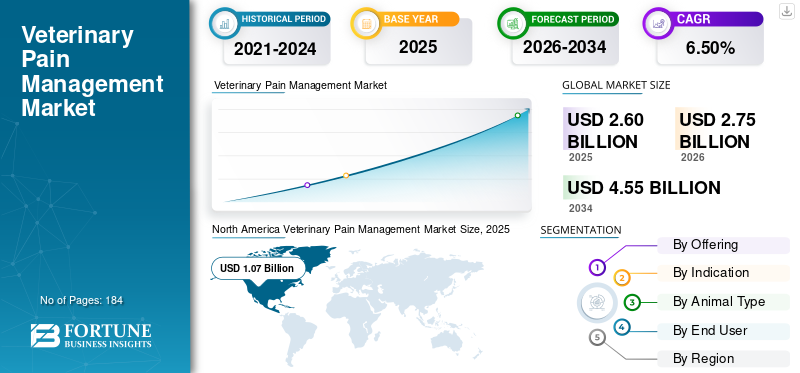
The global veterinary pain management market size was valued at USD 2.60 billion in 2025. The market is projected to grow from USD 2.75 billion in 2026 to USD 4.55 billion by 2034, exhibiting a CAGR of 6.50% during the forecast period. North America dominated the veterinary pain management market with a market share of 41.15% in 2025.
The global market comprises pain relief medications for animals along with devices and apparatus, as well as services designed to manage both acute and chronic pain, particularly in companion and farm animals. The market is expanding owing to more people owning companion animals, a rise in osteoarthritis and mobility disorder diagnoses, increased spending on pet healthcare, and a higher adoption rate of multimodal pain management. The global market demand is further bolstered by the growth of veterinary hospitals, rehabilitation facilities, livestock pain treatment techniques, and the increasing adoption of advanced injectable and service-oriented pain remedies.
Key players in the global market include Zoetis Services LLC., Elanco, Boehringer Ingelheim International GmbH, and Merck Co. Inc., among others. Strong veterinary pain management drug portfolios, wide geographic presence, and emphasis on innovation are some of the factors supporting the dominance of these companies in the global market.
Download Free sample to learn more about this report.
Veterinary Pain Management Market Key Takeaways
 Global Market Size & Forecast
- 2025 Market Size: USD 2.60 billion
- 2026 Market Size: USD 2.75 billion
- 2034 Forecast Market Size: USD 4.55 billion
- CAGR: 6.50% from 2026-2034
 Market Share
- North America dominated the veterinary pain management market with a 41.15% share in 2025.
- The services segment is projected to grow at a CAGR of 8.67% during the forecast period.
- The post-operative & procedural pain segment is expected to grow at a CAGR of 5.01% during the forecast period.
 Key Regional Highlights
North America
North America led the veterinary pain management market with a value of USD 1.07 billion in 2025.
Asia Pacific
Asia Pacific is expected to reach a valuation of USD 0.59 billion by 2026, supported by increasing veterinary healthcare adoption.
Europe
Europe is projected to witness steady growth with a CAGR of 5.74% during the forecast period.
U.S.
The U.S. market is estimated to reach USD 1.02 billion by 2026, accounting for around 37.2% of global revenues.
Japan
Japan is projected to reach USD 0.13 billion in 2026, representing approximately 4.9% of global revenues.
Read More

VETERINARY PAIN MANAGEMENT MARKET TRENDS
Shift toward AI-enabled Animal Monitoring Technologies is a Remarkable Market Trend
The shift toward AI-driven animal monitoring technologies is becoming a significant market trend as veterinarians and livestock producers are utilizing digital tools more frequently to detect pain-related movement changes sooner and more objectively. Detecting pain in animals can be challenging since they might conceal their distress, and indicators such as lameness, decreased mobility, postural changes, and modified gait may go unnoticed during regular observation. Monitoring systems enhanced by AI aid in bridging this gap by employing cameras, sensors, and software to monitor movement patterns, physical condition, and behavioral alterations in real time. This facilitates earlier identification of osteoarthritis, lameness, pain from injuries, and post-treatment recovery, which subsequently boosts the need for prompt pain relief, rehabilitation, and ongoing care. This trend holds particular significance in dairy cattle, equine care, and the management of mobility in companion animals, as early detection can enhance welfare and decrease long-term treatment expenses. These factors are supporting the global veterinary pain management market growth during the forecast period.
- In November 2024, GEA launched an AI-driven Body Condition Scoring solution for cows as part of its CattleEye technology. The system uses a camera and AI software to analyze cow movement patterns and body shape, supporting lameness detection and herd health monitoring.
MARKET DYNAMICS
MARKET DRIVERS
Download Free sample to learn more about this report.
Rising Awareness Regarding Animal Health and Welfare to Propel Market Growth
Growing awareness of animal health and welfare is a primary factor propelling the market growth, as pet owners, veterinarians, and livestock producers increasingly understand that unmanaged pain impacts animal mobility, behavior, recovery, productivity, and overall quality of life. Previously, pain in animals was frequently overlooked as they tend to conceal distress or present subtle indicators such as decreased movement, stiffness, changes in appetite, or modified posture. With increasing awareness, veterinarians are more inclined to suggest organized pain evaluation, NSAIDs, local anesthetics, biologics, rehabilitation, and a multimodal approach to pain management for osteoarthritis, surgical procedures, trauma, dental issues, and pain associated with cancer. This is raising demand in both companion animal and livestock environments, particularly as welfare standards emphasize reducing preventable suffering and enhancing recovery results. All these factors cumulatively drive the global market growth.
- In September 2024, the International Veterinary Academy of Pain Management promoted Animal Pain Awareness Month to educate pet owners and veterinary teams on recognizing and managing acute and chronic animal pain.
MARKET RESTRAINTS
Limited Awareness Regarding Advanced Pain Management Therapies in Developing Regions to Hamper Market Growth
Limited awareness regarding advanced pain management therapies in developing regions acts as a restraint for the market as many animal owners and even some care settings still rely on basic or episodic treatment instead of structured pain assessment and multimodal therapy. In these regions, pain signs such as reduced mobility, lameness, appetite change, stiffness, or behavioral shifts are often missed or treated late, which lowers the use of advanced solutions such as anti-NGF biologics, rehabilitation, laser therapy, local nerve blocks, and chronic pain follow-up programs. The restraint is stronger in livestock and low-income companion animal settings, where veterinary access, affordability, and training gaps limit adoption. As a result, market growth remains concentrated in urban clinics and developed countries, while many developing markets continue to underuse advanced pain-management products and services.
- World Small Animal Veterinary Association’s (WSAVA) Pain Committee notes that its objective is to improve global understanding of animal pain and its management while recognizing regional differences in attitude, education and available analgesic modalities.
MARKET OPPORTUNITIES
Growing Demand for Advanced Veterinary Treatment Solutions to Offer Market Growth Opportunities
Increasing demand for advanced veterinary treatment options is generating a significant opportunity in the sector, as veterinarians and pet owners shift from simple pain relief to more targeted, longer-lasting, and multimodal therapies. Conventional NSAIDs still play a significant role, but ongoing issues such as osteoarthritis, post-surgical discomfort, dental pain, and cancer-associated pain are progressively demanding options that enhance mobility, lessen the need for frequent dosing, and promote a higher quality of life. This encourages companies to allocate resources toward biologics, injectable pain relievers, local anesthetic preparations, rehabilitation, and digital tools for pain assessment. Enhanced therapies also assist veterinarians in handling situations where traditional medications might be restricted by age, existing health issues, tolerability, or safety concerns over the long term. With the growth of specialized veterinary services, the need for high-quality pain management solutions is projected to rise in companion animal hospitals, rehabilitation facilities, and specialty clinics. All these factors would collectively drive the market growth in the coming years.
- In March 2025, Zoetis announced results from the first clinical trial comparing Librela (bedinvetmab injection) with meloxicam for canine osteoarthritis pain management. Such advancements are likely to drive the market expansion in the near future.
MARKET CHALLENGES
Stringent Regulations Associated with Veterinary Pharmaceuticals to Emerge as a Prominent Challenge to Market Growth
Strict regulations concerning veterinary pharmaceuticals pose a challenge for the market, as pain medications must demonstrate safety, efficacy, quality, appropriate dosing, species-specific applicability, and post-market safety both prior to and following commercialization. This is particularly intricate for pain relief medications used in pets and farm animals, as regulatory bodies evaluate animal safety, owner guidelines, food-animal residue hazards, management of controlled substances, and reporting of adverse events. These criteria raise development expenses, prolong approval schedules, and may restrict the swift release of innovative products such as injectable biologics, opioids, and long-lasting pain treatments. Even after receiving approval, companies are required to consistently oversee product safety, modify labels when necessary, and address regulatory inquiries, which can influence physician/veterinarian trust and utilization.
- In December 2024, the U.S. FDA issued a Dear Veterinarian Letter regarding adverse events reported in dogs treated with Librela, a canine osteoarthritis pain therapy. The U.S. FDA stated that it had identified and analyzed adverse event reports and made summaries available for veterinary review.
Segmentation Analysis
By Offering
Drugs Segment Dominated the Market Due to High Use in Pharmacological Pain Control Across Acute and Chronic Conditions
In terms of offering, the market is divided into drugs, devices & equipment, and services.
The drugs segment captured the largest global veterinary pain management market share in 2025. The segment’s demand is due to the fact that medicines remain the first-line and most widely adopted option for controlling pain in animals. The dominance is also supported by broad veterinary prescribing, easier availability through hospitals and clinics, and stronger suitability for both short-term and long-term pain management. In addition, the launch and regulatory progress of advanced injectable therapies are expanding the drug segment beyond traditional NSAIDs.
- In July 2025, Zoetis received a positive opinion from the European Medicines Agency’s CVMP for Portela (relfovetmab), a monoclonal antibody therapy intended to alleviate pain associated with osteoarthritis in cats.
The services segment is anticipated to rise at a CAGR of 8.67% over the forecast period.
To know how our report can help streamline your business, Speak to Analyst
By Indication
High Chronic Pain Burden in Companion Animals Led to Osteoarthritis & Degenerative Joint Disease Segment’s Dominance
On the basis of indication, the market is divided into osteoarthritis & degenerative joint disease, post-operative & procedural pain, traumatic & injury pain, dental & oral pain, cancer & palliative pain, and others.
The osteoarthritis & degenerative joint disease segment accounted for the largest global market share in 2025. It represents one of the most common and recurring causes of chronic pain in dogs, cats, horses, and other animals. The segment’s growth is supported by rising pet aging, obesity-related joint stress, improved owner awareness of mobility problems, and increasing diagnosis of subtle pain signs in cats and dogs. Furthermore, the segment is set to hold a 45.0% share in 2026.
- In December 2025, Zoetis received European Commission marketing authorization for Lenivia (izenivetmab) for the reduction of pain associated with osteoarthritis in dogs.
The post-operative & procedural pain segment is poised to grow at a CAGR of 5.01% over the forecast period.
By Animal Type
Higher Diagnosis and Treatment of Pain Conditions in Dogs Supported the Canine Segment’s Growth
In terms of animal type, the market is segmented into canine, feline, equine, bovine, and others.
The canine segment dominated the market in 2025. The segmental dominance is supported by higher diagnosis and treatment rates for pain-related conditions coupled with the availability of dog-specific pain management products. Such drug treatments include osteoarthritis & degenerative joint disease drugs, post-operative & procedural pain therapies, traumatic & injury pain medications and others. Additionally, strong owner willingness to spend on dog healthcare, broad availability of canine NSAIDs and injectable therapies, and increasing adoption of rehabilitation and mobility-focused pain care kept the canine segment in leading position in the global market. Furthermore, the segment is set to hold a 45.3% share in 2026.
- In October 2025, Zoetis announced Health Canada’s approval of Lenivia (izenivetmab injection) for the alleviation of pain associated with osteoarthritis in dogs.
The feline segment is anticipated to rise at a CAGR of 7.78% over the forecast period.
By End User
Veterinary Hospitals & Clinics Segment Dominated Due to Higher Access to Diagnosis, Prescription, and In-clinic Pain Treatment
On the basis of end user, the market is segmented into veterinary hospitals & clinics, animal rehabilitation & pain management centers, livestock farms, and others.
The veterinary hospitals & clinics segment dominated the market in 2025 as these facilities act as the primary point of diagnosis, prescription, treatment, and follow-up care for animal pain conditions. These settings also handle post-operative pain, dental procedures, trauma cases, osteoarthritis diagnosis, and cancer-related pain, making them the main revenue-generating channel. The segment’s dominance is further supported by the availability of trained veterinarians, coupled with expansion and modernization of veterinary hospitals. Furthermore, the segment is set to hold a 66.5% share in 2026.
- In April 2025, the Schwarzman Animal Medical Center completed Phase II of its 83,000-square-foot, USD 125 million expansion and renovation project.
The animal rehabilitation & pain management centers segment is anticipated to rise at a CAGR of 10.27% over the forecast period.
Veterinary Pain Management Market Regional Outlook
By region, the market is separated into Europe, North America, Asia Pacific, Latin America, and the Middle East & Africa.
North America
North America Veterinary Pain Management Market Size, 2025 (USD Billion)
To get more information on the regional analysis of this market, Download Free sample
The North America market reached USD 1.01 billion in 2024 and led the global market. In 2025, the region continued to hold its leading position, with a value of USD 1.07 billion. The region’s market growth is supported by high pet healthcare spending, strong veterinary clinic access, and higher adoption of advanced pain therapies. The regional growth is further supported by the presence of major players along with faster adoption of biologics for animal health and multimodal pain care.
U.S. Veterinary Pain Management Market
The U.S. dominated the North American market and can be analytically approximated at around USD 1.02 billion by 2026, accounting for roughly 37.2% of the global market.
Europe
Europe market size is anticipated to grow at a CAGR of 5.74% during the forecast period. The region’s growth is supported by a large companion animal base, mature veterinary infrastructure, strong animal welfare standards, and rising adoption of chronic pain management for aging pets.
U.K. Veterinary Pain Management Market
The U.K. market is estimated to reach around USD 0.13 billion by 2026, representing roughly 4.7% of global revenues.
Germany Veterinary Pain Management Market
The Germany market size is projected to reach approximately USD 0.14 billion by 2026, equivalent to around 5.0% of global sales.
Asia Pacific
The Asia Pacific market is expected to reach a valuation of USD 0.59 billion by 2026. The region is expected to record the fastest growth due to rising pet ownership, expanding veterinary access, growing middle-class spending, and increasing awareness of animal pain and welfare. The growth is also supported by veterinary clinic modernization, rising use of branded pain drugs, and gradual adoption of rehabilitation and injectable therapies.
Japan Veterinary Pain Management Market
The Japan market size is estimated to reach a value of around USD 0.13 billion in 2026, accounting for roughly 4.9% of global revenues.
China Veterinary Pain Management Market
The China market is projected to reach revenues of around USD 0.16 billion in 2026, representing roughly 5.8% of global sales.
India Veterinary Pain Management Market
The Indian market size is estimated to reach around USD 0.07 billion by 2026, accounting for roughly 2.5% of global revenues.
Latin America and Middle East & Africa
The Middle East & Africa and Latin America regions are likely to witness a slower growth over the forecast period. Prominent factors such as expanding pet ownership, improving veterinary services in urban areas, strong livestock production, and gradual expansion of premium veterinary clinics are boosting the market growth in these regions. The market in Latin America is projected to hit a valuation of USD 0.16 billion by 2026.
GCC Veterinary Pain Management Market
In the Middle East & Africa region, the GCC market is projected to reach approximately USD 0.05 billion by 2026, representing about 1.8% of global revenues.
COMPETITIVE LANDSCAPE
Key Industry Players
Strong Pain Drug Portfolios and Advanced Therapy Launches by Leading Animal Health Companies to Support Market Competition
The competitive landscape of the global veterinary pain management market is moderately consolidated, with leading players competing through established drug portfolios, advanced osteoarthritis therapies, local anesthetics, and pain-focused veterinary solutions. Zoetis Services LLC., Elanco, Boehringer Ingelheim International GmbH, and Merck Co. Inc. hold strong positions due to their broad companion animal and livestock product reach.
- For instance, Boehringer Ingelheim continued to position its Pain and Inflammation Portfolio as a “one-stop shop” for osteoarthritis and post-operative pain patients, including PREVICOX chewable tablets, METACAM oral suspension, and METACAM injectable solution.
Additional key contributors include Virbac, Dechra Limited, and Ceva, among others. These companies are expanding their presence through analgesics, NSAIDs, rehabilitation technologies, and laser therapy solutions.
LIST OF KEY VETERINARY PAIN MANAGEMENT COMPANIES PROFILED
- Zoetis Services LLC (U.S.)
- Elanco (U.S.)
- Dechra Limited (U.K.)
- Boehringer Ingelheim International GmbH (Germany)
- Virbac (France)
- Merck Co. Inc. (Germany)
- Enovis (U.S.)
- Ceva (France)
- Chanelle Pharma (Ireland)
- Dimed Laser (China)
KEY INDUSTRY DEVELOPMENTS
- April 2026: U Gallant reported positive pilot data for its feline osteoarthritis stem cell therapy and received FDA eligibility for the expanded conditional approval pathway.
- November 2025: Exubrion Therapeutics announced that the 100th veterinary hospital became licensed to provide Synovetin OA, its targeted radiotherapeutic treatment is designed to provide year-long pain relief for dogs with osteoarthritis.
- August 2025: Zomedica partnered with VerticalVet to bring advanced veterinary technologies, including shock wave therapy, tPEMF therapy, monitoring, and related therapeutic solutions, to more than 2,600 independent veterinary practices in the U.S.
- July 2025: Zomedica announced a strategic sponsorship agreement between its PulseVet shock wave device and the World Equestrian Center, Ocala, strengthening the use of shock wave therapy for equine health and performance-related pain care.
- April 2025: Creative Science, a CIMA Animal Health company, acquired Astaria Global, an equine health company known for orthobiologic therapies in pain management and equine asthma.
REPORT COVERAGE
The global veterinary pain management market analysis encompasses an extensive examination of the market size and projections for all market segments featured in the report. It provides information on the market dynamics and trends that are anticipated to propel the market during the forecast period. It offers insights into crucial factors, such as innovations in products, the regulatory landscape, pipeline analysis, and the introduction of new products. Furthermore, the global market report outlines collaborations, mergers & acquisitions, along with significant advancements in the industry within the market. The global market forecast report additionally offers a comprehensive competitive landscape with details on market share and profiles of major active participants.
Request for Customization to gain extensive market insights.
Report Scope & Segmentation
| ATTRIBUTE | DETAILS |
| Study Period | 2021-2034 |
| Base Year | 2025 |
| Estimated Year | 2026 |
| Forecast Period | 2026-2034 |
| Historical Period | 2021-2024 |
| Growth Rate | CAGR of 6.50% from 2026-2034 |
| Unit | Value (USD Billion) |
| Segmentation | By Offering, Indication, Animal Type, End User, and Region |
| By Offering |
|
| By Indication |
|
| By Animal Type |
|
| By End User |
|
| By Region |
|
Frequently Asked Questions
According to Fortune Business Insights, the global market value stood at USD 2.60 billion in 2025 and is projected to reach USD 4.55 billion by 2034.
In 2025, the market value stood at USD 1.07 billion.
The market is expected to exhibit a CAGR of 6.50% during the forecast period.
By offering, the drugs segment is expected to lead the market.
Rising prevalence of cancer and osteoarthritis in animals coupled with increasing awareness regarding animal health are primarily driving market expansion.
Zoetis Services LLC., Elanco, Boehringer Ingelheim International GmbH, and Merck Co. Inc. are some of the leading players in the global market.
North America dominated the market in 2025.



- 2021-2034
- 2025
- 2021-2024
- 184
Get 30-60 hrs Free Customization
Expand Regional and Country Coverage, Segments Analysis, Company Profiles, Competitive Benchmarking, and End-user Insights.













.webp)






Related Reports
-
US +1 833 909 2966 ( Toll Free )
-
Get In Touch With Us