Emergency Medical Services Market Size, Share & Industry Analysis, By Service Type (Emergency Response & Transport Services and Emergency Interfacility Transfer Services), By Service Model (Basic Life Support, Advanced Life Support, and Critical Care Support), By Emergency Type (Medical Emergencies, Trauma & Injuries, Environmental & Disaster Emergencies, and Others), By Provider Type (Public/Government, Private, Hospital-based, and Others), and Regional Forecast, 2026-2034
 Download Free Sample
 KEY MARKET INSIGHTS
 Listen to Audio Version
The global emergency medical services market size was valued at USD 31.65 billion in 2025 and is projected to grow from USD 33.56 billion in 2026 to USD 52.19 billion by 2034, exhibiting a CAGR of 5.7% during the forecast period. North America dominated the emergency medical services market with a market share of 45.27% in 2025.
Emergency Medical Services (EMS) are a coordinated system providing urgent, pre-hospital care and transportation for individuals suffering from injuries or acute illnesses. The increasing number of medical emergencies, rising trauma cases, advancements in these services, and the expansion of emergency care networks are resulting in a growing adoption of these services in the market. The increasing aging population is further boosting the growth of the market.
- For instance, according to 2024 statistics published by the Centers for Disease Control & Prevention (CDC), approximately 1 in 20 adults suffered from coronary artery disease in the U.S.
The rising focus toward rapid response systems, digital integration, and service expansion among the major companies, such as Acadian Ambulance Service and Air Methods, is further contributing to the demand for these services in the market.
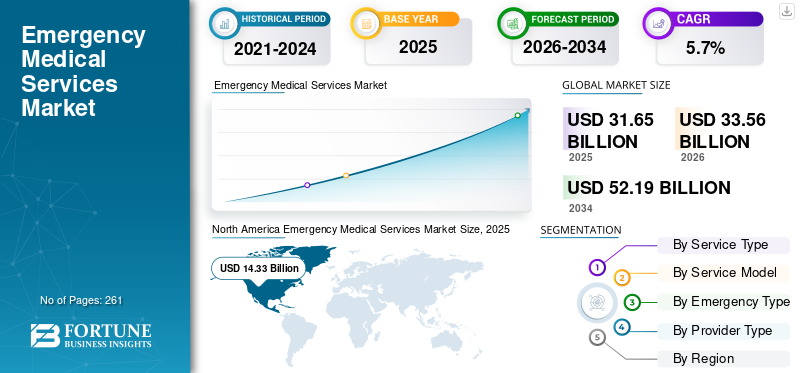
Download Free sample to learn more about this report.
Emergency Medical Services Market KEY TAKEAWAYS
 Global Market Size & Forecast
- 2025 Market Size: USD 31.65 billion
- 2026 Market Size: USD 33.56 billion
- 2034 Forecast Market Size: USD 52.19 billion
- CAGR: 5.7% from 2026–2034
 Market Share
- North America dominated the emergency medical services market with a 45.27% share in 2025.
- Advanced life support accounted for 46.5% of the market, driven by rising demand for emergency and trauma care.
- Medical emergencies held 59.6% of the market, supported by the increasing prevalence of chronic diseases.
 Key Regional Highlights
Asia Pacific
Projected to reach USD 7.95 billion by 2026, fueled by expanding healthcare access and increasing trauma cases.
North America
Held 45.27% market share, driven by advanced healthcare infrastructure, increasing EMS agencies, and rising trauma cases.
Europe
Expected to reach USD 7.44 billion by 2026, supported by the growing prevalence of chronic diseases.
U.K.
Estimated to reach USD 1.23 billion by 2026, driven by strong emergency healthcare services and rising EMS demand.
Japan
Expected to reach USD 1.42 billion by 2026, supported by a high burden of chronic diseases and increasing demand for EMS.
Read More

Emergency Medical Services Market Trends
Growing Adoption of Telemedicine to Support Market Growth
The rising incorporation of telemedicine in ambulances is emerging as a major trend in the global market. Ambulance-based telemedicine enables emergency medical technicians and paramedics to connect with emergency specialists, physicians, cardiologists, neurologists, and trauma teams in real-time during patient transport.
Additionally, the adoption of artificial intelligence and telemedicine is mainly important for time-sensitive emergencies, including cardiac arrest, stroke, myocardial infarction, trauma, and others, where early intervention can significantly improve patient outcomes. Telemedicine-driven ambulances are filling the gap between the emergency site and hospital care by enabling physicians to guide paramedics on medication, stabilization, routing decisions, and others.
- For instance, according to 2024 survey published by Becker’s Healthcare, 100% of respondents including hospitals and health systems offered virtual care for various applications among the patient population.
Other Prominent Trends
- Adoption of advanced life support systems
- Growth in private EMS providers
- Increasing use of air ambulance services
Market Dynamics
Market Drivers
Download Free sample to learn more about this report.
Increasing Number of Medical Emergencies to Drive Market Growth
The increasing prevalence of chronic disorders such as respiratory disorders cardiovascular disorders are resulting in the rising demand for emergency support, pre-hospital stabilization, and timely access to hospitals among the patient population, driving the adoption of such services in the market.
- For instance, according to 2023 data published by the American Lung Association (ALA), approximately 11.1 million adults in the U.S. were living with COPD in the U.S.
This, along with a growing geriatric population, rising incidence of accidents and medical emergencies, increasing healthcare expenditure, and expansion of emergency response systems, is further augmenting the adoption of these services in the market. The rising focus of key companies on providing novel services are further likely to contribute to the global emergency medical services market growth.
Market Restraints
High Operating Cost of EMS to Hinder Market Growth
The high operating cost associated with emergency medical services is a key restraint for the global market. EMS devices require continuous investment in ambulances, emergency medical technicians, trained paramedics, medical equipment, communication devices, dispatch centers, maintenance, insurance, medicines, consumables, and regulatory compliance. Additionally, the cost burden is especially high for advanced life support ambulances, critical-care transport units, air ambulances, and specialized emergency response services, as these requires highly trained professionals and expensive systems including ventilators, defibrillators, cardiac monitors, oxygen devices, stretchers, infusion pumps, communication devices, and infection-control supplies, thereby hampering the adoption of these services in the market.
- For instance, according to the 2023 statistics published by the Emergency Medical Services Association of Colorado, it was reported that placing one ambulance in service costs about USD 407,200, with an additional USD 42,000 for fuel, maintenance, and insurance annually.
Market Opportunities
Expansion in Emerging Markets to Create Growth Opportunities
The expansion of emergency medical networks in developing countries presents a strong growth opportunity for the global market. There is an increasing development of structured pre-hospital emergency response systems, ambulance networks, centralized dispatch platforms, trained paramedic professionals, and trauma referral pathways in the emerging countries, including Brazil, and India. Increasing improvement in healthcare infrastructure, along with growing healthcare expenditure, is resulting in growing demand for emergency call centers, organized ambulance services, advanced life support units, and interfacility transport services in the market.
- For instance, according to 2025 data published by the International Trade Administration (ITA), the healthcare expenditure was around USD 135.0 billion in the Brazil.
Market Challenges
Limited Healthcare Access in Developing Nations to Limit Market Growth
There is a growing demand for innovative emergency medical services among the patient population. However, limited healthcare access in emerging countries remains a key challenge for the global market. The lack of well-organized pre-hospital emergency systems, centralized ambulance dispatch platforms, trained paramedic professionals, and adequate emergency transport coverage resulting in delayed emergency care, especially during trauma, stroke, cardiac emergencies, respiratory distress, and other time-sensitive conditions, limiting the adoption of these services in the market.
- For instance, according to 2023 data published by The World Bank Group (WBG), approximately 4.5 billion people lack full access to essential health services globally.
SEGMENTATION ANALYSIS
By Service Type
Increasing Prevalence of Chronic Conditions Boosted the Emergency Response & Transport Services Segment Growth
Based on service type, the market is classified into emergency response & transport services and emergency interfacility transfer services.
The emergency response & transport services segment held the largest market share in 2025. The growth is due to the growing prevalence of chronic conditions among patients, resulting in a rising demand for on-site emergency response, basic life support, patient stabilization, and advanced life support. This, coupled with the established emergency networks offering novel services, is further anticipated to contribute to the segment‘s growth.
- For instance, according to 2026 data published by the Asthma and Allergy Foundation of America (AAFA), about 28 million people are suffering from asthma in the U.S.
To know how our report can help streamline your business, Speak to Analyst
The emergency interfacility transfer services segment is expected to grow at a CAGR of 6.0% over the forecast period.
By Service Model
Increasing Burden of Trauma Injuries Encouraged the Advanced Life Support Segment Expansion
Based on service model, the market is segmented into basic life support, advanced life support, and critical care support.
The advanced life support segment dominated the global market, holding 46.5% share in 2025. The growth is due to the rising prevalence of chronic conditions, including cardiac arrest, myocardial infarction, and trauma injuries, resulting in a growing demand for emergency and trauma care services.
- For instance, according to 2023 statistics published by the American Heart Association (AHA) around 805,000 people experienced myocardial infarction each year in the U.S.
The basic life support segment is set to grow at a growth rate of 5.4% during the forecast period.
By Emergency Type
Growing Incidence of Chronic Conditions Led to the Dominance of the Segment
Based on emergency type, the market is segmented into medical emergencies, trauma & injuries, environmental & disaster emergencies, and others.
The medical emergencies segment dominated the global market, holding 59.6% share in 2025. The growth is due to the growing prevalence of chronic conditions, including cardiovascular diseases, and respiratory diseases, resulting in an increasing number of public and private medical emergencies worldwide.
- For instance, according to the 2024 data published by the Centers for Disease Control & Prevention (CDC), it was reported that more than 795,000 people have a stroke in the U.S.
The trauma & injuries segment is set to grow at a growth rate of 5.0% during the forecast period.
By Provider Type
Increasing Number of Emergency Medical Networks Boosted the Public/Government Segment Growth
Based on provider type, the market is divided into public/government, private, hospital-based, and others.
The public/government segment dominated the market in 2025. The increasing demand for emergency medical services, rising response rate among the public-based ambulance services, and the growing number of emergency medical networks, are some of the crucial factors contributing to the growth of the segment in the market. Furthermore, the segment is set to hold 48.0% share by 2026.
- For instance, according to 2024 statistics published by the NHS England, it was reported that about 860,543 calls to 999 were answered by ambulance services in the U.K.
The private segment is projected to grow at a CAGR of 6.4% during the forecast period.
Emergency Medical Services Market Regional Outlook
Based on region, the market has been studied across North America, Europe, Asia Pacific, Latin America, and the Middle East & Africa.
North America
North America Emergency Medical Services Market Size, 2025 (USD Billion)
To get more information on the regional analysis of this market, Download Free sample
The North America market held the dominant share in 2024, valued at USD 13.66 billion, and also maintained its leading share in 2025 with USD 14.33 billion. The growing prevalence of chronic conditions, rising cases of trauma and injuries, increasing number of EMS agencies, and advanced healthcare infrastructure are some of the factors contributing to the growth of the market.
- For instance, according to 2020 statistics published by the U.S. Department of Homeland Security, there were more than 23,000 licensed EMS agencies in the U.S.
U.S. Emergency Medical Services Market
Based on North America’s strong contribution and the U.S. dominance within the region, the U.S. market is likely to reach around USD 13.74 billion by 2026, accounting for roughly 41.0% of global sales.
Europe
Europe is projected to record a growth rate of 4.8% in the coming years, which is the second-highest among all regions. The market is expected to reach a valuation of USD 7.44 billion by 2026. The growing prevalence of chronic conditions is likely to support the market growth.
U.K. Emergency Medical Services Market
The U.K.’s market is estimated to reach around USD 1.23 billion by 2026, representing roughly 3.7% of global revenues.
Germany Emergency Medical Services Market
Germany’s market is projected to reach approximately USD 1.39 billion by 2026, equivalent to around 4.1% of global sales.
Asia Pacific
Asia Pacific is estimated to reach USD 7.95 billion by 2026, securing the position of the third-largest region in the market. The growing trauma and injury cases, expanding hospital capacity, and increasing healthcare access are likely to support the growth of the market. In the region, India and China are both estimated to reach USD 1.27 billion and USD 2.16 billion, respectively, by 2026.
Japan Emergency Medical Services Market
The Japan market is estimated to reach around USD 1.42 billion by 2026, accounting for roughly 4.2% of global revenues. Japan has historically reported a relatively high prevalence of chronic diseases, with a large demand for EMS.
China Emergency Medical Services Market
China’s market is projected to be one of the largest worldwide. The market is expected to reach around USD 2.16 billion by 2026, representing roughly 6.4% of global sales.
India Emergency Medical Services Market
The Indian market is estimated to reach around USD 1.27 billion by 2026, accounting for roughly 3.8% of global revenues.
Latin America and Middle East & Africa
The Latin America and Middle East & Africa regions are expected to witness moderate growth in this market during the forecast period. The Latin America market is set to reach a valuation of USD 1.72 billion by 2026, supported by gradual market expansion driven by increasing public healthcare investment. The growth in the Middle East & Africa region is driven by the rising number of key companies expanding their geographic presence in the market. In the Middle East & Africa, the GCC is set to reach a valuation of USD 0.66 billion by 2026.
South Africa Emergency Medical Services Market
The South African market is projected to reach around USD 0.22 billion by 2026, representing roughly 0.6% of global revenues.
Competitive Landscape
Key Industry Players
Key Players Focus on Expansion to Boost Their Market Presence
A diversified services portfolio, along with a strong emphasis on inorganic growth strategies globally remains one of the key factors supporting the dominance of leading companies in the market. Acadian Ambulance Service and Air Methods were among the major companies in the market in 2025. Furthermore, the growing presence of key companies on expanding service coverage and strengthening operational capabilities is expected to reinforce their market presence and contribute to the global emergency medical services market growth.
- For instance, in April 2026, Acadian Ambulance Service launched its 911 emergency response service in Liberty County, Texas to strengthen its market presence.
Other key players, including Global Medical Response are also expanding their market presence through acquisitions and collaborations among other companies aimed at expanding service capabilities.
List of Key Emergency Medical Services Companies Profiled
- Acadian Ambulance Service (U.S.)
- Air Methods (U.S.)
- Global Medical Response (U.S.)
- Falck A/S (Denmark)
- ZIQITZA HEALTHCARE LIMITED (India)
- GVK Emergency Management and Research Institute (GVK EMRI) (India)
- Health (India)
- Priority OnDemand (U.S.)
- National Ambulance (UAE)
- Response Plus Holding PJSC (UAE)
KEY INDUSTRY DEVELOPMENTS
- November 2025: City of Boulder partnered with Falck A/S to provide ambulance transport services, ensuring high quality service for Boulder residents.
- September 2025: Global Medical Response signed a purchase agreement for seven Bell 429s with the option to purchase an additional eight, maintaining its spot in the Helicopter Emergency Medical Service (HEMS) field.
- August 2025: Falck A/S, a private emergency medical services company, started emergency medical services in Fort Worth to expand its presence in the U.S.
- March 2025: Global Medical Response acquired a new Bell 407GXi helicopter, which offers cruise speeds of 246km/h, with a range of 624km, to be used to further expand GMR’s air medical coverage.
- March 2025: Air Methods, the air medical provider, added nearly 50 aircraft including 15 IFR-configured Bell 407GXis and a Bell 429 to serve more patients in need of emergency transport in the U.S.
- March 2025: Air Methods, the air medical provider, added Airbus helicopters. The agreement includes the acquisition of H140 helicopters, 10 H125s, and 11 H135s to support air medical missions in the U.S.
- April 2024: Acadian Ambulance Service started 911 emergency response service in Harrison County and the cities of D’Iberville, Long Beach, and Pass Christian, with an aim to strengthen its market presence.
REPORT COVERAGE
The report provides a detailed global emergency medical services market analysis and focuses on key aspects such as leading companies and market segmentation, including service type, service model, emergency type, and provider type. Besides this, the global report offers insights into the market growth trends and highlights key industry developments. In addition to the aforementioned factors, the report encompasses several factors that have contributed to the growth and advancement of the market over recent years.
Request for Customization to gain extensive market insights.
Report Scope & Segmentation
| ATTRIBUTE | DETAILS |
| Study Period | 2021-2034 |
| Base Year | 2025 |
| Estimated Year | 2026 |
| Forecast Period | 2026-2034 |
| Historical Period | 2021-2024 |
| Growth Rate | CAGR of 5.7% from 2026-2034 |
| Unit | Value (USD Billion) |
| Segmentation | By Service Type, Service Model, Emergency Type, Provider Type, and Region |
| By Service Type |
|
| By Service Model |
|
| By Emergency Type |
|
| By Provider Type |
|
| By Region |
|
Frequently Asked Questions
Fortune Business Insights says that the global market size was valued at USD 31.65 billion in 2025 and is projected to reach USD 52.19 billion by 2034.
In 2025, the North America regional market value stood at USD 14.33 billion.
Growing at a CAGR of 5.7%, the market will exhibit steady growth over the forecast period (2026-2034).
By service type, the emergency response & transport services segment led the market.
Increasing number of medical emergencies is the key factors driving the market's growth.
Acadian Ambulance Service and Air Methods are the major players in the global market.
North America dominated the market share.



- 2021-2034
- 2025
- 2021-2024
- 261
Get 30-60 hrs Free Customization
Expand Regional and Country Coverage, Segments Analysis, Company Profiles, Competitive Benchmarking, and End-user Insights.













.webp)






Related Reports
-
US +1 833 909 2966 ( Toll Free )
-
Get In Touch With Us