Accounting Software Market Size, Share & Industry Analysis, By Deployment (Cloud and On-premise), By Enterprise Type (Small & Medium Enterprises (SMEs) and Large Enterprises), By Type (General Accounting, Payroll Accounting, Tax & Compliance Accounting, Industry Specific Accounting, and Others), By End-use Industry (BFSI, Manufacturing, Retail & E-Commerce, IT & Telecom, Construction, Healthcare, Government & Public Sector, and Others), and Regional Forecast, 2026-2034
 Download Free Sample
Accounting Software Market Size
 Listen to Audio Version
The global accounting software market size was valued at USD 7.4 billion in 2025 and is projected to grow from USD 8.05 billion in 2026 to USD 49.94 billion by 2034, exhibiting a CAGR of 10.16% during the forecast period. North America dominated the global accounting software market with a market share of 35.4% in 2025.
The accounting software refers to recording, managing, processing, and reporting the financial transactions and accounting information across business operations.
The market scope includes accounting software deployed through both cloud and on-premises models. It encompasses general accounting, payroll accounting, tax and compliance accounting, industry-specific accounting, and related functions such as expense management, billing, and invoicing. The market serves small and medium-sized enterprises as well as large enterprises across various industries, including BFSI, manufacturing, retail and e-commerce, IT & telecom, construction, healthcare, government & public sector, and others.
The market growth is driven by the shift toward cloud based accounting, increasing compliance and tax reporting requirements, growing demand for automation in invoicing, payroll, and reconciliation, and expanding SME digitization supported by subscription pricing and integrated payments. The market is also supported by rising focus on regulatory compliance, operational efficiency, and access to financial data, along with the increased demand for real time visibility across enterprises. In addition, adoption is strengthened by preference for cost effective, globally accounting software that can standardize reporting and improve decision-making across multi-country operations.
Key companies operating in the global accounting software market include Intuit Inc., Oracle Corporation, Sage Group Plc, Workday, Inc., SAP SE, Intuit, Inc., Microsoft Corporation, Infor, Xero Corporation, Wave Financial, Inc., and Zoho Corporation.
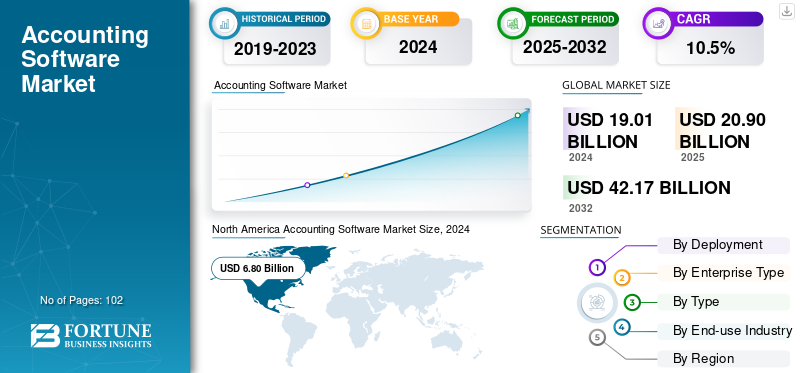
Download Free sample to learn more about this report.
Accounting Software Market Key Takeaways
 Global Market Size & Forecast
- 2025 Market Size: USD 7.4 billion
- 2026 Market Size: USD 8.05 billion
- 2034 Forecast Market Size: USD 49.94 billion
- CAGR: 10.16% from 2026–2034
 Market Share
- North America dominated the accounting software market with a 35.40% share in 2025.
- The Cloud segment is projected to account for 19.99% of the market in 2026.
- The SMEs segment is expected to hold a 15.93% market share in 2026.
 Key Regional Highlights
North America
North America led the global market with revenue of USD 7.4 billion in 2025 and is projected to reach USD 8.05 billion in 2026.
Asia Pacific
Asia Pacific accounted for 30.28% of the global market in 2025, generating USD 6.33 billion in revenue.
Europe
Europe represented 21.18% of global demand in 2025, reaching USD 4.43 billion and is expected to grow to USD 4.84 billion in 2026.
U.S.
The accounting software market was estimated at approximately USD 6.6 billion in 2026, accounting for around 31.7% of global sales.
Japan
The market is estimated to reach USD 0.83 billion in 2026, representing approximately 4.4% of global revenues.
Read More

ACCOUNTING SOFTWARE MARKET TRENDS
Rising Integration with ERP and Various Other Business Applications is a Key Trend for the Market
Rising integration with ERP and other business applications is emerging as a key trend in the market as organizations seek a unified view of their operations and finances. As enterprises prioritize end-to-end digital transformation, demand is rising for accounting software that functions as a core financial engine within a broader business ecosystem. Businesses are increasingly adopting accounting solutions that seamlessly integrate with ERP systems, CRM platforms, inventory management tools, payroll software, and procurement systems, thereby eliminating data silos and reducing the work of manually entering the data. This integration enables real-time synchronization of financial data across departments, improving accuracy in reporting, budgeting, and forecasting.
Automated data flow from sales, inventory, and operations into accounting systems enables faster month-end close cycles, improved cash flow management, and enhanced compliance with regulatory requirements. For instance,
- In October 2025, AI startup DualEntry raised USD 90 million to deepen its ERP market push through the automation of financial workflows and rapid migrations from legacy accounting systems, underscoring the demand for modern, integrated platforms that connect accounting and ERP data.
Download Free sample to learn more about this report.
MARKET DYNAMICS
MARKET DRIVERS
Rise of Small Business Focused Solutions is Setting the Pace for Market Growth
The growing demand for accounting software tailored to small businesses, solopreneurs, and startups is a significant driver for accounting software market growth. Historically, many small enterprises relied on manual bookkeeping, spreadsheets, or generic software that were either too complex or too costly for their needs.
To address this gap, software vendors are developing lightweight, affordable, and intuitive platforms that cater to the unique needs of smaller organizations. These solutions offer essential functionalities, including invoicing, expense tracking, payroll management, tax calculations, and basic financial reporting, without the complexity of enterprise-level systems. For instance,
- In October 2025, Capitec partnered with accounting software start-up Stub to simplify financial management for small and micro businesses in South Africa. The integration connects Capitec banking data directly to Stub’s platform, providing real-time insights into cash flow, expenses, and invoices. This automation streamlines manual data entry, enabling entrepreneurs to monitor business performance more easily, and supports Capitec’s strategy to serve the informal and micro-business sector.
MARKET RESTRAINTS
Data Security and Privacy Concerns to Hamper the Market Development
Data security and privacy represent one of the most significant restraints for the market growth, particularly for cloud based solutions. Many businesses, especially Small and Medium-Sized Enterprises (SMEs), remain cautious about fully adopting these platforms due to the perceived risks of unauthorized access, data breaches, and potential loss of sensitive financial information. For instance,
- In September 2024, U.S. construction firms, including plumbing, HVAC, and concrete subcontractors, were targeted via Foundation Accounting Software. Hackers exploited default or weak passwords in older on-premise versions, often using brute-force attacks. Affected firms were advised to change credentials and, where possible, switch to the Foundation’s hosted software to reduce risk.
Despite advancements in encryption techniques, multi-factor authentication, and other cybersecurity measures, trust remains a critical barrier. Companies often fear that storing financial data on external servers could expose them to cyberattacks or unauthorized access to sensitive data. For instance,
- In February 2025, the New Jersey Cybersecurity & Communications Integration Cell (NJCCIC) warned of an increase in the number of cyberattacks exploiting trusted accounting software in early 2025, especially during tax season. Cyber attackers are using phishing emails, impersonation, fake software updates, and account compromises to target platforms such as QuickBooks and UltraTax CS.
MARKET OPPORTUNITIES
Leveraging Analytics and Business Intelligence for Strategic Financial Management to Create Opportunities for the Market
One of the most promising opportunities in the market lies in integrating advanced data analytics and Business Intelligence (BI) capabilities. Modern accounting software is no longer limited to basic bookkeeping or transactional record-keeping; it now enables organizations to extract actionable insights from their financial data.
Real-time dashboards, automated reporting, predictive analytics, and scenario-based forecasting allow businesses to make informed strategic decisions quickly and accurately. By leveraging data analytics, companies can identify trends, monitor cash flow, optimize budgeting, detect anomalies or potential fraud, and evaluate overall financial performance with greater precision. For instance
- In November 2024, Wolters Kluwer launched CCH iFirm Analytics, an accounting software module for Australia and New Zealand, providing real-time dashboards and insights. It enhances firm management by streamlining reporting, monitoring financials, productivity, and profitability, and enabling data-driven decisions for accounting practices.
SEGMENTATION ANALYSIS
By Deployment
Cloud Deployment Leads Owing to Its Speed, Scalability, and Lower Cost
Based on the deployment, the market is divided into cloud and on-premise.
Cloud deployment is expected to lead and grow at the maximum CAGR because it offers faster implementation, lower upfront costs, automatic updates, and easier scalability for businesses that are growing. The Cloud segment will account for 19.99% market share in 2026.
On-premises deployment holds the second largest share because many large organizations and regulated industries still prefer internal control over data, customization, and system configurations. Legacy infrastructure, complex integrations, and strict governance requirements also sustain demand for on-premises accounting environments, especially where migration risks and compliance constraints remain high.
By Enterprise Type
SMEs Dominate Owing to Broad Base and Fast Adoption
Based on enterprise type, the market is segmented into SMEs and large enterprises.
SMEs hold the largest share and are expected to grow at the highest CAGR, as they are increasingly adopting software to reduce manual work, improve cash flow visibility, and streamline invoicing, payroll, and reporting. Cloud subscription pricing also facilitates adoption by lowering the costs of implementation and maintenance. The SMEs segment is expected to account for 15.93% of the market in 2026.
Large enterprises hold the second-largest share because they require advanced accounting capabilities, such as consolidation, multi-entity reporting, audit controls, and integration with ERP systems. Their spending per deployment is higher, but growth is moderate because many organizations already use established finance platforms, and upgrades occur in longer replacement cycles.
By Type
General Accounting Leads As It Covers Core Financial Functions
Based on type, the market is segmented into general accounting, payroll accounting, tax & compliance accounting, industry-specific accounting, and others.
General accounting holds the maximum share because it is the foundational layer required by every business, covering core functions such as the general ledger, accounts payable, accounts receivable, reconciliation, and financial reporting. It forms the base module across both standalone accounting tools and broader ERP finance suites, ensuring consistent demand. The general accounting segment is expected to lead the market, contributing 82.66% globally in 2026.
Tax and compliance accounting is projected to grow at the highest CAGR as governments expand digital tax systems and electronic reporting requirements. Businesses are increasingly adopting automated compliance tools to reduce filing errors, maintain audit trails, support evolving tax regulations, and streamline statutory reporting, particularly as cross-border transactions and real-time reporting become more prevalent.
By End-use Industry
To know how our report can help streamline your business, Speak to Analyst
Retail & E-commerce Dominates Owing to High Transaction and Reconciliation Volume
Based on end-use industry, the market is categorized into BFSI, manufacturing, retail & e-commerce, IT and telecom, construction, healthcare, government & public sector, and others.
Retail and e-commerce hold the highest share because they generate high volumes of daily transactions which involve frequent invoicing, utilize multi-channel sales, and require complex inventory and payment reconciliations. Accounting software is essential to manage cash flow, automate billing, handle refunds, and integrate with online marketplaces, payment gateways, and POS systems. The retail and e-commerce segment will account for 55.16% market share in 2026.
IT and telecom are projected to record the highest CAGR due to rapid digitization, subscription billing, and an increasing use of recurring revenue models. These businesses require automation for revenue recognition, billing cycles, expense control, and multi-region compliance, which drives the adoption of scalable, integrated accounting systems that align with their fast-growing operations.
ACCOUNTING SOFTWARE MARKET REGIONAL OUTLOOK
By geography, the market is categorized into Europe, North America, Asia Pacific, South America, and the Middle East & Africa.
North America
North America Accounting Software Market Size, 2025 (USD Billion)
To get more information on the regional analysis of this market, Download Free sample
North America contributed approximately USD 7.4 Billion to the global market in 2025, accounting for 35.40% share, and is expected to reach USD 8.05 Billion in 2026. This is due to the strong concentration of large enterprises and cloud-first SMEs, high penetration of automated finance tools, and early adoption of advanced features such as AI-driven reporting, integrated payments, and compliance automation.
U.S Accounting Software Market
Based on North America’s strong contribution and the U.S. dominance within the region, the U.S. market was approximated at around USD 6.6 billion in 2026, accounting for roughly 31.7% of global sales. This position is supported by research indicating that the U.S. alone accounts for more than 82.0% of global hyperscale data center capacity, underscoring the North America’s high server density.
Europe
In 2025, the Europe market stood at USD 4.43 Billion, representing 21.18% of global demand, and is projected to grow to USD 4.84 Billion in 2026. The significant share is attributed to the widespread adoption among mid-sized enterprises, strong demand for VAT and statutory compliance capabilities, and the continued modernization of ERP and finance platforms across various industries.
U.K Accounting Software Market
The U.K. market in 2026 is estimated to be around USD 1.05 billion, representing approximately 5.0% of global revenues.
Germany Accounting Software Market
Germany's market size is projected to reach approximately USD 0.95 billion in 2026, equivalent to around 4.5% of the global market.
Asia Pacific
The Asia Pacific region captured 30.28% of the global market in 2025, generating USD 6.33 Billion in revenue, and is projected to reach USD 7.09 Billion in 2026. In the region, India and China are both estimated to reach USD 1.53 billion and USD 2.02 billion, respectively, in 2025. The market is driven by the rapid formalization of SMEs, accelerating cloud adoption, expanding digital payments, and strong growth in e-commerce and cross-border trade, all of which increase the need for scalable accounting systems.
Japan Accounting Software Market
The Japan market in 2026 is estimated to be around USD 0.83 billion, accounting for approximately 4.4% of global revenues.
China Accounting Software Market
China’s market is projected to be one of the largest markets globally, with revenues estimated at approximately USD 2.02 billion in 2026, accounting for roughly 10.6% of global sales.
India Accounting Software Market
The India market in 2026 is estimated to be around USD 1.53 billion, accounting for approximately 8.0% of global revenues.
South America and the Middle East & Africa
The South America and Middle East & Africa regions are expected to witness moderate growth in this market space during the forecast period. The South America market is set to reach a valuation of USD 1.24 billion in 2025. In 2025, Middle East & Africa generated USD 1.51 Billion, contributing 7.21% to global market revenue, and is projected to grow to USD 1.67 Billion in 2026, as adoption rises gradually with improving connectivity and government-led digital initiatives. However, growth is moderated by uneven digital readiness, price sensitivity, and slower upgrade cycles in traditional businesses.
GCC Accounting Software Market
The GCC market has been projected to reach approximately USD 0.60 million by 2025, accounting for roughly 3.0% of global market revenues.
Latin America
Latin America recorded a market size of USD 1.24 Billion in 2025, capturing 5.94% of the global market share, and is projected to reach USD 1.37 Billion in 2026.
COMPETITIVE LANDSCAPE
Key Industry Players
Players in the accounting software industry are launching new solutions to enhance their market positioning by leveraging technological advancements, such as machine learning, and addressing diverse consumer needs, thereby staying ahead of competitors. They prioritize portfolio enhancement and strategic collaborations, as well as acquisitions and partnerships, to strengthen their offerings. Such strategic launches enable the technology companies to maintain and expand their market share in a rapidly evolving landscape.
LIST OF KEY ACCOUNTING SOFTWARE COMPANIES PROFILED
- Oracle Corporation (U.S.)
- Sage Group Plc (U.K.)
- Workday, Inc. (U.S.)
- SAP SE (Germany)
- Intuit, Inc. (U.S.)
- Microsoft Corporation (U.S.)
- Infor (U.S.)
- Xero Corporation (New Zealand)
- Wave Financial, Inc. (Canada)
- Zoho Corporation (India)
KEY INDUSTRY DEVELOPMENTS
- In December 2025, Tata Consultancy Services partnered with Workday to help TCS sell, deploy, and support Workday’s comprehensive suite of solutions, including Workday Financial Management.
- In November 2025, Sage introduced the Sage Intacct Finance Intelligence Agent. Finance Intelligence Agent joins Sage’s growing network of AI agents, delivering autonomous insights alongside existing close, accounts payable, time, and assurance agents.
- In November 2025, SAP highlighted the growing adoption of cloud-based S/4HANA Finance among enterprises as organizations migrate their core accounting systems from legacy systems.
- In November 2025, Intuit and Rehmann partnered to deliver the Intuit Enterprise Suite to the firm’s growing list of scaling, mid-market businesses that need a powerful, AI-native ERP solution to drive growth.
- In November 2025, Microsoft continued rolling out Copilot and AI-driven capabilities in Business Central to automate financial tasks. This will help to improve reporting and support natural language queries for accounting and operations.
- In October 2025, PwC expanded the adoption of Oracle Fusion Cloud Enterprise Resource Planning (ERP) across its global network of firms. With Oracle Cloud ERP, PwC can leverage embedded predictive and generative AI to improve financial controls.
- In October 2025, Infor’s bi-annual product release cycle introduced innovations, including AI and process improvements, across its CloudSuite and industry cloud products, such as financials and ERP capabilities.
REPORT COVERAGE
Request for Customization to gain extensive market insights.
Report Scope & Segmentation
|
ATTRIBUTE |
DETAILS |
|
Study Period |
2021-2034 |
|
Base Year |
2025 |
|
Estimated Year |
2026 |
|
Forecast Period |
2026-2034 |
|
Historical Period |
2021-2024 |
|
Growth Rate |
CAGR of 10.16% from 2026-2034 |
|
Unit |
Value (USD Billion) |
|
Segmentation |
By Deployment, Enterprise Type, Type, End-use Industry, and Region |
|
By Deployment |
· Cloud · On-premise |
|
By Enterprise Type |
· Small and Medium sized Enterprises (SMEs) · Large Enterprises |
|
By Type |
· General Accounting · Payroll Accounting · Tax & Compliance Accounting · Industry Specific Accounting · Others (Expense Management, Billing & Invoicing, etc.) |
|
By End-use Industry |
· BFSI · Manufacturing · Retail & E-Commerce · IT & Telecom · Construction · Healthcare · Government & Public Sector · Others (Energy & Utilities, Hospitality, etc.) |
|
By Region |
· North America (By Deployment, Enterprise Type, Type, End-use Industry, and Country/Sub-region ) o U.S. o Canada o Mexico · Europe (By Deployment, Enterprise Type, Type, End-use Industry, and Country/Sub-region) o U.K. o Germany o France o Italy o Spain o Russia o Benelux o Nordics o Rest of Europe · Asia Pacific (By Deployment, Enterprise Type, Type, End-use Industry, and Country/Sub-region) o China o India o Japan o South Korea o ASEAN o Oceania o Rest of Asia Pacific · South America (By Deployment, Enterprise Type, Type, End-use Industry, and Country/Sub-region) o Brazil o Argentina o Rest of South America · Middle East & Africa (By Deployment, Enterprise Type, Type, End-use Industry, and Country/Sub-region) o Turkey o Israel o GCC o North Africa o South Africa o Rest of Middle East & Africa |
Frequently Asked Questions
According to Fortune Business Insights, the global market value stood at USD 8.05 billion in 2026 and is projected to reach USD 49.94 billion by 2034.
In 2025, the market value stood at USD 7.4 billion.
The market is expected to exhibit a CAGR of 10.16% during the forecast period.
By type, the general accounting is expected to lead the market.
Reductions in operational costs and processing times drive market growth.
Oracle Corporation, Sage Group Plc, Workday, Inc., and SAP SE are the major players in the global market.
North America dominated the market in 2025.



- 2021-2034
- 2025
- 2021-2024
- 102
Get 30-60 hrs Free Customization
Expand Regional and Country Coverage, Segments Analysis, Company Profiles, Competitive Benchmarking, and End-user Insights.




















Related Reports
-
US +1 833 909 2966 ( Toll Free )
-
Get In Touch With Us