Injection Molded Plastics Market Size, Share & Industry Analysis, By Type (Polypropylene (PP) Acrylonitrile Butadiene Styrene (ABS), High-density Polyethylene (HDPE), Polystyrene (PS), and Others), By Application (Automotive, Packaging, Building & Construction, Electrical & Electronics, Medical, and Others), and Regional Forecast, 2026-2034
 Download Free Sample
Injection Molded Plastics Market Size
 Listen to Audio Version
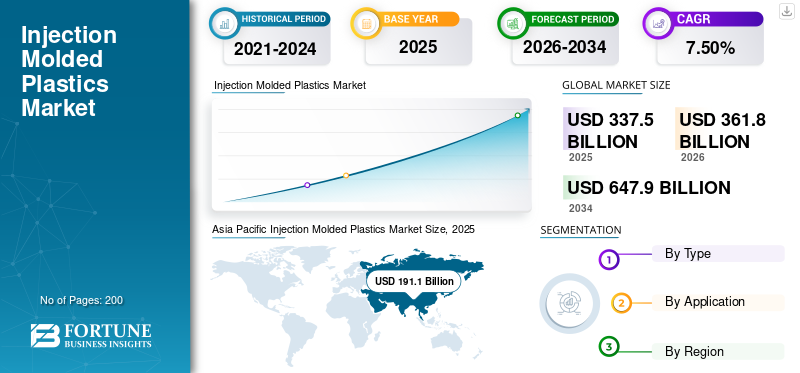
The global injection molded plastics market size was valued at USD 337.50 billion in 2025 and is projected to grow from USD 361.80 billion in 2026 to USD 647.90 billion by 2034 at a CAGR of 7.50% during the forecast period. Asia Pacific dominated the injection molded plastics market with a market share of 56.60% in 2025.
The global injection molded plastics market is a core segment of the plastics manufacturing industry, supplying high-volume and precision components across automotive, packaging, consumer goods, electrical & electronics, medical, and industrial sectors. Injection molding is a manufacturing process in which molten plastic is injected into molds to produce complex parts with consistent quality, tight tolerances, and dimensional accuracy at scale. The market is characterized by cost-efficient mass production and the ability to integrate multiple functions into a single component. Market growth is supported by light weighting trends in automotive and electronics, rising demand for consumer and packaged goods, and expanding medical and healthcare applications that require reliable, repeatable, and high-precision plastic components.
The major players operating in the market are BASF SE, DuPont, Dow, Huntsman Corporation, and Exxon Mobil Corporation.
Download Free sample to learn more about this report.
INJECTION MOLDED PLASTICS MARKET Key Takeaways
 Market Size & Forecast
- 2025 Market Size: USD 337.50 billion
- 2026 Market Size: USD 361.80 billion
- 2034 Forecast Market Size: USD 647.90 billion
- CAGR: 7.50% from 2026–2034
 Market Share
- Asia Pacific dominated the injection molded plastics market with a 56.60% share in 2025.
- Polypropylene (PP) segment is projected to account for 37.73% of the market in 2026.
- Packaging segment held the largest share by application in 2025.
 Key Regional Highlights
Asia Pacific
Asia Pacific generated USD 191.1 billion and accounted for 56.60% of the global market in 2025.
Europe
Europe reached USD 55.8 billion, representing 16.50% of the global market in 2025.
North America
North America generated USD 48.0 billion, capturing 14.20% of the global market in 2025.
U.S.
The U.S. market is projected to reach USD 43.8 billion by 2026, driven by strong demand from packaging and electronics industries.
Japan
The Japan market is projected to reach USD 12.9 billion by 2026, supported by robust automotive and manufacturing demand.
Read More

INJECTION MOLDED PLASTICS MARKET TRENDS
Rising Electronics & Specialty Glass Demand Driving a Shift to Higher-Purity (Technical-Grade) Injection Molded Plastics
The shift toward sustainable and energy-efficient materials across global industries is creating strong opportunities for injection molded plastics. Automotive, packaging, medical, and consumer goods manufacturers increasingly seek lightweight, durable materials that lower environmental impact while maintaining performance. Injection molding supports these needs through design flexibility, efficient processing, and the ability to replace heavier traditional materials. Growing adoption of engineered polymers is expanding use in electric vehicles, medical devices, and advanced electronics that require precision and reliability. The rapid rise of electric mobility further strengthens demand for molded connectors, housings, and structural parts. Moreover, investments in bio-based polymers, recyclable materials, and advanced molding technologies are enabling production of lighter, sustainable, and high-performance components, positioning injection molded plastics for long-term growth.
MARKET DYNAMICS
MARKET DRIVERS
Rising Demand for Precision Molded Components in Healthcare and Medical Applications to Drive Market Growth
Demand for injection molded plastics is rising in the healthcare sector as the need for safe, reliable, and high-precision components increases. Medical devices, diagnostic equipment, and pharmaceutical packaging rely on molded parts that deliver consistent quality, smooth surfaces, and stable performance. Injection molding enables production of complex medical components with tight tolerances, supporting sterile and regulated environments while maintaining cost efficiency at high volumes. Medical-grade polymers such as polypropylene, polyethylene, polycarbonate, and elastomers are widely used due to their biocompatibility and resistance to sterilization. Moreover, advances in cleanroom molding, automation, and material science continue to enhance product reliability, reinforcing the importance of injection molded plastics in modern healthcare applications.
Download Free sample to learn more about this report.
MARKET RESTRAINTS
Increasing Environmental Regulations and Waste Management Pressure to Restrain Market Growth
Environmental regulations are becoming increasingly stringent across major regions, creating challenges for injection molded plastics manufacturers. Governments are tightening controls on emissions, waste generation, and chemical usage, increasing compliance requirements, documentation, and inspection frequency. Expanding waste management and recycling regulations are influencing material selection, product design, and processing practices, particularly policies targeting single-use plastics and waste reduction. High waste generation intensifies scrutiny on plastics processing; for example, Environment and Climate Change Canada reported that only 27.5% of solid waste was diverted in 2020. In response, manufacturers are adopting cleaner technologies, improving energy efficiency, and enhancing sustainability programs, which raises costs and operational complexity, making regulations a key market restraint.
MARKET OPPORTUNITIES
Rising Use of Injection Molded Plastics in High Volume Manufacturing to Create Opportunities
Injection molded plastics are witnessing steady growth as industries increasingly adopt lightweight, durable, and cost-efficient materials for high-volume production. These materials provide strong mechanical performance, dimensional stability, and chemical resistance, enabling replacement of heavier materials without compromising functionality. Injection molding supports complex geometries, part consolidation, and repeatable quality, helping manufacturers reduce assembly effort, defects, and cycle times. Common thermoplastics such as polypropylene, ABS, polyethylene, and polycarbonate drive demand across automotive, packaging, medical, and electrical applications. Moreover, advancements in multi-material molding, over-molding, and precision technologies continue to enhance production efficiency and expand the applicability of injection molded plastics across diverse industrial sectors.
MARKET CHALLENGES
Raw Material Price Fluctuations to Challenge Market Growth
Raw material price volatility represents a significant challenge for the injection molded plastics market growth, as most polymers such as polypropylene, polyethylene, ABS, and polycarbonate are derived from petrochemical feedstocks. Fluctuations in crude oil and natural gas prices directly affect resin costs, creating uncertainty in procurement and production planning. Sudden price increases can compress margins, especially for manufacturers operating under long-term supply contracts or fixed-price agreements. Additionally, price fluctuations make inventory planning and pricing decisions more complex, making it harder to quickly pass higher costs on to customers. Smaller and mid-sized molders are particularly exposed, as they have limited bargaining power and reduced ability to hedge against raw material price fluctuations.
TRADE PROTECTIONISM AND GEOPOLITICAL IMPACT
Trade protectionism and geopolitical tensions pose growing challenges for the injection molded plastics market by disrupting global supply chains and increasing operational uncertainty. Tariffs, import restrictions, and trade disputes affect the availability and cost of polymers, molds, and machinery, particularly in regions dependent on cross-border sourcing. Geopolitical conflicts and sanctions can further restrict access to raw materials and export markets, forcing manufacturers to adjust sourcing strategies and absorb higher costs. In response, companies are increasingly pursuing near-shoring and supplier diversification to reduce risk. While these strategies improve supply security, they often increase production costs and complexity, impacting competitiveness and pricing across the injection molded plastics value chain.
RESEARCH AND DEVELOPMENT (R&D) TRENDS
Research and Development (R&D) in the injection molded plastics market is increasingly focused on material innovation, process efficiency, and sustainability. Manufacturers are investing in advanced polymers, including high-performance engineering plastics, bio-based materials, and recyclable compounds, to meet evolving regulatory and performance requirements. R&D efforts are also directed toward improving mold design, cycle times, and energy efficiency through simulation, digital tooling, and automation. Additionally, developments in multi-material molding, micro-molding, and precision manufacturing support complex and miniaturized components for electronics, medical, and automotive applications. These R&D advancements enhance product quality, reduce waste, and enable manufacturers to address higher-value, technology-driven end-use markets.
SEGMENTATION ANALYSIS
By Type
Polypropylene Segment Leads Due to Rising demand from Automotive and Construction Industries
Based on type, the injection molded plastics market is segmented into polypropylene (PP), acrylonitrile butadiene styrene (ABS), high-density polyethylene (HDPE), polystyrene (PS), and others.
The polypropylene segment will account for 37.73% market share in 2026. PP is the most proffered resin for automotive, and building & construction industries as the products formed using this resin are lightweight and shock-resistant, which make them suitable in terms of safety. PP is among the lowest density plastics and is generally safe for food contact. It does not leach harmful chemicals in the food products and keeps it safe from foreign particles and microbial attack. Additionally, polypropylene injection molding is used to produce various parts and products of all shapes and sizes. Some of the significant reason for PP being widely used in injection molding are moisture resistance, high molding capability, food-grade availability, excellent heat stability, strong chemical resistance, and comparatively low cost.
The acrylonitrile butadiene styrene segment also holds a considerable share in the injection molded plastics market. The products manufactured using ABS resins show high strength, excellent toughness and easy moldability. ABS has substantial application in manufacturing of automotive parts, packaging solutions, consumer goods, industrial parts and electronic bodies. It is largely employed in those areas wherein high impact resistance, toughness, high resistance to scratch and dimensional stability are required. The segment is expected to show considerable growth during the forecast period owing to its growing application in manufacturing of automotive parts and body structure.
HDPE segment on the other hand will grow positively during the forecast period. It is a commonly used plastic for injection molding applications owing to its lower cost and good chemical and impact resistance. It can be easily molded to produce parts of varying shapes and sizes. Usage of HDPE have benefits such as greater customization control, improved efficiency and rapid reproducibility.
Polystyrene is another plastic resin that is commonly used in thermoplastic injection molding operations. It is often used for manufacture of molded packaging and industrial components. Usually used in form of foam or thin walled arrangement, PS is a non-toxic and odorfree plastic and is predominantly used in packaging industry for food packaging applications and in the automation industry.
The others segment remains relatively small but is gradually expanding, driven by automotive components, industrial equipment, and selective electronics applications. Engineering plastics such as polycarbonate and polyamide are used where higher mechanical strength, heat resistance, and precision are required.
By Application
To know how our report can help streamline your business, Speak to Analyst
Glass & Ceramics Segment Increasingly Demanded Due to Its used as a Flux in Ceramic Glazes and Frits.
Based on application, the market is segmented into automotive, packaging, building & construction, electrical & electronics, medical, and others
The packaging segment holds the largest share in this market. The segment is driven by application in food & beverages, pharma, and retail applications. The demand for plastic caps and closures is driven by the long-term shift in consumer packaging as the consumers are moving from glass and metal to plastic owing to its excellent properties. Many injection molding companies work closely with the manufacturers of food & beverages, pharmaceutical, electronics and other manufacturers in order to help them meet governmental regulations and legal liabilities. The packaging segment is also driven by the demand from personal care and beauty, biomedical, and other industries.
The demand for injection molded plastics for electrical and electronics application is increasing exponentially as these materials are widely used for the manufacturing of electrical and electronic devices. The electrical and electronics segment is expected to account for 30.29% of the market in 2026. The manufacturing of various electronic devices, such as meters, sensors and industrial test equipment requires high accuracy. To meet this demand, components are made by injection molding method, which provides high accuracy.
In the automotive industry, injection molding is one of the prime methods used to form plastic parts. Some of the key application areas wherein injection molded plastics are under-the-hood components (cylinder head cover and oil pans), exterior parts (fenders, grilles, bumpers, door panels, and splash guards) and Interior components (dashboard, instrumentation units, door handles, glove compartments, and air vents). This increase in sales is expected to translate into the growth of injection molding components for automotive applications.
In the construction industry, materials such as metals, wood and glass are very common owing to their physical properties and capabilities. However, slowly and steadily plastics have permeated into the construction industry. Today, plastics find a variety of application in the industry ranging from flooring to roofing. Additionally, it is used in manufacture of construction component such as pipes, window panels, doors and construction components such as plastic welds, screws, and rivets, among others.
On the other hand, injection molding is a widely used manufacturing process in the medical industry. It is used for production of medical devices, components, and laboratory & facility equipment. It is also used for manufacturing implantable components, beakers, test-tubes, housings, casings, surgical equipment, drug delivery equipment and orthopedic components.
The “Others” segment includes household goods, consumer products, appliances, and basic industrial items. Moreover, population growth and rising urban consumption support steady demand for molded household products. Additionally, affordability and simple product designs favor injection molded plastics.
INJECTION MOLDED PLASTICS MARKET REGIONAL OUTLOOK
By geography, the market is categorized into Asia Pacific, Europe, North America, Latin America, and Middle East & Africa
ASIA PACFIC
Asia Pacific Injection Molded Plastics Market Size, 2025 (USD Billion) To get more information on the regional analysis of this market, Download Free sample
Asia Pacific contributed 56.60% to the global market in 2025, with a valuation of USD 191.1 billion, and is projected to reach USD 205.9 billion in 2026. Automotive manufacturers in the region are persuaded by the economy of the region to use cheaper materials for manufacturing their vehicles. As the spending capacity of the people in the region is lower than that of affluent countries in the west, people prefer family cars manufactured by Maruti and Tata. These companies largely employ injection molded plastic parts in their vehicles. These parts not only reduce the weight of the automotive, but also help improve the engine efficiency and mileage. Therefore, the automotive industry in the region is the key factor behind the considerable growth estimated in the regional market. The Japan market is projected to reach USD 12.9 Billion by 2026, the China market is projected to reach USD 107.2 Billion by 2026, and the India market is projected to reach USD 21.9 Billion by 2026.
EUROPE
The Europe market generated USD 55.8 billion in 2025, representing 16.50% of the global market landscape, and is expected to reach USD 59.4 billion in 2026. Europe is the pivotal hub for manufacturing of automotive and medical devices. In automotive manufacturing, major brands such as Mercedes, Porsche, BMW, Audi, Fiat, Ferrari, and Jaguar have their manufacturing base in Europe, resulting in heavy demand for injection molded automotive plastic parts in the region. On the other hand, increasing demand for convenient packaging for food and beverages have expanded the vision of packaging products manufacturers. The UK market is projected to reach USD 3.7 Billion by 2026, while the Germany market is projected to reach USD 5.1 Billion by 2026.
NORTH AMERICA
In 2025, North America represented USD 48 billion, accounting for 14.20% of the worldwide market, and is projected to grow to USD 51.1 billion in 2026. The demand is expected to grow positively, primarily owing to an exponential demand traction from the packaging and electronics industry in the region. In this region, U.S. is not only one of the largest consumer of injection molded plastics, it also is the leading manufacturer of advanced computer chips, which find applications in areas such as medical devices, military equipment, and communication technologies. Hence, this is expected to result in healthy growth for the market in the near future. The U.S. market is projected to reach USD 43.8 Billion by 2026.
LATIN AMERICA
The market in Latin America reached USD 17.4 billion in 2025, representing 5.10% of total market revenue, and is projected to reach USD 18.4 billion in 2026. In Latin America, the construction industry in the region is expanding on account of increasing population and improving living conditions. Moreover, the demand for molded plastic furniture is gaining traction in the region owing to their cheaper cost as compared to metal and wooden alternatives, thus resulting in slow yet steady growth of the market.
MIDDLE EAST & AFRICA
The Middle East & Africa market was valued at USD 25.3 billion in 2025, capturing 7.50% of global revenue, and is estimated to reach USD 26.9 billion in 2026. In Middle East & Africa, the demand for molded plastic products such as furniture, consumer goods and electronic components is swiftly growing in the region, primarily due to them being cheaper and having physical properties similar to conventional metal products. Therefore, the market in Middle East & Africa is expected to have golden days during the forecast period.
COMPETITIVE LANDSCAPE
KEY INDUSTRY PLAYERS
BASF SE, DuPont, Dow, Huntsman Corporation, and Exxon Mobil Corporation are key players, along with LyondellBasell, SABIC, INEOS, and Eastman Chemical, in the injection molded plastics landscape. These companies are actively investing in sustainable, recycled, and bio-based resins, as well as high-performance and lightweight materials, to meet evolving requirements across automotive, packaging, electronics, consumer goods, and healthcare end-use industries.
LIST OF KEY INJECTION MOLDED PLASTICS COMPANIES PROFILED IN REPORT
- BASF SE (Germany)
- Huntsman Corporation (U.S.)
- DuPont (U.S.)
- Dow (U.S.)
- HTI Plastics (U.S.)
- Coastal Plastic Molding, Inc. (U.S.)
- Valder Kunststoffverarbeitungs Gmbh (Germany)
- Magna International Inc. (Canada)
- LyondellBasell Industries Holdings B.V. (U.S.)
- Exxon Mobil Corporation (U.S.)
- Others
KEY INDUSTRY DEVELOPMENTS
- October 2025: BASF expanded its DMAPA and polyetheramine production at its Nanjing site, nearly doubling DMAPA capacity and increasing PEA output by around 25%. The site now operates on 100% renewable electricity, supporting lower-carbon supply of amines used in epoxy curing agents, coatings, adhesives and reaction injection molding applications.
- October 2025: Huntsman expanded its TPU distribution partnership with WOBATEK to include Austria and Poland alongside existing regions. The agreement increases access to Huntsman’s AVALON, IROGRAN and IROSTIC TPU materials used in injection-molded technical and automotive applications.
- June 2025: BASF introduced Ultramid Advanced N3U42G6, a halogen-free flame-retardant PPA 9T grade designed for e-mobility high-voltage connectors. It minimizes electro-corrosion of metal contacts and improves durability of electrical molded parts in harsh environments.
- June 2025: DuPont expanded its healthcare manufacturing site in Heredia, Costa Rica, adding 16,000 square feet to increase sterile packaging capacity using Tyvek and expand medical tubing production. The expansion strengthens DuPont’s support for medical device manufacturing, including precision injection molding and sterile packaging for global healthcare applications.
- March 2024: Dow formulated and launched a new polyolefin elastomer-based artificial leather option for automotive seating applications, providing a lighter, low-VOC alternative suited for performance parts that are often injection molded.
REPORT COVERAGE
The global injection molded plastics market provides a detailed analysis in the report. It focuses on key aspects, such as leading companies, type, and application. Besides this, it offers insights into the market and current industry trends and highlights key industry developments. In addition to the factors mentioned above, the report encompasses several factors contributing to the market's growth.
Request for Customization to gain extensive market insights.
Report Scope & Segmentation
|
ATTRIBUTE |
DETAILS |
|
Study Period |
2021-2034 |
|
Base Year |
2025 |
|
Estimated Year |
2026 |
|
Forecast Period |
2025-2034 |
|
Historical Period |
2021-2024 |
|
Unit |
Value (USD Billion) |
|
Growth Rate |
CAGR of 7.50% from 2026 to 2034 |
|
Segmentation |
By Type, By Application, By Region |
|
By Type |
· Polypropylene (PP) · Acrylonitrile Butadiene Styrene (ABS) · High-density Polyethylene (HDPE) · Polystyrene (PS) · Others |
|
By Application |
· Automotive · Packaging · Building & Construction · Electrical & Electronics · Medical · Others |
|
By Region |
· North America (By Type, By Application, By Country) o U.S. o Canada · Europe (By Type, By Application, By Country) o Germany o U.K. o Italy o France o Russia o Rest of Europe · Asia Pacific (By Type, By Application, By Country) o China o India o Japan o South Korea o Rest of Asia Pacific · Latin America (By Type, By Application, By Country) o Brazil o Mexico o Rest of Latin America · Middle East & Africa (By Type, By Application, By Country) o Saudi Arabia o South Africa o Rest of Middle East & Africa |
Frequently Asked Questions
Fortune Business Insights says that the global market size was valued at USD 337.50 billion in 2025 and is projected to reach USD 647.90 billion by 2034.
Recording a CAGR of 7.50%, the market is slated to exhibit steady growth during the forecast period of 2026-2034.
The polypropylene segment led in 2026.
Asia Pacific dominated the injection molded plastics market with a market share of 56.60% in 2025.
Growing packaging and electronics industries are driving higher injection molded plastics demand.



- 2021-2034
- 2025
- 2021-2024
- 200
Get 30-60 hrs Free Customization
Expand Regional and Country Coverage, Segments Analysis, Company Profiles, Competitive Benchmarking, and End-user Insights.


















Related Reports
-
US +1 833 909 2966 ( Toll Free )
-
Get In Touch With Us