Insect Pest Control Market Size, Share & Industry Analysis by Type (Chemical Control, Physical Control, Biological Control, and Others), By Application (Commercial & Industrial, Residential, Livestock Farms, and Others), and Regional Forecast, 2026-2034
 Download Free Sample
(Offer valid till 15th Oct 2026)

KEY MARKET INSIGHTS
 Listen to Audio Version
The global insect pest control market size was valued at USD 12.29 billion in 2025 and is projected to grow from USD 12.77 billion in 2026 to USD 20.1 billion by 2034, exhibiting a CAGR of 5.83% during the forecast period. North America dominated the insect pest control market with a market share of 45.63% in 2025.
Insect pest control is the management and reduction of insects that are harmful to humans, crops, or the environment. It uses a variety of methods, including the use of insecticides, biological control using natural predators, physical and mechanical methods such as trapping and temperature control, and integrated pest management (IPM), which combines multiple strategies to minimize pest impact. An increase in consumer awareness about the spread of health issues by insects and pests is primarily driving market growth.
In the global market, key players such as Rentokil Initial, Rollins Inc., and Ecolab Inc. hold a dominant share. These companies strongly dedicate their businesses to offering pest control services and products to control insect pests across institutional, residential, government, and commercial applications.
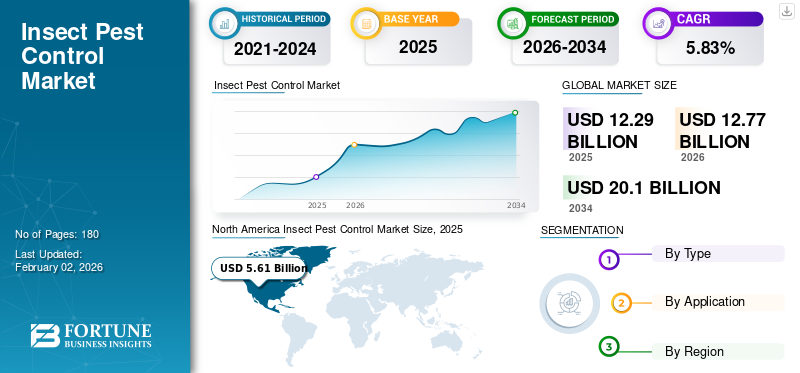
Download Free sample to learn more about this report.
INSECT PEST CONTROL MARKET KEY TAKEAWAYS
 Market Size & Forecast
- 2025 Market Size: USD 12.29 Billion
- 2026 Market Size: 12.77 Billion
- 2034 Forecast Market Size: USD 20.10 Billion
- CAGR: 5.83% from 2026–2034
 Market Share
- North America dominated the insect pest control market with a 45.63% share in 2025.
- The chemical control segment accounted for 59.44% of the global market share.
- The commercial and industrial segment represented 43.15% of the total market share.
 Key Regional Highlights
North America
North America led the market with USD 5.61 billion in 2025.
Europe
Europe held a 17.62% market share in 2025.
Asia Pacific
Asia Pacific accounted for 23.56% of global revenue in 2025.
U.S.
The market is projected to reach USD 5.33 billion in 2026.
Japan
The market is projected to reach USD 0.42 billion in 2026.
Read More

MARKET DYNAMICS
MARKET DRIVERS
Impact of Climate Change and Increasing Insect-borne Health Issues to Drive the Market Growth
Insects and pests have had a detrimental impact on public health in recent years and continue to do so. The illnesses linked to pests and insects have significantly impacted people’s well-being. Mosquitoes are responsible for more human diseases and fatalities than any other category of pests, other insects, and mammals. Mosquito-borne diseases continue to pose a significant global health threat, with a disproportionate impact on children. According to the International Journal of Clinical Pediatrics, as of April 2024, over 7.6 million dengue cases have been reported globally, including 3.4 million confirmed cases, more than 16,000 severe cases, and over 3,000 deaths. Such a rise in insect-borne health issues is anticipated to propel insect pest control market growth over the coming years.
MARKET RESTRAINTS
Insect Resistance and Adaptation to Control Methods to Create Challenges
The emergence of insect pest resistance creates a challenge for industry players. As product efficacy declines, consumer trust and satisfaction reduce, leading to greater scrutiny of pesticide producers and service providers. To improve the product efficiency, companies need to invest heavily in research and development to discover new active ingredients, biological alternatives, and resistance management strategies. This will require significant investment and a considerable amount of time in product development and seeking approval from regulatory bodies, creating challenges for key players.
The challenges extend further in regions where climate change accelerates pest metabolism and breeding cycles, potentially increasing mutation rates that lead to the emergence of new resistant strains. Beyond chemical resistance, insects are also exhibiting behavioral adaptations, such as avoiding treated surfaces or altering their feeding habits, which make traditional control tactics less reliable.
MARKET OPPORTUNITY
Adoption of Emerging Pest Control Methods and Technologies to Provide Market Opportunity
The global insect pest control industry is emerging and expanding, driven by rapid technological advancements in various stages of insect control, including monitoring, detection, and eradication. As pest populations evolve under changing environmental and urban conditions, traditional control methods alone are no longer sufficient to ensure efficacy, safety, and regulatory compliance. The convergence of digital technologies, biotechnology, and automation is, therefore, creating a new era of intelligent, precise, and sustainable pest management, which is propelling the industry’s growth in the near future. Companies and new startups are raising funds to invest in novel technologies, such as IoT and AI, to enhance product efficiency and optimize various pest control stages. For instance, in September 2025, PATS, a company specializing in pest control solutions, raised approximately USD 2.9 million in seed funding for expanding its AI-powered pest management solutions. The company planned to develop automated tools designed to reduce dependence on insecticides through targeted interventions and real-time monitoring. Such developments, along with companies' focus on expanding their operations, will boost the global market growth.
INSECT PEST CONTROL MARKET TRENDS
Rising Implementation of Integrated Pest Management (IPM) Practices
The increasing recognition of the negative impact of conventional insect control has further exacerbated the uptake of Integrated Pest Management (IPM)-based pest management. The IPM approach concentrates mainly on long-term prevention and is designed to minimize risks to environmental issues and human health. By integrating pest control measures such as physical, chemical, and traditional, IPM offers a balanced solution. Therefore, an increase in the adoption of IPM (integrated pest management) practices and soaring concerns over the spread of vector-borne illnesses such as dengue, malaria, and plague are expected to drive the global insect pest control market growth.
Download Free sample to learn more about this report.
Segmentation Analysis
By Type
High Efficiency and Quick Response on Insects to Push the Dominance of the Chemical Control Segment
On the basis of type, the market is segmented into chemical control, physical control, biological control, and others.
The chemical control segment by type is projected to reach USD 7.59 billion, accounting for 59.44% of the market share., accounting for the largest market share in 2024. The efficacy of chemical insecticides is high, as they can kill pests quickly, leading to their high usage in hospitals, restaurants, hotels, and warehouses. This plays a pivotal role in specific environmental situations where urgent action on insects is required. Therefore, it is a time-efficient method to protect business and public areas.
The biological control segment is anticipated to grow at a considerable CAGR of 6.78% from 2025 to 2032. The process of biological control involves infection, behavioral disruption, and growth regulation and does not immediately kill the pests. This makes them less suited for emergency infestations (e.g., cockroaches, bedbugs, mosquitoes) where instant results are required. However, these products have no effect to human and environmental health.
By Application
To know how our report can help streamline your business, Speak to Analyst
Increased Hygiene Concern across Various Industrial Sectors to Drive Commercial & Industrial Segment
Based on application, the market is segmented into commercial & industrial, residential, livestock farms, and others.
The commercial and industrial segment by application is expected to attain USD 5.51 billion, representing 43.15% of the total market share. Business establishments, such as food and beverage industries, pharmaceutical companies, and healthcare providers, must maintain strict sanitation and contamination control regulations to prevent any pest interventions. Restaurant operators and supermarket stores may need to recall their products if multiple pest attacks occur in their establishments, which can have a negative impact on the brand and even result in legal penalties. Thus, business operators adopt various methods, including chemical and physical applications, to mitigate pest attacks. The use of pest control products helps business owners meet the safety standards required to obtain certification from food safety authorities. Hence, there is a continuously increasing demand for pest control services and products in this sector.
The residential segment is anticipated to grow at the highest CAGR of 5.60% during the forecast period. There is a rapid growth in urban population in developing economies and such high-density housing environments create ideal breeding conditions for common household pests, namely cockroaches, ants, flies, termites, and bedbugs. The expanding urban middle-class accommodations in these regions are also increasing the household spending on pest-control products and services.
Insect Pest Control Market Regional Outlook
By geography, the market is categorized into North America, Europe, Asia Pacific, Latin America, and the Middle East & Africa.
North America
North America Insect Pest Control Market Size, 2025 (USD Billion)
To get more information on the regional analysis of this market, Download Free sample
In 2024, North America dominated the global insect pest control market share by holding the highest share of the global market with a value of USD 5.44 billion. The North American market is estimated to have reached USD 5.61 billion in 2025. The high urban population in the U.S. and Canada is one of the major factors that impact the demand for residential pest control products in the region. As insects thrive in built and urban environments, there is a significant risk of high pest infestations, due to which there is a high demand for pest control services in that region. The field of commercial infrastructure also depicts the needs to maintain hygiene in commercial establishments and enhance food processing, hospitality, and institutional facilities. The need for professional pest control services to manage pests in these facilities boosts the demand for pest control services. The increasing adoption of technology-driven products to enhance efficiency is further promoting market growth. For instance, in July 2025, Central Life Sciences launched a smart, app-enabled mosquito-control kit in the U.S. market that uses "eco-conscious" larvicides and real-time yard monitoring. The product is aimed at household use to kill mosquitoes. The U.S. market is projected to reach USD 5.33 billion by 2026. The North America region captured 45.63% of the global market in 2025, generating USD 5.61 billion in revenue, and is projected to reach USD 5.82 billion in 2026.
Europe
The European insect pest control market is driven by rapid urbanization, stricter regulations, and climate change, leading to the spread of invasive species and increased pest activity. Stringent rules regarding pest management and pesticide use are driving the adoption of more effective, often non-chemical, or integrated pest management (IPM) solutions. Emerging IPM methods and bio-based insect pest control products are likely to drive the market in the region. The UK market is projected to reach USD 0.49 billion by 2026, while the Germany market is projected to reach USD 0.6 billion by 2026. Europe maintained a strong presence in the global market, reaching USD 2.17 billion in 2025, accounting for 17.62% share, and is expected to reach USD 2.24 billion in 2026.
Asia Pacific
Asia Pacific is another leading consumer of such products. Some key factors influencing the market include urban growth, tropical climates, and public health risks associated with exposure to disease-carrying vectors. The market is rapidly transforming from an unorganized to a formalized sector as governments address vector-borne diseases and commercial infrastructure expands. Additionally, the increasing prevalence of vector-borne illnesses across Asian countries is further driving the demand for these products. According to the Ministry of Health & Family Welfare, Government of India, malaria cases have increased from 161,753 in 2021 to 255,500 in 2024 across India. The Japan market is projected to reach USD 0.42 billion by 2026, the China market is projected to reach USD 1.3 billion by 2026, and the India market is projected to reach USD 0.61 billion by 2026. In 2025, Asia Pacific generated USD 2.9 billion, contributing 23.56% to global market revenue, and is projected to grow to USD 3.03 billion in 2026.
Latin America
Public health programs, urbanization, and agricultural expansion drive the Latin America market. The outbreaks of mosquito-borne diseases sustain demand for vector control, while the hospitality and food sectors drive growth in professional services. Economic instability and fragmented regulation slow the adoption of technology, but a gradual movement toward biological and integrated methods is evident across Brazil, Argentina, and Chile. The Latin America market generated USD 1.15 billion in 2025, representing 9.36% of the global market landscape, and is expected to reach USD 1.2 billion in 2026.
Middle East & Africa
In the Middle East, pest control is part of broader urban hygiene mandates linked to tourism and real estate establishments. The Gulf States are early adopters of digital monitoring and green formulations, whereas African markets remain primarily focused on public health, with a strong emphasis on malaria and dengue prevention. Across the region, rising urbanization and government engagement are gradually transforming the sector, even though reliant on imported chemicals persists. Middle East & Africa recorded a market size of USD 0.47 billion in 2025, capturing 3.81% of the global market share, and is projected to reach USD 0.49 billion in 2026.
COMPETITIVE LANDSCAPE
Key Industry Players
Mergers and Acquisitions Emerge as the Key Strategies Adopted by Pivotal Manufacturers to Expand Market Presence
The global insect pest control market exhibits a semi-consolidated structure as there are several well-established multinational companies, startups, and regional manufacturers operating in this space. The active players in the global market are embarking on two major strategies: mergers & acquisitions and base expansion. In addition to these, the companies are also focusing on new product launches, promotions, partnerships, investments/agreements, which help them attain a competitive advantage across the global market.
LIST OF KEY INSECT PEST CONTROL COMPANIES PROFILED
- Ensystex, Inc. (U.S.)
- Arrow Exterminators, Inc. (U.S.)
- Rentokil Initial plc (U.K.)
- Environmental Science U.S. LLC (U.S.)
- Insects Limited Corporation (U.S.)
- Ecolab Inc. (U.S.)
- Sumitomo Chemical Co., Ltd. (Japan)
- BAYER AG (Germany)
- Syngenta AG (Switzerland)
- Pest UK (U.K.)
- Rollins, Inc. (U.S.)
- BASF SE (Germany)
KEY INDUSTRY DEVELOPMENTS
- July 2025: Arrow Exterminators Inc. opened three new offices in Alabama and Florida. Through this expansion, the enterprise can enhance its product offerings.
- May 2025: Rentokil Initial plc, acquired Pest Terminator, an Indonesian pest control firm under PT Reliance Anugerah Sejahtera, PT Reliance Dewata Sejahtera, and PT Reliance Sukses Sejahtera.
- October 2024: Arrow Exterminators Inc., a U.S.-based firm, announced the acquisition of an American firm, “Spider Man Pest Control.” This transaction provides Arrow with a space in Texas, one of the largest metropolitan areas. Via this acquisition, the company can strengthen its position and increase its global market share.
- June 2024: Sumitomo held a completion ceremony, “MEGURU,” at its new innovation center based in Chiba, Japan. Through this latest facility, the firm can scale up the chances of new product developments, ultimately driving the company’s revenue.
- June 2024: Rentokil opened its latest and first pest control innovation center across North America. This center serves as a hub for technician training, innovation center, and research & development.
REPORT COVERAGE
Request for Customization to gain extensive market insights.
Report Scope & Segmentation
|
ATTRIBUTE |
DETAILS |
|
Study Period |
2021–2034 |
|
Base Year |
2025 |
|
Estimated Year |
2026 |
|
Forecast Period |
2026-2034 |
|
Historical Period |
2021–2024 |
|
Growth Rate |
CAGR of 5.83%% from 2026-2034 |
|
Unit |
Value (USD Billion) |
|
Segmentation |
By Type, Application, and Region |
|
By Type |
· Chemical Control · Physical Control · Biological Control · Others |
|
By Application |
· Commercial & Industrial · Residential · Livestock Farms · Others |
|
By Geography |
North America (By Type, Application, and Country)
Europe (By Type, Application, and Country)
Asia Pacific (By Type, Application, and Country)
Latin America (By Type, Application, and Country)
Middle East and Africa (By Type, Application, and Country) · Turkey · Saudi Arabia · UAE |
Frequently Asked Questions
Fortune Business Insights says that the global market value stood at USD 12.29 billion in 2025 and is projected to reach USD 20.1 billion by 2034.
In 2025, the North America market value has touched USD 5.61 billion.
The market is expected to exhibit a CAGR of 5.83% during the forecast period of 2026-2034.
By type, the chemical control segment led the global market in 2025.
Impact of climate change and increasing insect-borne health issues are key factors driving the market growth.
Rentokil Initial, Rollins Inc., Ecolab Inc., and BASF SE., are a few of the players in the market.
North America held the largest market share in 2025.
The rising implementation of integrated pest management (IMP) practices is a major trend in the market.



- 2021-2034
- 2025
- 2021-2024
- 180
-
(Offer valid till 15th Oct 2026)
Get 30-60 hrs Free Customization
Expand Regional and Country Coverage, Segments Analysis, Company Profiles, Competitive Benchmarking, and End-user Insights.














Related Reports
-
US +1 833 909 2966 ( Toll Free )
-
Get In Touch With Us