Institutional Food Service Market Size, Share & Industry Analysis, By Restaurant Type (Chained and Independent), By Service Type (Dine-In and Takeout), and Regional Forecast, 2026-2034
 Download Free Sample
(Offer valid till 15th Oct 2026)

Institutional Food Service Market Size and Industry Overview
 Listen to Audio Version
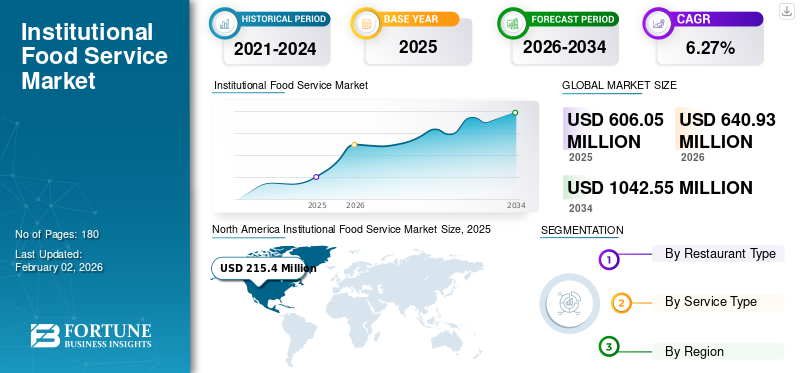
The global institutional food service market size was valued at USD 606.05 million in 2025 and is projected to grow from USD 640.93 million in 2026 to USD 1,042.55 million by 2034, exhibiting a CAGR of 6.27% during the forecast period. North America dominated the institutional food service market with a market share of 35.54% in 2025. A few of the key players in the industry include Sodexo, Compass Group, and Aramark.
Institutional food services are entities that prepare and offer meals at institutions such as educational, correctional, and healthcare facilities. It encompasses a range of operations, from small café-chains to large-scale kitchens, and includes caterers that aim to provide well-balanced and nutritious meals within the institutions. This service targets specific groups such as employees, inmates, patients, and students. Globally, the U.S. is considered a main consumer of institutional services, alongside other potential markets such as Germany, China, and the U.K. Food service is cost-effective compared to in-house dining, and convenience entices consumers’ attention.
The trend of spending on out-of-home food and using advanced technology in the production process propels the global market growth.
Download Free sample to learn more about this report.
INSTITUTIONAL FOOD SERVICE MARKET KEY TAKEAWAYS
 Global Market Size & Forecast
- 2025 Market Size: USD 606.05 million
- 2026 Market Size: USD 640.93 million
- 2034 Forecast Market Size: USD 1,042.55 million
- CAGR: 6.27% from 2026–2034
 Market Share
- North America dominated the institutional food service market with a market share of 35.54% in 2025.
- The takeout sector is predicted to grow at the highest CAGR in the global market.
- Chained restaurants emerged as the fastest-growing segment and held the highest CAGR.
 Key Regional Highlights
North America
North America generated USD 215.40 Million in 2025, accounting for 35.54% of the global market.
Europe
Europe reached USD 105.80 Million in 2025, representing 17.46% of the global market.
Asia Pacific
Asia Pacific dominated the market with USD 247.57 Million in 2025, capturing 40.85% of the global market.
U.S.
The U.S. market is projected to reach USD 205.88 Million by 2026.
Japan
The Japan market is projected to reach USD 44.86 Million by 2026.
Read More

MARKET DYNAMICS
Market Drivers
Surging Spending on Out-of-Home Food Fuels Market Growth
The growing consumer spending on out-of-home food is the major driver facilitating the market’s growth. As the majority of the population shifts to metropolitan areas and lifestyles become more hectic, there’s a higher dependency on foodservice operators for quick/ fast food meals. To minimize cooking hassle, consumers, especially parents, depend on institutional services to provide nutritious meals to their kids. Moreover, working individuals opt for such food services which saves their efforts in cooking. As a result, to save effort and time, most individuals are turning toward institutional sectors to fulfill their daily food intake.
Market Restraints
Labor Shortages and Food Safety Challenges Hinder Market Growth
One of the pivotal challenges encountered by the food service sector is the labor shortage. Short staffing results in slower table turnover and longer customer waits, negatively affecting the overall service quality. This situation often arises due to low wages offered to the workforce, which acts as an obstacle to attract potential employees. As a result, this factor leads to reduced revenue generation and dissatisfied customers.
Another obstacle in the institutional industry is growing concerns regarding food safety. Safe food handling practices and maintaining appropriate temperatures during transportation and storage are pivotal in the food service sector, as inconsistencies can result in foodborne outbreaks and illnesses.
Market Opportunities
Utilization of Advanced Technology Unlocks Growth Opportunities
The increasing use of advanced technology in the hospitality sector unlocks opportunities for improving efficiency and overall customer experience. One of the major technologies used is AI-powered systems, which can help optimize supply chain management and menu items planning. Moreover, a few food service sectors are adopting robotics that aid cooking and preparation, strengthening precision and efficiency. Following this, RFID technology is also utilized in food catering services as it minimizes food waste and enhances transparency and inventory management across the supply chain. Additionally, with the help of modern technology, the food service industry provides personalized or tailored dietary plans, fostering an enhanced dietary experience.
Institutional Food Service Market Trends
Rising Inclination Toward Sustainable Practices is the Current Trend
Sustainability is a notable and surging trend in the institutional food service sector. Modern consumers, particularly Gen Z, are highly conscious of the social and environmental impact and prefer food establishments with sustainable practices. The food service domain is known for contributing substantially to waste generation and greenhouse gas emissions, posing a stress on food operators. As a result, professional food chefs prioritize organic or local ingredients and implement various strategies to minimize food waste.
Download Free sample to learn more about this report.
SEGMENTATION ANALYSIS
By Restaurant Type
Independent Restaurant Led the Market Due to Its Various Advantages
Depending on restaurant type, the market has segments including chained and independent.
Out of both, the independent restaurant type dominated the global marketplace in 2025. Independent restaurants are dining establishments operated by a family or individual and not part of a franchise. Compared to chained restaurants, the independent sector easily adapts to changing consumer demands and market trends, allowing chances for menu personalization. Moreover, such a food service sector focuses on product innovation and has strong potential for profit margins.
Chained restaurants emerged as the fastest-growing segment and held the highest CAGR. The brand consistency and operational efficiency enhance the segment’s growth.
By Service Type
Dine-In Sector Dominated the Market Owing to the Rising Out-of-Home Food Consumption
Based on service type, the market is distributed into dine-in and takeout.
The dine-in category leads globally and is backed by the growing popularity of out-of-home food culture and the increasing trend of socialization. In today’s era, most consumers are inclined toward outside food to reduce the hassle of cooking at home.
The takeout sector is predicted to grow at the highest CAGR in the global market. The rising convenience and no extra tax on takeaway services will likely drive the global market share.
Institutional Food Service Market Regional Outlook
Based on regions, the market is segmented into North America, Europe, Asia Pacific, South America, and the Middle East & Africa.
North America
North America Institutional Food Service Market Size, 2025 (USD Million)
To get more information on the regional analysis of this market, Download Free sample
North America dominated the global market in 2025 and is backed by surging integration of technology and a rising need for convenience food. The North America market generated USD 215.4 million in 2025, representing 35.54% of the global market landscape, and is expected to reach USD 226.28 million in 2026. The increasing trend of therapeutic nutrition, which concentrates on tailored diet plans, intensifies the dependence on the food service sector. Moreover, the surging adoption of digital technology, such as AI-driven menus, drone food deliveries, and procurement automation, further bolsters the industry’s growth. Additionally, the growing number of food service outlets and improved awareness regarding institutional food services strengthen North America’s market expansion.
The U.S. is the leading nation in the region followed by Canada and Mexico. The surging demand for convenient food options and increasing use of advanced technology in the institutional food services sector bolster the market’s growth. The U.S. institutional food service market is expected to reached a valued at USD 205.88 million by 2026.
Asia Pacific
Asia Pacific has captured a strong institutional food service market share in 2025 owing to an increasing preference for convenient food and beverage, and expanding food franchises. Asia Pacific accounted for USD 247.57 million in 2025, representing 40.85% of the global market share, and is projected to reach USD 264.44 million in 2026. Additionally, the busy lifestyle of consumers fuels the need for quick and prepared meal solutions, improving the growth of the food service sector. The growing female workforce participation in the region also increases the reliance on out-of-home dining options for their family. Thus, such instances collectively drive the Asia Pacific market expansion. In this region, Japan and China are observing a robust trend for tourism and a surging inclination toward gatherings and social dining. As a result, the aforementioned factors will add to the region’s growth. The Japan institutional food service market is anticipeated to raeched a valued at USD 44.86 million by 2026, the China institutional food service market is projecte to reached a valued at USD 122.86 million by 2026, and the India institutional food service market is valued at USD 12.42 million by 2026.
Europe
Europe contributed 17.46% to the global market in 2025, with a valuation of USD 105.8 million, and is projected to reach USD 110.91 million in 2026. Europe is the third-largest region and has a notable market share as most Europeans are seeking online delivery, which is easily integrated into the institutional sector. Moreover, to attract consumers, a few institutional food sectors focus on serving organic and plant-based meals. As Europeans are highly inclined toward veganism, the demand for natural-based products is rising. Additionally, the enhanced affordability of institute-based food and technology in kitchens boosts regional growth. The UK institutional food service market is projected to reached a valued at USD 15.65 million by 2026, while the Germany institutional food service market is expected to reached a valued at USD 21.44 million by 2026.
Middle East & Africa
In 2025, Middle East & Africa held 4.01% of the global market, reaching a valuation of USD 24.31 million, and is projected to grow to USD 25.68 million in 2026. The Middle East & Africa are progressing and projected to grow faster in the forecast period owing to rising tourism and surging disposable income in the region.
South America
South America is also nascent and expected to soar at the same growth trajectory in the near term driven by expanding hospitality industry, growing dual-income household and the influence of globalization.
Latin America
Latin America contributed approximately USD 12.98 million to the global market in 2025, accounting for 2.14% share, and is expected to reach USD 13.6 million in 2026.
COMPETITIVE LANDSCAPE
KEY MARKET PLAYERS
Major Players Are Aiming at Expanding Their Base to Facilitate Market’s Growth
The active players in the global industry include Sodexo, Aramark, Compass Group, and YummyCorp, among others. The firms operating in the market are putting their efforts into expanding their base for institutional services, which aids in improving the company’s visibility. Moreover, a few companies concentrate on investments, further boosting the institutional food service market growth.
List of Key Institutional Food Service Companies Profiled
- YummyCorp (Indonesia)
- ISS A/S (Denmark)
- Symega Food Ingredients Limited (India)
- U.S. Foods Holding Corp. (U.S.)
- Sodexo (France)
- Gordon Food Service (U.S.)
- Aramark (U.S.)
- Sysco (U.S.)
- Compass Group (U.K.)
- Gategroup (Switzerland)
KEY INDUSTRY DEVELOPMENTS
- May 2025: YummyCorp, an Indonesian player in institutional food facility management, announced the news of expanding its base with the launch of ManGan and Jinsei inside Gama Tower. The new facilities were launched in collaboration with KPN Corp, a holding firm in Indonesia, serving over 6,000 professionals across Jakarta’s Kuningan district.
- August 2023: ISS Facility Services India, a subsidiary of ISS A/S, a Danish facility management firm, released the news of its target of expanding its food service sector for institutional and corporate customers across the Indian market. The firm aims to improve its footprint by the end of 2025.
- May 2022: Symega Food Ingredients Limited, a food seasoning producer in India, introduced “Cuisinary,” a superior quality food range, particularly for kitchen professionals, at a B2B event, AAHAR-International Food and Hospitality Fair, New Delhi. Via this cuisinary range, the enterprise provides cooking ingredients across HoReCa, institutional catering, and QSR in India.
- December 2021: Sodexo, a French food service company, announced its investment in Meican, a Chinese digital catering company, via Sodexo Ventures. This investment aids in facilitating the workplace catering experience across the Chinese market.
- July 2021: Creating Culinary Communities, a tech-enabled enterprise in the U.S., secured USD 80 million in institutional funding, co-led by REEF Technology, a Florida-based software company, and Brookfield Asset Management Inc., a Canadian investment firm, along with Silver Lake Technology Management, L.L.C., an American private equity enterprise, and Luber Adler, a business development service in the U.S.
REPORT COVERAGE
The market research report includes quantitative and qualitative insights into the market. It also offers a detailed market analysis of the market sizing and growth rate for all possible market segments. Key insights in the report include an overview of related markets, a competitive landscape, recent industry developments such as mergers & acquisitions, regulatory environment in critical countries, and current global market trends.
Request for Customization to gain extensive market insights.
Report Scope & Segmentation
|
ATTRIBUTE |
DETAILS |
|
Study Period |
2021-2034 |
|
Base Year |
2025 |
|
Estimated Year |
2026 |
|
Forecast Period |
2026-2034 |
|
Historical Period |
2021-2024 |
|
Unit |
Value (USD Billion) |
|
Growth Rate |
CAGR of 6.27% from 2026 to 2034 |
|
Segmentation |
By Restaurant Type
|
|
By Service Type
|
|
|
By Region
|
Frequently Asked Questions
Fortune Business Insights says that the global foodservice market size was valued at USD 606.05 million in 2025.
The market is expected to grow at a CAGR of 6.27% during the forecast period.
By restaurant type, the independent segment led the market.
Surging spending on out-of-home food fuels the market’s growth.
Sodexo, Compass Group, and Aramark are a few of the top players in the market.
North America held the highest share of the market.
Utilization of advanced technology unlocks growth opportunities.



- 2021-2034
- 2025
- 2021-2024
- 180
-
(Offer valid till 15th Oct 2026)
Get 30-60 hrs Free Customization
Expand Regional and Country Coverage, Segments Analysis, Company Profiles, Competitive Benchmarking, and End-user Insights.




















Related Reports
-
US +1 833 909 2966 ( Toll Free )
-
Get In Touch With Us