Kitchen Knife Market Size, Share & Industry Analysis, By Product (Cook’s Knife, Utility Knife, Bread Knife, Cleaver, Boning Knife, Paring Knife, and Others), By Application (Commercial and Household), By Price (High (Premium) [Hypermarket/Supermarket, Online Stores, and Others] and Low [Hypermarket/Supermarket, Online Stores, and Others]), By Sales Channel (Hypermarket/Supermarket, Online Stores, and Others), and Regional Forecast, 2026-2034
 Download Free Sample
(Offer valid till 30th Sep 2026)

KEY MARKET INSIGHTS
 Listen to Audio Version
The global kitchen knife market size was valued at USD 2.11 billion in 2025 and is projected to grow from USD 2.23 billion in 2026 to USD 3.73 billion by 2034, exhibiting a compound annual growth rate (CAGR) of 6.64% during the forecast period (2026-2034). US dominated the kitchen knife market with a market share of 21.46% in 2026.
Kitchen knives are must-have cutlery products in commercial and residential kitchens. Product attributes, including blade sharpness, edge retention, and ease of use, are crucial in developing culinary skills. Innovative knives enable chefs to explore culinary skills and perform multiple kitchen tasks, including slicing, dicing, mincing, and chopping. Advancements in the design of tableware knives and increasing households’ demand for premium kitchenware products support the market’s development. In August 2023, Kyocera, an advanced ceramic product manufacturer, launched INNOVATIONwhite, a new line of ceramic kitchen knives made of a patented blend of zirconia and alumina nanoscale particles. These design-based products provide a better grip for different cutting techniques.
The key industry players in the global market include Groupe SEB, Zwilling J. A. Henckels AG, WÜSTHOF, Yoshida Metal Industry Co. Ltd., and Victorinox International. These players conduct base expansion activities to broaden their position across emerging markets, including India & Southeast Asia, the Middle East, and Europe. For instance, in September 2023, Victorinox International opened its second shop of cutlery products at Forum Mall, Maradu, Kochi, India. In May 2022, the company opened its first shop at Palladium Shopping Mall in Mumbai, India.
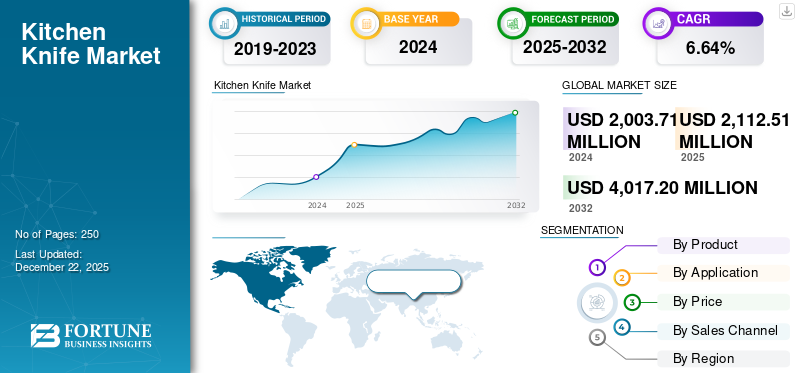
Download Free sample to learn more about this report.
Kitchen Knife Market KEY TAKEAWAYS
 Global Market Size & Forecast
- 2025 Market Size: USD 2.11 billion
- 2026 Market Size: USD 2.23 billion
- 2034 Forecast Market Size: USD 3.73 billion
- CAGR: 6.64% from 2026–2034
 Market Share
- The U.S. dominated the kitchen knife market with a 21.46% share in 2026.
- The Cook’s Knife segment accounted for the largest market share with 28.70% in 2026.
- The Commercial segment held the largest market share with 73.09% in 2026.
 Key Regional Highlights
North America
The region is driven by strong household spending on premium kitchenware, rising home renovation activities.
Europe
The market is supported by growing hospitality infrastructure, rising international tourism.
Asia Pacific
The market is fueled by robust cutlery manufacturing, growing online sales, increasing demand for specialized knives.
U.S.
The market is projected to reach USD 0.48 billion by 2026.
Japan
The market is projected to reach USD 0.17 billion by 2026.
Read More

MARKET DYNAMICS
Market Drivers
Rising Number of HoReCa Settings Preferring Innovative Chef Knives Drive Market Growth
Chef knives are crucial at quick-service restaurants for instantly preparing food items. The rising number of hotels, restaurants, and café settings prefer chef and santoku knives to prepare dining cuisine drives the kitchen knife market growth. In addition, there is a growing number of household cooks exploring their culinary skills which involve paring and utility knives to prepare homely meals.
- According to the Department of Agriculture, Government of Canada, the number of street stalls/kiosks outlets in Malaysia increased from 11,799 in 2016 to 13,284 in 2022. According to a similar source, the number is expected to grow to 15,455 by 2026.
Growing Demand for Kitchen Knives Made of Innovative Technologies to Support Market Growth
Recent innovations in kitchen knife design include vibration-cutting technologies, innovative designs, and advancements in the materials used in blade knives. Manufacturers consistently provide these innovative technology-based products to make them accessible to consumers at specialty restaurant stores and supermarkets. For instance, WMF offers a wide variety of chef knives made of hand-forged acid-resistant blade steel, which significantly enhances the cutting performance of hotel chefs. These grand gourmet chef knives are available in the German market.
Market Restraints
Consumers’ Accessibility to Alternative Products Restrain Market Growth
Consumers’ accessibility to alternative products, including food choppers, kitchen shears, food processors, slicers, and cheese wires, is expected to restrain the kitchen knives demand among commercial kitchen settings. Additionally, the rising availability and attractiveness of alternative kitchen tools, fueled by various factors such as convenience, technological progress, and enhanced online accessibility, may hinder the expansion of the conventional kitchen knife market.
Market Opportunities
Reinventions of Ceramic Knives with Infusions of High-quality Materials to Favor Industry Development
Luxury ceramic knives are widely popular in commercial kitchen settings due to their strong capability of edge retention and cutting precision, compared to steel-based knives. Advancements in the development of ceramic knives with the infusions of high-quality zirconium oxide material, resulting in sharper fixed blades and higher resistance to wear & tear, favor future developments in the industry.
- In 2022, Kyocera developed its patented ceramic knife technology with knives twice the sharpness of conventional ceramic blades.
- Other companies producing innovative ceramic knives are Shenzhen Knives, Cuisinart, and Victorinox.
Market Challenges
Higher Material Handling and Production Costs to Challenge Market Players in Business Expansion Activities
Higher costs of material handling, cutlery manufacturing tool maintenance, and the production of bronze, copper, brass, and iron materials to further manufacture knives limit cutlery manufacturers in their operational expansion activities, restraining market growth. In addition, rising demand for knife blade sharpening services is expected to reduce the consumer demand for newer knife products, challenging market growth.
Kitchen Knife Market Trends
Emerging Trend of Gift-giving Tableware Goods to Uplift Product Revenues
The emerging trend of gift-giving tableware goods, including artisanal-made cutlery for passionate home cooks, uplifts product revenues across many countries. In addition, growing festival celebration trends and increased demand for heirloom-quality knives at the Halloween celebrations create newer growth opportunities. Furthermore, the increasing popularity of knives made of vibrant & decorative blade colors at birthday celebration kitchens and restaurants supports the demand for such products.
Download Free sample to learn more about this report.
Impact of Tariffs
Tariffs elevated the cost of imported kitchen knives, leading to higher retail prices and reduced competitiveness on Chinese products in the U.S. market. Several kitchen brands that source knives from China and India increased the prices of their products to offset higher import costs. According to the European Commission, the U.S. government imposed a trade tariff of 25% on imports of steel and aluminum. As a result, this is expected to increase the production of kitchen products, including kitchen knives, raising its final price.
SEGMENTATION ANALYSIS
By Product
Increasing Interest in Exploring Destination Food Culture and Culinary Boost Sales of Cook’s Knife
By product, the market is sub-divided into cook’s knife, utility knife, bread knife, cleaver, boning knife, paring knife, and others.
The cook’s knife segment held a dominating market share in 2026, accounting for 28.70% of the total market share as chefs at higher establishments demand chef knives for chopping, slicing, mincing, and dicing. Consumers' increasing interest in exploring destination food culture and culinary art is expected to drive the demand for cook’s knives at the fastest rate.
The utility knife segment exhibited the third-leading kitchen knife market share in 2024 and is expected to grow at the third fastest rate during the forecast period. The growing popularity of cooking television shows and increasing usage of multipurpose utility knives among home cooks to prepare newer food dishes supports segment growth. In addition, rising demand for self-retracting utility knives to prevent accidental injuries during cutting leads to segmental revenue growth.
The paring knife segment exhibited a fourth-leading market share and is expected to grow at the fourth fastest rate during the forecast period. Advancements in paring knife technologies and rising demand for recently available products in commercial settings to perform delicate kitchen tasks accelerate sales of pairing knives.
The bread knives segment is projected to grow at the fifth fastest rate during the forecast period. The rise in home baking and artisanal bread-making intensified the demand for specialized and functional bread knives across many countries. Consumers prefer precision bread knives that provide a feel of sophistication and functionality in bread-cutting activities. The rising number of bakery shops utilizing innovative bread knives is driving the consumption of bread kitchen knives.
Cleaver segment is projected to grow at the sixth fastest rate during the forecast period of 2025-2035. The rising number of meat-producing centers preferring sharp-bladed cleavers to perform cutting activity drives segmental growth. In addition, advancements in developing cleaver of innovative shapes and designs support the future development of the cleaver segment.
The boning knife segment is projected to grow at the seventh fastest rate as an increasing number of commercial kitchens are prioritizing boning knives equipped with antimicrobial handles and handy designs.
The others segment covers the analysis of various products, including nakiri knives, santoku knives, carving knives, steak knives, and other specialized knives. Broadening consumers' necessity to buy a diverse range of cutlery tools to perform multiple kitchen tasks drives segmental growth.
To know how our report can help streamline your business, Speak to Analyst
By Application
Increasing Number of Cloud Kitchens Boosted Commercial Segment Growth
Based on application, the market is bifurcated into commercial and household.
The commercial segment exhibited a major market share in 2026, accounting for 73.09% of the total market share, driven by strong demand from hotels, restaurants, and cafés for high-performance knives. In addition, growing hospitality infrastructural facilities and a rising number of international travelers exploring dining experiences in foreign countries support the future development of the commercial segment. The increasing number of cloud kitchens offering delicious food items from online platforms also creates growth opportunities.
The household segment is projected to scale at the fastest-rate during the forecast period. Rapid construction of newer housing projects and broadening home kitchens’ needs of functional cutlery to efficiently perform chopping, cutting, slicing, and dicing tasks drive household segmental growth globally. Furthermore, increasing cookbook subscriptions enable home cooks to explore food preparation and culinary skills, accelerating household product demand.
By Price
High (Premium) Segment Leads Due to Significant Demand for Premium Kitchen Tools Among Hotel Chefs
Based on price, the market is bifurcated into high (premium) and low. High-priced or premium kitchen knives are mainly characterized by superior materials, such as stainless steel and carbon steel, and are equipped with high-quality blades. Hotel cooks’ higher preference for superior-quality, premium-priced kitchen tools resulted in the high segment holding a major market share in 2024. In addition, the growing trend of culinary tourism and the growing popularity of gourmet cooking requiring premium-based cutlery items accelerate high growth at the fastest rate. The high (premium) segment accounted for 73.09% of the total market share in 2026.
The low segment is mainly driven by the growing expansion of manufacturing companies producing mass-produced kitchenware goods worldwide. Furthermore, a growing number of first-time home cooks preferring affordable products to prepare food items favor low segmental growth.
By Sales Channel
Online Sales Channel is Set to Depict Rapid Growth with Increased Online Dropshopping Portals
Based on sales channel, the market is divided into hypermarket/supermarket, online stores, and others.
The rising number of online dropshipping portals offering diverse kitchenware goods is set to accelerate online store’s segment growth at the fastest rate during the forecast period. In addition, a growing number of direct-to-consumer (DTC) brands offering premium products in emerging marketing, including China, India, Europe, and Southeast Asia, favor online stores.
The others segment covers the analysis of various sales channels, including restaurant supply stores, brand shops, wholesale stores, and direct selling offline channels. The others segment exhibited a major market share in 2026, accounting for 57.85% of the total market share. due to the hospitality settings’ purchases of premium-based kitchen tools from the restaurant supply stores across many countries. In addition, consistent brands’ base expansion activities are expected to increase the supply rate of luxury kitchenware goods.
The hypermarket/supermarket segment exhibited a second-leading market share and is projected to grow at the second-fastest rate due to the growing trend of bulk purchasing homeware goods and consistent provision of discounted products at supermarkets. Furthermore, the growing number of hypermarkets, retailing facilities and governmental assistance in constructing such stores also favor segment growth.
Kitchen Knife Market Regional Outlook
Geographically, the global market is divided into the U.S., Canada, Germany, China, Japan, and the rest of the world.
U.S.
US Kitchen Knife Market Size, 2025 (USD Billion)
To get more information on the regional analysis of this market, Download Free sample
The U.S. dominated the global market, with the market size reaching USD 0.48 billion in 2026. Significant household spending on newer kitchenware goods and rising demand for artisanal custom cutlery products among American households resulted in considerable revenue generation. In addition, rising sales of cookbooks enabling Americans to explore natural ingredient-based food items is expected to increase the demand for newer cutlery products in the country. Furthermore, consistent manufacturers provision of vibration and sensor technology-based premium knives for hospitality settings create newer market avenues in the U.S.
To know how our report can help streamline your business, Speak to Analyst
Increasing home-ownership rates and significant household spending on home renovation and decoration are expected to generate considerable revenues from kitchen tools, including knives. According to the Department of Statistics, Government of Canada, the home-ownership rate in Canada reached 69.30% in 2021, up from 66.80% in 2019. In addition, increasing hospitality settings’ adoption of sustainable kitchen solutions involves the usage of knives made of eco-friendly materials, including recycled steel, organic cotton, bamboo, and others.
Germany
Increasing hotel accommodation rates and a rising number of international travelers exploring newer cuisines to enrich their dine-out experiences drive the demand for professional knives among commercial kitchens in Germany. According to the German Travel Association, travel spending in Germany rose by around 27% to USD 0.13 billion in 2026. Furthermore, growing restaurant infrastructural facilities preferring artisanal crafted kitchen tools favor market growth in Germany.
China
Robust manufacturing facilities of cutlery tools and consistent brands’ implementation of promotional campaigns uplift the product demand in China and other Asia Pacific regions. In addition, significant consumption of kitchen knives of specialized blades and handle designs among luxury hospitality settings uplifts the product revenues across China. The market is projected to reach USD 0.32 billion by 2026.
Japan
Easy household & commercial consumers’ accessibility to affordable kitchen knives and significant demand for the innovative design-based Gyuto, Nakiri, and Santoku knives generated considerable product revenues in Japan. Furthermore, the rising adoption of online shopping for homeware goods among commercial kitchens uplifts product sales nationwide. The Japan market is projected to reach USD 0.17 billion by 2026
Rest of the World
The demand for knives made of sustainable blade and handle materials and eco-friendly packaging is higher in the emerging markets in the rest of the world, including the U.K., France, Italy, India, Australia, and Saudi Arabia. The rising number of eco-conscious consumers preferring sustainably made kitchenware goods support the future market development in the rest of the world. Furthermore, the rising number of quick-service restaurants preferring premium-based kitchen tools to perform delicate chef tasks skyrocket product revenues across the region.
COMPETITIVE LANDSCAPE
Key Industry Players
Key Players Consistent Product Launches to Build Their Market Positions
Groupe SEB, Zwilling J. A. Henckels AG, WÜSTHOF, Victorinox International, Yoshida Metal Industry Co. Ltd., and other key players consistently focus on launching durable and innovative products to build their product portfolio in the domestic and international markets. For instance, in July 2024, Global, a Yoshida Metal Industry Co. Ltd.-owned brand, launched a GLOBAL CAMP Black series of kitchen knives at its direct-operated stores located in Japan.
Major Players in the Kitchen Knife Market
Groupe SEB, Zwilling J. A. Henckels AG, WÜSTHOF, Victorinox International, and Yoshida Metal Industry Co. Ltd. are key players operating in the global market. These players collectively accounted for around 33.11% share of the global market in 2024.
List of Key Kitchen Knife Companies Profiled
- Groupe SEB (France)
- Zwilling J. A. Henckels AG (Germany)
- WÜSTHOF (Germany)
- Victorinox International (Switzerland)
- Yoshida Metal Industry Co. Ltd. (Japan)
- MAC Corporation (Japan)
- Kai Corporation (Japan)
- Tupperware Brands Corporation (U.S.)
- Marquee Brands (U.S.)
- Mauviel1830 (France)
- Klein Tools (U.S.)
KEY INDUSTRY DEVELOPMENTS
- In March 2025, Butterfork, a kitchenware brand, launched the Purest Series of kitchen knives made of blends of sleek design and exceptional functionality. These products are ideally made for both professional chefs and passionate home cooks.
- In September 2024, Stahl, an Indian cookware brand, launched Talon's collection of products, including high-performance kitchen knives for everyday use. These knives are made of durable German steel with exceptional sharpness and the balance of Japanese blade craftsmanship.
- In January 2024, Kadant Inc. completed the acquisition of Key Knife, Inc., a global supplier of cutlery systems, to expand its presence in Canada and the U.S.
- In November 2023, Fork N Knife, a cloud kitchen business, secured an investment of USD 800,000 for strategic expansion in the European and African markets.
- In June 2023, Pappy & Company launched a custom collection of artisanal Barrel Stave Bar Knife in partnership with Middleton Made Knives.
INVESTMENT ANALYSIS AND OPPORTUNITIES
Key market players focus on investing in installing newer production plants at the geographies requiring lesser facility maintenance, raw material and labor costs. In addition, these geographies are selected based on key players' capabilities in accessing a wider distributor network and customer base. For instance, Groupe SEB acquired La Brigade de Buyer, an international group owning three France-located production facilities of a wide range of products, including forged knives, cookware, mandolins, pressure pistons, bakery equipment, and others. The acquisition was aimed to build the company’s production base across the emerging European markets.
REPORT COVERAGE
The market report analysis includes in-depth market-related information, highlighting crucial aspects such as prominent companies and product types. In addition, the global report on the kitchen knife market provides competitive analysis and strategic recommendation-related information to support informed decision-making. Besides this, the global kitchen knife market research report delivers insights into market trends for cutlery items. Furthermore, the report overview highlights significant product developments in the industry.
Request for Customization to gain extensive market insights.
Report Scope & Segmentation
|
ATTRIBUTE |
DETAILS |
|
Study Period |
2021-2034 |
|
Base Year |
2025 |
|
Estimated Year |
2026 |
|
Forecast Period |
2026-2034 |
|
Historical Period |
2021-2024 |
|
Growth Rate |
CAGR of 6.64% from 2026 to 2034 |
|
Unit |
Value (USD Billion) |
|
Segmentation |
By Product
|
|
By Application
|
|
|
By Price
|
|
|
By Sales Channel
|
|
|
By Region
|
Frequently Asked Questions
Fortune Business Insights says the global market was USD 2.11 billion in 2025 and is anticipated to reach USD 3.73 billion by 2034.
In 2025, the global market value stood at USD 2.11 billion.
The global market is forecast to grow at a CAGR of 6.64% during 2026-2034.
By product, the cooks knife segment dominated the market.
The rising number of HoReCa settings preferring innovative chef knives is a crucial factor driving global market growth.
Groupe SEB, Zwilling J. A. Henckels AG, WÜSTHOF, Victorinox International, and Yoshida Metal Industry Co. Ltd. are the leading companies.
The U.S. dominated the international market in 2025.
The reinvention of ceramic knives with infusions of high-quality materials will create newer growth opportunities.



- 2021-2034
- 2025
- 2021-2024
- 250
-
(Offer valid till 30th Sep 2026)
Get 30-60 hrs Free Customization
Expand Regional and Country Coverage, Segments Analysis, Company Profiles, Competitive Benchmarking, and End-user Insights.



















-
US +1 833 909 2966 ( Toll Free )
-
Get In Touch With Us