 Download Free Sample



Get a Quote
Receive a tailored pricing based on your needs.
- Choose license type
- Multiple user options
- Custom scope & coverage
- Fast turnaround
"Designing Growth Strategies is in our DNA"
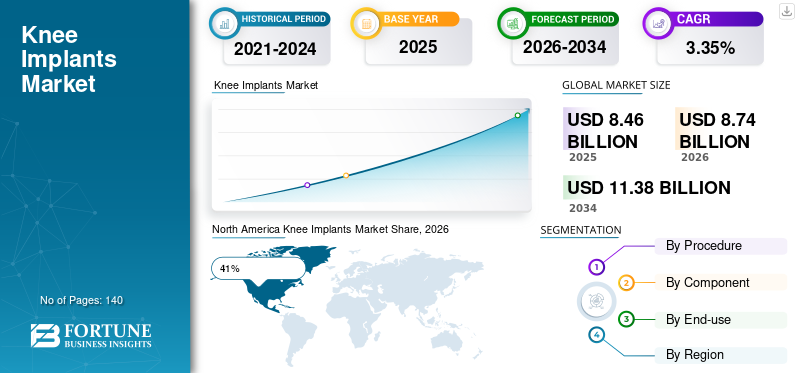
The knee implants market size was valued at USD 8.46 Billion in 2025. The market is projected to grow from USD 8.74 Billion in 2026 to USD 11.38 Billion by 2034, exhibiting a CAGR of 3.35% during the forecast period.

The knee implants market is a vital segment of the orthopedic devices industry, driven by the growing burden of knee osteoarthritis, sports injuries, obesity-related joint disorders, and age-related degeneration. Knee implants are designed to restore joint function, improve mobility, and reduce pain through surgical replacement procedures. The market is witnessing continuous innovation in implant materials, robotic-assisted surgery integration, personalized implant design, and advanced fixation technologies. Growing healthcare infrastructure, increased awareness of joint preservation and replacement procedures, and rising demand for minimally invasive orthopedic surgeries continue to strengthen the knee implants market. The knee implants market report indicates sustained demand across developed and emerging healthcare systems.
Download Free sample to learn more about this report.
The United States represents the largest individual market for knee implants due to high procedure volumes, advanced healthcare facilities, and strong adoption of innovative orthopedic technologies. The prevalence of osteoarthritis affects millions of adults, creating consistent demand for knee replacement surgeries. Hospitals and ambulatory surgical centers increasingly utilize robotic-assisted systems and patient-specific implants to improve surgical precision. Favorable reimbursement frameworks, widespread orthopedic specialist availability, and strong investment in musculoskeletal healthcare support market expansion. The USA knee implants market analysis highlights increasing utilization of total knee replacement procedures among aging populations and active adults seeking long-term mobility improvement.
 Global Market Size & Forecast
 Market Share
 Key Regional Highlights
North America
North America led the market with a 41% share, supported by advanced orthopedic healthcare infrastructure and high adoption of knee replacement procedures.
Europe
Europe accounted for 29% of the market, driven by established healthcare systems and growing demand for orthopedic treatments.
Asia-Pacific
Asia-Pacific held a 24% share, supported by expanding healthcare infrastructure and increasing demand for joint replacement procedures.
U.S
The U.S. remains a key market, supported by advanced orthopedic care and widespread adoption of knee replacement technologies.
Japan
Japan accounted for approximately 26% of the Asia-Pacific market, supported by advanced healthcare infrastructure and established orthopedic services.
Read More

The knee implants market Trends reveal a significant shift toward personalized orthopedic solutions. Manufacturers are increasingly developing customized implants based on patient anatomy through advanced imaging and digital planning technologies. This trend improves implant fit, surgical outcomes, and patient satisfaction. The adoption of 3D printing technologies is also accelerating product development and enhancing precision manufacturing capabilities.
Another major trend shaping the knee implants market Outlook is the growing integration of robotic-assisted surgical systems. Healthcare providers are adopting robotics to improve implant positioning accuracy and reduce procedural variability. Mobile-bearing implant systems, highly cross-linked polyethylene materials, and cementless fixation designs are gaining popularity. The Knee Implants Industry Report further identifies rising demand for outpatient knee replacement procedures due to shorter recovery periods, reduced hospitalization requirements, and increasing healthcare cost optimization efforts. Digital surgical planning, smart instrumentation, and artificial intelligence-supported surgical workflows are becoming important differentiators within the global knee implants market.
Download Free sample to learn more about this report.
Rising Prevalence of Osteoarthritis and Aging Population
The primary growth driver in the knee implants market is the increasing incidence of osteoarthritis and age-related joint degeneration. As populations continue to age globally, the number of individuals experiencing severe knee pain, cartilage deterioration, and reduced mobility is expanding steadily. Osteoarthritis remains one of the leading causes of disability among older adults, significantly increasing demand for knee replacement procedures.
The knee implants market research report indicates that rising obesity rates also contribute to increased stress on knee joints, accelerating degeneration and creating greater demand for surgical intervention. Improved awareness regarding joint replacement outcomes encourages patients to seek treatment earlier than previous generations. Advancements in implant durability and surgical techniques have improved long-term success rates, making knee replacement a preferred treatment option for severe joint damage. Expanding orthopedic service availability and growing healthcare expenditures further strengthen the demand environment supporting knee implants market Growth.
High Procedural Costs and Surgical Risks
One of the primary restraints affecting the knee implants market is the substantial cost associated with knee replacement surgery and post-operative rehabilitation. Advanced implants, robotic systems, imaging technologies, and specialized orthopedic care can create financial burdens for patients and healthcare systems.
Although reimbursement support exists in many developed markets, affordability remains a challenge in several developing regions. The Knee Implants Industry Analysis also highlights concerns related to surgical complications, infection risks, implant loosening, and revision procedures. Some patients delay surgery due to fear of complications or extended recovery periods. Limited access to specialized orthopedic surgeons in rural and underserved regions further restricts procedure volumes. Regulatory requirements for implant approval and product validation can also increase development costs and extend commercialization timelines, creating barriers for smaller manufacturers entering the knee implants market.
Expansion of Personalized and Robotic-Assisted Knee Replacement Solutions
A significant opportunity within the knee implants market lies in the development of personalized implants and robotic-assisted surgical technologies. Customized implant solutions designed using patient-specific imaging data are becoming increasingly attractive due to their ability to improve alignment and functional outcomes.
The knee implants market Forecast suggests growing demand for advanced surgical planning platforms, navigation systems, and smart orthopedic devices. Emerging healthcare markets are investing in modern orthopedic infrastructure, creating new growth opportunities for implant manufacturers. Rising medical tourism activity in orthopedic treatment destinations is also contributing to market expansion. Companies focusing on innovative biomaterials, cementless fixation techniques, and enhanced implant longevity are positioned to capitalize on evolving customer requirements. Strategic partnerships between hospitals, research institutions, and medical device manufacturers continue to create favorable conditions for innovation-driven growth across the knee implants market.
Increasing Pressure on Healthcare Efficiency and Implant Performance
A major challenge facing the knee implants market is the growing demand for improved clinical outcomes while maintaining cost efficiency. Healthcare providers increasingly evaluate implant performance, patient satisfaction, and long-term durability before adopting new technologies.
The knee implants market Insights indicate that revision surgeries remain a concern when implants fail prematurely or complications arise. Manufacturers must continuously invest in research, clinical trials, and product validation to demonstrate effectiveness and safety. Competitive pricing pressures, procurement restrictions, and hospital budget constraints further complicate market operations. In addition, surgeons require specialized training for advanced robotic and navigation-assisted procedures, increasing implementation complexity. Meeting regulatory expectations while maintaining innovation speed remains a critical challenge influencing the overall knee implants market Size and competitive landscape.
Total Knee Replacement: Total Knee Replacement accounts for approximately 82% of the global knee implants market share. This procedure involves replacing the entire knee joint with prosthetic components when severe osteoarthritis, rheumatoid arthritis, or extensive joint damage affects multiple compartments of the knee.
The dominance of this segment is supported by high clinical success rates, broad patient eligibility, and extensive surgeon familiarity. Healthcare providers frequently recommend total knee replacement for advanced degenerative conditions where conservative treatments no longer provide adequate relief. Improvements in implant materials, polyethylene wear resistance, and fixation methods continue to enhance long-term outcomes. Robotic-assisted surgery adoption further supports growth within this segment by improving implant positioning accuracy. The knee implants market analysis identifies total knee replacement as the cornerstone procedure driving demand across hospitals, specialty orthopedic centers, and ambulatory surgical facilities worldwide.
To know how our report can help streamline your business, Speak to Analyst
Partial Knee Replacement: Partial Knee Replacement represents approximately 18% of the global knee implants market share. This procedure is designed for patients whose knee damage is limited to a single compartment, allowing preservation of healthy bone and ligaments.
The segment is gaining attention due to shorter recovery periods, less invasive surgical techniques, and improved post-operative mobility. Patients undergoing partial knee replacement often experience faster rehabilitation and reduced hospital stays compared with total replacement procedures. Advances in imaging, surgical navigation, and implant design have improved patient selection and procedural accuracy. The knee implants market research report highlights increasing utilization among younger and more active patients seeking bone-preserving treatment alternatives. Although the segment remains smaller than total knee replacement, technological innovation and growing awareness continue to support its expansion.
Fixed-bearing knee implants hold approximately 74% of the knee implants market share. These implants feature a polyethylene insert fixed firmly to the tibial component, creating a stable and widely accepted design.
The segment remains dominant due to its long clinical history, reliability, and suitability for a broad patient population. Orthopedic surgeons frequently select fixed-bearing systems because of their predictable performance and established evidence base. Continuous improvements in polyethylene materials have significantly reduced wear-related concerns. The Knee Implants Industry Report indicates strong demand for fixed-bearing implants across both developed and emerging healthcare markets due to affordability and widespread surgeon experience. Their compatibility with robotic-assisted procedures and advanced surgical planning systems further supports continued market leadership.
Mobile-bearing implants account for approximately 26% of the knee implants market share. These implants allow controlled movement between components, potentially improving knee motion and reducing wear.
The segment attracts attention among younger and physically active patients who require enhanced joint function. Manufacturers continue to invest in mobile-bearing technology to improve stability, durability, and biomechanical performance. The knee implants market Opportunities assessment identifies increasing research into advanced bearing designs aimed at improving patient satisfaction and implant longevity. Adoption remains selective because patient suitability and surgical expertise requirements are more specialized compared with fixed-bearing systems. However, ongoing technological refinement continues to strengthen the long-term outlook for this segment.
Hospitals contribute approximately 68% of the knee implants market share. Large healthcare facilities perform the majority of knee replacement procedures due to comprehensive surgical infrastructure, advanced imaging capabilities, and multidisciplinary care teams.
Hospitals are often early adopters of robotic-assisted surgical platforms and next-generation implant technologies. The availability of intensive rehabilitation services and specialized orthopedic departments further strengthens their market position. Growing demand for complex and revision knee replacement procedures supports continued dominance within the knee implants market.
North America accounts for 41% of the global knee implants market share. The region benefits from advanced healthcare infrastructure, strong orthopedic expertise, and widespread adoption of innovative implant technologies. High prevalence of osteoarthritis, obesity-related joint disorders, and sports injuries contributes to consistent procedure volumes. Healthcare providers actively utilize robotic-assisted surgical systems and patient-specific implant solutions to improve outcomes.
The region also benefits from established reimbursement systems and extensive orthopedic research activity. Strong demand for revision procedures and technologically advanced implants continues to support the regional market. The knee implants market report identifies North America as a leading center for innovation, clinical adoption, and product commercialization.
North America Knee Implants Market Share, 2026 (%)
To get more information on the regional analysis of this market, Download Free sample
Europe holds 29% of the global knee implants market share. The region demonstrates strong demand due to aging populations, advanced public healthcare systems, and increasing awareness of orthopedic treatment options. Countries across Western Europe continue to invest in surgical modernization and rehabilitation infrastructure.
Growing acceptance of minimally invasive procedures and personalized implant technologies supports market expansion. Regulatory emphasis on safety and clinical performance encourages manufacturers to maintain high-quality standards. The knee implants market Insights indicate stable demand across both established and emerging European healthcare systems.
Germany represents approximately 28% of the European knee implants market. The country maintains a strong orthopedic surgery ecosystem supported by advanced hospitals, specialized surgeons, and extensive healthcare coverage. Demand is driven by a large aging population and increasing prevalence of degenerative joint disorders.
German healthcare providers actively adopt advanced implant materials, robotic-assisted surgery, and precision-guided procedures. Strong domestic manufacturing capabilities and continuous investment in orthopedic research contribute to market leadership. The Germany knee implants market analysis highlights increasing demand for customized implants and digital surgical planning technologies. High clinical standards and a focus on long-term patient outcomes further support sustained procedure growth.
The United Kingdom accounts for approximately 22% of the European knee implants market. Growing demand for joint replacement procedures is supported by an aging population and increasing diagnosis of osteoarthritis. Healthcare institutions continue to expand access to orthopedic services while improving surgical efficiency.
The UK knee implants market Outlook emphasizes growing utilization of enhanced recovery pathways and outpatient surgical programs. Adoption of advanced implants, navigation systems, and digital planning technologies is increasing across major healthcare facilities. Continued investment in orthopedic workforce development and modernization of surgical infrastructure supports future market expansion.
Asia-Pacific accounts for 24% of the global knee implants market share. The region is experiencing rapid expansion due to growing healthcare investments, increasing orthopedic awareness, and rising prevalence of age-related joint disorders. Expanding access to advanced surgical care is supporting procedure growth across several countries.
Economic development and healthcare modernization are enabling broader adoption of innovative implant technologies. Medical tourism activity and increasing availability of specialized orthopedic services further contribute to regional demand. The Knee Implants Industry Analysis identifies Asia-Pacific as one of the most dynamic regions for future market development.
Japan contributes approximately 26% of the Asia-Pacific knee implants market. The country's aging population represents a major driver for knee replacement demand. High healthcare standards and strong orthopedic expertise support consistent procedure volumes.
Japanese healthcare providers focus heavily on implant quality, surgical precision, and long-term functional outcomes. Adoption of advanced imaging technologies and minimally invasive surgical techniques continues to expand. The Japan knee implants market research report indicates growing interest in patient-specific implants and robotic-assisted orthopedic procedures.
China accounts for approximately 34% of the Asia-Pacific knee implants market. Rapid healthcare infrastructure development and increasing awareness of joint replacement treatments are driving strong demand. Rising life expectancy and expanding middle-class populations support procedure growth.
Government initiatives aimed at improving healthcare access have increased availability of orthopedic services across urban and regional areas. The China knee implants market Forecast highlights growing investment in domestic manufacturing, advanced implant development, and surgical modernization. Expanding hospital networks continue to strengthen market potential.
Rest of World represents 6% of the global knee implants market share. This region includes Latin America, the Middle East, and Africa, where healthcare infrastructure continues to improve steadily. Rising awareness of orthopedic treatment options and increasing access to specialized surgical services are supporting market growth.
Investment in hospital modernization, surgeon training, and advanced medical devices is creating opportunities for implant manufacturers. Medical tourism and public healthcare expansion initiatives further contribute to market development. The knee implants market Opportunities assessment identifies substantial untapped potential across several emerging economies.
Investment activity within the knee implants market continues to focus on robotic surgery platforms, personalized implant manufacturing, digital orthopedic solutions, and advanced biomaterials. Venture capital groups, institutional investors, and strategic healthcare investors are increasingly targeting orthopedic innovation due to growing global procedure demand.
The knee implants market Opportunities landscape includes expansion into emerging healthcare markets, development of patient-specific implants, and integration of artificial intelligence into surgical planning. Manufacturers are investing heavily in clinical research to improve implant longevity and reduce revision rates. Strategic acquisitions and partnerships remain common as companies seek to strengthen product portfolios and geographic presence. Healthcare providers are also investing in robotic-assisted systems to improve efficiency and attract patients seeking advanced orthopedic care. These factors continue to create favorable conditions for long-term market development.
Innovation remains a defining characteristic of the knee implants market. Manufacturers are introducing highly durable implant materials, advanced polyethylene technologies, and cementless fixation systems designed to improve long-term outcomes. Personalized implant platforms based on patient anatomy continue to gain commercial traction.
The knee implants market Trends also highlight increasing integration of digital technologies into orthopedic workflows. Robotic-assisted systems, real-time surgical navigation, and artificial intelligence-supported planning tools are improving procedural precision. Companies are developing implants that preserve bone structure while enhancing natural knee movement. Research efforts focused on smart implants, advanced coatings, and improved wear resistance continue to accelerate product differentiation and strengthen competitive positioning across the industry.
The knee implants market report provides a comprehensive evaluation of industry performance, competitive positioning, technological advancements, and future growth opportunities. The report examines implant categories, procedure types, component technologies, end-user adoption patterns, and regional demand dynamics.
Request for Customization to gain extensive market insights.
The knee implants market analysis includes assessment of market drivers, restraints, opportunities, challenges, competitive strategies, product innovation trends, and investment activity. Coverage extends across North America, Europe, Asia-Pacific, and Rest of World regions while providing detailed insights into major country-level markets. The report also evaluates market share distribution, technological developments, regulatory influences, and strategic initiatives undertaken by leading manufacturers. Special attention is given to robotic-assisted surgery, personalized implant development, digital orthopedic solutions, and evolving healthcare delivery models shaping the future of the Knee Implants Industry.
Fortune Business Insights says that the global market value stood at USD 8.46 billion in 2025 and is projected to reach USD 11.38 billion by 2034.
The market is expected to exhibit a CAGR of 3.35% during the forecast period of 2026-2034.
Total Knee Replacement led the procedure segment with approximately 82% share, supported by broad patient eligibility, high clinical success rates, and extensive surgeon familiarity.
Key players include DePuy Synthes, Zimmer Biomet, Stryker, Smith+Nephew, Aesculap, Inc. - a B. Braun company, and CONMED Corporation.
Major trends include personalized implants using advanced imaging and 3D printing and growing adoption of robotic-assisted surgery, digital planning, and AI-supported surgical workflows. North America led the market with a 41% share.


(Offer valid till 15th Nov 2026)
Get 30-60 hrs Free Customization
Expand Regional and Country Coverage, Segments Analysis, Company Profiles, Competitive Benchmarking, and End-user Insights.













.webp)






Get In Touch With Us
US +1 833 909 2966 ( Toll Free )
Receive a tailored pricing based on your needs.
Discuss your questions with our industry experts.
Have questions? Get quick answers before you purchase.

