L-Carnitine Market Size, Share & Industry Analysis, By Process (Bioprocess, Chemical Synthesis), By Product (Food & Pharma Grade, Feed Grade), By Application (Animal Feed, Healthcare Products, Functional Food & Beverage), and Regional Forecast, 2026-2034
 Download Free Sample

L-Carnitine Market Overview
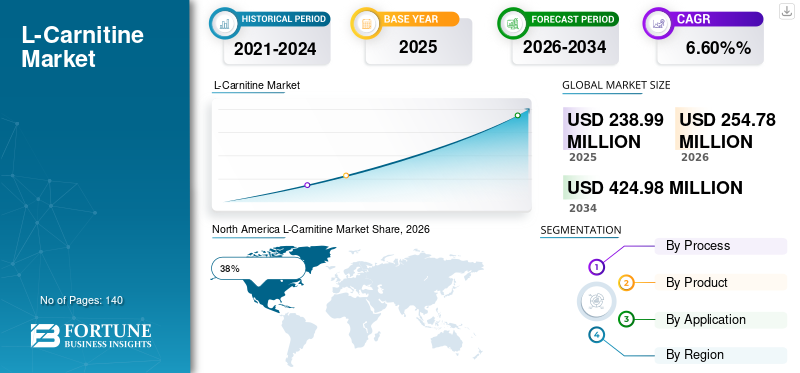
The global L-Carnitine market size was valued at USD 238.99 Million in 2025. The market is projected to grow from USD 254.78 Million in 2026 to USD 424.98 Million by 2034, exhibiting a CAGR of 6.60% during the forecast period. The market in North America dominated with a revenue share of 38% in 2025.

The L-Carnitine Market is experiencing strong growth due to increasing demand for nutritional supplements, sports nutrition products, and pharmaceutical formulations designed to improve energy metabolism and physical performance. L-Carnitine is widely utilized in healthcare, functional foods, animal feed, and dietary supplement industries because of its role in fatty acid transportation and cellular energy production. Growing consumer awareness regarding fitness, weight management, cardiovascular health, and nutritional supplementation continues driving market demand globally. Manufacturers are increasingly focusing on advanced production technologies and high-purity formulations to meet rising industry standards. Expanding applications across food, pharmaceutical, and feed industries continue supporting long-term market development.
The United States represents one of the largest contributors to the L-Carnitine Market due to increasing health awareness, rising fitness participation, and strong demand for dietary supplements and sports nutrition products. Consumers across the country are increasingly adopting L-Carnitine supplements to support energy metabolism, weight management, and athletic performance. The pharmaceutical sector is also contributing to market expansion through growing utilization of L-Carnitine in therapeutic formulations targeting metabolic disorders and cardiovascular health. Functional beverage manufacturers are integrating L-Carnitine into energy drinks and wellness products to attract health-conscious consumers. Strong retail distribution networks and increasing e-commerce penetration continue strengthening the U.S. L-Carnitine industry landscape.
Download Free sample to learn more about this report.
L-Carnitine Market Key Takeaways
 Global Market Size & Forecast
- 2025 Market Size: USD 238.99 Million
- 2026 Market Size: USD 254.78 Million
- 2034 Forecast Market Size: USD 424.98 Million
- CAGR: 6.60% from 2026-2034
 Market Share
- The market in North America dominated with a revenue share of 38% in 2025.
- Healthcare Products dominated by application with a market share of approximately 46%.
- Bioprocess manufacturing dominated by process with the largest market share.
 Key Regional Highlights
North America
North America led the market with a 38% share, supported by strong demand for nutritional supplements and healthcare products.
Europe
Europe accounted for 29% of the market, driven by growing demand for dietary supplements and functional nutrition.
Asia-Pacific
Asia-Pacific held a 24% share, supported by expanding nutritional, pharmaceutical, and animal feed applications.
U.S
The U.S. remains a key market, supported by strong demand for sports nutrition, dietary supplements, and wellness products.
Japan
Japan accounted for approximately 22% of the Asia-Pacific market, supported by growing demand for nutritional and healthcare products.
Read More

L-Carnitine Market Latest Trends
The L-Carnitine Market is evolving rapidly with growing emphasis on health-focused nutrition and advanced supplement formulations. One major trend influencing the market is the increasing use of L-Carnitine in sports nutrition products designed to improve endurance, energy utilization, and recovery performance. Fitness-conscious consumers are actively seeking supplements that support weight management and physical wellness, driving demand across global markets.
Download Free sample to learn more about this report.
Another significant trend involves rising adoption of bio-based production technologies for L-Carnitine manufacturing. Companies are increasingly focusing on sustainable bioprocess methods to improve purity levels and reduce environmental impact. Functional beverages, meal replacement products, and wellness supplements enriched with L-Carnitine are also gaining strong consumer acceptance. The pharmaceutical industry continues exploring expanded therapeutic applications of L-Carnitine for cardiovascular disorders, metabolic conditions, and neurological support. In addition, growing demand for premium animal nutrition products is encouraging feed manufacturers to incorporate L-Carnitine into livestock and pet nutrition formulations. These trends continue strengthening the L-Carnitine Market Report, L-Carnitine Market Analysis, L-Carnitine Market Outlook, and L-Carnitine Industry Analysis globally.
L-Carnitine Market Dynamics
DRIVER
Rising Demand for Dietary Supplements and Sports Nutrition Products
The primary growth driver for the L-Carnitine Market is the increasing global demand for dietary supplements, sports nutrition formulations, and wellness products. Consumers are becoming more health conscious and actively seeking nutritional ingredients that support energy metabolism, weight management, and physical performance. L-Carnitine has gained strong popularity among athletes, fitness enthusiasts, and health-focused consumers because of its role in transporting fatty acids into cells for energy production.
The growing prevalence of obesity and lifestyle-related health conditions is further contributing to market expansion. Consumers are increasingly incorporating L-Carnitine supplements into daily wellness routines to support exercise performance and fat metabolism. Functional beverage manufacturers are also integrating L-Carnitine into energy drinks and nutritional formulations aimed at active consumers. In the pharmaceutical industry, L-Carnitine is increasingly utilized in therapies targeting metabolic disorders and cardiovascular health. Rising demand for personalized nutrition solutions and preventive healthcare products continues strengthening the L-Carnitine Market Growth, L-Carnitine Market Size, and L-Carnitine Market Forecast globally.
RESTRAINT
Regulatory Complexities and Fluctuating Raw Material Costs
One of the major restraints affecting the L-Carnitine Market is the presence of strict regulatory standards governing dietary supplements, pharmaceuticals, and food-grade nutritional ingredients. Manufacturers must comply with extensive quality control requirements and ingredient safety regulations, increasing operational complexity and production costs.
Fluctuating prices of raw materials used in chemical synthesis and bioprocess manufacturing methods also create challenges for producers. Maintaining high-purity L-Carnitine formulations requires advanced processing technologies and quality assurance systems, which can increase manufacturing expenses. In some markets, limited consumer awareness regarding the specific benefits of L-Carnitine supplements restricts product adoption. Counterfeit nutritional products and inconsistent labeling standards in certain regions may also negatively impact consumer confidence. These factors continue influencing competition and operational strategies across the L-Carnitine Market Research Report and L-Carnitine Industry Report environment.
OPPORTUNITY
Expansion of Functional Foods and Preventive Healthcare Products
The increasing popularity of functional foods and preventive healthcare presents substantial opportunities for the L-Carnitine Market. Consumers are actively seeking nutritional products that support overall wellness, energy management, and long-term health maintenance. This shift is encouraging manufacturers to develop innovative food and beverage products enriched with L-Carnitine.
Growing demand for personalized nutrition and healthy aging solutions is creating new application opportunities across the healthcare and wellness sectors. Functional beverages, protein supplements, meal replacement products, and fortified nutrition bars are increasingly incorporating L-Carnitine as a performance-enhancing ingredient. Expanding healthcare infrastructure in emerging economies and rising disposable incomes are further supporting market growth. Animal nutrition applications also present strong opportunities as livestock producers increasingly utilize feed-grade L-Carnitine to improve animal growth performance and metabolic efficiency. These developments continue strengthening the L-Carnitine Market Opportunities and L-Carnitine Market Insights landscape globally.
CHALLENGE
Intense Market Competition and Product Differentiation Pressures
The L-Carnitine Market faces significant challenges related to intense competition and the need for continuous product differentiation. Numerous manufacturers are competing across dietary supplement, pharmaceutical, and animal nutrition sectors, creating pricing pressure and competitive complexity. Companies must continuously invest in product innovation and marketing strategies to maintain market share.
Consumers are increasingly demanding premium-quality nutritional products with scientifically supported health claims. Manufacturers must therefore focus on improving formulation quality, purity standards, and clinical validation to remain competitive. Counterfeit supplements and low-quality nutritional products in certain markets also create reputational challenges for established companies. In addition, rapidly changing consumer preferences within the wellness and fitness industry require manufacturers to adapt quickly to evolving market trends. Companies operating within the L-Carnitine Market Analysis ecosystem must continue strengthening research capabilities, regulatory compliance, and product innovation strategies to sustain long-term market competitiveness.
L-Carnitine Market Segmentation
By Process
Bioprocess manufacturing dominates the L-Carnitine Market due to increasing demand for high-purity and environmentally sustainable production methods. Bioprocess technologies utilize microbial fermentation and enzymatic synthesis techniques to produce L-Carnitine with improved quality consistency and reduced environmental impact. Manufacturers increasingly prefer bioprocess methods because they support cleaner production systems and comply with evolving sustainability standards within the pharmaceutical and nutritional supplement industries. Technological advancements in fermentation efficiency and microbial engineering continue improving production scalability and cost optimization. Growing demand for premium sports nutrition and dietary supplements further supports expansion within the L-Carnitine Market Report and L-Carnitine Market Trends landscape.
Chemical synthesis remains an important production method within the L-Carnitine Market due to its large-scale manufacturing capabilities and cost efficiency. Chemical synthesis technologies enable manufacturers to produce substantial volumes of L-Carnitine suitable for food, pharmaceutical, and feed-grade applications. This method remains widely utilized in regions with strong industrial chemical manufacturing infrastructure. Manufacturers continue improving chemical synthesis processes to enhance purity levels and reduce production waste. Demand for chemically synthesized L-Carnitine remains strong in feed-grade applications where cost-effective production is critical.
By Product
Food and pharmaceutical grade applications account for the largest share of the L-Carnitine Market due to increasing demand for nutritional supplements, wellness products, and therapeutic formulations. L-Carnitine is widely incorporated into sports nutrition products, energy beverages, dietary supplements, and pharmaceutical preparations aimed at supporting metabolism and cardiovascular health. Healthcare professionals and nutrition experts increasingly recommend L-Carnitine supplements for energy metabolism support and weight management programs. Pharmaceutical manufacturers continue exploring expanded therapeutic applications involving metabolic disorders and chronic health conditions. Functional food producers are integrating L-Carnitine into fortified beverages, nutrition bars, and wellness products to attract health-conscious consumers.
Feed-grade L-Carnitine represents an important application segment within the market due to growing demand for advanced animal nutrition products. Livestock producers increasingly utilize L-Carnitine in feed formulations to improve animal growth performance, energy metabolism, reproductive efficiency, and overall health outcomes. The ingredient is widely used in poultry, swine, aquaculture, and pet nutrition products. Manufacturers are developing specialized feed-grade formulations designed to enhance feed conversion efficiency and support healthy animal development. Rising global demand for high-quality meat products and improved livestock productivity continues supporting market expansion. Pet nutrition manufacturers are also incorporating L-Carnitine into premium pet food products targeting weight management and metabolic health.
By Application
Animal Feed represents a significant application segment within the L-Carnitine Market due to increasing demand for advanced livestock nutrition and performance-enhancing feed additives. L-Carnitine is widely utilized in poultry, swine, aquaculture, ruminant, and companion animal nutrition because of its ability to support fatty acid metabolism, energy production, and overall animal health. Livestock producers are increasingly incorporating L-Carnitine into feed formulations to improve feed conversion efficiency, reproductive performance, growth rates, and weight management. The growing need to enhance productivity while maintaining animal welfare standards continues supporting demand for feed-grade L-Carnitine products across global agricultural markets. Manufacturers are developing specialized L-Carnitine formulations tailored to different animal species and production requirements. Rising global demand for high-quality meat, dairy, and aquaculture products is encouraging greater adoption of nutritional feed additives that improve metabolic efficiency and animal performance. T
Healthcare Products constitute the largest application segment within the L-Carnitine Market due to widespread utilization in pharmaceutical formulations, dietary supplements, clinical nutrition products, and preventive healthcare solutions. L-Carnitine is extensively used to support energy metabolism, cardiovascular health, muscle recovery, and metabolic function. Healthcare professionals increasingly recommend L-Carnitine supplementation for individuals seeking improved physical performance, healthy aging support, and nutritional management of specific metabolic conditions. The Healthcare Products segment accounts for approximately 46% of the global L-Carnitine Market share, reflecting its dominant position within the industry. Rising healthcare expenditures, increasing adoption of nutritional supplementation, and growing demand for personalized wellness solutions continue supporting segment expansion.
Functional Food & Beverage applications are emerging as a rapidly expanding segment within the L-Carnitine Market due to increasing consumer preference for health-enhancing food products and wellness beverages. Manufacturers are incorporating L-Carnitine into energy drinks, fortified beverages, meal replacement products, protein shakes, nutrition bars, and functional snacks designed to support energy metabolism and active lifestyles. Consumers are increasingly seeking convenient nutritional solutions that deliver health benefits beyond basic nutrition, encouraging widespread adoption of L-Carnitine-enriched food and beverage products. The segment benefits from growing demand for sports nutrition, weight management solutions, and wellness-oriented consumer products. Beverage companies are introducing innovative formulations targeting fitness enthusiasts, working professionals, and health-conscious consumers seeking improved energy levels and metabolic support.
L-Carnitine Market Regional Outlook
North America L-Carnitine Market Share, 2026 (%)
To get more information on the regional analysis of this market, Download Free sample
North America
North America remains one of the leading regions within the L-Carnitine Market due to strong consumer demand for dietary supplements, sports nutrition products, and functional wellness beverages. The region benefits from high health awareness and growing participation in fitness activities, encouraging consumers to adopt nutritional ingredients that support metabolism and energy management. Functional beverage manufacturers and supplement companies continue launching innovative L-Carnitine-enriched products aimed at athletes, fitness enthusiasts, and wellness-focused consumers. Increasing obesity concerns and rising interest in preventive healthcare are also encouraging consumers to incorporate nutritional supplements into their daily routines.
The pharmaceutical sector also contributes significantly to regional market growth through increasing use of L-Carnitine in therapeutic formulations targeting metabolic and cardiovascular conditions. Manufacturers operating across North America are investing heavily in advanced production technologies and premium supplement formulations. North America accounted for approximately 38% of the global L-Carnitine Market share, reflecting its dominant industry position. Expanding e-commerce channels, strong retail infrastructure, and rising preventive healthcare awareness continue supporting long-term market growth across the region. In addition, increasing investments in research and development activities and growing consumer preference for clean-label nutritional products are expected to strengthen future market expansion throughout North America.
Europe
Europe represents a major market for L-Carnitine products due to increasing consumer preference for functional nutrition, preventive healthcare, and sports supplementation. Consumers throughout the region are actively seeking nutritional products designed to improve energy metabolism, physical performance, and healthy aging. The market is also benefiting from growing awareness regarding wellness-focused lifestyles and balanced nutrition practices. Rising participation in fitness programs, sports activities, and wellness campaigns across countries such as Germany, France, Italy, and the United Kingdom is contributing significantly to regional demand for L-Carnitine supplements and fortified beverages.
European manufacturers continue focusing on sustainable production technologies and high-purity nutritional formulations to meet strict regional quality standards. Demand for L-Carnitine-enriched beverages, dietary supplements, and therapeutic products remains strong across healthcare and wellness sectors. Europe contributes nearly 29% of the global L-Carnitine Market share, making it one of the most influential regional markets. Growing investment in nutritional science research and increasing popularity of active lifestyles continue supporting regional market expansion and innovation. In addition, favorable regulatory frameworks supporting nutritional supplements and increasing consumer preference for organic and clean-label products are encouraging manufacturers to introduce advanced formulations tailored to evolving market trends and health-conscious consumer preferences across Europe.
Germany L-Carnitine Market
Germany plays a leading role within the European L-Carnitine Market due to advanced pharmaceutical manufacturing capabilities and strong consumer interest in wellness and sports nutrition products. The country has a well-developed dietary supplement industry supported by increasing health awareness and rising participation in fitness activities. Consumers increasingly seek scientifically supported nutritional products that improve metabolism and energy management.
Manufacturers are focusing on premium-quality L-Carnitine formulations suitable for pharmaceutical, food, and wellness applications. Germany accounts for approximately 25% of the European L-Carnitine Market, highlighting its strong position within the regional industry landscape. Increasing demand for functional beverages, preventive healthcare products, and personalized nutrition solutions continues supporting market growth across the country. In addition, Germany’s strong pharmaceutical research infrastructure and advanced biotechnology capabilities are encouraging innovation in high-purity L-Carnitine production technologies. Expanding online retail channels and increasing consumer preference for clean-label nutritional products are further strengthening market opportunities.
United Kingdom L-Carnitine Market
The United Kingdom remains an important market for L-Carnitine products due to growing consumer focus on health optimization, fitness, and preventive wellness. Dietary supplement manufacturers continue introducing innovative L-Carnitine-based products targeting weight management, sports performance, and healthy aging applications. Functional nutrition trends and increasing participation in gym and fitness activities continue supporting market demand. Consumers are increasingly adopting nutritional supplements as part of daily wellness routines, particularly among younger populations and working professionals seeking improved energy management and physical performance.
The market also benefits from strong online retail growth and expanding accessibility of wellness supplements across the country. Manufacturers are increasingly investing in premium product formulations and clean-label nutritional ingredients to address evolving consumer preferences. The United Kingdom contributes nearly 18% of the European L-Carnitine Market, reflecting its significant role within the regional nutritional supplement industry. Growing awareness regarding preventive healthcare and balanced nutrition is encouraging consumers to purchase functional beverages and dietary supplements enriched with L-Carnitine. In addition, rising investments in sports nutrition innovation and increasing demand for personalized wellness products are expected to create new opportunities for manufacturers operating within the United Kingdom’s expanding health and nutrition industry landscape.
Asia-Pacific
Asia-Pacific is emerging as one of the fastest-growing regions within the L-Carnitine Market due to rising disposable incomes, growing health awareness, and expanding demand for functional nutrition products. Consumers across countries such as China, Japan, India, and South Korea are increasingly adopting dietary supplements and sports nutrition products designed to improve energy metabolism and overall wellness. Rapid urbanization and changing lifestyles are encouraging consumers to focus more on preventive healthcare and balanced nutrition. Increasing participation in fitness activities and rising popularity of wellness-focused lifestyles are also contributing significantly to regional market growth.
The region benefits from strong pharmaceutical manufacturing capabilities and increasing investments in nutritional product development. Functional beverages and wellness supplements enriched with L-Carnitine are gaining strong popularity among younger consumers and fitness-focused populations. Asia-Pacific accounted for approximately 24% of the global L-Carnitine Market share, highlighting its growing importance within the industry. Rapid urbanization, changing dietary habits, and increasing preventive healthcare awareness continue supporting strong regional market expansion. In addition, expanding e-commerce platforms and improving accessibility of nutritional supplements across emerging economies are creating favorable growth opportunities for manufacturers.
Japan L-Carnitine Market
Japan represents a technologically advanced market for L-Carnitine products due to strong consumer demand for premium nutritional supplements and healthy aging solutions. Japanese consumers prioritize wellness, balanced nutrition, and scientifically supported dietary products, encouraging manufacturers to develop high-quality L-Carnitine formulations for health-conscious consumers. The country’s aging population is significantly influencing demand for nutritional supplements designed to support cardiovascular health, energy metabolism, and overall physical wellness. Increasing awareness regarding preventive healthcare and active lifestyles is also contributing to market expansion across Japan.
The country’s aging population and increasing focus on preventive healthcare continue supporting demand for energy metabolism and cardiovascular wellness products. Japan contributes approximately 22% of the Asia-Pacific L-Carnitine Market, making it a major regional contributor. Strong investment in nutritional science and advanced supplement manufacturing technologies continues supporting long-term market growth across the country. In addition, Japanese manufacturers are focusing on innovative product formulations, premium packaging solutions, and clean-label nutritional ingredients to meet evolving consumer expectations. Growing popularity of functional beverages and wellness-focused dietary supplements among younger consumers is further strengthening market demand. Increasing research activities related to healthy aging and metabolic health are expected to create additional opportunities within Japan’s expanding L-Carnitine industry.
China L-Carnitine Market
China remains one of the most influential markets within the Asia-Pacific L-Carnitine industry due to expanding consumer health awareness and strong pharmaceutical manufacturing capabilities. Rising disposable incomes and growing participation in fitness and wellness activities are significantly influencing demand for dietary supplements and functional beverages enriched with L-Carnitine. Consumers are increasingly adopting preventive healthcare practices and seeking nutritional products that support energy metabolism, weight management, and physical performance. Rapid urbanization and changing dietary habits are also contributing to strong market expansion across the country.
Manufacturers are heavily investing in advanced production technologies and distribution expansion to meet increasing domestic and international demand. China accounts for approximately 11% of the Asia-Pacific L-Carnitine Market, reflecting its dominant regional position. Expanding e-commerce platforms, rising preventive healthcare awareness, and strong demand for sports nutrition products continue supporting long-term market development. In addition, government support for pharmaceutical and biotechnology industries is encouraging innovation in nutritional ingredient manufacturing and quality improvement initiatives. Domestic supplement brands are increasingly introducing premium L-Carnitine formulations tailored to health-conscious consumers.
Rest of World
The Rest of World region, including Latin America, the Middle East, and Africa, is gradually emerging as a promising market for L-Carnitine products due to increasing health awareness and expanding accessibility of dietary supplements. Consumers across these regions are becoming more interested in fitness, weight management, and preventive healthcare products designed to support energy metabolism and overall wellness. Rising urbanization and improving healthcare infrastructure are encouraging consumers to adopt nutritional supplements and wellness-focused lifestyles.
Manufacturers are introducing affordable L-Carnitine supplements and functional beverages tailored to regional consumer preferences and nutritional needs. The Rest of World region contributed nearly 9% of the global L-Carnitine Market share, demonstrating its developing role within the industry. Expanding retail infrastructure, growing urbanization, and increasing investment in wellness-focused products continue creating new growth opportunities across emerging markets. In addition, rising internet penetration and expanding e-commerce platforms are improving consumer access to nutritional supplements and health products. Governments and healthcare organizations are also promoting preventive healthcare initiatives, encouraging greater adoption of wellness supplements.
List of Top L-Carnitine Companies
- Lonza
- Northeast Medicines Group Co., Ltd. (NEPG)
- Biosint S.p.A.
- Cayman Chemical
- Merck KGaA
- Tokyo Chemical Industry Co., Ltd.
- Ceva
- Kaiyuan Hengtai Nutrition Co., Ltd.
- ChengDa PharmaCeuticals Co., Ltd.
- Huanggang Huayang PharmaCeuticals Co., Ltd.
- HuBei Yuancheng Saichuang Technology Co. Ltd.
Top Two Companies by Market Share
- Lonza – 21%
- Northeast Medicines Group Co., Ltd. (NEPG) – 17%
Investment Analysis and Opportunities
The L-Carnitine Market is attracting substantial investments due to growing demand for nutritional supplements, sports nutrition products, and preventive healthcare solutions. Manufacturers are investing heavily in advanced bioprocess technologies and sustainable production methods to improve purity standards and manufacturing efficiency. Strategic partnerships among pharmaceutical companies, supplement brands, and wellness product manufacturers are accelerating product innovation and market expansion.
Emerging economies present attractive investment opportunities due to rising disposable incomes and increasing consumer interest in fitness and wellness products. Functional food and beverage sectors are also generating strong investment activity as companies introduce L-Carnitine-enriched nutrition products targeting health-conscious consumers. Increasing demand for premium animal feed formulations and personalized nutrition solutions continues creating new growth opportunities across global markets.
New Product Development
Manufacturers operating within the L-Carnitine Market are focusing on advanced product development strategies aimed at improving bioavailability, formulation quality, and consumer convenience. Companies are introducing innovative liquid supplements, flavored powders, capsules, and functional beverages enriched with L-Carnitine to address growing wellness and fitness demand.
Research into high-purity bioprocess-produced L-Carnitine and clean-label nutritional formulations is also accelerating across the industry. Manufacturers are integrating L-Carnitine into meal replacement products, protein supplements, and healthy aging solutions targeting diverse consumer groups. Advanced packaging technologies and personalized supplement solutions are further transforming the market. Continuous innovation in nutritional science and wellness-focused formulations continues supporting long-term industry expansion.
Five Recent Developments (2023–2025)
- Lonza expanded premium L-Carnitine supplement production capabilities in 2023.
- Merck KGaA strengthened nutritional ingredient research initiatives in 2024.
- Northeast Medicines Group Co., Ltd. increased bioprocess manufacturing investments in 2024.
- Biosint S.p.A. launched advanced high-purity L-Carnitine formulations for wellness products in 2025.
- ChengDa PharmaCeuticals Co., Ltd. expanded global distribution networks for food-grade L-Carnitine products in 2025.
Report Coverage
The L-Carnitine Market Report provides comprehensive analysis of market trends, industry dynamics, competitive developments, and technological advancements influencing the global nutritional ingredient industry. The report evaluates key growth drivers, restraints, opportunities, and industry challenges affecting manufacturers, suppliers, and investors operating across dietary supplement, pharmaceutical, and animal nutrition sectors.
Request for Customization to gain extensive market insights.
Coverage includes detailed segmentation analysis based on production type, application, and regional performance. The report examines bioprocess and chemical synthesis manufacturing methods along with food and pharmaceutical grade and feed-grade applications. Regional analysis covers North America, Europe, Asia-Pacific, and Rest of World markets with country-level insights for Germany, the United Kingdom, Japan, and China. The study also profiles major companies operating within the industry and highlights innovation strategies, investment activities, and product development trends shaping the L-Carnitine Market Outlook globally.
Frequently Asked Questions
Fortune Business Insights says that the global market value stood at USD 238.99 million in 2025 and is projected to reach USD 424.98 million by 2034.
The market is expected to exhibit a CAGR of 6.60% during the forecast period of 2026-2034.
Healthcare Products was the leading application segment, accounting for approximately 46% of the global market share, supported by its use in pharmaceutical formulations, dietary supplements, and clinical nutrition products.
Key players include Lonza, Northeast Medicines Group Co., Ltd. (NEPG), Biosint S.p.A., Cayman Chemical, Merck KGaA, and Tokyo Chemical Industry Co., Ltd.
Major trends include growing use of L-Carnitine in sports nutrition products and increasing adoption of bio-based production technologies and sustainable bioprocess methods. North America led the market with a 38% share in 2025.


- 2021-2034
- 2025
- 2019-2024
- 140
-

(Offer valid till 15th Nov 2026)
Get 30-60 hrs Free Customization
Expand Regional and Country Coverage, Segments Analysis, Company Profiles, Competitive Benchmarking, and End-user Insights.
















-
US +1 833 909 2966 ( Toll Free )
-
Get In Touch With Us