Lab-grown Food Market Size, Share & Industry Analysis, By Product Type (Cultivated Pork Fat & Fat-Enabled Products, Cultivated Poultry, Cultivated Salmon / Fish, and Other Cultivated Products), By End Use (Commercial Food Sales, B2B Product Co-Development, Technology/Input Suppliers, and R&D Regulatory and Pilot Facilities), By Format (Processed / Prepared Products, Blended / Hybrid Products, Whole-Cut / Structured Products, and Others), and Regional Forecast, 2026-2034
 Download Free Sample
(Offer valid till 15th Sep 2026)

Lab-grown Food Market Size and Future Outlook
 Listen to Audio Version
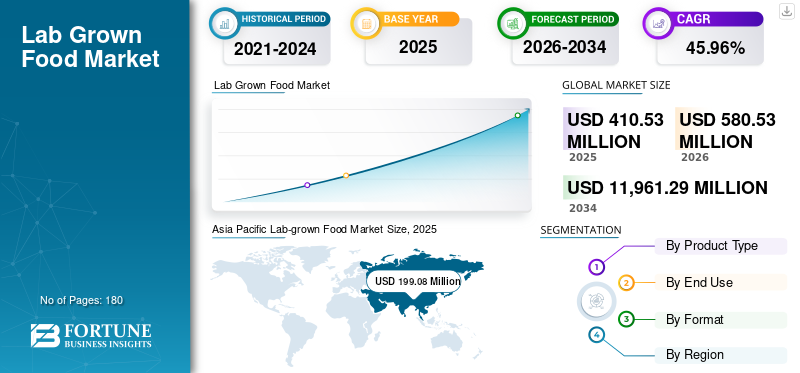
The global lab-grown food market size was valued at USD 410.53 million in 2025. The market is projected to grow from USD 580.53 million in 2026 to USD 11,961.29 million by 2034, exhibiting a CAGR of 45.96% during the forecast period. Asia Pacific dominated the lab grown food market with a market share of 48.49% in 2025.
Lab-grown food, also known as cultivated or cell-based food, is produced by growing animal cells in controlled environments. This includes products such as cultured meat and seafood created using cellular agriculture and biotechnology processes. The market is expanding due to growing concerns about sustainability, animal welfare, and the environmental effects of traditional farming. Key factors driving this growth include higher global demand for protein, limited natural resources, and the push to lower greenhouse gas emissions.
Companies such as Upside Foods, Mosa Meat, and Aleph Farms are some of the key players operating in this market. The launch of new products and receiving regulatory approvals are the key strategy boosting product sales and supporting the market growth.
Download Free sample to learn more about this report.
LAB-GROWN FOOD MARKET KEY TAKEAWAYS
 Global Market Size & Forecast
- 2025 Market Size: USD 410.53 million
- 2026 Market Size: USD 580.53 million
- 2034 Forecast Market Size: USD 11,961.29 million
- CAGR: 45.96% from 2026–2034
 Market Share
- Asia Pacific dominated the lab-grown food market with a 48.49% share in 2025.
- The cultivated poultry segment held the largest market share in 2025.
- The R&D regulatory and pilot facilities segment dominated the market in 2025.
 Key Regional Highlights
Asia Pacific
Asia Pacific the market reached USD 199.08 million in 2025, driven by strong government support, food security initiatives, and investments in cellular agriculture.
North America
North America the market reached USD 109.78 million in 2025, supported by early regulatory approvals, strong biotech infrastructure, and increasing commercialization.
Europe
Europe the market was valued at USD 66.74 million in 2025, with growth supported by rising investments despite stringent novel food regulations.
U.S.
The market reached USD 101.06 million in 2025, driven by FDA and USDA approvals and growing investments in cultivated meat commercialization.
Japan
The country is witnessing increasing investments in cellular agriculture, supported by government initiatives to strengthen long-term food security and alternative protein production.
Read More

LAB-GROWN FOOD MARKET TRENDS
Shift toward Process Optimization, Modular Bioreactors, and Ingredient-Level Commercialization to Drive Market Evolution
The market is focusing more on improving production processes. Companies are moving toward using smaller, modular bioreactor systems instead of large, centralized facilities due to challenges related to the scaling up of the operations. Moreover, companies are partnering with bioprocessing and fermentation firms and use existing infrastructure for production. Firms are also choosing to design products that are more likely to get regulatory approval, instead of focusing on offering a wide variety for consumers. There is also a growing focus on selling ingredients such as fats or cell biomass, rather than complete finished products further supporting sales and boosting growth.
MARKET DYNAMICS
MARKET DRIVERS
Download Free sample to learn more about this report.
Rising Sustainability, Food Security, and Animal Welfare Concerns to Drive Investment in Lab-Grown Food Technologies
The market is driven by increasing pressure on conventional protein supply systems due to the rising global population and resource constraints. Concerns around environmental impact, including greenhouse gas emissions, land use, and water consumption from traditional livestock farming, are accelerating interest in cellular agriculture. A stronger focus on animal welfare and ethical eating is encouraging consumers to switch toward lab-cultured foods. Large investments from venture capital and support from government innovation programs are helping the further development of the technology. The market is gaining traction as surveys conducted indicate growing consumer curiosity and the gradual acceptance of cultured meat as a sustainable protein alternative. Early regulatory approvals in places such as the U.S. and Singapore are allowing companies to start selling these products supporting the lab-grown food market growth.
MARKET RESTRAINTS
High Production Costs, Scalability Barriers, and Regulatory Complexity May Limit Commercial Expansion
The market is heavily impacted by high production costs, especially for growth media and bioreactor equipment. Scaling up production is challenging and requires high investment cost, as current output is much lower than what the market needs. Several countries are still restricting the commercialization of the products hindering market expansion in new territories. Additionally, consumer acceptance is also uncertain due to limited awareness among consumers about 'lab-grown' food. Infrastructure and a lack of standardized production systems further restrict large-scale deployment. It also faces competition from plant-based meat manufacturers which are gaining wider acceptance among consumers.
MARKET OPPORTUNITIES
Media Cost Reduction, Hybrid Product Development, and Strategic Partnerships to Create Pathways for Commercial Viability
Companies can lower costs by improving media, scaling up bioprocesses, and using automation. Making hybrid products that mix cultivated and plant-based ingredients can help support better product commercialization. Partnering with foodservice providers, ingredient companies, and research institutions can help companies enter the market faster. Focusing on export-driven markets and areas with food security needs can further open up new growth opportunities.
Segmentation Analysis
By Format
Replication of Conventional Meat Experience to Drive Dominance of Whole-Cut / Structured Products Segment
The market is segmented by format into processed / prepared products, blended / hybrid products, whole-cut / structured products, and others.
The whole-cut / structured products segment led the global lab-grown food market share in 2025. Whole-cut or structured products account for the highest market share as they replicate conventional meat in form, texture, and eating experience. Companies focus on these products to build a premium image and gain consumer acceptance, especially in foodservice.
The blended / hybrid products segment is anticipated to expand at a CAGR of 46.99% during the forecast period. Blended or hybrid products hold the second-largest share as they combine cultivated cells with plant-based ingredients to reduce cost and improve scalability.
By Product Type
Lower Production Complexity to Drive Dominance of Cultivated Pork Fat & Fat-Enabled Products Segment
By product type, the market is segmented into cultivated pork fat & fat-enabled products, cultivated poultry, cultivated salmon / fish, and other cultivated products.
The cultivated poultry segment accounted for the largest market share in 2025 and is expected to register a CAGR of 46.97% during the forecast period. The segment holds the largest share as avian cells can multiply quickly in comparison to other animal pork cells. This helps to shorten the bioreactor production cycles and enhances the production capacity with quick turnaround time.
The cultivated pork fat & fat-enabled products segment held the second-largest share in the global market in 2025 with increasing lab-grown food demand. The segment is expanding rapidly as these products are easier and cheaper to produce than whole muscle meat. Fat cells are less complex, need less precise equipment, and can be produced faster, which makes them easier to scale. Moreover, companies can improve plant-based or hybrid products by adding even small amounts of this meat, supporting the meat industry growth.
To know how our report can help streamline your business, Speak to Analyst
By End Use
Rising Investments Focused on Cultivated Food Ingredient Endeavors to Push R&D Regulatory and Pilot Facilities Segment Growth
The market is segmented by end use into commercial food sales, B2B product co-development, technology/input suppliers, and R&D regulatory and pilot facilities.
The R&D regulatory and pilot facilities segment accounted for the largest market share in 2025. Several companies are exploring the integration of cultivated ingredients into processed foods. As significant investment is required to move from small-scale labs to massive bioreactors, investment has increased in recent years to reduce the cost of growth media and improve cell lines that helps to bring down the production cost and make the products affordable for consumers.
The commercial food sales is the fastest growing segment, which is anticipated to expand at a CAGR of 46.96% during the forecast period as commercialization is currently limited to controlled, small-scale environments. Restaurants provide an ideal entry point where companies can introduce cultivated products in limited quantities, manage pricing at a premium level, and gather real-time consumer feedback. Fine dining and pilot partnerships help brands present lab-cultured food as a new, high-value option without facing the challenges of large-scale production.
Lab-grown Food Market Regional Outlook
By geography, the market is categorized into Europe, North America, Asia Pacific, South America, and the Middle East & Africa.
Asia Pacific
Asia Pacific Lab-grown Food Market Size, 2025 (USD Million)
To get more information on the regional analysis of this market, Download Free sample
The Asia Pacific market was valued at USD 199.08 million in 2025 and is the leading region in the global market. Asia Pacific is becoming a key area for growth due to soaring concerns related to food security and a rising need for protein. Singapore is the first country in the world to approve cultivated meat for commercial sale, setting a standard for regulations. China and Japan are making major investments in cellular agriculture to support their long-term plans for food independence. The region receives support through government funding and partnerships between the public and private sectors. But gaps in infrastructure and limited ability to produce at scale are holding back commercialization in the short term. The market growth is shaped more by government policies than by consumer demand.
Singapore Lab-grown Food Market
The Singapore market was around USD 57.94 million in 2025, accounting for roughly 1.25% of global market revenues. Singapore is the most advanced market globally in terms of regulatory approval, being the first country to allow the commercial sale of cultivated meat. The market is policy-driven, with strong government support aimed at enhancing food security under its “30 by 30” initiative. Companies work in a regulated yet innovation-friendly setting, concentrating on pilot-scale production and integrating products into foodservice. The country acts more as a hub for regulation and innovation than as a major consumer market.
Australia and New Zealand Lab-grown Food Market
The Australia and New Zealand market was valued at around USD 45.15 million in 2025, representing roughly 0.53% of the global market. The Australia market is in the early development stage, supported by research institutions and a growing number of startups. The country is leveraging its strong agricultural base to explore alternative protein innovations, including cellular agriculture. The market is expected to grow slowly, with a focus on export-driven alternative protein strategies.
North America
The North America market reached USD 109.78 million in 2025. North America is the most advanced market, led by the U.S., where regulatory approvals have enabled early commercialization of cultivated meat. The region is characterized by strong investment in this sector, the presence of key players such as Upside Foods and Eat Just, and a well-developed biotech infrastructure. Several companies are partnering with foodservice operators as a key way to bring their products to the market.
U.S. Lab-grown Food Market
In 2025, the U.S. market reached a valuation of USD 101.06 million. The U.S. leads the market, impelled by clear regulations from the FDA and USDA. Companies such as Upside Foods and Eat Just have received approvals, allowing them to start limited foodservice sales. The market benefits from strong venture capital support and advanced biotech facilities. Consumer acceptance is increasing but still limited.
- In June 2023, the U.S. Department of Agriculture (USDA) approved two companies, UPSIDE Foods and Good Meat, to sell lab-grown meat in the country. With these approvals, the U.S. became the second country, after Singapore, to allow the sale of cultivated meat.
Canada Lab-grown Food Market
In 2025, the Canada market reached USD 6.22 million. The Canada market is still focused on research, with support from top universities and government innovation programs. Most of the activity initiates from early-stage startups and pilot projects, not from products already on the market. Investment is lower and infrastructure for scaling up is still improving. The market is likely to grow slowly due to evolving regulatory changes.
Europe
The European market reached a valuation of USD 66.74 million in 2025. The Europe market faces challenges due to different regulations across countries and a slower approval process by EFSA compared to the U.S. and Singapore. Companies such as Mosa Meat and Aleph Farms are also investing in the European market, but strict novel food regulations are slowing down commercialization. The region is developing stringent rules related to process validation, safety data, and traceability instead of pushing for early market entry.
Germany Lab-Grown Food Market
The market in Germany reached around USD 12.25 million in 2025, representing roughly 3.40% of the global market revenues. The Germany market is driven by strong demand for organic-certified and cold-pressed oils, particularly olive oil and emerging alternatives such as flaxseed and avocado oil.
U.K. Lab-Grown Food Market
The U.K. market reached approximately USD 16.10 million in 2025, equivalent to around 2.40% of global market sales.
South America and Middle East & Africa
The South America market recorded a value of USD 14.81 million in 2025. South America has minimal direct activity in lab-cultured food commercialization. There is limited startup presence and negligible infrastructure for cellular agriculture. Investment is constrained and the economic case for cultivated meat is weak given the region’s cost advantage in conventional meat production. As a result, the market is not demand-driven and remains largely absent from the current global value chain.
The Middle East & Africa region reached a valuation of USD 20.12 million in 2025. In the Middle East, development is very selective, and Israel serves as a critical center for research and development, while the UAE focuses on commercializing products and importing them. The government policies shape the market, especially those aimed at improving food security and reducing reliance on imports. In Africa, the market is niche with small growth that requires a high investment cost. Growth is still limited to a few innovation hubs with limited growth.
Israel Lab-grown Food Market
The Israel market is set to grow at a CAGR of 44.19% during the forecast period. Israel is a leading innovation hub in the market, with a high concentration of startups such as Aleph Farms and Future Meat Technologies. The ecosystem is driven by strong government support, venture capital funding, and advanced R&D capabilities. The country focuses on technological breakthroughs in cell lines, growth media, and production efficiency. While commercialization is still limited, Israel is positioning itself as a global exporter of cultivated meat technology.
COMPETITIVE LANDSCAPE
Key Industry Players
Companies Emphasize Cost Reduction and Meat Products Production to Secure a Strong Footing
The lab-grown food market is dominated by a few well-funded companies, including Upside Foods, Eat Just, Mosa Meat, and Aleph Farms, which are leading in early commercialization. In this market, competition is based less on branding and more on scaling up the production of meat products, improving bioreactor efficiency, and lowering the cost per kilogram. Some companies are manufacturing hybrid products that combine cultivated and plant-based ingredients. This move helps them reach commercial goals and increases competition in technology and formulation, rather than just focusing on product differences.
LIST OF KEY LAB-GROWN FOOD COMPANIES PROFILED
- Upside Foods (U.S.)
- Aleph Farms (Israel)
- Mosa Meat (Netherlands)
- GOOD Meat (U.S.)
- Believer Meats (U.S.)
- Meatable (Netherlands)
- Vow (Australia)
- BlueNalu (U.S.)
- SuperMeat (Israel)
- Wildtype (U.S.)
KEY INDUSTRY DEVELOPMENTS
- September 2025: U.S. based company Mission Barns commercially sold its cultivated pork for the first time. Few months back, the company also received approval from the USDA to sell its products in the market.
- June 2025: U.S.-based company Wildtype launched its cultivated salmon in restaurants across restaurants the U.S.
- June 2023: UPSIDE Foods, a leading cultivated meat, poultry, and seafood company, completed the pre-market regulatory review process for its Cultivated Poultry and obtained a Grant of Inspection (GOI) from the U.S. Department of Agriculture (USDA). With this approval, UPSIDE Foods started the commercial production and sales of its cultivated poultry.
- January 2023: U.S.-based company Wildtype raised USD 100 million in Series B funding and launched its cultivated sushi-grade salmon in restaurants. This funding further helped the company expand its operations in the U.S. market.
- August 2022: Novel Farms Inc., a U.S. based company, launched marbled cultivated pork loin in the market. It developed a proprietary microbial fermentation approach to produce edible, customizable scaffolds.
REPORT COVERAGE
The global lab-grown food market research report provides an in-depth study of market size & forecast by all the market segments included in the report. The market analysis includes details on the market dynamics and trends expected to drive the market forecast. It offers information on technological advancements, new product launches, meat market, key industry developments, and details on partnerships, mergers, and acquisitions. The market report also encompasses detailed competitive landscape with information on the market segmentation, market share, and profiles of key operating players.
Request for Customization to gain extensive market insights.
Report Scope & Segmentation
| ATTRIBUTE | DETAILS |
| Study Period | 2021-2034 |
| Base Year | 2025 |
| Estimated Year 2026 | 2026 |
| Forecast Period | 2026-2034 |
| Historical Period | 2021-2024 |
| Growth Rate | CAGR of 45.96% from 2026-2034 |
| Unit | Value (USD Million) |
| Segmentation | By Product Type, By End Use, By Format, and Region |
| By Product Type |
|
| By End Use |
|
| By Format |
|
| By Region |
|
Frequently Asked Questions
Fortune Business Insights says that the global market value stood at USD 410.53 million in 2025 and is projected to reach USD 11,961.29 million by 2034.
In 2025, the North America market value stood at USD 109.78 million.
The market is expected to exhibit a CAGR of 45.96% during the forecast period.
By product type, the cultivated pork fat & fat-enabled products segment led the global market in 2025.
Rising sustainability, food security, and animal welfare concerns are key factors driving the market.
Upside Foods, Mosa Meat, and Aleph Farms are the top players in the market.
Asia Pacific held the largest market share in 2025.
Shift toward process optimization, modular bioreactors, and ingredient-level commercialization is a major trend in the market.



- 2021-2034
- 2025
- 2021-2024
- 180
-
(Offer valid till 15th Sep 2026)
Get 30-60 hrs Free Customization
Expand Regional and Country Coverage, Segments Analysis, Company Profiles, Competitive Benchmarking, and End-user Insights.



















-
US +1 833 909 2966 ( Toll Free )
-
Get In Touch With Us