 Download Free Sample



Get a Quote
Receive a tailored pricing based on your needs.
- Choose license type
- Multiple user options
- Custom scope & coverage
- Fast turnaround
"Designing Growth Strategies is in our DNA"
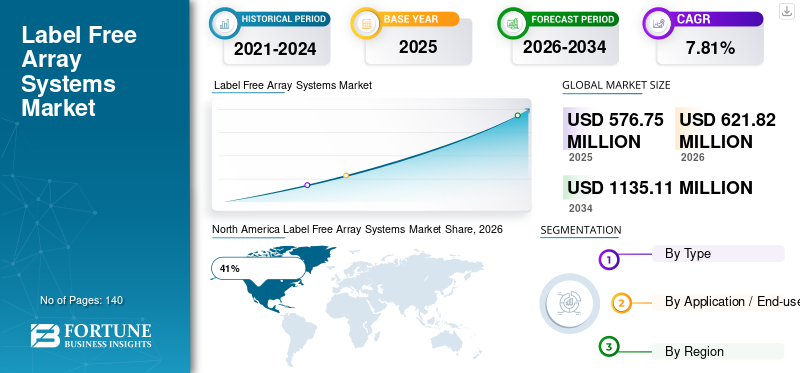
The label free array systems market size was valued at USD 576.75 Million in 2025. The market is projected to grow from USD 621.82 Million in 2026 to USD 1135.11 Million by 2034, exhibiting a CAGR of 7.81% during the forecast period.

The label free array systems market is experiencing strong momentum due to increasing demand for advanced biomolecular interaction analysis, drug discovery applications, and high-throughput screening technologies. Label-free array systems enable researchers to analyze biological interactions without fluorescent or radioactive labels, improving data accuracy and reducing assay complexity. Pharmaceutical companies, biotechnology firms, and academic research institutions are increasingly utilizing these systems for protein interaction studies, antibody characterization, biomarker discovery, and cell-based assays. label free array systems market analysis indicates growing adoption of real-time detection technologies that provide kinetic and affinity measurements. Continuous innovation in biosensing platforms and automation capabilities is strengthening the label free array systems market outlook across multiple research domains.
The United States remains a leading contributor to the label free array systems market due to its strong pharmaceutical research ecosystem, extensive biotechnology infrastructure, and advanced life science research activities. Research organizations and drug developers continue investing in technologies that improve screening efficiency and biomolecular analysis accuracy. Growing emphasis on biologics development and precision medicine has accelerated the use of label-free technologies in laboratories throughout the country. Federal support for biomedical research and the presence of major industry participants further contribute to market expansion. The USA remains a significant hub for label free array systems market research report developments and technological advancements.
Download Free sample to learn more about this report.
 Global Market Size & Forecast
 Market Share
 Key Regional Highlights
North America
North America led the market with a 41% share, supported by strong pharmaceutical and biotechnology research activities.
Europe
Europe accounted for 29% of the market, driven by established life sciences research and drug development activities.
Asia-Pacific
Asia-Pacific held a 23% share, supported by expanding biotechnology research and pharmaceutical investments.
U.S
The U.S. remains a key market, supported by advanced pharmaceutical research and adoption of label-free analytical technologies.
Japan
Japan accounted for approximately 22% of the Asia-Pacific market, supported by advanced life sciences research and pharmaceutical development.
Read More

The label free array systems market trends are evolving rapidly as life science researchers seek faster, more accurate, and cost-efficient analytical technologies. One major trend involves the integration of artificial intelligence and machine learning algorithms into label-free platforms to improve data interpretation and predictive modeling capabilities. Researchers are increasingly using automated systems capable of handling large sample volumes while maintaining analytical precision.
Download Free sample to learn more about this report.
Another key trend is the growing adoption of multiplexed array technologies that enable simultaneous analysis of multiple biological interactions within a single experiment. Pharmaceutical and biotechnology companies are emphasizing high-throughput screening approaches to accelerate drug development timelines. Advances in sensor sensitivity, microfluidics, and real-time monitoring technologies continue enhancing system performance. label-free array systems industry analysis also highlights increasing demand for cloud-connected laboratory platforms that support remote data access, collaborative research environments, and streamlined workflow management. These developments are expected to shape future label free array systems market growth and create new commercial opportunities for industry participants.
Growing Demand for Drug Discovery and Biopharmaceutical Research
The primary driver of label free array systems market growth is the expanding demand for advanced drug discovery and biopharmaceutical research technologies. Pharmaceutical companies are under increasing pressure to accelerate the development of novel therapeutics while improving research efficiency. Label-free systems provide valuable insights into molecular interactions without requiring chemical labels that can alter biological behavior.
The growing focus on biologics, monoclonal antibodies, and targeted therapies has significantly increased demand for technologies capable of delivering accurate kinetic and affinity measurements. Research institutions and biotechnology companies are adopting label-free platforms to support biomarker identification, protein characterization, and therapeutic validation. label free array systems market forecast assessments indicate that continuous investment in life science research and pharmaceutical innovation will remain a major factor driving industry expansion. The ability to generate high-quality data while reducing assay preparation requirements further enhances the attractiveness of these systems across research environments.
High Initial Equipment and Infrastructure Costs
One of the key restraints affecting the label free array systems market is the substantial investment required for system acquisition, laboratory integration, and ongoing maintenance. Advanced label-free technologies often involve sophisticated instrumentation, specialized software platforms, and highly trained personnel, creating financial barriers for smaller organizations.
Academic institutions and emerging biotechnology companies may face budget limitations that restrict adoption despite recognizing the benefits of label-free analysis. In addition, laboratories transitioning from traditional analytical methods often require infrastructure upgrades and workforce training. These factors can extend implementation timelines and influence purchasing decisions. While technological advancements are gradually improving accessibility, cost considerations remain a significant challenge within the Label Free Array Systems Industry Report landscape. Vendors continue developing scalable solutions and service-based business models to address affordability concerns and broaden market penetration.
Expansion of Precision Medicine and Biomarker Discovery
The growing emphasis on precision medicine represents a major opportunity for participants in the label free array systems market. Healthcare providers and researchers are increasingly focused on developing personalized treatment approaches based on individual biological characteristics. This trend requires advanced analytical tools capable of identifying and validating disease-specific biomarkers.
Label-free technologies offer significant advantages for biomarker discovery because they provide real-time interaction data without modifying biological samples. Pharmaceutical companies are utilizing these platforms to improve patient stratification strategies and therapeutic targeting. Expanding research activities related to oncology, immunology, and rare diseases are expected to create additional opportunities. label free array systems market Opportunities are further supported by increasing collaboration among academic institutions, biotechnology firms, and pharmaceutical manufacturers seeking innovative solutions for precision healthcare applications.
Complexity of Data Interpretation and Standardization
A major challenge within the label free array systems market involves the complexity associated with data analysis and result standardization. Label-free technologies generate extensive datasets that require advanced analytical expertise and specialized software tools. Variability in experimental conditions and platform configurations can affect data comparability across different laboratories.
Researchers often face difficulties in establishing universally accepted protocols for certain applications, creating challenges for validation and reproducibility. Regulatory expectations regarding data quality and consistency further increase operational complexity. Market participants must invest in software innovation, user training, and workflow standardization to address these concerns. Successfully overcoming these challenges will be essential for strengthening confidence in label-free technologies and supporting broader market adoption.
Surface Plasmon Resonance (SPR) accounts for approximately 46% of the label free array systems market share by type. SPR technology is widely recognized for its ability to provide real-time monitoring of biomolecular interactions with high sensitivity and precision. Researchers extensively utilize SPR systems for drug discovery, antibody characterization, protein binding analysis, and biomarker validation studies.
The popularity of SPR is driven by its capability to measure kinetic parameters without labeling requirements. Pharmaceutical companies rely on SPR platforms to evaluate molecular binding affinities and support therapeutic development programs. Continuous improvements in sensor design, automation, and throughput capabilities have strengthened the technology's competitive position. label free array systems market insights indicate that SPR remains the preferred technology for many high-value research applications due to its established reliability and extensive scientific validation.
Bio-layer Interferometry (BLI) represents approximately 31% of the market share. BLI systems provide efficient, label-free analysis of molecular interactions through optical interference measurements. The technology is particularly valued for its operational simplicity, scalability, and suitability for high-throughput screening environments.
Biotechnology and pharmaceutical organizations increasingly adopt BLI platforms for antibody screening, protein quantification, and biosimilar development activities. The ability to process multiple samples simultaneously improves laboratory productivity while maintaining analytical accuracy. Advancements in automation and software integration continue enhancing workflow efficiency. As demand for biologics research expands, BLI technologies are expected to maintain strong relevance within the label free array systems market Size landscape.
Cellular Dielectric Spectroscopy (CDS) holds approximately 23% of the market share. This technology enables real-time monitoring of cellular responses by measuring changes in electrical properties associated with biological activity. Researchers utilize CDS platforms to investigate receptor signaling pathways, cellular behavior, and pharmacological responses.
The technology is gaining traction in drug development programs that require functional cellular analysis without fluorescent labeling. Pharmaceutical companies are increasingly incorporating CDS systems into screening workflows to improve understanding of complex biological mechanisms. Growing interest in cell-based assays and personalized medicine applications supports ongoing demand. label free array systems market trends indicate increasing utilization of CDS technologies in advanced therapeutic research and translational medicine initiatives.
To know how our report can help streamline your business, Speak to Analyst
Pharmaceutical and biotechnology companies account for approximately 52% of total market demand. These organizations rely heavily on label-free array systems for target identification, lead optimization, therapeutic validation, and biomolecular interaction studies. The growing complexity of modern drug development programs has increased demand for analytical technologies capable of delivering accurate and reproducible results. Label-free platforms support critical research activities involving biologics, gene therapies, and precision medicine solutions. Their ability to provide real-time interaction analysis reduces development risks and improves decision-making efficiency. Ongoing investment in therapeutic innovation continues reinforcing the dominance of this end-use segment within the label free array systems market Report environment.
Academic and research institutes represent approximately 30% of market share. Universities and government-funded laboratories utilize label-free systems to investigate fundamental biological processes, disease mechanisms, and molecular interactions. These institutions often serve as early adopters of emerging analytical technologies. Research grants supporting life sciences innovation contribute significantly to equipment procurement and infrastructure development. Academic collaborations with pharmaceutical companies further expand utilization of advanced analytical platforms. label-free array systems industry analysis suggests sustained growth within this segment as global research activity continues increasing.
Contract Research Organizations account for approximately 18% of the market. CROs provide outsourced research services for pharmaceutical and biotechnology clients seeking specialized expertise and cost-efficient development solutions. Label-free technologies enable these organizations to deliver high-quality analytical services while maintaining operational flexibility. Increasing outsourcing trends across the pharmaceutical sector continue supporting demand for advanced screening and characterization capabilities. CROs are investing in modern analytical platforms to differentiate service offerings and attract new clients. This segment remains an important contributor to label free array systems market Opportunities.
North America Label Free Array Systems Market Share, 2025 (%)
To get more information on the regional analysis of this market, Download Free sample
North America accounts for approximately 41% of the global label free array systems market share. The region benefits from strong pharmaceutical research activity, extensive biotechnology infrastructure, and substantial investment in life sciences innovation. Research institutions, academic centers, and pharmaceutical companies actively utilize label-free technologies for drug discovery and molecular characterization.
Advanced laboratory infrastructure and access to highly skilled scientific talent support widespread adoption. Regulatory frameworks encouraging innovation and biomedical research further strengthen market development. The region remains a primary center for technological advancement and commercialization of next-generation analytical systems.
Europe represents approximately 29% of the global market. The region maintains a strong position due to extensive pharmaceutical manufacturing capabilities, advanced academic research networks, and increasing investment in precision medicine initiatives. Researchers across Europe continue adopting label-free technologies to support therapeutic development and biomarker discovery programs.
Collaborative research projects involving industry and academic institutions contribute significantly to innovation. Government funding for life science research and healthcare modernization further enhances market prospects. European laboratories remain important users of advanced analytical platforms supporting complex biological investigations.
Germany contributes approximately 31% of the European label free array systems market. The country benefits from a well-established biotechnology sector, extensive pharmaceutical manufacturing capabilities, and strong academic research infrastructure. German research institutions are recognized globally for innovation in molecular biology, analytical chemistry, and biomedical engineering.
Demand for label-free technologies is increasing across pharmaceutical development programs, academic laboratories, and industrial research centers. The country's emphasis on scientific excellence and precision manufacturing supports adoption of advanced analytical systems. Ongoing investment in biotechnology research continues creating favorable opportunities for market expansion.
The United Kingdom accounts for approximately 25% of the European market. The country maintains a highly developed life sciences ecosystem supported by world-class research institutions and biotechnology clusters. Pharmaceutical companies and academic organizations continue investing in technologies that accelerate drug discovery and biomarker identification.
The increasing focus on personalized medicine and translational research contributes to growing demand for label-free analytical platforms. Collaborative innovation programs and supportive research funding environments further strengthen market development. The UK remains a key contributor to regional technological advancement.
Asia-Pacific holds approximately 23% of the global market share. Rapid expansion of pharmaceutical manufacturing, increasing biotechnology investments, and growing research capabilities are supporting regional growth. Countries throughout the region are enhancing scientific infrastructure to strengthen competitiveness within global life science markets.
The adoption of advanced analytical technologies continues increasing among academic institutions, contract research organizations, and pharmaceutical companies. Government initiatives promoting biotechnology innovation and healthcare modernization contribute to favorable market conditions across the region.
Japan represents approximately 22% of the Asia-Pacific market. The country possesses advanced scientific research capabilities and extensive expertise in precision instrumentation. Pharmaceutical companies and academic institutions actively utilize label-free technologies to support therapeutic development and molecular interaction studies.
The growing focus on regenerative medicine, biologics research, and personalized healthcare continues driving demand. Japanese organizations remain influential contributors to analytical technology innovation, supporting the adoption of sophisticated research platforms across multiple disciplines.
China accounts for approximately 42% of the Asia-Pacific market. The country has significantly expanded its biotechnology and pharmaceutical research capabilities over recent years. Government initiatives supporting scientific innovation and healthcare development have accelerated adoption of advanced analytical technologies.
Research organizations and pharmaceutical companies increasingly invest in label-free systems to enhance drug discovery efficiency and biomolecular analysis capabilities. Expanding laboratory infrastructure and strong manufacturing capabilities further strengthen China's position within the regional market.
The Rest of World region accounts for approximately 7% of the global market. Growth is supported by increasing research investments, expanding healthcare infrastructure, and rising awareness of advanced analytical technologies. Countries in Latin America, the Middle East, and Africa are gradually strengthening life science research capabilities.
Academic institutions and emerging biotechnology companies are adopting modern analytical systems to support local research initiatives. International collaborations and technology transfer programs continue creating new opportunities for market development throughout these regions.
Investment activity within the label free array systems market is increasing as pharmaceutical companies, biotechnology firms, and research institutions seek advanced technologies that improve analytical efficiency and accelerate discovery programs. Capital investments are particularly focused on automation, artificial intelligence integration, sensor innovation, and high-throughput screening capabilities.
Strategic acquisitions and research collaborations continue shaping competitive dynamics. Investors recognize significant opportunities associated with biologics development, biomarker discovery, and precision medicine initiatives. Contract research organizations are also expanding analytical service portfolios through investments in label-free technologies. The increasing importance of real-time molecular interaction analysis supports long-term investment attractiveness. label free array systems market Opportunities are expected to expand further as scientific research becomes increasingly data-driven and technologically sophisticated.
Manufacturers are focusing on the development of highly sensitive, automated, and scalable label-free array systems capable of supporting modern research requirements. Recent innovations include enhanced sensor architectures, advanced microfluidic platforms, and software tools powered by machine learning algorithms.
New product development efforts are also emphasizing multiplexing capabilities that enable simultaneous analysis of multiple biomolecular interactions. Improved workflow automation reduces operator intervention and increases laboratory productivity. Companies are introducing user-friendly interfaces, cloud-based data management systems, and integrated analytical solutions that support collaborative research environments. These innovations continue strengthening the label free array systems market outlook and expanding application potential across pharmaceutical, biotechnology, and academic sectors.
The label free array systems market research report provides comprehensive evaluation of industry developments, technological advancements, market dynamics, competitive positioning, and emerging growth opportunities. The report examines evolving research requirements across pharmaceutical, biotechnology, academic, and contract research sectors.
Request for Customization to gain extensive market insights.
Coverage includes detailed segmentation by type, application, end-use industry, and geographical region. The analysis evaluates adoption patterns for Surface Plasmon Resonance, Bio-layer Interferometry, and Cellular Dielectric Spectroscopy technologies while assessing their impact on research productivity and innovation. The study also explores investment trends, strategic partnerships, product development initiatives, and regulatory influences affecting market evolution. label free array systems market insights presented within the report support informed decision-making for manufacturers, investors, research organizations, and industry stakeholders seeking competitive advantages in a rapidly evolving scientific landscape.
Fortune Business Insights says that the global market value stood at USD 576.75 million in 2025 and is projected to reach USD 1,135.11 million by 2034.
The market is expected to exhibit a CAGR of 7.81% during the forecast period of 2026-2034.
Surface Plasmon Resonance (SPR) led the type segment with approximately 46% share, supported by its high sensitivity and precision in real-time biomolecular interaction analysis.
Key players include Illumina Inc., Thermo Fisher Scientific Inc., Agilent Technologies Inc., PerkinElmer Inc., Merck KGaA, and Danaher Corporation.
Major trends include the integration of AI and machine learning into label-free platforms and growing adoption of multiplexed array technologies and automated high-throughput screening. North America led the market with a 41% share.


(Offer valid till 31st Oct 2026)
Get 30-60 hrs Free Customization
Expand Regional and Country Coverage, Segments Analysis, Company Profiles, Competitive Benchmarking, and End-user Insights.













.webp)






Get In Touch With Us
US +1 833 909 2966 ( Toll Free )
Receive a tailored pricing based on your needs.
Discuss your questions with our industry experts.
Have questions? Get quick answers before you purchase.

