 Download Free Sample




Get a Quote
Receive a tailored pricing based on your needs.
- Choose license type
- Multiple user options
- Custom scope & coverage
- Fast turnaround
"Designing Growth Strategies is in our DNA"
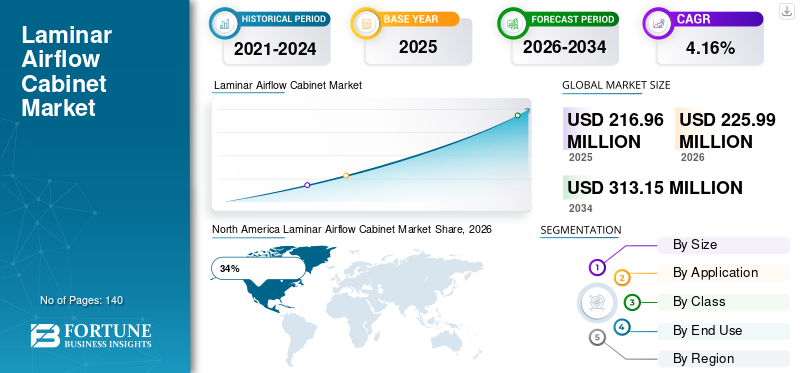
The global laminar airflow cabinet market size was valued at USD 216.96 million in 2025. The market is projected to grow from USD 225.99 million in 2026 to USD 313.15 million by 2034, exhibiting a CAGR of 4.16% during the forecast period.

The laminar airflow cabinet market is expanding steadily due to increasing demand for contamination-free environments across pharmaceutical manufacturing, biotechnology laboratories, healthcare facilities, food processing units, and research institutions. Laminar airflow cabinets are critical for maintaining sterile working conditions by directing filtered air through HEPA filtration systems. The market is witnessing higher adoption of advanced airflow technologies, energy-efficient systems, and low-noise cabinet designs that improve laboratory productivity and operational safety. laminar airflow cabinet market analysis indicates that growing emphasis on laboratory quality standards and cleanroom compliance is accelerating procurement activities globally. Manufacturers are introducing compact, modular, and customizable cabinet solutions to meet varying industrial requirements while improving operational reliability.
The USA laminar airflow cabinet market remains highly developed due to strong pharmaceutical production capabilities, advanced biotechnology research infrastructure, and strict laboratory safety regulations. Research institutions, clinical laboratories, and pharmaceutical companies are investing heavily in contamination-control technologies to ensure compliance with sterile processing standards. laminar airflow cabinet market trends in the United States show increasing adoption of energy-efficient vertical airflow systems with advanced monitoring features and touchscreen controls. Rising investments in life sciences research and vaccine production are further strengthening demand for high-performance airflow cabinets. In addition, laboratory modernization projects across universities and healthcare facilities continue to generate stable replacement demand throughout the country.
Download Free sample to learn more about this report.
 Global Market Size & Forecast
 Market Share
 Key Regional Highlights
North America
North America led the market with a 34% share, supported by strong pharmaceutical and biotechnology activities.
Europe
Europe accounted for 28% of the market, driven by established healthcare and laboratory infrastructure.
Asia-Pacific
Asia-Pacific held a 30% share, supported by expanding pharmaceutical manufacturing and biotechnology research.
U.S
The U.S. remains a key market, supported by strong demand for contamination-control equipment in pharmaceutical and biotechnology facilities.
Japan
Japan accounted for approximately 19% of the Asia-Pacific market, supported by advanced laboratory infrastructure and pharmaceutical research.
Read More

The laminar airflow cabinet market is witnessing substantial technological advancement driven by rising laboratory automation and increasing focus on contamination prevention. One of the most significant trends involves the adoption of smart airflow cabinets equipped with digital monitoring systems, airflow alarms, and automated filter performance tracking. laminar airflow cabinet market insights indicate that pharmaceutical and biotechnology companies increasingly prefer cabinets with energy-saving features and low-maintenance filtration systems. Compact cabinet configurations designed for limited laboratory spaces are also gaining popularity among small-scale research facilities and educational institutions.
Download Free sample to learn more about this report.
Another important trend influencing the laminar airflow cabinet industry is the growing demand for modular and customizable cabinet solutions. Manufacturers are offering cabinets tailored for specialized applications such as microbiology testing, tissue culture, semiconductor manufacturing, and pharmaceutical compounding. laminar airflow cabinet market research report findings also show rising adoption of antimicrobial coatings and UV sterilization technologies to improve contamination control. Sustainability concerns are encouraging manufacturers to develop cabinets with lower power consumption and recyclable components. Additionally, digital integration with laboratory management systems is improving operational efficiency and supporting the expansion of intelligent laboratory environments across global industries.
Rising Demand for Sterile Laboratory and Pharmaceutical Environments
The increasing need for contamination-free workspaces across pharmaceutical production, biotechnology research, and healthcare laboratories is a major growth driver for the laminar airflow cabinet market. Regulatory authorities worldwide are enforcing strict sterile processing and cleanroom compliance standards, compelling organizations to invest in advanced airflow cabinet systems. laminar airflow cabinet market analysis indicates that pharmaceutical manufacturers are expanding production capacities for biologics, vaccines, and injectable medicines, directly increasing demand for contamination-control equipment.
Biotechnology companies and academic research institutions are also strengthening investments in sterile laboratory infrastructure to support advanced scientific research and product development activities. laminar airflow cabinet market growth is further supported by rising awareness regarding laboratory safety and infection prevention. Healthcare facilities are increasingly using laminar airflow cabinets for microbiological testing and pharmaceutical preparation to reduce contamination risks. The rapid expansion of clinical laboratories and diagnostic centers globally continues to strengthen commercial demand for high-performance airflow cabinet systems designed for precision-controlled laboratory environments.
High Installation and Maintenance Costs
The high initial investment required for purchasing and installing advanced laminar airflow cabinets remains a significant restraint affecting market expansion. Small laboratories, educational institutions, and medium-sized healthcare facilities often face budget limitations when procuring high-quality contamination-control systems. laminar airflow cabinet market research report findings indicate that premium cabinets equipped with digital monitoring systems, advanced HEPA filtration, and automated controls involve substantial procurement costs, particularly for facilities operating multiple sterile workstations.
Maintenance expenses also contribute to operational challenges within the market. Regular replacement of HEPA filters, airflow calibration, and performance validation are essential to maintain sterile conditions and regulatory compliance. laminar airflow cabinet market trends reveal that improper maintenance can reduce operational efficiency and compromise contamination-control effectiveness. In addition, fluctuations in raw material prices and electronic component costs may increase manufacturing expenses and influence product pricing structures. These financial factors can restrict adoption rates among cost-sensitive end users, particularly in developing regions with limited laboratory infrastructure budgets.
Expansion of Biotechnology and Pharmaceutical Research Activities
The rapid growth of biotechnology research, pharmaceutical development, and healthcare diagnostics is creating substantial opportunities in the laminar airflow cabinet market. Research laboratories and pharmaceutical companies are continuously expanding sterile processing capacities to support drug discovery, vaccine development, and molecular testing activities. laminar airflow cabinet market opportunities are particularly strong in emerging economies where governments and private investors are increasing healthcare and life sciences infrastructure investments.
The growing adoption of personalized medicine and cell-based therapies is also increasing demand for advanced contamination-control equipment. laminar airflow cabinet market outlook studies indicate that expanding biotechnology startups and clinical research organizations are investing heavily in modern laboratory environments equipped with high-efficiency airflow cabinets. Educational institutions and university laboratories are additionally contributing to market growth through laboratory modernization projects. Manufacturers developing compact, energy-efficient, and digitally integrated airflow cabinet systems are expected to benefit from expanding demand across healthcare, pharmaceutical, and industrial research sectors globally.
Compliance with Evolving Regulatory Standards
One of the major challenges facing the laminar airflow cabinet market is maintaining compliance with constantly evolving laboratory safety and contamination-control regulations. Manufacturers must ensure that airflow cabinets meet stringent international standards regarding airflow performance, filtration efficiency, and contamination prevention. laminar airflow cabinet industry analysis indicates that obtaining certifications and regulatory approvals can increase development costs and extend product commercialization timelines.
Another challenge involves increasing competition among regional and international manufacturers. Companies are under pressure to deliver technologically advanced cabinet systems while maintaining competitive pricing. laminar airflow cabinet market trends also reveal growing customer expectations regarding energy efficiency, automation, and sustainability. Continuous innovation is required to meet the operational requirements of pharmaceutical laboratories, biotechnology facilities, and healthcare institutions. In addition, disruptions in electronic component supply chains and rising raw material costs can affect manufacturing schedules and product availability, creating operational complexity across the global market.
The 2x2 Feet segment accounts for approximately 42% of the laminar airflow cabinet market and is widely preferred by small laboratories, research institutions, and educational facilities with limited workspace availability. These compact airflow cabinets provide effective contamination control while optimizing laboratory space utilization. laminar airflow cabinet market analysis indicates strong adoption among microbiology labs, pathology centers, and small-scale pharmaceutical testing facilities where compact equipment configurations are essential for operational flexibility. Manufacturers are increasingly introducing portable and energy-efficient 2x2 Feet laminar airflow cabinets equipped with advanced HEPA filtration systems and low-noise airflow technologies. laminar airflow cabinet market trends show rising demand for cabinets featuring UV sterilization, digital airflow monitoring, and ergonomic workstation designs. Small biotechnology startups and university laboratories are key end users of this segment due to its affordability and adaptability to diverse research applications.
The 3x2 Feet segment represents approximately 58% of the laminar airflow cabinet market and dominates commercial laboratory installations due to its larger working area and improved operational efficiency. Pharmaceutical manufacturing facilities, biotechnology companies, and advanced research laboratories frequently utilize these cabinets for sterile processing applications requiring larger workspace dimensions. laminar airflow cabinet market insights indicate that this segment benefits from increasing demand for high-capacity laboratory systems capable of supporting complex testing and pharmaceutical preparation procedures. The larger cabinet size allows operators to handle multiple instruments and laboratory processes simultaneously while maintaining sterile conditions. laminar airflow cabinet market research report findings reveal rising adoption of 3x2 Feet cabinets with energy-efficient blowers, automated airflow controls, and enhanced filtration systems.
To know how our report can help streamline your business, Speak to Analyst
Vertical Laminar Flow Cabinets account for approximately 63% of the laminar airflow cabinet market due to their superior contamination-control efficiency and widespread industrial applicability. These cabinets direct filtered air vertically downward, minimizing contamination risks and providing enhanced operator protection. laminar airflow cabinet market analysis indicates that pharmaceutical laboratories, biotechnology facilities, and semiconductor manufacturing units strongly prefer vertical airflow systems because they reduce cross-contamination and optimize sterile processing conditions. Vertical airflow cabinets are increasingly equipped with advanced digital interfaces, UV sterilization systems, and low-energy motors to improve operational efficiency. laminar airflow cabinet market trends also highlight rising demand for cabinets with adjustable airflow speed and touchscreen monitoring capabilities.
Horizontal Laminar Flow Cabinets hold approximately 37% of the laminar airflow cabinet market and remain important for applications requiring direct airflow across the work surface. These cabinets are commonly utilized in electronics assembly, medical device manufacturing, and non-hazardous laboratory operations where product protection is prioritized. laminar airflow cabinet market insights indicate that horizontal cabinets offer excellent visibility and workspace accessibility, making them suitable for precision-oriented laboratory procedures.Manufacturers are focusing on developing compact horizontal airflow systems with enhanced filtration efficiency and ergonomic workstation configurations. laminar airflow cabinet market outlook studies reveal increasing adoption among academic laboratories and small-scale industrial facilities due to their cost-effectiveness and operational simplicity.
Class 1 Laminar Airflow Cabinets account for approximately 46% of the laminar airflow cabinet market and are widely utilized in applications requiring operator protection and controlled airflow management. These cabinets are designed to maintain sterile conditions while protecting laboratory personnel from hazardous particles and contaminants generated during operational processes. laminar airflow cabinet market analysis indicates that pharmaceutical laboratories, microbiology research centers, and diagnostic facilities are major users of Class 1 systems due to their ability to ensure contamination-free processing environments. Increasing emphasis on occupational safety standards and laboratory hygiene protocols continues to strengthen adoption of these cabinets across healthcare and industrial facilities. Manufacturers are increasingly developing Class 1 airflow cabinets with advanced filtration systems, digital airflow monitoring technologies, and low-energy operational designs.
Class 2 Laminar Airflow Cabinets represent approximately 54% of the laminar airflow cabinet market and dominate high-containment laboratory applications due to their superior contamination-control capabilities. These cabinets provide protection for operators, products, and laboratory environments simultaneously, making them highly suitable for biotechnology research, vaccine production, pharmaceutical compounding, and advanced microbiological testing. laminar airflow cabinet market insights indicate that increasing regulatory requirements regarding sterile processing and laboratory biosafety are significantly driving demand for Class 2 systems across pharmaceutical and healthcare industries. Healthcare laboratories and research organizations increasingly prefer these cabinets because of their enhanced biosafety performance and operational flexibility. Growing demand for cell culture research, molecular diagnostics, and personalized medicine development is expected to support strong market expansion for Class 2 laminar airflow cabinet systems during the forecast period.
The Pharmaceutical & Biotechnology Companies segment accounts for approximately 48% of the laminar airflow cabinet market and remains the leading end-use category due to extensive sterile processing requirements. Pharmaceutical manufacturers utilize laminar airflow cabinets for drug formulation, vaccine production, microbiological testing, and contamination-sensitive laboratory operations. Increasing investments in biologics manufacturing and advanced pharmaceutical research are significantly strengthening demand for high-performance contamination-control equipment. Biotechnology companies are also expanding laboratory capacities to support molecular diagnostics, cell culture studies, and personalized medicine development. Growing adoption of advanced Class 2 cabinets equipped with digital airflow monitoring systems and automated filtration controls continues to support market expansion within this segment. Hospitals & Diagnostic Laboratories represent approximately 29% of the laminar airflow cabinet market due to increasing demand for sterile laboratory environments and infection-control technologies. Healthcare institutions rely on airflow cabinets for microbiological testing, pharmaceutical preparation, sample processing, and contamination-sensitive diagnostic procedures.
North America Laminar Airflow Cabinet Market Share, 2026 (%)
To get more information on the regional analysis of this market, Download Free sample
North America accounts for approximately 34% of the laminar airflow cabinet market due to its advanced pharmaceutical industry, biotechnology research capabilities, and strong laboratory infrastructure. The region benefits from extensive investments in healthcare innovation, vaccine manufacturing, and clinical diagnostics. laminar airflow cabinet market analysis indicates that pharmaceutical companies and research organizations across the United States and Canada prioritize contamination-control technologies to maintain regulatory compliance and product quality standards.
In addition, government funding for biomedical research and public health preparedness programs continues to support the installation of advanced laboratory infrastructure across hospitals, universities, and pharmaceutical facilities. The United States remains the largest contributor within the region due to its extensive pharmaceutical manufacturing base and strong biotechnology ecosystem. Canada is also witnessing rising investments in healthcare laboratories and life sciences innovation centers. Increasing focus on laboratory worker safety and contamination prevention is encouraging organizations to replace outdated systems with technologically advanced airflow cabinets. The growing adoption of automation in laboratory operations and rising demand for precision-controlled sterile environments are expected to further strengthen market growth across North America during the forecast period.
Europe represents approximately 28% of the laminar airflow cabinet market and remains a major hub for pharmaceutical production, biotechnology research, and laboratory innovation. laminar airflow cabinet market research report findings show increasing investments in sterile laboratory infrastructure among pharmaceutical manufacturers and healthcare institutions throughout the region. European laboratory operators prioritize high-performance airflow systems capable of meeting stringent contamination-control standards and sustainability objectives.
European countries are also emphasizing modernization of healthcare laboratories and expansion of biotechnology research centers to strengthen medical innovation capabilities. Regulatory agencies across the region enforce strict laboratory safety and contamination-control standards, encouraging continuous investments in certified airflow cabinet technologies. Countries such as France, Italy, and the Netherlands are witnessing increasing procurement of advanced sterile processing equipment for pharmaceutical and diagnostic applications. The region also benefits from strong collaboration between academic institutions and biotechnology companies, supporting demand for high-performance laboratory infrastructure. Growing focus on sustainable laboratory operations and energy-efficient equipment is expected to influence future purchasing decisions.
Germany contributes approximately 26% of Europe’s laminar airflow cabinet market due to its strong pharmaceutical manufacturing sector and advanced industrial research infrastructure. laminar airflow cabinet market analysis indicates that German laboratories prioritize precision-engineered airflow systems with high filtration efficiency and long operational durability. Biotechnology research centers, healthcare institutions, and pharmaceutical production facilities are major end users driving demand for advanced contamination-control equipment.
Germany also benefits from a highly developed industrial manufacturing ecosystem that supports innovation in laboratory equipment and contamination-control technologies. Pharmaceutical companies operating in the country are investing heavily in modern cleanroom facilities and sterile production environments to maintain international quality standards. Research universities and biotechnology institutes are increasingly adopting advanced airflow cabinets equipped with automated monitoring systems and enhanced filtration technologies. The country’s focus on precision engineering and technological advancement encourages manufacturers to develop highly efficient and durable laboratory systems.
The United Kingdom accounts for approximately 21% of Europe’s laminar airflow cabinet market and remains an important center for pharmaceutical research and laboratory innovation. laminar airflow cabinet market research report findings show increasing demand for contamination-control equipment among biotechnology firms, academic research institutions, and healthcare laboratories. Pharmaceutical companies are investing in advanced airflow cabinet systems to improve sterile processing efficiency and regulatory compliance.
The United Kingdom is also witnessing increased investments in biotechnology startups and pharmaceutical innovation programs supported by both government and private funding initiatives. Universities and research organizations are expanding laboratory capacities to support advanced scientific studies and clinical research projects. Demand for compact and energy-efficient airflow cabinets is rising among healthcare laboratories seeking to optimize operational efficiency while maintaining contamination-control standards. The country’s growing emphasis on personalized medicine and biologics manufacturing is creating additional opportunities for advanced sterile processing equipment suppliers. Furthermore, increasing collaboration between pharmaceutical companies and academic institutions is driving procurement of technologically advanced laboratory systems.
Asia-Pacific holds approximately 30% of the laminar airflow cabinet market and remains one of the fastest-growing regions due to expanding pharmaceutical manufacturing and healthcare infrastructure development. laminar airflow cabinet market analysis indicates strong demand from China, Japan, India, South Korea, and Southeast Asia where biotechnology research and laboratory modernization projects are accelerating rapidly. Rising healthcare investments and increasing government support for pharmaceutical production are strengthening regional demand for sterile laboratory equipment.
Rapid industrialization and increasing healthcare awareness are encouraging governments throughout the region to strengthen laboratory infrastructure and pharmaceutical production capabilities. Countries such as India and South Korea are investing heavily in biotechnology parks, research laboratories, and healthcare modernization initiatives. Rising demand for affordable healthcare services and expansion of diagnostic testing facilities are also contributing to increased adoption of contamination-control equipment. International pharmaceutical companies are expanding manufacturing operations across Asia-Pacific due to favorable production costs and growing domestic demand for medicines. Educational institutions and scientific research centers are additionally investing in advanced laboratory technologies to support innovation and academic research activities.
Japan represents approximately 19% of the Asia-Pacific laminar airflow cabinet market due to its advanced healthcare sector and strong pharmaceutical research capabilities. laminar airflow cabinet market trends indicate increasing demand for precision-engineered airflow systems capable of supporting high-performance laboratory operations. Pharmaceutical manufacturers and biotechnology companies are investing in contamination-control technologies to improve operational efficiency and maintain stringent quality standards.
Japan’s aging population and increasing healthcare requirements are encouraging expansion of pharmaceutical research and advanced diagnostic services across the country. Government initiatives supporting biotechnology innovation and regenerative medicine research are creating additional opportunities for laboratory equipment manufacturers. Japanese companies are known for emphasizing technological precision, reliability, and operational efficiency, which drives demand for high-quality airflow cabinet systems. Research institutions and healthcare laboratories are increasingly adopting smart laboratory technologies integrated with automated monitoring and contamination-control features. The country is also witnessing rising investments in vaccine development and molecular diagnostics, further strengthening demand for sterile laboratory environments. Continuous advancements in robotics, automation, and laboratory engineering are expected to support future innovation within Japan’s laminar airflow cabinet market while maintaining stable long-term commercial growth opportunities.
China accounts for approximately 38% of the Asia-Pacific laminar airflow cabinet market due to rapid expansion of pharmaceutical manufacturing, biotechnology research, and healthcare infrastructure projects. laminar airflow cabinet market analysis highlights strong government support for domestic pharmaceutical production and advanced laboratory development initiatives. Research institutions and pharmaceutical companies are increasingly investing in high-efficiency airflow cabinet systems to support sterile manufacturing and laboratory testing activities.
China’s rapidly growing healthcare sector and increasing investments in scientific research are significantly strengthening demand for contamination-control technologies. Government policies encouraging domestic pharmaceutical innovation and biotechnology development are supporting expansion of laboratory infrastructure across major cities and industrial zones. Hospitals, diagnostic centers, and academic institutions are increasingly adopting advanced airflow cabinet systems to improve laboratory safety and operational efficiency. The country is also emerging as a major manufacturing hub for laboratory equipment, enabling wider availability of cost-effective airflow cabinet solutions. Rising exports of pharmaceutical products and increasing participation in global clinical research activities are further driving demand for sterile laboratory environments. Continuous advancements in healthcare technology, expansion of biotechnology startups, and modernization of pharmaceutical production facilities are expected to sustain strong growth momentum within China’s laminar airflow cabinet market.
The Rest of World region accounts for approximately 8% of the laminar airflow cabinet market and includes emerging opportunities across Latin America, the Middle East, and Africa. laminar airflow cabinet market insights indicate increasing investments in healthcare infrastructure, pharmaceutical manufacturing, and laboratory modernization initiatives throughout these regions. Governments and private organizations are expanding diagnostic and research capabilities, generating rising demand for contamination-control equipment. laminar airflow cabinet market outlook studies reveal growing adoption of cost-effective airflow cabinet systems among educational laboratories and healthcare facilities in developing economies.
Several countries within Latin America and the Middle East are focusing on strengthening domestic pharmaceutical production and reducing dependence on imported healthcare products. This shift is encouraging investments in sterile laboratory environments and contamination-control technologies. Healthcare modernization programs across Africa are also contributing to rising demand for laboratory equipment used in diagnostics, microbiology testing, and pharmaceutical preparation. International aid organizations and healthcare partnerships are supporting laboratory infrastructure development in underserved regions. Educational institutions and research centers are increasingly adopting airflow cabinet systems to improve laboratory safety and research quality. Growing awareness regarding infection prevention and contamination control is expected to encourage wider adoption of advanced airflow technologies. As healthcare infrastructure continues to improve across emerging economies, the Rest of World region is projected to offer significant long-term growth opportunities for laminar airflow cabinet manufacturers.
The laminar airflow cabinet market is attracting significant investment due to increasing pharmaceutical manufacturing activities and expansion of biotechnology research infrastructure globally. laminar airflow cabinet market opportunities are particularly strong in emerging economies where governments are increasing funding for healthcare modernization and laboratory development projects. Pharmaceutical companies are investing heavily in sterile processing facilities and advanced contamination-control systems to support biologics production and vaccine manufacturing.
Manufacturers are also expanding production capacities and investing in advanced filtration technologies, smart monitoring systems, and energy-efficient cabinet designs. laminar airflow cabinet market analysis indicates that rising laboratory automation trends are creating opportunities for companies developing digitally integrated airflow systems with remote monitoring capabilities. Academic institutions and clinical research organizations continue to invest in laboratory modernization programs, generating stable commercial demand for advanced airflow cabinets. Strategic partnerships between equipment manufacturers and healthcare providers are expected to support long-term market expansion.
Innovation remains a major competitive factor in the laminar airflow cabinet market as manufacturers focus on improving contamination control, energy efficiency, and operational convenience. laminar airflow cabinet market trends show increasing introduction of smart airflow cabinets featuring touchscreen interfaces, digital airflow monitoring, automated alarms, and remote diagnostic capabilities. Manufacturers are also developing cabinets with enhanced HEPA filtration systems capable of improving sterile processing performance in pharmaceutical and biotechnology laboratories.
Compact and modular cabinet designs are becoming increasingly popular among laboratories with limited operational space. laminar airflow cabinet market research report findings reveal rising adoption of UV sterilization technologies and antimicrobial interior coatings to strengthen contamination prevention capabilities. Companies are additionally focusing on low-noise airflow systems and energy-efficient motors to improve workplace comfort and sustainability performance. Continuous advancements in airflow engineering and smart laboratory integration are expected to support future product innovation across the global market.
The laminar airflow cabinet market report provides detailed analysis of contamination-control equipment demand across pharmaceutical manufacturing, biotechnology research, healthcare laboratories, and industrial applications. laminar airflow cabinet market research report coverage includes segmentation by cabinet type, application, regional outlook, competitive landscape, and technological developments influencing market expansion. The report evaluates operational trends, laboratory modernization activities, and regulatory factors affecting procurement strategies worldwide.
Request for Customization to gain extensive market insights.
laminar airflow cabinet industry analysis also examines market dynamics including drivers, restraints, opportunities, and challenges shaping industry development. The report highlights investment patterns, product innovation strategies, and advancements in airflow monitoring technologies. Regional analysis covers pharmaceutical infrastructure growth, healthcare investments, and biotechnology expansion influencing commercial demand for airflow cabinets. The study additionally reviews strategic developments among leading manufacturers and evaluates evolving customer requirements within highly regulated laboratory environments.
Fortune Business Insights says that the global market value stood at USD 216.96 million in 2025 and is projected to reach USD 313.15 million by 2034.
The market is expected to exhibit a CAGR of 4.16% during the forecast period of 2026-2034.
Vertical Laminar Flow Cabinets led the product segment with approximately 63% share, supported by their contamination-control efficiency and widespread industrial applicability.
Key players include MRC Group, Brinda Pharma Technologies, Bionics Scientific Technologies (P) Ltd., Esco Micro Pte. Ltd., Labocon, and Roch Mechatronics Inc.
Major trends include the adoption of smart airflow cabinets with digital monitoring and automated filter tracking and growing demand for modular, customizable, energy-efficient systems with UV sterilization and antimicrobial coatings. North America led the market with a 34% share.


(Offer valid till 31st Oct 2026)
Get 30-60 hrs Free Customization
Expand Regional and Country Coverage, Segments Analysis, Company Profiles, Competitive Benchmarking, and End-user Insights.













.webp)






Get In Touch With Us
US +1 833 909 2966 ( Toll Free )
Receive a tailored pricing based on your needs.
Discuss your questions with our industry experts.
Have questions? Get quick answers before you purchase.

