Landscaping Products Market Size, Share & Industry Analysis, By Product (Ground Coverings, Planting Material, Hardscaping), By Application (Commercial, Residential and Regional Forecast, 2026-2034
 Download Free Sample
Landscaping Products Market Size & Overview
The landscaping products market size was valued at USD 2192.78 Billion in 2025. The market is projected to grow from USD 2341.92 Billion in 2026 to USD 3964.42 Billion by 2034, exhibiting a CAGR of 6.80% during the forecast period.

The landscaping products market is a vital segment of the outdoor construction, horticulture, and property improvement industry. Landscaping products include ground coverings, planting materials, hardscaping materials, decorative aggregates, pavers, retaining walls, garden structures, and outdoor enhancement products used in residential and commercial projects. Increasing urbanization, expansion of green infrastructure, growing interest in outdoor living spaces, and rising investment in sustainable landscape design continue to influence market development. Demand for durable and environmentally friendly landscaping solutions has increased across public parks, corporate campuses, hospitality facilities, educational institutions, and residential communities. The landscaping products market report highlights growing adoption of permeable paving systems, native plant materials, and water-efficient landscaping solutions.
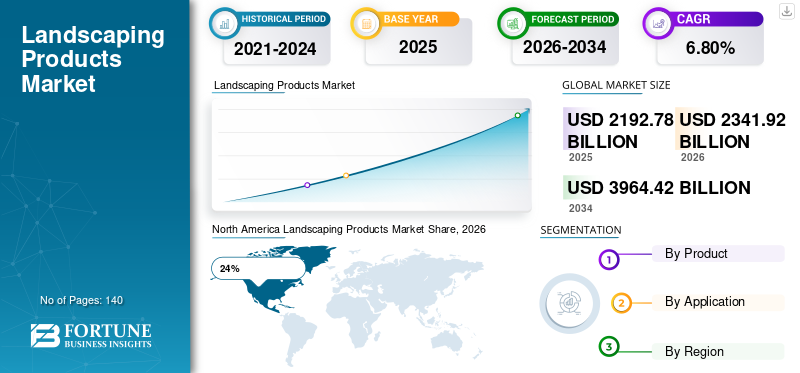
Download Free sample to learn more about this report.
USA landscaping products market
The United States remains the largest individual contributor to the landscaping products market due to strong residential renovation activity and extensive commercial property development. Homeowners increasingly invest in patios, outdoor kitchens, decorative stone installations, and sustainable garden designs. Municipal authorities continue to allocate resources for parks, recreational areas, and urban greening projects. The landscaping products market analysis for the United States indicates rising demand for hardscaping products, drought-resistant planting materials, and recycled landscaping materials. Commercial facilities, retail centers, hotels, healthcare campuses, and educational institutions also support market expansion through continuous landscape improvement projects. The growing focus on outdoor aesthetics and property value enhancement strengthens long-term demand.
Landscaping Products Market Key Takeaways
 Global Market Size & Forecast
- 2025 Market Size: USD 2,192.78 Billion
- 2026 Market Size: USD 2,341.92 Billion
- 2034 Forecast Market Size: USD 3,964.42 Billion
- CAGR: 6.80% from 2026-2034
 Market Share
- The market in Asia-Pacific dominated with a revenue share of 27% in 2025.
- Hardscaping dominated by product with a market share of approximately 41%.
- Residential applications dominated by application with a market share of approximately 62%.
 Key Regional Highlights
Asia-Pacific
Asia-Pacific led the market with a 27% share, supported by expanding urban development and landscaping investments.
Europe
Europe accounted for 26% of the market, driven by growing demand for sustainable landscaping and green infrastructure.
North America
North America held a 24% share, supported by strong residential and commercial landscaping activities.
U.S
The U.S. remains a key market, supported by strong demand for residential landscaping and outdoor living solutions.
Japan
Japan accounted for approximately 16% of the Asia-Pacific market, supported by growing demand for sustainable and low-maintenance landscaping solutions.
Read More

landscaping products market Latest trends
The landscaping products market trends demonstrate a major shift toward sustainability, smart landscape management, and multifunctional outdoor spaces. Permeable pavers, recycled aggregates, climate-resilient plants, and environmentally responsible hardscaping materials are gaining widespread acceptance among contractors and property developers. Businesses increasingly prioritize products that reduce water consumption and improve environmental performance.
Download Free sample to learn more about this report.
Smart irrigation systems integrated with sensors and automated controls are becoming standard components of modern landscaping projects. Commercial customers seek landscaping products that support long-term maintenance efficiency while enhancing visual appeal. The landscaping products market research report also identifies growing demand for outdoor living environments incorporating seating areas, decorative stone, retaining structures, lighting systems, and native vegetation. Green roofs, urban gardens, biodiversity-focused planting schemes, and sustainable drainage solutions are creating additional opportunities for manufacturers and suppliers. These trends continue to reshape procurement strategies across residential and commercial sectors.
landscaping products market Dynamics
DRIVER
Rising Demand for Outdoor Living Spaces and Property Enhancement
The primary growth driver in the landscaping products market is the increasing demand for outdoor living spaces across residential and commercial properties. Property owners are allocating larger budgets toward garden renovations, outdoor entertainment zones, patios, walkways, and decorative landscaping installations. Businesses are investing in attractive exterior environments to improve customer experiences and strengthen brand image. Hotels, resorts, office complexes, healthcare facilities, and educational institutions increasingly incorporate landscaping as part of overall infrastructure development.
The Landscaping Products Industry report indicates that landscaping projects are no longer limited to aesthetics. Modern landscape designs contribute to environmental sustainability, stormwater management, temperature regulation, and biodiversity enhancement. Growing awareness of these benefits encourages greater adoption of advanced landscaping products. The landscaping products market Growth is also supported by increasing urban green space development and public-sector investment in parks and recreational facilities. These factors collectively drive continuous product demand across multiple end-user segments.
RESTRAINT
High Installation and Maintenance Costs
One of the major restraints affecting the landscaping products market is the relatively high cost associated with installation and ongoing maintenance. Premium hardscaping materials, specialized planting materials, irrigation systems, and decorative landscape features often require substantial capital investment. Labor-intensive installation procedures further increase project expenses.
Commercial developers and residential consumers frequently delay landscaping projects during periods of economic uncertainty. Additionally, maintenance requirements for certain landscaping products can create long-term financial obligations. Seasonal replacement of plants, irrigation repairs, weed management, and surface maintenance contribute to overall ownership costs. The landscaping products market Outlook indicates that budget constraints remain a significant challenge for smaller property owners and municipalities with limited infrastructure funding. As a result, adoption rates may vary depending on economic conditions and local investment priorities.
OPPORTUNITY
Expansion of Sustainable and Eco-Friendly Landscaping Solutions
The strongest opportunity within the landscaping products market opportunities landscape is the growing adoption of sustainable landscaping practices. Governments, municipalities, businesses, and homeowners increasingly prioritize environmentally responsible landscape development. Demand for recycled materials, permeable paving systems, native plants, organic ground coverings, and water-efficient landscaping products continues to increase.
Sustainable landscaping products support stormwater management, reduce urban heat island effects, and improve biodiversity. Commercial property owners seek certifications and sustainability credentials that encourage investment in eco-friendly landscape infrastructure. The landscaping products market Forecast suggests significant opportunities for manufacturers developing innovative products with lower environmental impact. Green infrastructure projects, urban redevelopment programs, and climate adaptation initiatives are expected to generate substantial demand for sustainable landscaping materials over the coming years. These trends create favorable conditions for product innovation and market expansion.
CHALLENGE
Supply Chain Volatility and Raw Material Availability
A significant challenge facing the landscaping products market involves fluctuations in raw material availability and supply chain disruptions. Products such as natural stone, cement-based materials, aggregates, decorative gravel, timber, and specialty horticultural materials are vulnerable to transportation constraints and sourcing challenges.
Manufacturers frequently encounter rising production costs due to changes in energy prices, logistics expenses, and raw material procurement conditions. Seasonal demand patterns can also create inventory management difficulties. The Landscaping Products Industry analysis indicates that maintaining consistent product availability remains a critical concern for suppliers serving large-scale commercial projects. Extended lead times may delay construction schedules and increase project costs. Businesses operating in this market must continuously optimize supply chains and diversify sourcing strategies to maintain competitiveness.
landscaping products market Segmentation
By Product
Ground coverings account for approximately 28% of the landscaping products market share. This category includes mulch, decorative bark, gravel, artificial turf, landscape fabrics, and protective soil coverings used across residential and commercial applications. Ground coverings play an essential role in erosion control, moisture retention, weed suppression, and visual enhancement.
Demand continues to increase as property owners seek low-maintenance landscape solutions capable of improving site appearance while reducing maintenance requirements. Commercial developments, parks, and institutional facilities frequently utilize decorative ground coverings to improve operational efficiency. Sustainable mulch products and recycled materials are becoming increasingly popular among environmentally conscious customers. The landscaping products market Insights indicate that demand for premium decorative ground coverings remains particularly strong in urban development projects and commercial landscape installations.
Planting material represents approximately 31% of the landscaping products market size. This segment includes trees, shrubs, flowers, ornamental grasses, native plants, and specialized horticultural products. Growing interest in biodiversity, environmental sustainability, and green infrastructure continues to support segment expansion.
Municipal greening initiatives, urban forestry programs, and residential gardening activities contribute significantly to demand. Commercial properties increasingly utilize planting materials to improve environmental performance and enhance visual appeal. Native species and drought-tolerant plants are gaining popularity because they require less water and maintenance. The landscaping products market report identifies increasing adoption of climate-resilient plant materials as a major factor supporting long-term segment growth. Landscape architects and designers increasingly prioritize plant diversity and ecological performance when selecting planting materials.
Hardscaping is the largest product segment, accounting for approximately 41% of the landscaping products market share. This category includes pavers, retaining walls, natural stone, concrete products, decorative aggregates, outdoor structures, pathways, and related construction materials.
Demand is driven by increasing investment in patios, outdoor entertainment areas, walkways, terraces, and commercial landscape infrastructure. Hardscaping products provide durability, functionality, and long-term value, making them highly attractive to property owners. Commercial developments frequently incorporate hardscaping features to improve accessibility and site aesthetics. The landscaping products market analysis indicates that permeable pavers and sustainable hardscape materials are experiencing particularly strong adoption. Continued innovation in design, durability, and environmental performance supports the dominance of this segment across global markets.
To know how our report can help streamline your business, Speak to Analyst
By Application
The commercial segment accounts for approximately 38% of the landscaping products market. Commercial applications include office complexes, hospitality facilities, educational institutions, healthcare campuses, retail centers, public parks, airports, and government facilities.
Organizations increasingly recognize landscaping as an important element of property value enhancement and customer experience. Commercial landscape investments often focus on long-term durability, sustainability, and maintenance efficiency. Hardscaping products, decorative planting materials, and ground coverings are widely utilized to create attractive and functional outdoor environments. The landscaping products market Outlook indicates continued investment in commercial landscape upgrades driven by urban development projects and public infrastructure programs. Sustainability goals and green building initiatives further strengthen demand across this segment.
The residential segment dominates the landscaping products market with approximately 62% share. Homeowners continue to invest in outdoor improvements that enhance property appearance, usability, and market value. Popular projects include patios, gardens, walkways, retaining walls, decorative stone installations, and outdoor entertainment areas.
Growing interest in outdoor living has significantly influenced purchasing behavior. Consumers increasingly seek landscaping products that combine aesthetic appeal with practical functionality. Water-efficient landscaping, native planting schemes, and low-maintenance materials remain highly attractive options. The landscaping products market research report identifies strong demand for premium residential landscaping solutions across both new construction and renovation projects. Continuous investment in home improvement activities supports the segment's leading position within the market.
landscaping products market Regional Outlook
North America Landscaping Products Market Share, 2026 (%)
To get more information on the regional analysis of this market, Download Free sample
North America
North America remains the leading regional market due to strong residential renovation activity, commercial property development, and extensive public investment in green infrastructure. Landscaping products are widely used across housing developments, hospitality facilities, educational campuses, and municipal projects. Sustainable landscaping practices continue gaining momentum throughout the region. Demand for hardscaping materials, decorative aggregates, and native planting solutions remains particularly strong. The Landscaping Products Industry report highlights ongoing investments in urban parks, recreational facilities, and climate-resilient landscape projects. Strong contractor networks and mature distribution systems further support market expansion.
Europe
Europe maintains a significant position within the landscaping products market due to widespread adoption of sustainable landscaping practices and urban greening initiatives. Municipal authorities continue investing in public parks, green corridors, and biodiversity enhancement projects. Demand for permeable paving, recycled materials, and native plant species remains strong. Commercial property owners increasingly prioritize environmentally responsible landscape solutions that support regulatory compliance and sustainability objectives. Landscape architects across the region focus on water-efficient designs and ecological restoration projects, contributing to stable market demand.
Germany landscaping products market
Germany represents approximately 24% of the European landscaping products market. The country benefits from strong environmental awareness, extensive urban planning programs, and significant investment in public green spaces. Municipalities actively promote sustainable landscaping solutions that support biodiversity and climate adaptation objectives.
Commercial developments frequently incorporate advanced landscaping products into office parks, mixed-use developments, and public infrastructure projects. Demand for permeable surfaces, decorative stone products, and native planting materials continues to increase. Residential consumers also invest heavily in garden improvements and outdoor living spaces. Germany's focus on environmental performance and sustainable urban development supports ongoing adoption of innovative landscaping solutions across both public and private sectors.
United Kingdom landscaping products market
The United Kingdom accounts for approximately 18% of the European landscaping products market. Demand is supported by residential garden renovation projects, commercial property upgrades, and public-sector landscape improvement initiatives. Outdoor living trends continue to influence consumer purchasing behavior across the country.
Landscape designers increasingly recommend climate-resilient plants, permeable paving systems, and sustainable hardscaping materials. Commercial developments prioritize attractive outdoor environments that improve visitor experiences and employee well-being. Urban regeneration projects also create opportunities for landscaping product suppliers. Growing interest in biodiversity and environmental sustainability contributes to expanding demand for eco-friendly landscaping solutions throughout the United Kingdom.
Asia-Pacific
Asia-Pacific accounts for approximately 27% of the landscaping products market. Rapid urbanization, infrastructure development, and rising residential construction activity continue driving regional demand. Governments increasingly invest in green infrastructure and public space enhancement projects to improve urban livability.
Growing middle-class populations and rising disposable income levels support residential landscaping activities across major economies. Commercial developments, hospitality facilities, and mixed-use projects contribute significantly to product demand. Sustainable landscape design and smart irrigation technologies are becoming more common throughout the region. These factors collectively support long-term market expansion.
Japan landscaping products market
Japan represents approximately 16% of the Asia-Pacific landscaping products market. The country emphasizes high-quality landscape design, efficient land utilization, and environmental sustainability. Public parks, corporate campuses, and residential developments frequently incorporate advanced landscaping products.
Japanese consumers value aesthetically refined outdoor environments that blend natural elements with architectural design. Demand remains strong for decorative stone, specialized planting materials, and compact landscaping solutions suitable for urban settings. Sustainability objectives and aging infrastructure renewal programs further support market activity.
China landscaping products market
China accounts for approximately 36% of the Asia-Pacific landscaping products market. Large-scale urbanization projects, smart city initiatives, and public infrastructure investments continue generating substantial demand for landscaping products. Municipal governments actively support green space development and ecological restoration programs.
Commercial real estate projects, transportation infrastructure, and residential communities increasingly incorporate comprehensive landscaping features. Demand for hardscaping products, planting materials, and sustainable ground coverings remains particularly strong. Continuous urban development and environmental improvement initiatives position China as a major contributor to regional market growth.
Rest of World
The Rest of World region accounts for approximately 8% of the landscaping products market. Demand is driven by urban development projects, tourism infrastructure investments, and increasing awareness of landscape aesthetics. Countries in the Middle East, Africa, and South America continue investing in public spaces, hospitality facilities, and residential developments.
Water-efficient landscaping products are especially important in regions with limited water resources. Governments increasingly promote green infrastructure initiatives to improve environmental quality and urban resilience. Growing adoption of sustainable landscaping practices supports long-term market opportunities across these emerging markets.
List of Top Landscaping Products Companies
- Griffon Corporation Inc.
- Haddonstone
- Home Depot
- Kafka Granite, LLC
- Heidelberg Materials
- Oldcastle APG, a CRH company
- The QUIKRETE Companies
- The Monarch Cement Company
- Henri Studio
- ecoDynamics
Top Two Companies by Market share
- Oldcastle APG, a CRH company – 11%
- Home Depot – 9%
Investment analysis and opportunities
Investment activity within the landscaping products market continues to focus on sustainable materials, advanced manufacturing technologies, and environmentally responsible product development. Companies are expanding production capacities for permeable paving systems, recycled aggregates, decorative stone products, and climate-resilient planting materials. Investors increasingly recognize the long-term value of landscaping products that support green infrastructure and urban sustainability objectives.
Significant opportunities exist in smart irrigation systems, eco-friendly ground coverings, recycled hardscaping materials, and biodiversity-focused planting solutions. Public-sector investment in parks, recreational facilities, and urban greening initiatives creates additional demand across multiple regions. The landscaping products market opportunities landscape also benefits from increasing adoption of outdoor living concepts and property enhancement projects. Strategic partnerships between manufacturers, landscape architects, contractors, and municipal authorities are expected to generate further investment potential.
New Product Development
Innovation remains a key competitive factor within the landscaping products market. Manufacturers continue introducing products designed to improve sustainability, durability, and installation efficiency. Permeable pavers with enhanced drainage performance are gaining popularity among commercial developers and municipalities. Recycled composite materials are increasingly utilized in landscape construction applications.
Advanced planting products featuring drought tolerance, disease resistance, and climate adaptability are attracting strong interest from landscape professionals. Smart irrigation technologies incorporating sensors, weather monitoring, and automated controls continue expanding across residential and commercial projects. Manufacturers are also developing decorative hardscaping materials with improved environmental performance and reduced maintenance requirements. Product innovation focused on sustainability and long-term value remains a critical driver of competitive differentiation.
Five Recent Developments (2023-2025)
- Oldcastle APG expanded sustainable hardscaping product offerings with enhanced permeable paving solutions.
- Heidelberg Materials increased investment in low-carbon construction and landscape materials.
- Kafka Granite introduced additional recycled aggregate and decorative stone product lines.
- The QUIKRETE Companies expanded specialty outdoor construction material solutions for landscape applications.
- Home Depot broadened its landscaping product portfolio with increased emphasis on eco-friendly and water-efficient products.
report Coverage
The landscaping products market report provides comprehensive analysis of industry structure, product categories, application sectors, regional performance, competitive dynamics, and emerging market opportunities. The report evaluates market trends affecting ground coverings, planting materials, and hardscaping products across residential and commercial applications.
Request for Customization to gain extensive market insights.
The landscaping products market research report also examines technological developments, sustainability initiatives, investment patterns, and innovation strategies influencing industry participants. Regional assessments cover North America, Europe, Asia-Pacific, and Rest of World markets, with detailed insights into key countries. Competitive analysis evaluates leading manufacturers and suppliers operating within the industry. The report supports strategic decision-making by identifying market opportunities, growth drivers, operational challenges, and evolving customer preferences affecting future industry development.
Frequently Asked Questions
Fortune Business Insights says that the global market value stood at USD 2,192.78 billion in 2025 and is projected to reach USD 3,964.42 billion by 2034.
The market is expected to exhibit a CAGR of 6.80% during the forecast period of 2026-2034.
Hardscaping was the leading product segment with approximately 41% share, driven by demand for durable and functional products for patios, walkways, terraces, and commercial landscape infrastructure.
Key players include Griffon Corporation Inc., Haddonstone, Home Depot, Kafka Granite, LLC, Heidelberg Materials, and Oldcastle APG, a CRH company.
Major trends include growing adoption of sustainable landscaping products and smart landscape management, including permeable pavers, recycled aggregates, climate-resilient plants, and smart irrigation. Asia-Pacific accounted for approximately 27% of the market.



- 2021-2034
- 2025
- 2021-2024
- 140
-

(Offer valid till 15th Oct 2026)
Get 30-60 hrs Free Customization
Expand Regional and Country Coverage, Segments Analysis, Company Profiles, Competitive Benchmarking, and End-user Insights.
















-
US +1 833 909 2966 ( Toll Free )
-
Get In Touch With Us