Ammunition Market Size, Share & Industry Analysis, By Application (Military & Homeland Security, and Civil & Commercial) By Caliber (Small, Medium, and Large) By Product (Bullets, Aerial Bombs, Grenades, Mortars, Artillery Shells, and Others), By Component (Fuses& Primers, GunPowder, Projectile, Cases, and Others) By Guidance (Guided, and Non-Guided) By Lethality (Lethal, and Less-Lethal) and Regional Forecast, 2026-2034
 Download Free Sample
Ammunition Market Size and Industry Overview
 Listen to Audio Version
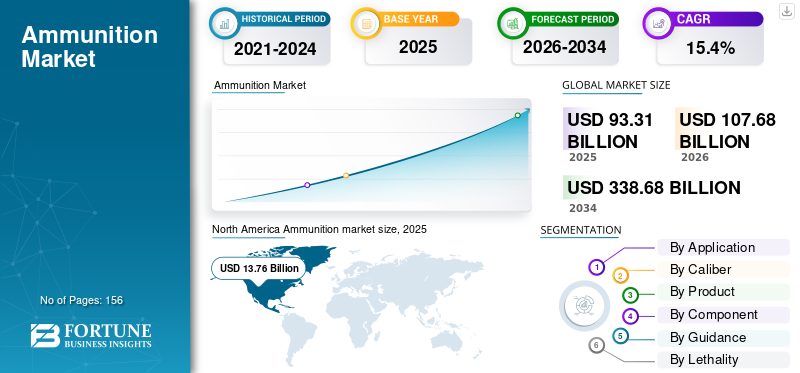
The global ammunition market size was valued at USD 93.31 billion in 2025 and is projected to grow from USD 107.68 billion in 2026 to USD 338.68 billion by 2034, exhibiting a CAGR of 15.40% during the forecast period. North America dominated the ammunition market with a market share of 54.05% in 2025. Industry growth driven by rising defense expenditure, modernization of military systems, increasing security concerns, and sustained demand from civil and commercial shooting activities
Ammunition is an object that can be shot from a weapon, such as a bomb and bullet. It includes the propellant, a projectile, and a primer that ignites the propellant. It is manufactured using a variety of materials such as steel, brass, and others. The small and medium-scale projectiles are mainly used for civilian use, such as shooting sports and self-defense. The large-caliber projectile is mostly used for military applications, with the size of the caliber ranging from 50mm to 240mm.
The rise in the procurement of ammo by the defense forces, border security forces, and local enforcement agencies, due to increasing terrorist activities, political unrest, and geopolitical tensions, drives the market. Furthermore, the growing demand for small-caliber projectiles by civilians and the homeland security department due to their lesser lethality would drive the market growth.
In 2016, BAE Systems launched a new high-performance 7.62mm small ammo. It can defeat lightly protected vehicles and aircraft at longer ranges. In 2019, Reload Swiss launched its new universal rifle projectile powder, RS76. This powder is suitable for different calibers such as .338 Lapua Magnum, .338 Norma Magnum, 7mm Remington Magnum, and .300 Norma Magnum.
The global ammunition market represents a critical component of the defense and security ecosystem, supporting military operations, law enforcement activities, and civilian applications. Ammunition demand is closely tied to geopolitical dynamics, defense modernization programs, and internal security requirements across nations. As a result, the ammunition market size reflects both strategic defense priorities and commercial consumption patterns.
Military procurement remains the primary driver of the ammunition market growth. Governments worldwide continue investing in advanced weapon systems and ammunition stockpiling to maintain operational readiness. Modernization initiatives increasingly emphasize precision-guided munitions, improved lethality, and enhanced performance in diverse operational environments.
The civil and commercial segment also contributes significantly to the ammunition market share. Recreational shooting, hunting, and personal defense applications sustain steady demand, particularly in regions with established firearm ownership cultures. This segment demonstrates relatively stable consumption patterns compared with defense procurement cycles.
Key structural forces shaping ammunition market trends include:
- Increasing global defense budgets and military modernization programs
- Rising demand for precision-guided and advanced munitions
- Growth in civilian shooting sports and recreational activities
- Technological advancements in materials and ballistic performance
Download Free sample to learn more about this report.
AMMUNITION MARKET KEY TAKEAWAYS:
 Market Size & Forecast
- 2025 Market Size: USD 93.31 billion
- 2026 Market Size: USD 107.68 billion
- 2034 Forecast Market Size: USD 338.68 billion
- CAGR: 15.40% from 2026–2034
 Market Share
- North America dominated the ammunition market with a market share of 54.05% in 2025.
- The large-caliber ammo segment holds the highest market share.
- Medium caliber ammunition is primarily used in military and law enforcement applications.
 Key Regional Highlights
North America
North America leads the ammunition market, supported by high defense spending, advanced manufacturing capabilities, and strong civilian demand for recreational and personal defense applications.
Europe
Europe maintains steady market growth through defense modernization initiatives, increased security investments, and strong industrial ammunition production capabilities.
Asia Pacific
Asia Pacific is projected to witness significant growth due to rising defense budgets, military modernization programs, and expanding armed forces across major economies.
U.S.
he United States dominates the global ammunition market owing to extensive military procurement, large-scale training activities, high civilian firearm ownership, and advanced production infrastructure.
Japan
Japan’s ammunition market is driven by defense modernization efforts, a focus on enhancing self-defense capabilities, and procurement of technologically advanced ammunition within a regulated policy framework.
Read More

Key Market Dynamics
Ammunition Market Trends
Adoption of Advanced 9mm Cartridge to Drive Market Growth
Nowadays, the 9mm cartridge is gaining more popularity compared to other calibers. The adoption of a 9mm caliber is due to its versatile performance and the advancements in technology. The latter has improved its performance. In October 2015, the FBI announced that its agents would carry 9mm pistols instead of .40 S&W. The main advantage of the 9mm round's design is its reduced recoil that provides a tactical advantage. Reduced recoil enables faster target reacquisition that helps in creating more accurate and faster follow-up shots. Furthermore, it is cost-efficient and popular among frequent shooters.
Download Free sample to learn more about this report.
Development of Self-Guided Bullet Will Create Better Opportunities for Key Players
The development of self-guided smart bullets that can change their path will be a key opportunity for manufacturers. The Extreme Accuracy Tasked Ordnance (EXACTO) program conducted by the Defense Advanced Research Projects Agency (DARPA) has developed a 50-caliber round that is the first guided small-caliber bullet. The projectile changes its path in mid-flight as it has a real-time optical guidance system. It helps in improving sniper accuracy and overcoming adverse weather conditions. Furthermore, the U.S. Army has developed technologically advanced laser-guided sniper bullets, which would help the defense forces to track the target in unfavorable conditions such as windy and harsh weather.
The ammunition market is evolving through technological advancements and shifting procurement strategies within the defense and security sectors. One of the most prominent ammunition market trends involves increasing adoption of precision-guided munitions designed to enhance targeting accuracy and operational efficiency.
Military forces are prioritizing advanced ammunition systems that integrate guidance technologies and improved ballistic performance. These developments support more effective deployment while reducing collateral impact.
Another key trend involves the modernization of manufacturing processes. Automation and advanced materials are improving production efficiency, consistency, and safety. Manufacturers are investing in technologies that enhance scalability and reduce operational risks.
Key trends shaping the ammunition market include:
- Increasing development of precision-guided and smart munitions
- Adoption of advanced materials to improve ballistic performance
- Integration of automation in ammunition manufacturing processes
- Growing emphasis on interoperability with modern weapon systems
Market Drivers
Growing Personal Safety Concerns and Increasing Shooting Ranges are Propelling Market Growth
Ammunition is mostly used in handguns, shotguns, and rifles with different calibers. Increasing procurement of small-caliber ammo by civilians for personal safety and the growing number of shooting ranges would drive the growth of the market. Increasing terrorist activities and mass shooting incidents are leading to increased personal safety, which, in turn, is creating demand for handguns. Expansion of the shooting ranges industry due to fears of terrorism, increased fears over stricter gun control laws, and political rhetoric would propel the growth of the market.
Political Conflicts, Geopolitical Tensions, and Cross-Border Issues in Various Countries to Drive Growth
The growing incidence of geopolitical tensions, political unrest, and cross-border conflicts, especially in the Middle East and Asian countries, would lead to the strengthening of the military forces. The expansion of the military and increased procurement of small, medium, and large-caliber ammunition would drive the growth of the global market. Large caliber ammo is mostly used in defense forces for combat operations in several countries such as Japan, Russia, South Korea, and others. Furthermore, manufacturers are increasing their spending on R&D activities to develop technically advanced ammo, thus propelling the market growth.
The ammunition market is primarily driven by sustained increases in global defense expenditure and evolving security priorities. Governments continue to allocate significant budgets toward military readiness, including procurement of ammunition for training, stockpiling, and operational deployment. This trend directly supports ammunition market growth across both developed and emerging economies.
Geopolitical tensions also influence demand patterns. Regional conflicts, border security concerns, and defense alliances encourage nations to maintain adequate ammunition reserves. Military modernization programs increasingly emphasize compatibility with advanced weapon systems, further strengthening procurement requirements.
The civil and commercial segment represents another important driver. Recreational shooting, hunting, and personal defense applications contribute to consistent ammunition consumption. In regions with established firearm ownership, demand remains stable even during fluctuations in defense procurement.
Key drivers supporting ammunition market expansion include:
- Rising global defense budgets and military modernization initiatives
- Increasing need for ammunition stockpiling and operational readiness
- Growth in civilian shooting sports and personal defense usage
- Technological improvements in ballistic performance and reliability
Market Restraints
Imposing Gun Control Legislation From Different Government Agencies
The stringent government rules and regulations for the use of firearms are the major factor hampering the growth of the global market. After the Christchurch shooting incident in New Zealand, the government has reformed its gun laws. It imposed strict regulations on the use of guns, such as requiring that only licensed holders can purchase guns with strict background checks. Furthermore, the Australian government banned semi-automatic and fully automatic firearms from civilian ownership after the Port Arthur Massacre mass shooting incident that killed 35 people.
Due to the spread of coronavirus across the globe, sales have decreased in most countries. Due to lockdown, the ammo manufacturing companies stopped production, which, in turn, would result in a decrease in gun and ammo sales. Thus, it would hamper the growth of the market.
Despite strong demand fundamentals, the ammunition market faces several structural constraints that influence production, distribution, and consumption. Regulatory restrictions represent one of the most significant challenges. Governments impose strict controls on ammunition manufacturing, distribution, and ownership, particularly within civilian markets.
Compliance with safety and environmental regulations increases operational complexity. Manufacturers must adhere to stringent standards related to the storage, transportation, and disposal of explosive materials. These requirements can raise production costs and limit scalability.
Supply chain dependencies also affect the ammunition industry. Key raw materials, including metals and propellants, are subject to price volatility and availability constraints. Disruptions in supply chains may impact production timelines and inventory levels.
Key constraints affecting the ammunition market growth include:
- Stringent regulatory frameworks governing production and distribution
- Environmental and safety compliance requirements
- Volatility in raw material availability and pricing
- Dependence on government procurement cycles
Market Opportunities
The ammunition market presents several strategic opportunities as defense requirements evolve and technological capabilities advance. One of the most significant opportunities lies in the development of next-generation ammunition systems designed for enhanced precision, range, and operational efficiency.
Emerging markets offer considerable growth potential. Many countries are increasing defense spending to strengthen military capabilities and address regional security concerns. This trend creates opportunities for manufacturers to expand their presence in new geographic markets.
Another important opportunity involves the diversification of product portfolios. Manufacturers can develop specialized ammunition tailored to specific applications, including training, defense, and law enforcement.
Key opportunities supporting ammunition market growth include:
- Expansion of defense procurement in emerging economies
- Development of advanced and precision-guided ammunition systems
- Increasing demand for less-lethal ammunition in security applications
- Adoption of innovative manufacturing technologies
SEGMENTATION ANALYSIS
By Caliber Analysis
Large Caliber Segment to Lead the Ammunition Market
Based on caliber, the market is segmented into small, medium, and large.
Large Caliber
The large-caliber ammo segment holds the highest market share. Rising threats from terrorist organizations, growing political conflicts, and increasing defense expenditure are the key factors driving the growth of this segment. Large caliber ammunition represents a specialized segment within the ammunition market, primarily used in heavy artillery, naval systems, and large-scale defense operations.
Demand for large caliber ammunition is driven by strategic defense requirements and the modernization of heavy weapon systems. These munitions are typically used in combat scenarios and large-scale military operations.
Small Caliber
The small caliber segment is estimated to showcase significant growth during the forecast period. The growth is attributed to the increasing use of small caliber in a handgun as well as a rifle. In February 2020, gun sales in the U.S. reached a record high due to the COVID-19 pandemic. Ammo.com, a retail online projectile store in the U.S., has witnessed an increase in transactions by 68% in just 11 days. The medium caliber segment will exhibit moderate growth during the forecast period, owing to the rising demand from the military forces for combat operations.
Small-caliber ammunition represents the largest volume segment within the ammunition market. These rounds are widely used in both military training and civilian applications due to their versatility and cost efficiency. Military forces utilize small-caliber ammunition extensively for training exercises and standard infantry operations. Civilian demand is also strong, particularly for recreational shooting and personal defense.
Due to high consumption volumes, this segment plays a critical role in overall ammunition market growth.
Medium Caliber
Medium caliber ammunition is primarily used in military and law enforcement applications. These rounds are typically deployed in armored vehicles, aircraft systems, and specialized weapon platforms.
Demand is closely linked to defense modernization programs and procurement of advanced combat systems. Medium caliber ammunition offers enhanced firepower and operational effectiveness compared with small caliber rounds.
By Application Analysis
To know how our report can help streamline your business, Speak to Analyst
Military & Homeland Security Segment to Hold Largest Share Backed by Demand from Military Forces
Based on the application, the market is classified into military & homeland security and civil & commercial.
Military & Homeland Security
The military & homeland security segment is anticipated to hold the largest market share in the global market during the forecast period. This growth is attributable to the growing demand for ammunition from military forces due to political unrest, cross-border conflicts, and military modernization initiatives in various countries across the globe. The Military & Homeland Security segment is expected to hold a 65% share in 2019.
Military and homeland security applications represent the dominant segment within the ammunition market, accounting for the largest share of global demand. This segment is closely linked to defense procurement cycles, operational readiness requirements, and evolving geopolitical dynamics. Governments allocate substantial budgets toward ammunition stockpiling, training exercises, and deployment in active operations.
Demand within this segment is influenced by modernization initiatives and interoperability requirements across armed forces. Military organizations increasingly prioritize compatibility with advanced weapon systems and integrated combat platforms. Precision-guided munitions and high-performance ammunition types are gaining importance in this context.
Civil & Commercial
The civil & commercial segment will showcase significant growth in the market. The growth is attributed to the rising demand for guns for personal safety, the rapid expansion of shooting ranges, and the increasing popularity of shooting sports.
The civil and commercial segment represents a stable and recurring demand base within the ammunition market. This segment includes recreational shooting, hunting, sports shooting competitions, and personal defense applications. Retail distribution channels play an important role in this segment. Manufacturers collaborate with distributors and retailers to ensure product availability and compliance with local regulations.
Consumer behavior in this segment is influenced by cultural, regulatory, and economic factors. Regions with established firearm ownership traditions demonstrate consistent demand for ammunition products. Recreational shooting sports and hunting activities further contribute to steady consumption levels.
By Product Analysis
Rising Demand for Bullets From Defense Forces is Propelling the Segment
By product, the market is classified into bullets, aerial bombs, grenades, mortars, artillery shells, and others.
Bullets
The bullets segment holds the largest market share and will continue its domination during the forecast period. The growth is attributed to the increasing defense expenditure, rising political conflicts, and the development of advanced products. Bullets represent the most widely used product category within the ammunition market. They are utilized across military, law enforcement, and civilian applications.
High demand for small arms ammunition ensures consistent production volumes. Manufacturers focus on improving accuracy, penetration, and reliability.
Aerial Bombs
The aerial bombs and grenades segments would exhibit significant growth in this market owing to the increased contracts from defense forces, raising concerns over security issues, and the strengthening of military forces. In April 2019, Boeing signed a contract worth USD 65 million with the United States Air Force (USAF) to supply small diameter bomb increment I miniature munitions.
Aerial bombs are primarily used in military aviation operations. These munitions are deployed in strategic and tactical missions requiring high-impact capabilities. Demand is influenced by defense strategies and the modernization of air force capabilities.
Grenades
Grenades are used in both military and law enforcement applications. They serve various functions, including offensive operations and crowd control. Less-lethal variants are increasingly used for law enforcement purposes.
Mortars & Artillery Shells
The mortars and artillery shells segments would show moderate growth owing to the increasing demand for mortar projectiles for military applications. In December 2018, NIOA signed a three-year contract with the Australian defense forces worth USD 81.6 million to provide 81mm live and practice mortar ammunition.
Mortars represent a critical component of indirect fire systems. These munitions are widely used in military operations requiring flexible deployment and rapid response. Demand is driven by military training and operational requirements. Artillery shells are essential for large-scale military operations. These munitions provide long-range firepower and are used in various combat scenarios. Modernization of artillery systems supports demand within this segment.
By Component Analysis
Case Segment to Remain at the Forefront, Stoked by Their High Usage
Based on components, the market is classified into fuzes and primers, gunpowder, cases, projectiles, warheads, and others.
Cases
The case segment holds the largest and most significant share of this market. The cartridge case is made up of brass, aluminum, steel, or plastic. The brass case is more popular and easier to manufacture. Some handgun caliber cases are nickel-plated for corrosion resistance and durability in reloading. In September 2018, Armtec Defense Products signed a contract with the U.S. Army worth USD 35.9 million for the production and delivery of M231/M232 combustible case cartridges. Cases house the ammunition components and ensure structural integrity. Materials used in cases must withstand high-pressure and temperature conditions. Reusability and durability are important considerations.
Fuses & Primers
The fuzes and primer segment will showcase significant growth during the forecast period, owing to the increasing demand for rimfire primers for low-cost ammo and the high adoption of centerfire primers for military applications. Furthermore, an increasing use of time fuze in large ammo would drive the growth of this segment.
The development of different varieties of projectiles would propel the growth of the projectile and warhead segment. Fuses and primers are essential components that initiate the firing process. These elements require high precision and reliability to ensure safe operation. Technological improvements focus on enhancing safety and performance.
Gunpowder
Gunpowder serves as the propellant within ammunition. Its quality directly influences ballistic performance and consistency. Manufacturers invest in advanced formulations to improve efficiency and stability.
Projectile
The projectile represents the active component of ammunition responsible for delivering impact. Design improvements aim to enhance accuracy and penetration. Material innovation plays a key role in this segment.
By Guidance Analysis
Rising Application in Combat to Drive Growth of Non-guided Segment
By guidance, the market is classified into guided and non-guided.
Non-Guided
The non-guided segment holds the largest ammunition market share. The growth is attributed to the increasing use of conventional non-guided projectiles for combat operations by military forces across the world. Non-guided ammunition remains the dominant segment in terms of volume. These munitions are widely used across military, law enforcement, and civilian applications. Cost efficiency and simplicity support widespread adoption.
Guided
The guided segment will showcase the fastest growth during the forecast period owing to the growing demand for precision-guided projectiles worldwide. In April 2019, Elbit Systems signed a contract worth USD 30 million with the Asia Pacific to supply its precision-guided mortar munition (GMM), STYLET. In 2017, BAE Systems and Leonardo made a partnership on new precision-guided munitions for large caliber weapon systems for the U.S. and allied military and armed forces.
Guided ammunition represents a technologically advanced segment within the ammunition market. These munitions incorporate guidance systems to improve targeting accuracy. Demand is increasing due to the need for precision in modern warfare. Guided systems reduce collateral impact and enhance operational efficiency. This segment is characterized by high value and advanced technological integration.
By Lethality Analysis
Rising Demand for Less Lethal Ammunition from Law Enforcement Agencies to Propel Growth of the Segment
By lethality, the market is segmented into lethal and less lethal. The lethal segment holds the largest market share.
Lethal
Lethal ammo is used by individuals by obtaining permits from the respective authorities. Lethal ammunition represents the largest segment within the ammunition market. These products are used in military operations, law enforcement, and personal defense. Demand is driven by defense procurement and civilian usage patterns.
Less-Lethal
The less-lethal segment would exhibit significant growth during the forecast period due to the increasing demand from law enforcement agencies and the military. The less-lethal ones use rubber bullets, plastic bullets, bean bag rounds, flash-bang rounds, smoke munitions, and others. They are most commonly used for riots and crowd control. Technological advancements, including the availability of different chemical alternatives such as smoke grenades, pepper balls, and others, are set to influence the growth of the segment during the forecast period.
Less-lethal ammunition is gaining importance within law enforcement and security applications. These products are designed to incapacitate without causing permanent harm. Increasing emphasis on non-lethal engagement strategies supports growth in this segment.
Regional Insights
North America Ammunition market size, 2025 (USD Billion)
To get more information on the regional analysis of this market, Download Free sample
The ammunition market has been segmented into North America, Europe, Asia Pacific, the Middle East, and the rest of the world.
North America Ammunition Market Analysis
North America is estimated to be the largest market during the forecast period. This growth is attributed to the increasing expenditure on research & development and the procurement of advanced ammunition from the U.S. Army. Due to COVID-19, there is increasing insecurity among people, which would lead to a surge in the sales of ammo and guns in the U.S. The FBI’s National Instant Criminal Background Check System (NICS) had reported over 30% monthly surge in the background checks for handguns and long guns in February 2020. Thus, the market in North America will exhibit exponential growth in 2020. The ammo sales are occurring through stockpiling from stores, but there are some states where ammo production has stopped due to lockdown.
North America represents the largest ammunition market, supported by substantial defense spending and strong civilian demand. The region maintains advanced manufacturing capabilities and well-established supply chains. Military modernization programs and consistent training requirements sustain demand. Civil and commercial consumption remains stable due to recreational shooting and personal defense. These factors collectively support continued ammunition market growth and regional market share leadership.
United States Ammunition Market
The United States dominates the global ammunition market due to its high defense budget and extensive civilian firearm ownership. Military procurement and training activities generate significant demand across all ammunition categories. The civil and commercial segment also contributes meaningfully through hunting and shooting sports. Established manufacturers and advanced production infrastructure further reinforce the United States’ leading position in the ammunition market size and growth.
Asia-Pacific Ammunition Market Analysis
Asia-Pacific will showcase significant growth in the market during the forecast period. The growth is attributed to the expansion of military forces in countries such as China, India, South Korea, and others. Furthermore, the increasing defense expenditure and military modernization programs in countries such as India, Japan, and China would drive the growth of the market across the region.
Asia-Pacific represents a rapidly expanding ammunition market driven by increasing defense expenditure and regional security concerns. Countries invest in modernizing military capabilities and strengthening defense infrastructure. Growing geopolitical tensions contribute to sustained demand for ammunition stockpiling and training. Expanding industrial capacity and local production capabilities further support ammunition market growth across the region’s evolving defense landscape.
Japan Ammunition Market
Japan’s ammunition market is characterized by controlled growth aligned with its defense policy framework. The country focuses on enhancing self-defense capabilities and modernizing military systems. Procurement emphasizes high-quality and technologically advanced ammunition. Domestic production remains limited, with reliance on strategic partnerships. These factors support Japan’s steady participation in the global ammunition market while maintaining regulatory compliance and defense readiness.
China Ammunition Market
China represents a significant contributor to the ammunition market due to its expanding defense capabilities and large-scale military modernization programs. The country invests in domestic production and advanced ammunition technologies to support strategic objectives. Government-led initiatives drive consistent demand for various ammunition categories. These developments strengthen China’s position within the global ammunition market and support long-term market growth.
Europe Ammunition Market Analysis
In Europe, an increase in the procurement of guns and projectiles in countries such as Russia, Germany, the U.K, and others due to increasing demand for defense as well as commercial applications would drive the market across the region. The Middle East will exhibit significant growth owing to the increasing defense expenditure in countries such as Saudi Arabia, Israel, and others. The rest of the world would show moderate growth during the forecast period. This growth is owing to the increasing expenditure on defense and the strengthening of military forces by several countries in the region.
Europe demonstrates steady ammunition market growth driven by defense modernization and increased focus on regional security. Governments invest in upgrading military capabilities and ensuring interoperability among allied forces. Civilian demand remains moderate compared with North America due to stricter regulations. Strong industrial capabilities and established defense contractors support production. These factors contribute to Europe’s stable ammunition market share within the global landscape.
Germany Ammunition Market
Germany plays a significant role in the European ammunition market due to its advanced defense manufacturing sector. The country focuses on the modernization of military systems and participation in multinational defense initiatives. Industrial capabilities support the production of high-quality ammunition products. Regulatory frameworks emphasize safety and compliance. These factors contribute to Germany’s steady contribution to regional ammunition market growth and technological development.
United Kingdom Ammunition Market
The United Kingdom ammunition market is supported by ongoing defense investments and participation in international security operations. Military procurement focuses on modernization and compatibility with allied forces. Domestic manufacturing capabilities remain strong within specialized segments. Civilian demand is relatively limited due to regulatory constraints. The country’s strategic defense posture continues to support stable ammunition market growth and operational readiness.
Latin America Ammunition Market Analysis
Latin America’s ammunition market demonstrates gradual growth driven by defense requirements and internal security needs. Governments allocate resources toward law enforcement and military operations to address regional challenges. Civilian demand varies depending on regulatory frameworks and cultural factors. Developing industrial capabilities and increasing security concerns contribute to steady ammunition market growth across the region’s evolving defense environment.
Middle East & Africa Ammunition Market Analysis
The Middle East and Africa ammunition market is influenced by ongoing security challenges and defense modernization efforts. Governments invest in military capabilities and ammunition stockpiling to address regional instability. Demand remains strong across various ammunition categories. Increasing defense budgets and strategic procurement initiatives are expected to support continued ammunition market growth across the region.
Ammunition Industry Competitive Landscape
Increasing Expenditure on R&D to Develop Lethal Ammunition by Key Market Players to Drive Growth
Nowadays, key players are focusing on the development of lightweight lethal ammo and multipurpose munitions. Besides, the introduction of advanced technologies such as caseless ammo, laser-initiated ammo, precision-guided munitions, and green ammo is the key ammunition market trend. A diversified portfolio and continuous R&D investments are the factors responsible for the dominance of these key market players.
The ammunition market is characterized by a concentrated competitive structure dominated by established defense contractors and specialized manufacturers. Market participants compete across production capacity, technological capabilities, product reliability, and long-term government relationships.
Large defense contractors maintain strong positions due to their ability to secure long-term procurement contracts and deliver large-scale production. These companies benefit from established manufacturing infrastructure, advanced research capabilities, and extensive experience in meeting military specifications.
Specialized ammunition manufacturers also play a critical role within the ammunition industry. These firms often focus on specific product categories or niche applications, including precision ammunition and less-lethal solutions. Their expertise allows for product differentiation and targeted market positioning.
Key competitive strategies observed within the ammunition market include:
- Investment in advanced manufacturing technologies and automation
- Development of precision-guided and high-performance ammunition systems
- Strategic partnerships with defense agencies and government organizations
- Expansion of production capacity to meet increasing demand
List of Top Ammunition Companies:
- BAE Systems (The U.K)
- CBC Global Ammunition (Brazil)
- Denel SOC Ltd (South Africa)
- General Dynamics Corporation (The U.S.)
- Nammo AS (Norway)
- Nexter group KNDS (France)
- Northrop Grumman Corporation (The U.S.)
- Olin Corporation (The U.S.)
- Poongsan Corporation (South Korea)
- RAUG Group (Switzerland)
- Thales Group (France)
- Vista Outdoor, Inc. (The U.S.)
Latest Ammunition Industry Developments
- March 2025: BAE Systems plc – Expanded its ammunition production capacity to support increasing defense demand across allied nations. The initiative aims to enhance supply chain resilience and meet procurement requirements. The expansion incorporates advanced manufacturing systems, automated production lines, and improved quality control technologies.
- January 2025: Northrop Grumman Corporation – Introduced a new precision-guided ammunition system designed for enhanced targeting accuracy in modern combat environments. The objective is to improve operational effectiveness. The system integrates advanced guidance technologies, improved ballistic performance, and real-time targeting capabilities.
- October 2024: Rheinmetall AG – Announced the development of next-generation artillery ammunition to support the modernization of land-based defense systems. The initiative focuses on improving range and impact efficiency. The development incorporates advanced materials, propulsion technologies, and enhanced payload capabilities.
- June 2024: General Dynamics Corporation – Expanded its portfolio of less-lethal ammunition solutions for law enforcement applications. The strategy aims to address the increasing demand for non-lethal engagement tools. The products integrate controlled impact technologies, improved safety features, and enhanced operational reliability.
- February 2024: Nammo AS – Advanced its ammunition manufacturing technologies to improve production efficiency and environmental compliance. The initiative focuses on reducing emissions and optimizing resource usage. The upgrade incorporates sustainable propellant formulations, energy-efficient processes, and advanced materials engineering capabilities.
REPORT COVERAGE
Request for Customization to gain extensive market insights.
The ammunition market report offers qualitative and quantitative insights on the market and a detailed analysis of market size & growth rate for all possible segments in the market.
Along with this, the report and study provide an elaborate analysis of market dynamics, emerging trends, and the competitive landscape. Key insights offered in the report are the adoption trends by individual segments, recent industry developments such as partnerships, mergers & acquisitions, consolidated SWOT analysis of key players, Porter’s five forces analysis, business strategies of leading market players, macro and micro-economic indicators, and key ammunition industry trends.
Report Scope& Segmentation
|
SEGMENTATION |
DETAILS |
|
Study Period |
2021-2034 |
|
Base Year |
2025 |
|
Forecast Period |
2026-2034 |
|
Historical Period |
2021-2024 |
|
Unit |
Value (USD Billion) |
|
By Application |
|
|
By Caliber |
|
|
By Products |
|
|
By Components |
|
|
By Guidance |
|
|
By Lethality |
|
|
By Region |
|
Frequently Asked Questions
According to Fortune Business Insights, the global ammunition market was valued at USD 93.31 billion in 2025 and is projected to reach USD 338.68 billion by 2034.
Growing at a CAGR of 15.4%, the market will exhibit steady growth in the forecast period (2026-2034).
The market is driven by increasing procurement by defense and homeland security, rising civilian demand for personal safety, geopolitical tensions, and advancements in ammunition technology such as self-guided bullets and smart cartridges.
North America held the largest market share of 54.05% in 2025, driven by high defense spending, large civilian ownership of firearms, and increased ammunition purchases during geopolitical or health crises like COVID-19.
Key trends include the adoption of advanced 9mm cartridges, development of self-guided smart bullets, introduction of laser-guided projectiles, and increased use of green and caseless ammunition.
The market is segmented by caliber (small, medium, large), application (military, civil & commercial), product (bullets, grenades, bombs), component (cases, primers, gunpowder), guidance (guided, non-guided), and lethality (lethal, less-lethal).
Top players include BAE Systems, General Dynamics, Nammo AS, CBC Global Ammunition, Thales Group, and Northrop Grumman, all focusing on R&D, strategic contracts, and innovations in smart and multipurpose munitions.
Key challenges include strict gun control laws, bans on civilian firearm sales, production halts during pandemics, and public opposition in some regions. These factors can significantly slow market expansion despite rising demand.



- 2021-2034
- 2025
- 2021-2024
- 156
Get 30-60 hrs Free Customization
Expand Regional and Country Coverage, Segments Analysis, Company Profiles, Competitive Benchmarking, and End-user Insights.















Related Reports
-
US +1 833 909 2966 ( Toll Free )
-
Get In Touch With Us