Laser Processing Equipment Market Size, Share & Industry Analysis, By Technology Type (Fiber Lasers, CO2, Solid State, and Others (Semiconductor)), By Process Type (Cutting & Drilling, Welding, Marking & Engraving, Punching & Micro Machining, and Others (Heat Treatment)), By Function Type (Semi-Automatic and Robotic), By End User (Automotive, Metal & Fabrication, Electronics, Energy & Power, and Others (Medical)), and Regional Forecast, 2026 – 2034
 Download Free Sample
(Offer valid till 30th Sep 2026)

Laser Processing Equipment Market Size and Future Outlook
 Listen to Audio Version
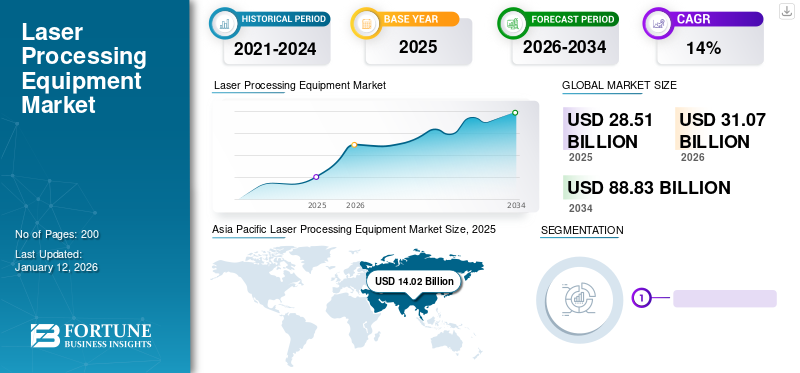
The global laser processing equipment market size was valued at USD 27.88 billion in 2025 and is projected to grow from USD 30.23 billion in 2026 to USD 58.16 billion by 2034, exhibiting a CAGR of 8.5% during the forecast period. Asia Pacific dominated the laser processing equipment market with a market share of 48.46% in 2025.
Laser processing equipment is emerging as an advanced manufacturing solution, providing improved precision and efficiency through enhanced cutting accuracy, higher processing speed, reduced production downtime, better material utilization, and enhanced operational efficiency across industrial manufacturing processes. The market’s growth is supported by the increasing need for manufacturers to improve production accuracy, automate material processing, reduce rework, and strengthen manufacturing flexibility across complex industrial operations. The industry is steadily expanding as fiber lasers, CO2 lasers, solid-state lasers, semiconductor-based laser systems, and advanced laser processing technologies gain popularity across automotive, metal & fabrication, electronics, energy & power, and other industrial applications. This is becoming increasingly important as manufacturers face rising pressure to improve output quality, reduce processing time, support lightweight material production, and maintain consistent product accuracy across manufacturing facilities, further supporting market growth across key end-use industries.
Key players in the market include Trumpf, Hanslaser, HGTECH, Bystronic, and Jinan Bodor CNC Machine Co., Ltd. These companies are progressively developing advanced laser cutting systems, laser welding equipment, marking and engraving machines, punching systems, fiber laser technologies, fully automatic/robotic laser processing systems, digitally integrated manufacturing solutions to improve industrial efficiency and precision, expand their product portfolios, and strengthen their competitiveness. In the long run, rising demand for Industry 4.0 integration, industrial automation, electric vehicle manufacturing, precision cutting, sheet metal processing, precision electronics production, and high-speed metal fabrication across key segments will boost market growth.
Download Free sample to learn more about this report.
Laser Processing Equipment Market Trends
Rising Adoption of Fiber Laser-Based Automated Processing Systems to Improve Precision and Throughput
The laser processing equipment market is witnessing a growing shift toward fiber laser-based automated processing systems as manufacturers seek to improve cutting speed, processing accuracy, material utilization, and production flexibility. Industrial facilities are increasingly adopting fiber lasers, automated cutting and welding systems, robotic welding equipment, laser processing systems, marking and engraving machines, and digitally controlled laser processing platforms to handle complex material processing requirements across automotive, metal & fabrication, electronics, energy & power, and other industrial applications.
Fiber laser-based automated systems help manufacturers reduce setup time, improve repeatability, minimize rework, enhance energy efficiency, and support high-speed processing of metals and precision components. As manufacturing operations become more automated, this trend is supporting the transition from conventional material processing methods toward faster, more precise, and digitally integrated laser processing environments.
- For instance, in May 2025, AMADA launched the ORSUS-3015AJe fiber laser cutting machine for overseas markets to strengthen its product lineup and support high-speed sheet metal processing applications.
MARKET DYNAMICS
MARKET DRIVERS
Download Free sample to learn more about this report.
Rising EV Battery Manufacturing is Increasing Demand for High Precision Laser Technologies
The rapid expansion of electric vehicle manufacturing worldwide, particularly in the automotive sector, is significantly increasing the deployment of laser processing equipment across battery production and vehicle assembly facilities. Laser systems are widely used for battery tab welding, busbar welding, foil cutting, battery sealing, hairpin motor welding, and precision joining applications due to their ability to deliver superior accuracy, high-speed processing, and minimal thermal distortion compared to conventional welding technologies. This is especially important as automotive manufacturers increase focus on improving vehicle efficiency, battery performance, and production consistency.
The demand is particularly strong across EV manufacturing and battery production facilities, where companies are adopting fiber laser systems, laser welding equipment, automated cutting systems, robotic laser processing platforms, and AI-enabled quality inspection technologies to support lightweight vehicle architectures and complex battery pack integration. These laser processing systems help manufacturers improve dimensional accuracy, electrical conductivity, weld quality, and production throughput across high-volume automotive manufacturing lines.
- For instance, in April 2026, TRUMPF developed a new laser welding solution for electric vehicle power electronics, enabling copper electrical conductors to be welded directly onto copper busbars and improving efficiency in EV component production.
|
Rank |
Market Drivers |
Overall Impact Rank |
CAGR Contribution (2026-2034) |
Impact 2026-2028 |
Impact 2029-2031 |
Impact 2032-2034 |
|
1 |
Rising EV battery manufacturing |
High |
+3.4% |
High |
High |
High |
|
2 |
Increasing adoption of automated laser cutting, welding, marking, engraving, and punching systems across manufacturing industries |
High |
+2.8% |
High |
High |
Medium |
|
3 |
Growing demand for high-precision and non-contact material processing across electronics and semiconductor manufacturing |
Medium-High |
+2.2% |
Medium |
High |
High |
|
4 |
Expansion of metal fabrication, industrial machinery, and advanced manufacturing activities |
Medium |
+1.8% |
Medium |
Medium |
High |
|
5 |
Technological advancements in fiber lasers, solid-state lasers, CNC controls, robotics, and machine vision integration |
Medium-Low |
+1.5% |
Medium |
Medium |
Medium |
|
6 |
Others (aerospace manufacturing, medical-device processing, additive manufacturing, renewable-energy equipment production, etc.) |
Low |
+1.0% |
Low |
Low |
Medium |
|
|
Total Positive Growth Contribution |
|
+12.7% |
|
|
|
MARKET RESTRAINTS
High Initial Capital Investment and Integration Complexity are Limiting Adoption among Small and Medium Manufacturers
High initial capital investment remains one of the key restraints for the market. Advanced laser processing systems require high-power fiber lasers, CO2 lasers, solid-state lasers, CNC controls, cooling systems, precision optics, safety enclosures, fume extraction systems, automated material handling, and software-based process control, which can significantly increase the total cost of deployment. This makes adoption difficult for small and mid-sized manufacturers, especially those operating in price-sensitive metal fabrication, job shop, and contract manufacturing environments.
In addition, integrating laser processing equipment into existing production lines can be complex and time-consuming. Manufacturers may need to modify plant layouts, upgrade power supply systems, train operators, calibrate laser parameters, and connect laser systems with CNC platforms, robotic arms, machine vision systems, and digital manufacturing software. Maintenance costs related to optics, beam delivery systems, cooling units, and calibration can also increase operational expenditure. These factors can slow adoption among small and medium enterprises, particularly in developing economies where conventional cutting, welding, marking, and punching methods remain more cost-effective for low-volume production operations.
|
Rank |
Market Restraints |
Overall Impact Rank |
Negative CAGR Contribution (2026-2034) |
Impact 2026-2028 |
Impact 2029-2031 |
Impact 2032-2034 |
|
1 |
High initial capital investment and integration complexity are limiting adoption among small and medium manufacturers |
High |
-1.8% |
High |
High |
Medium |
|
2 |
Shortage of skilled operators, laser-processing engineers, programmers, and maintenance professionals |
Medium-High |
-1.1% |
High |
Medium |
Medium |
|
3 |
High maintenance costs, optical-component replacement requirements, and operational safety concerns |
Medium |
-0.8% |
High |
Medium |
Low |
|
4 |
Others (material-reflectivity challenges, power-consumption concerns, regulatory compliance, and competition from conventional processing technologies) |
Low |
-0.5% |
Low |
Low |
Low |
|
|
Total Negative Growth Impact |
|
-4.2% |
|
|
|
MARKET OPPORTUNITIES
Increasing Adoption of Laser-Based Additive Manufacturing Creates New Growth Opportunities
The growing adoption of laser-based additive manufacturing technologies is creating significant opportunities for the market. Aerospace, medical devices, automotive, and industrial machinery manufacturers are increasingly using laser-enabled metal 3D printing systems to produce lightweight, complex, and high-performance components that are difficult to manufacture using conventional machining methods. Laser additive manufacturing technologies, including selective laser melting and direct metal laser sintering, help manufacturers reduce material waste, improve design flexibility, lower tooling requirements, and support faster prototyping for precision-engineered components.
Laser-based additive manufacturing is especially attractive for aerospace and medical applications, where component weight, customization, material performance, and dimensional accuracy are critical. Aerospace manufacturers are using laser additive manufacturing for turbine components, structural brackets, fuel nozzles, and lightweight aircraft parts, while medical device manufacturers are adopting it for customized implants, surgical instruments, dental components, and orthopedic devices. As industries continue to shift toward low-volume, high-value, and design-intensive manufacturing, laser-based additive manufacturing is expected to expand the application scope of the product across mature and emerging industrial markets.
- For instance, in November 2024, TRUMPF upgraded its TruPrint 3000 3D printer with two 700-watt lasers, automatic multilaser alignment, and integrated build-platform cooling to improve productivity and support serial production of high-quality parts for automotive and aerospace applications.
Segmentation Analysis
By Technology Type
Solid State Segment Held Largest Share Due to its Wider Use across Precision Material Processing Applications
Based on technology type, the market segmentation is divided into fiber lasers, CO2, solid state, and others (semiconductor).
The solid state segment held the largest laser processing equipment market share in 2025, driven by its extensive use across cutting, welding, marking, drilling, engraving, and precision material processing applications. Solid state laser systems are widely used across automotive, metal & fabrication, electronics, energy & power, aerospace, and other industrial applications due to their high beam quality, stable processing performance, and suitability for complex manufacturing operations. These systems support accurate material removal, high-speed processing, and improved process repeatability, making them suitable for industries requiring superior precision and efficiency, durability, and consistent output quality. Compared with conventional material processing technologies, solid state lasers remain strongly adopted as they support advanced manufacturing operations, reduce thermal impact, and improve productivity across industrial production environments.
- For instance, in June 2025, IPG Photonics released new high-power lasers on its rack-integrated platform, offering 60% floor space savings, simplified integration, and improved reliability for manufacturers using industrial laser processing systems.
The fiber lasers segment is expected to witness the highest growth rate of 9.6% during the forecast period, driven by increasing adoption of high-speed cutting, precision welding, EV battery manufacturing, sheet metal processing, and automated industrial laser processing applications.
To know how our report can help streamline your business, Speak to Analyst
By Process Type
Cutting & Drilling Segment Dominates Due to Extensive Use across Sheet Metal and Industrial Metal Fabrication Applications
Based on process type, the market is segmented into cutting & drilling, welding, marking & engraving, punching & micro machining, and others.
The cutting & drilling segment held the largest market share in 2025, attributed to the extensive use of laser cutting systems across sheet metal processing, automotive component manufacturing, electronics production, industrial machinery, energy equipment, and metal fabrication applications. Laser cutting equipment is widely preferred as it provides high cutting speed, improved edge quality, reduced material wastage, and better flexibility for processing complex designs. Compared with conventional cutting technologies, laser cutting systems offer higher precision, lower tooling requirements, and better suitability for automated production environments. Rising demand for fiber laser cutting machines, CNC laser systems, and automated sheet metal processing continues to strengthen the segment’s adoption across industrial manufacturing facilities.
- For instance, in July 2025, Bystronic partnered with SSAB to enhance cutting and bending processes using advanced sheet metal materials, recycled steel, fossil-free steel, and new material concepts for the sheet metal industry.
The punching segment is expected to witness the second-highest growth rate of 9.0% during the forecast period, driven by increasing adoption of laser punching systems across sheet metal fabrication, automotive component manufacturing, industrial machinery, electrical enclosures, and precision metalworking applications.
By Function Type
Fully Automatic/Robotic Segment Held Largest Share Due to Rising Demand for Automated Laser Processing Lines
Based on function type, the market is segmented into semi automatic and robotic.
The robotic segment held the largest market share in 2025, driven by increasing adoption of automated laser processing systems across high-volume manufacturing facilities. Manufacturers are increasingly deploying robotic laser cutting, welding, punching, marking, and material handling systems to improve production speed, reduce manual intervention, enhance repeatability, and maintain consistent product quality. Fully automatic and robotic systems are widely used across automotive, metal & fabrication, electronics, energy & power, and industrial machinery applications where continuous production, high precision, and lower downtime are critical. Compared with semi automatic systems, fully automatic/robotic laser processing equipment offers higher throughput, better process control, improved safety, and stronger integration with CNC platforms, robotic arms, machine vision, and digital manufacturing software.
- For instance, in October 2025, TRUMPF presented a fully automated interlinked production system combining laser cutting, punching, bending, and automated storage to support more flexible and efficient sheet metal processing operations.
The semi automatic segment is expected to witness the highest growth rate of 10.7% during the forecast period, driven by rising demand for robotic laser processing, automated production lines, connected manufacturing systems, and high-throughput industrial material processing.
By End User
Automotive Segment Leads with Higher Adoption of Laser Processing Across EV and Vehicle Component Manufacturing
By end user, the market is segmented into automotive, metal & fabrication, electronics, energy & power, and others.
The automotive segment held the largest market share in 2025, attributed to the extensive use of the product across vehicle body manufacturing, EV battery production, power electronics, engine components, transmission parts, lightweight structures, and precision joining applications. Automotive sector manufacturers depend heavily on laser cutting, laser welding, marking and engraving, punching, and robotic laser processing systems to improve production speed, weld quality, dimensional accuracy, and material utilization. Compared with other end user, automotive manufacturing has higher adoption intensity due to large-scale production volumes, strict quality requirements, growing EV battery assembly, and increasing demand for lightweight vehicle components. Rising demand for electric vehicles, automated production lines, and high-precision metal processing continues to strengthen laser processing equipment adoption across the automotive sector.
- For instance, in April 2026, TRUMPF developed a new laser welding solution for electric vehicle power electronics, enabling copper electrical conductors to be welded directly onto copper busbars and improving efficiency in EV component production.
Metal & fabrication segment is expected to remain the second-leading segment during the forecast period, with a CAGR of 8.7%, driven by increasing adoption of laser processing equipment for sheet metal cutting, welding, punching, marking, and precision fabrication across industrial machinery, construction equipment, automotive components, and general metalworking applications.
Laser Processing Equipment Market Regional Outlook
By geography, the market is categorized into North America, Europe, Asia Pacific, South America, and the Middle East & Africa.
North America
Asia Pacific Laser Processing Equipment Market Size, 2025 (USD Billion)
To get more information on the regional analysis of this market, Download Free sample
North America’s market accounted for USD 5.36 billion in revenue in 2025, supported by strong adoption of advanced manufacturing technologies, high penetration of automated laser cutting systems, and increasing demand for precision processing equipment across the U.S., Canada, and Mexico. Regional demand is strongly influenced by the need to improve production accuracy, reduce material wastage, enhance processing speed, and support high-quality cutting, welding, marking and engraving, and punching operations across automotive, metal & fabrication, electronics, aerospace, and energy industries. The region benefits from strong adoption of fiber lasers, solid-state lasers, robotic laser processing systems, CNC-based laser equipment, and fully automatic manufacturing solutions across large-scale industrial facilities.
U.S. Laser Processing Equipment Market
The U.S. is expected to dominate the North America market with an estimated revenue of about USD 3.71 billion in 2026, representing roughly 12.3% of global sales. Laser processing equipment market growth is driven by the country’s strong automotive, aerospace, electronics, defense, metal fabrication, and industrial machinery sectors. Demand for the product remains particularly strong across precision cutting, EV battery welding, aerospace component processing, electronics manufacturing, and automated sheet metal fabrication applications requiring high accuracy, faster throughput, and lower post-processing requirements.
Europe
Europe is expected to witness steady growth during the forecast period, driven by strong industrial manufacturing capabilities, rising adoption of energy-efficient laser systems, and increasing demand for advanced metal processing technologies across the U.K., Germany, France, Italy, Spain, Russia, and the rest of Europe. Regional demand is closely associated with automotive manufacturing, industrial machinery, aerospace, electronics, metal fabrication, and energy equipment production. Europe remains a key market as manufacturers increasingly prioritize automation, precision engineering, lower material waste, and digitally integrated laser processing systems to improve productivity and maintain competitiveness.
U.K. Laser Processing Equipment Market
The U.K. market is estimated to reach around USD 1.01 billion in 2026, representing roughly 3.3% of global revenues.
Germany Laser Processing Equipment Market
Germany’s market is projected to reach USD 1.17 billion in 2026, equivalent to around 3.9% of global sales.
Asia Pacific
Asia Pacific accounted for USD 13.51 billion in revenue in 2025 globally and is expected to dominate the market during the forecast period. Regional growth is strongly supported by large-scale manufacturing activities, rapid industrialization, strong electronics production, automotive manufacturing expansion, and increasing adoption of laser processing equipment across China, India, Japan, South Korea, ASEAN, and the rest of Asia Pacific, with South Korea positioned to strengthen its position in the laser technology manufacturing landscape. The region holds strong demand for the product and continues to witness strong adoption of fiber laser cutting machines, laser welding systems, marking & engraving equipment, punching systems, fully automatic/robotic laser processing lines, and CNC-based laser platforms that improve production speed, reduce labor dependency, enhance material utilization, and support high-volume manufacturing operations.
China Laser Processing Equipment Market
China’s market is projected to remain dominant in the Asia Pacific region. The region is expected to reach around USD 7.47 billion in 2026, representing roughly 24.7% of global sales.
Japan Laser Processing Equipment Market
The Japanese market is estimated to reach around USD 2.54 billion in 2026, accounting for roughly 8.4% of global sales.
India Laser Processing Equipment Market
India is estimated to reach around USD 2.22 billion in 2026, accounting for roughly 7.3% of global sales.
Middle East & Africa
The Middle East & Africa market is driven by increasing adoption of laser processing equipment across industrial manufacturing, energy equipment, metal fabrication, construction-related fabrication, and repair and maintenance applications across Israel, GCC countries, South Africa, and other regional markets. Demand is closely linked to industrial diversification, infrastructure development, energy projects, fabrication capacity expansion, and gradual replacement of conventional cutting and welding technologies with more precise and automated laser processing solutions. GCC countries lead regional adoption due to stronger investments in manufacturing localization, energy infrastructure, industrial zones, and metal fabrication facilities requiring high-quality cutting, welding, and marking equipment.
GCC Laser Processing Equipment Market
The GCC market is projected to reach around USD 0.69 billion in 2026, representing roughly 2.3% of global sales.
South America
The South America market is driven by rising demand for industrial modernization, metal fabrication efficiency, automotive component production, and precision material processing across Brazil, Argentina, and the rest of South America. Demand for the product is primarily associated with cutting, welding, marking & engraving, and punching applications across automotive, machinery, energy, construction equipment, and general industrial manufacturing sectors. Although adoption is comparatively gradual, the region offers long-term opportunities as manufacturers upgrade conventional processing methods, adopt fiber laser systems, and expand automated sheet metal and fabrication capabilities.
Brazil Laser Processing Equipment Market
The Brazil market is projected to reach around USD 1.58 billion in 2026, representing roughly 5.2% of global sales.
COMPETITIVE LANDSCAPE
Key Industry Players
Key Industry Players Focus on Automated Laser Processing Solutions to Improve Process Repeatability
The global market is highly competitive and continues to expand as manufacturers shift from conventional cutting, welding, marking, engraving, and punching methods toward faster, more precise, and automated laser-based processing technologies. Competition is shaped by the strength of fiber lasers, CO2 lasers, solid-state laser systems, CNC integration, and fully automatic/robotic laser processing platforms, beam quality, software control, service network, and application capabilities across complex industrial manufacturing environments. Companies are focusing on automated laser processing solutions that improve cutting accuracy, weld quality, production speed, material utilization, energy efficiency, process repeatability, and automation readiness across automotive, metal & fabrication, electronics, energy & power, and other end-use industries.
Trumpf, Hanslaser, HGTECH, Bystronic, and Jinan Bodor CNC Machine Co., Ltd. are among the major companies being tracked in this market. Several of these players are developing advanced laser processing technologies, ranging from fiber laser cutting machines, laser welding systems, marking & engraving equipment, punching systems, and robotic laser processing lines to digitally integrated CNC platforms, automated material handling systems, and smart manufacturing solutions. As the industry expands, partnerships with automotive manufacturers, metal fabrication companies, electronics producers, system integrators, and industrial automation providers are expected to become important competitive strategies.
LIST OF KEY LASER PROCESSING EQUIPMENT COMPANIES PROFILED
- Trumpf (Germany)
- Hanslaser (China)
- HGTECH (China)
- Bystronic (Switzerland)
- Jinan Bodor CNC Machine Co., Ltd. (China)
- Amada (Japan)
- Salvagnini (Italy)
- PrimaPower (Italy)
- Mazak (Japan)
- Messer (Germany)
- Mitsubishi (Japan)
- IGP Photonics (U.S.)
- Epilog Laser (U.S.)
KEY INDUSTRY DEVELOPMENTS
- April 2026: TRUMPF developed a new laser solution for hot-formed automotive components, using a new cutting nozzle, fiber laser generation, and beam shaping technology to reduce cutting costs and improve productivity in automotive manufacturing.
- February 2026: Bystronic completed the acquisition of Coherent Corp.’s ‘Tools for Materials Processing’ business unit, strengthening its capabilities in micro-material processing, marking, labeling, drilling, and precision laser applications for medical and semiconductor The acquired business is being integrated under the ‘Bystronic Rofin’ platform.
- February 2026: LIDROTEC and TRUMPF accelerated wafer dicing in the chip industry by advancing laser-based semiconductor processing solutions for thin and sensitive wafers.
- October 2025: Prima Industrie entered into an agreement to sell Prima Electro to Synov, supporting the group’s strategy to sharpen its focus on integrated sheet metal solutions under the Prima Power brand and strengthen its core sheet metal machinery business.
- September 2025: Bodor Laser launched its Space Series 3D five-axis laser cutting machine, marking its entry into high-end 3D metal processing for automotive, aerospace, mold-making, and construction machinery applications.
- November 2024: Mitsubishi Electric Corporation developed a compact, high-energy sub-nanosecond-pulse deep-ultraviolet laser system in collaboration with RIKEN and the Institute for Molecular Science, supporting future innovation in high-precision laser processing, drug discovery, cancer treatment, and other advanced applications.
REPORT COVERAGE
The global laser processing equipment market analysis includes a comprehensive study of the market size & forecast by all the market segments included in the report. It includes details on the market activities and market patterns expected to drive the market over the forecast period. It provides information on primary aspects, including an overview of laser processing equipment, fiber lasers, CO2 lasers, solid-state lasers, laser cutting systems, laser welding equipment, marking & engraving machines, punching systems, semi-automatic systems, fully automatic/robotic laser processing equipment, and precision material processing across automotive, metal & fabrication, electronics, energy & power, and other end-use industries. Additionally, it details product launches, partnerships, mergers & acquisitions, technology developments, laser-based automation solutions, advanced CNC laser systems, robotic laser processing platforms, and key industry developments and regional adoption trends. The global market research report also provides an in-depth competitive landscape with information on the market share and profiles of key operating players.
Request for Customization to gain extensive market insights.
Report Scope & Segmentation
| ATTRIBUTE | DETAILS |
| Study Period | 2021-2034 |
| Base Year | 2025 |
| Estimated Year | 2026 |
| Forecast Period | 2026-2034 |
| Historical Period | 2021-2024 |
| Growth Rate | CAGR of 8.5% from 2026 to 2034 |
| Unit | Value (USD Billion) |
| Segmentation | By Technology Type, Process Type, Function Type, End User, and Region |
| By Technology Type |
|
| By Process Type |
|
| By Function Type |
|
| By End User |
|
| By Region |
|
Frequently Asked Questions
According to Fortune Business Insights, the global market value stood at USD 27.88 billion in 2025 and is projected to reach USD 58.16 billion by 2034.
The market is projected to record a CAGR of 8.5% during the forecast period.
By technology type, the solid state segment led the market in 2025.
Rising EV battery manufacturing, along with increasing demand for high-precision cutting, welding, marking, and punching applications, are key factors driving market growth.
TRUMPF, Han’s Laser, HGTECH, Bystronic, Jinan Bodor CNC Machine Co., Ltd., AMADA, Salvagnini, Prima Power, Mazak, Messer, Mitsubishi Electric, IPG Photonics, and Epilog Laser are among the top players in the market.
Asia Pacific is expected to hold the largest market share.
By end user, the metal & fabrication segment is expected to record a significant CAGR during the forecast period.


- 2021-2034
- 2025
- 2021-2024
- 200
-
(Offer valid till 30th Sep 2026)
Get 30-60 hrs Free Customization
Expand Regional and Country Coverage, Segments Analysis, Company Profiles, Competitive Benchmarking, and End-user Insights.















Related Reports
-
US +1 833 909 2966 ( Toll Free )
-
Get In Touch With Us