Law Enforcement & Military Clothing Market Size, Share & Industry Analysis, By Uniform Class, By Protection Level (Flame-Resistant, Arc-Rated, CBRN-Compatible Clothing, Anti-Microbial Treated Clothing, and Others), By Garment System, By Fabric (Cotton, Polyester, Nylon, and Others), By Camouflage (Solid Duty Colors, Military Camouflage, and Others), By Clothing Technology (Passive Thermal Management, Sensor-Ready Garments, E-textile Integrated Garments, and Others), By End User (Military, Law Enforcement, Coast Guard, and Homeland Security), and Regional Forecast, 2026-2034
 Download Free Sample
Law Enforcement & Military Clothing Market Size and Future Outlook
 Listen to Audio Version
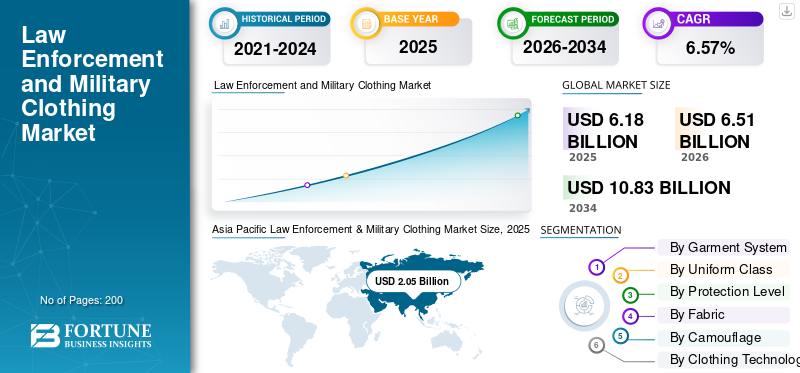
The global law enforcement & military clothing market size was valued at USD 6.18 billion in 2025. The market is projected to grow from USD 6.51 billion in 2026 to USD 10.83 billion by 2034, exhibiting a CAGR of 6.57% during the forecast period. Asia Pacific dominated the law enforcement and military clothing market with a market share of 33.17% in 2025.
The law enforcement agencies & military clothing market covers mission-ready uniforms, tactical shirts and pants, flame-resistant clothing, wet/cold-weather apparel, ballistic/protective wear, load-bearing garments, and related textile systems used by soldiers, police, SWAT, border forces, corrections, and emergency-response units.
The market is being driven by rising defense and internal-security spending, soldier-modernization programs, police tactical upgrades, higher threat environments, and demand for lighter protective clothing that does not restrict movement.
The major key players include Rothco, Crye Precision, UNI&FORMA d.o.o. / UF PRO, NFM Group AS, and Seyntex. The companies are focusing on expanding through broad law enforcement and military personnel product depth, including uniforms, tactical apparel, bags, and footwear.
Download Free sample to learn more about this report.
Law Enforcement and Military Clothing Market Key Takeaways
 Global Market Size & Forecast
- 2025 Market Size: USD 6.18 Billion
- 2026 Market Size: USD 6.51 Billion
- 2034 Forecast Market Size: USD 10.83 Billion
- CAGR: 6.57% from 2026-2034
 Market Share
- The market in Asia-Pacific dominated with a revenue share of 33.17% in 2025.
- Bottoms held the largest garment-system market share at 22.60%.
- Combat uniforms held the largest uniform-class market share at 24.27%.
 Key Regional Highlights
Asia Pacific
Asia-Pacific led the global market with a 33.17% share, supported by rising defense spending, geopolitical tensions, and military modernization.
North America
North America accounted for approximately 27.51% of the market in 2025, driven by high defense budgets and tactical gear modernization.
Europe
Europe held a 24.76% share, supported by NATO defense spending and demand for advanced protective apparel.
U.S.
The market reached USD 1.62 Billion in 2025 and is estimated to grow at a 5.91% CAGR during 2026-2034.
Japan
The market reached USD 0.21 Billion in 2025 and is estimated to grow at an 8.77% CAGR during 2026-2034.
Read More

Law Enforcement & Military Clothing Market Trends
A Shift Toward Lighter, Modular, Multi-Threat, and Body-Inclusive Protective Clothing Systems to be a Significant Market Trend
The strongest technology trend is the shift from heavy protective gear to lighter, more flexible, and better-fitting systems that keep protection high without reducing mobility. NIJ’s updated body armor standard, NIJ 0101.07, includes improved test methods for armor designed for women and references ASTM test methods, which is pushing suppliers to rethink fit, geometry, comfort, and certification not just ballistic resistance. This is important for law enforcement agencies since procurement is increasingly influenced by officer comfort, wear compliance, and gender-inclusive armor design.
Major OEMs are also moving in this direction. DuPont announced that Kevlar EXO is expanding from soft armor into hard armor applications such as helmets and ballistic plate inserts, with the material already being integrated into plates for TYR Tactical.
Cadre/Safariland is also expanding through M&A, it completed the acquisition of TYR Tactical in February 2026, and announced the acquisition of Alien Gear Holsters assets in March 2026, strengthening its tactical gear, armor, and law-enforcement equipment portfolio.
Market Dynamics
MARKET DRIVERS
Download Free sample to learn more about this report.
Higher Defense Spending and Recurring Troop-Sustainment Needs are Keeping Demand Strong for Uniforms
The biggest driver for law enforcement & military clothing market growth is armed forces and police agencies must constantly replace, upgrade, and issue mission clothing. This market is not a one-time procurement market; uniforms, helmet covers, cold-weather systems, FR clothing, rainwear, body armor carriers, field packs, gloves, and undergarments are recurring-use items. DLA Troop Support’s Clothing & Textiles unit says it procures more than 8,000 different items and manages more than 50,000 line items when size variations are included, which shows how large and repeat-driven the military clothing supply chain really is.
For instance, in April 2026, SIPRI reported the 2025 global military spending rise, reinforcing the demand outlook for military clothing and personal equipment procurement.
MARKET RESTRAINTS
Domestic Sourcing Rules, Certification Cycles, and Limited Supplier Visibility Make Entry and Scaling Difficult
The market is restrained by strict procurement compliance, especially in the U.S. defense channel. Under the Berry Amendment/DFARS rules, DoD buyers generally cannot acquire clothing, fabrics, synthetic textiles, wool, canvas products, and many individual-equipment items unless they are produced in the U.S.; this protects the domestic base but also narrows supplier options and raises compliance cost. For new suppliers, the issue is not only product quality but also documentation, traceability, domestic-content proof, testing history, and qualification under military or law-enforcement standards.
MARKET OPPORTUNITIES
Advanced Materials, Inclusive Fit, Biomaterials, and Apparel Tech Packs Can Create Premium Growth Pockets
A major opportunity is the move from uniform supply to integrated soldier clothing systems. Agencies are looking for clothing that performs across heat, cold, rain, fire, blast, ballistic, and long-duration wear conditions, which creates room for premium fabrics, modular uniforms, FR layers, breathable waterproof membranes, and better load-carriage integration. DLA is also shifting toward Apparel Tech Packs under its Joint Clothing & Textiles Modernization Initiative, meaning future solicitations may use more standardized technical packages rather than older-style MILSPECs, CIDs, and purchase descriptions.
Another long-term opportunity is next-generation domestic materials. GAO reported on February 2026 that DoD has invested about USD 965 million since 2020 in bio manufacturing, including materials such as bioengineered spider silk that could be lighter than carbon fiber and stronger than Kevlar, with possible relevance for body armor and future protective textiles.
MARKET CHALLENGES
PFAS Transition, Material Obsolescence, and Qualification Delays are Becoming Serious Operational Risks
One of the biggest technical challenges is the industry’s dependence on specialty coatings, membranes, and finishes that deliver water, oil, stain, chemical, and weather resistance. DoD’s 2025 PFAS update notes significant uncertainty about PFAS presence in complex defense supply chains and says regulatory actions and market changes can create risks from product obsolescence and reformulation. This directly affects military clothing as wet-weather gear, breathable membranes, protective barriers, and stain/oil-repellent finishes may need reformulation without reducing field performance.
SEGMENTATION ANALYSIS
By Garment System
Base Layer Segment is Expected to Grow Fastest as Comfort Demand is Rising by Soldiers in Various Departments
By garment system, the market is divided into base layer, mid layer, outer layer, bottoms, one-piece garments, specialty upper-body apparel, specialty lower-body apparel, and others.
The base layer is estimated to be the fastest-growing segment with the highest CAGR of 8.40% during the forecast period of 2026-2034. Growth is mainly supported by demand for moisture control, thermal regulation, anti-odor treatment, and next-to-skin comfort in long-duration military and law-enforcement operations. As forces operate in hotter, colder, and more physically demanding environments, base layers are becoming a performance item rather than a basic inner garment.
The bottoms segment held the largest global law enforcement & military clothing market share with a 22.60% in 2025 and is estimated to grow at a CAGR of 5.40% during the forecast period.
By Uniform Class
Combat Uniforms Segment Lead Growth and Dominance as Forces are Prioritizing Operational Readiness Over Ceremonial Clothing
By uniform class, the market is divided into class A dress uniforms, class B service uniforms, operational duty uniforms, tactical uniforms, combat uniforms, utility uniforms, and others.
The combat uniforms is estimated to be the fastest-growing sub-segment with a CAGR of 8.17% during the forecast period of 2026-2034. Also, in 2025 it held the largest market share with the valuation of 24.27%. This reflects the strong shift toward battlefield-ready and mission-specific apparel rather than traditional dress or service uniforms. Modern combat uniforms are no longer just camouflage clothing; they are expected to support mobility, durability, heat control, flame resistance, pocket utility, armor compatibility, and long field use.
The operational duty uniforms segment held the second largest global market share with a 20% in 2025 and is estimated to grow at a CAGR of 6.74% during the forecast period.
By Protection Level
CBRN-Compatible Clothing Segment to Grow Fastest as Threat Preparedness Rises
By protection level, the market is divided into flame-resistant (FR), arc-rated (AR), anti-static / ESD, CBRN-compatible clothing, anti-microbial treated clothing, cooling-enabled clothing, heat-stress mitigation clothing, and others.
The CBRN-compatible clothing is estimated to be the fastest-growing sub-segment with the highest CAGR of 8.25% during the forecast period of 2026-2034. Its growth is linked to rising concern around chemical, biological, radiological, and nuclear exposure risks, especially among military, border security, homeland security, and emergency-response units. This clothing is becoming more important as forces prepare for hybrid warfare, contaminated environments, industrial disaster response, and high-risk urban operations.
The flame-resistant (FR) sub-segment held the largest global market share with 22.41% in 2025 and is estimated to grow at a CAGR of 7.31% during the forecast period.
To know how our report can help streamline your business, Speak to Analyst
By Fabric
Elastane/Stretch Blends Segment is Estimated to Grow Fastest Since Mobility is Becoming Critical
By fabric, the market is divided into cotton, polyester, nylon, elastane / stretch blends, wool / merino blends, fleece fabrics, insulated synthetic loft fabrics, and others.
The elastane / stretch blends are estimated to be the fastest-growing sub-segment with the highest CAGR of 8.96% during the forecast period of 2026-2034. This growth is driven by the need for better mobility, ergonomic fit, kneeling comfort, climbing flexibility, and compatibility with armor and load-bearing gear. Military and law-enforcement users increasingly need uniforms that move with the body rather than restrict movement during combat, patrol, breaching, vehicle operations, or field exercises.
The polyester segment held the largest global market share with 18.65% in 2025 and is estimated to grow at a CAGR of 6.91% during the forecast period.
By Camouflage
IR/NIR Managed Colorways Segment to Grow Fastest as Sensor Threats Increase
By camouflage, the market is divided into solid duty colors, military camouflage, law enforcement visibility configurations, and IR / NIR managed colorways.
The IR/NIR managed colorways is estimated to be the fastest-growing sub-segment with the highest CAGR of 7.74% during the forecast period of 2026-2034. Growth is being driven by the rising use of night-vision devices, drones, thermal observation, and battlefield sensors. Traditional visual camouflage is no longer enough; uniforms increasingly need to reduce detectability across visible and near-infrared spectrums.
The military camouflage segment held the largest global market share with a 46.37% in 2025 and is estimated to grow at a CAGR of 6.96% over the forecast period.
By Clothing Technology
E-Textile Integrated Garments Segment Grow Fastest as Smart Uniforms Emerge
By clothing technology, the market is divided into passive thermal management, active cooling integration, heating integration, sensor-ready garments, e-textile integrated garments, and smart PPE-compatible garments.
The e-textile integrated garments is estimated to be the fastest-growing segment holding the highest CAGR of 8.82% during the forecast period of 2026-2034. Growth is supported by the gradual move toward smart uniforms that can support sensing, connectivity, physiological monitoring, and integration with soldier systems. The segment is still smaller than traditional technologies, but its growth profile is strong since defense and law-enforcement buyers are exploring wearable electronics, smart PPE, and data-enabled clothing.
The passive thermal management segment held the largest global market share with a 35.98% in 2025 and is estimated to grow at a CAGR of 4.79% during the forecast period.
By End User
Coast Guard Segment to Grow Fastest Due to Specialized Maritime Needs
By end user, the market is divided into military, law enforcement, coast guard, and homeland security.
The coast guard is estimated to be the fastest-growing sub-segment with the highest CAGR of 7.33% during the forecast period of 2026-2034. Growth is supported by rising maritime security, coastal surveillance, search-and-rescue, border protection, anti-smuggling, and disaster-response activities. Coast Guard clothing requires specialized performance such as wet-weather protection, saltwater durability, flotation compatibility, thermal insulation, high visibility, and fast-drying fabrics.
The military segment held the largest global market share with 80.99% in 2025 and estimated to grow at a CAGR of 6.57% over the forecast period.
Law Enforcement & Military Clothing Market Regional Outlook
By region, the market is categorized into Europe, North America, Asia Pacific, and the rest of world.
Asia Pacific
Asia Pacific Law Enforcement & Military Clothing Market Size, 2025 (USD Billion)
To get more information on the regional analysis of this market, Download Free sample
The Asia Pacific market accounted for the largest market share and dominated the region with a valuation of USD 2.05 billion in 2025. The dominance is due to the rising geopolitical tensions, increased defense budgets, and large-scale military modernization in China and India. Moreover, major, sustained increases in defense spending by China, India, and Japan, which represent over 40% of global defense spending, are driving high-tech gear adoption.
China Law Enforcement & Military Clothing Market
China’s market was valued at USD 0.87 billion in 2025 and is estimated to grow at a rate of 5.81% during the forecast period.
India Law Enforcement & Military Clothing Market
The Indian market was valued at USD 0.28 billion in 2025 and is estimated to grow at a rate of 9.62% during the forecast period.
Japan Law Enforcement & Military Clothing Market
The Japanese market was valued at USD 0.21 billion in 2025 and is estimated to grow at a rate of 8.77% during the forecast period.
North America
North America held the second dominant share in 2025, valued at USD 1.70 billion. The growth is driven primarily by high defense budgets, modernization of tactical gear, and rising safety requirements. Key factors fueling this expansion include the adoption of advanced, lightweight, flame-resistant materials, smart textiles, and the integration of wearable technology.
U.S. Law Enforcement & Military Clothing Market
Based on North America's strong contribution and the U.S. dominance within the region, the U.S. market reached USD 1.62 billion in 2025 and is estimated to have a CAGR of 5.91% during the forecast period.
Europe
Europe is projected to grow at fastest growing rate with a highest CAGR of 7.94% during the forecast period. In 2025, the market value stood at USD 1.53 billion. The growth is driven by increased NATO defense spending, geopolitical tensions, and the need to modernize legacy gear with advanced, modular, and protective fabrics. Enhanced border security, combat, and emergency response needs are accelerating replacement cycles.
U.K. Law Enforcement & Military Clothing Market
The U.K. market was valued at USD 0.22 billion in 2025 and is estimated to grow at a rate of 2.26% during the forecast period.
Germany Law Enforcement & Military Clothing Market
The German market was valued at USD 0.25 billion in 2025 and is estimated to grow at a rate of 8.27% during the forecast period.
Eastern Europe Law Enforcement & Military Clothing Market
The Eastern Europe market was valued at USD 0.48 billion in 2025 and is estimated to grow at a rate of 10.66% during the forecast period.
Rest of the World
The rest of world consists of Latin America and the Middle East & Africa regions and are expected to witness moderate growth in this market during the forecast period. The Latin America market is valued at USD 0.19 billion in 2025. This growth is driven by increasing regional security threats, government modernization programs, and a strong push for personnel safety. The Middle East & Africa market is valued at USD 0.70 billion in 2025. The growth is driven by rising geopolitical tensions, regional conflicts, and modernization initiatives. Governments are continuously upgrading personnel gear to enhance survivability, ballistic protection, and operational mobility in high-risk environments
COMPETITIVE LANDSCAPE
Key Industry Players
Key Players are Competing in Market through Technological Advancements and Broad Law Enforcement Product Portfolio
The competitive landscape is split between finished tactical-clothing brands and advanced-material suppliers. Major Tier 1 companies in law enforcement and military clothing market compete through a broad law-enforcement portfolio covering uniforms, duty gear, outerwear, footwear, and load-bearing products. In addition, they are strong in premium combat apparel such as G4 combat shirts, combat pants, hot-weather uniforms, FR garments, and shell systems.
Technology competition is increasingly moving toward lighter protection, stretch comfort, FR performance, waterproof-breathable systems, and signature-managed clothing. This is pushing major players toward Kevlar EXO beyond soft armor into hard-armor uses such as helmets and ballistic plate inserts, showing how material suppliers are shaping future protective clothing and gear. Overall, the market is shifting from basic uniform replacement toward integrated clothing systems where comfort, protection, mobility, climate resistance, and mission-specific performance decide supplier competitiveness.
LIST OF KEY LAW ENFORCEMENT & MILITARY CLOTHING COMPANIES PROFILED IN REPORT
- Rothco (U.S.)
- Crye Precision (U.S.)
- UNI&FORMA d.o.o. / UF PRO (Slovenia)
- NFM Group AS (Norway)
- Seyntex (Belgium)
- CARINTHIA (Austria)
- Pentagon Tactical (Greece)
- M-TAC (Ukraine)
- Point Blank Enterprises, Inc. (U.S.)
- Massif (U.S.)
- ARMORGUARD Tactical Gear Co., Ltd. (Thailand)
- Helikon-Tex (Poland)
- SIOEN N.V. (Belgium)
KEY INDUSTRY DEVELOPMENTS
- March 2026: Goodwill Industries of South Florida and Peckham Vocational Industries were awarded firm-fixed-price IDIQ contracts by DLA Troop Support for different types of combat uniform coats and trousers. The five-year awards serve the U.S. Army, Air Force, and Space Force, showing continued demand for operational combat uniforms rather than only ceremonial or service apparel.
- February 2026: The U.S. Department of War announced contracts for helmet covers and Point Blank Protective Apparel & Uniforms’ large field pack sets and pack frames for the Army.
- May 2025: Central Lake Armor Express, doing business as Armor Express, received a DLA Troop Support contract for modular scalable vests and related components for the Army and Air Force. This is important for the market as it reflects growing demand for body-armor-linked clothing systems, not only traditional uniforms.
- May 2025: Hardwick Tactical Corp. was awarded a five-year DLA Troop Support contract for broadfall trousers for the U.S. Navy. The contract shows that naval clothing procurement remains a steady revenue stream, especially for specialized uniform items that must meet military fit, durability, and service-use requirements.
- December 2024: Crown Clothing Co. received a contract modification from DLA Troop Support for men’s green dress coats, belts, and keepers for the U.S. Marine Corps. This news shows that formal and service-dress uniforms remain relevant even as the market shifts toward tactical and protective clothing.
REPORT COVERAGE
The global law enforcement & military clothing market analysis includes a comprehensive study of the market size & forecast by all the market segments included in the report. It contains details on the market dynamics and market trends expected to drive the market over the forecast period. It provides information on key aspects, including an overview of technological advancements, pipeline candidates, the regulatory environment, and product launches. Additionally, it details partnerships, mergers & acquisitions, as well as key industry developments and prevalence by key regions. The global market research report also provides a detailed competitive landscape with information on the market share and profiles of key operating players.
Request for Customization to gain extensive market insights.
Report Scope & Segmentation
| ATTRIBUTE | DETAILS |
| Study Period | 2021-2024 |
| Base Year | 2025 |
| Estimated Year | 2026 |
| Forecast Period | 2026-2034 |
| Historical Period | 2021-2024 |
| Growth Rate | CAGR of 6.57% from 2026-2034 |
| Unit | USD Billion |
|
By Segmentation |
By Garment System
By Uniform Class
By Protection Level
By Fabric
By Camouflage
By Clothing Technology
By End User
By Region
|
Frequently Asked Questions
Fortune Business Insights says that the global market value stood at USD 6.18 billion in 2025 and is projected to reach USD 10.83 billion by 2034.
In 2025, the European market value stood at USD 1.53 billion.
The market is expected to exhibit a CAGR of 6.57% during the forecast period.
The base layer segment is expected to hold the highest CAGR over the forecast period.
Higher defense spending and recurring troop-sustainment needs are keeping demand strong for uniforms
Rothco, Crye Precision, UNI&FORMA d.o.o. / UF PRO, NFM Group AS, and Seyntex are the top players in the market.
Asia Pacific held the largest market share in 2025.



- 2021-2034
- 2025
- 2021-2024
- 200
Get 30-60 hrs Free Customization
Expand Regional and Country Coverage, Segments Analysis, Company Profiles, Competitive Benchmarking, and End-user Insights.




















Related Reports
-
US +1 833 909 2966 ( Toll Free )
-
Get In Touch With Us