Licensed Sports Merchandise Market Size, Share & Industry Analysis, By Type (Apparel, Footwear, Sports Equipment, Accessories, and Others), By Sport Type (Cricket, Football, Basketball, Hockey, and Others), By Demography (Kids & Teens and Adults), By Distribution Channel (Brand Stores, Specialty Stores, Online Channels, and Others), and Regional Forecast, 2026-2034
 Download Free Sample
(Offer valid till 15th Oct 2026)

KEY MARKET INSIGHTS
 Listen to Audio Version
The global licensed sports merchandise market size was valued at USD 39.50 billion in 2025 and is projected to grow from USD 41.36 billion in 2026 to USD 56.21 billion by 2034, exhibiting a CAGR of 3.91% during the forecast period. North America dominated the global licensed sports merchandise market with a market share of 51.89% in 2025.
Licensed sports merchandise is the officially approved products featuring a particular team's, league's, or athlete’s logo, name, and brand. The increasing number of sports fans of different sports & sports players, coupled with the growing organization of live international tournaments and major sports leagues, is accelerating product demand worldwide. In addition, the wider acceptance of lifestyle-oriented products and the growing influence of social media are driving the market for licensed sports merchandise across many countries.
Key players operating in the worldwide market include Fanatics, Inc., Nike, Inc., Adidas AG, Puma SE, and VF Corporation. These players consistently focus on partnering with athletes and Premier League sponsors for product innovation and branding activities.
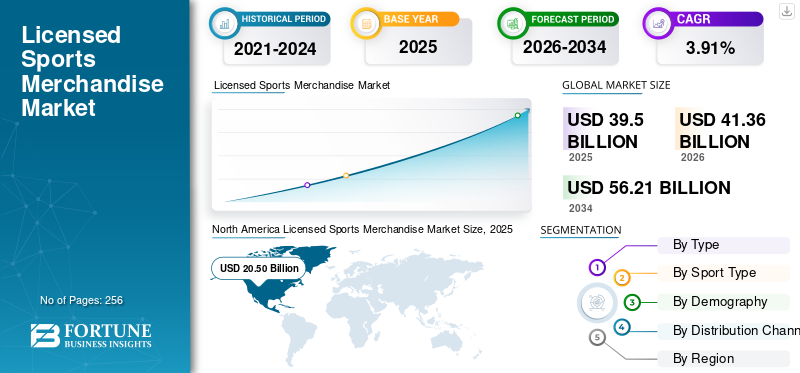
Download Free sample to learn more about this report.
Licensed Sports Merchandise Market KEY TAKEAWAYS
 Market Size & Forecast
- 2025 Market Size: USD 39.50 Billion
- 2026 Market Size: USD 41.36 Billion
- 2034 Forecast Market Size: USD 56.21 Billion
- CAGR: 3.91% from 2026–2034
 Market Share
- North America dominated the licensed sports merchandise market with a 51.89% share in 2025.
- The apparel segment held a 48.64% market share in 2025.
- The football segment accounted for 37.95% of the market in 2025.
 Key Regional Highlights
North America
North America led the market, driven by strong sports culture and broad fan engagement.
Europe
Europe reached USD 9.39 billion in 2025, driven by sports participation and merchandise demand.
Asia Pacific
Asia Pacific reached USD 6.52 billion in 2025 and is projected to grow at the fastest CAGR of 6.98% during 2026–2034.
U.S.
The licensed sports merchandise market reached USD 15.05 billion in 2025.
Japan
The licensed sports merchandise market was valued at approximately USD 0.99 billion in 2025.
Read More

LICENSED SPORTS MERCHANDISE MARKET TRENDS
Rising Demand for Lifestyle-Oriented and Athleisure-Inspired Products is a Prominent Trend
Consumers seek licensed apparel & accessories that blend functionality with everyday style. The rising demand for licensed lifestyle-oriented and athleisure-inspired products for occasional sporting activities is driving global product revenues. Furthermore, consistent manufacturers’ production of casual hoodies, caps, sneakers, and streetwear-inspired collections for licensing branding is accelerating the global market expansion.
Download Free sample to learn more about this report.
MARKET DYNAMICS
MARKET DRIVERS
Increasing Participation in Organized and Recreational Sports to Drive Market Growth
Recreational leagues encourage consumers to purchase officially licensed apparel and accessories, combining the functionality of sports with a sense of identity. The increasing participation in organized & recreational sports activities, as well as growing consumers’ digital engagement as spectators in sports leagues, are driving the global licensed sports merchandise market growth. Additionally, the growing number of sports institutions and governmental organizations promoting physical activity and encouraging sports participation is driving global demand for products. According to the Fédération Internationale de Basketball (FIBA), the growing popularity of basketball increased from 68% in 2019 to 74% in 2023.
MARKET RESTRAINTS
High Price of Official Licensed Products to Restrain Market Growth
The high royalty fees, licensing costs, and compliance expenses primarily increase the retail price of the licensed sports goods. High prices of officially licensed products are restricting demand for the products across many countries. In addition, greater consumers’ accessibility to counterfeit or unbranded products available at affordable prices is restraining key players’ product revenue growth worldwide.
MARKET OPPORTUNITIES
Integration of Sustainability and Eco-friendly Materials in Licensed Product Designs to Create Newer Growth Opportunities
Manufacturers use recycled polyester, organic cotton, and low-impact dyes to reduce environmental footprint, while prioritizing product performance and aesthetics. The consistent manufacturers’ efforts to integrate eco-friendly materials in the licensed sports goods’ designs to achieve their business sustainability goals are creating newer market growth opportunities. In addition, consistent brands’ provision of royalty programs and discounts effectively contributes to their green branding activities, favoring product revenues.
MARKET CHALLENGES
Complex Global Licensed Goods’ Regulatory and Trade Environments to Challenge Key Players’ Business Expansion
The complex global regulatory and trade environments for licensed goods are posing challenges to key players in their global business expansion activities. In addition, varying import regulations, product standards, labeling rules, and customs procedures are posing challenges to manufacturers conducting their international business operations. Additionally, product shipment delays and limited labor availability pose challenges to manufacturers’ business operational efficiencies.
Segmentation Analysis
By Type
High Purchasing Frequency and Broad Consumer Appeal of Apparel Led the Dominance of the Apparel Segment
By type, the licensed sports merchandise industry is segmented into apparel, footwear, sports equipment, accessories, and other categories. The apparel segment held a leading global licensed sports merchandise market share of 48.64% in 2025. The high purchasing frequency of athlete-endorsed licensed apparel, along with its broader appeal among worldwide consumers, is generating considerable revenues from the apparel segment. In addition, consistent apparel store launches of seasonal t-shirts and leggings featuring athlete- or team-specific designs are favoring the segment’s growth.
To know how our report can help streamline your business, Speak to Analyst
The other segment, including home décor & utility products, stationery, toys & collectibles, etc., is projected to grow at the fastest CAGR of 5.28% from 2026 to 2034. Increasing accessibility to casual fan toys, collectibles, and stationery, making them attractive to kids, is mainly driving the growth of the other segment. Additionally, the growing trend of sports-themed kids’ room decorations is driving global segmental revenue growth.
By Sport Type
Growing Popularity of National Football League (NFL) to Favor Football Segmental Growth
Based on sport type, the market is segmented into cricket, football, basketball, hockey, and others. The football segment exhibited a leading global market share of 37.95% in 2025. Significant football participation and the increasing popularity of the American National Football League (NFL) and FIFA World Cup are generating a substantial share of the football segment during the forecast period of 2026-2034.
Additionally, advancements in the development of stadium football equipment and a rising demand for football training courses are driving segmental revenue growth. According to the Football Foundation, as reported in the Sports Business Journal, approximately 474,000 schoolgirl students between the ages of 6 and 17 played flag football in 2022, representing a 63% increase from 2019.
The cricket segment is projected to grow at the fastest CAGR of 6.57% during 2026-2034. The rising popularity of domestic cricket franchise leagues and increasing digital broadcasting of cricket sports tournaments is uplifting the cricket fan engagements, positively contributing to the segment’s growth.
By Demography
High Purchasing Power and Significant Demand for Premium Products Led to the Dominance of the Adults Segment
Based on demography, the market is bifurcated into kids & teens and adults.
The adult segment exhibited a leading market share of 67.75% in 2025. High purchasing power, strong brand loyalty, and significant spending on licensed apparel, footwear, and sports equipment are mainly generating considerable revenues from the adults’ segment. Additionally, the growing number of adult fan followers and increasing digital shopping penetration are driving segmental revenue growth.
The kids & teens segment is projected to grow at a fastest rate of 4.55% during the forecast period of 2026-2034. The rising number of school students participating in sports activities, along with the increasing number of sports league fan followings, is driving the segment’s growth.
By Distribution Channel
Rising Demand for Online Shopping of Licensed Sports Goods Adoption to Favor Online Channels at the Fastest CAGR
Based on distribution channel, the global market is segmented into brand stores, specialty stores, online channels, and others.
The online channels segment exhibited a leading share of 40.15% in 2025. The segment’s leading share is attributed to the significant adoption of online shopping of licensed sports goods and limited exclusive editions. In addition, the consistent launches of licensed sports goods by online sports retailers, aligned with major sporting events, are accelerating the segment’s growth at the fastest CAGR of 4.51% from 2026 to 2034.
The brand stores segment is projected to grow at the second-fastest rate during the forecast period. The expanding base of brand stores offering premium and limited-edition merchandise sales at better prices is mainly driving the growth of the brand stores segment.
Licensed Sports Merchandise Market Regional Outlook
By region, the market is categorized into North America, Europe, Asia Pacific, South America, and Middle East & Africa.
North America
North America Licensed Sports Merchandise Market Size, 2025 (USD Billion)
To get more information on the regional analysis of this market, Download Free sample
The North America region exhibited a leading global market share of 51.89% in 2025 and is expected to maintain its leading position during the forecast period of 2026-2034. The North American market size reached USD 17.78 billion in 2023 and USD 18.39 billion in 2024. A strong sports culture, well-established professional leagues, and wider fan followings are primarily generating significant product revenues from the North American market. Additionally, the widespread availability of branded sports merchandise at licensed outlets is positively contributing to the region’s market growth.
U.S Licensed Sports Merchandise Market
The U.S. market size reached USD 15.05 billion in 2025. The U.S. market accounted for around 38.11% of the global market sales in 2025. A strong fan following and a robust base of sports participants are primarily driving the product's purchasing frequency and market growth across the U.S. In addition, advanced e-commerce retail infrastructure and increasing collaborations between favorite teams and athletes, as well as sports leagues, are favoring U.S. market revenue growth.
Asia Pacific
The Asia Pacific region’s market is projected to grow at the fastest rate of 6.98% from 2026 to 2034. The region’s market size reached USD 6.52 billion in 2025 and secured the position of the third-largest region in the market. Expanding sports awareness and increasing exposure to sports leagues, as well as promoting officially licensed products, are driving market growth across the region. Additionally, the increasing sports participation rate and the expanding number of online retail platforms offering discounted products are driving market growth across the region.
Japan Licensed Sports Merchandise Market
The Japanese licensed sports merchandise market in 2025 is estimated at around USD 0.99 billion, accounting for roughly 2.5% of global licensed sports merchandise revenues. Strong fan loyalty and a robust domestic sports ecosystem are mainly generating considerable product sales in Japan.
China Licensed Sports Merchandise Market
China’s licensed sports merchandise market is projected to be one of the largest worldwide, with 2025 revenues estimated at around USD 3.08 billion, representing roughly 7.8% of global licensed sports merchandise sales.
India Licensed Sports Merchandise Market
The Indian licensed sports merchandise market in 2025 is estimated at around USD 1.40 billion, accounting for roughly 3.54% of global licensed sports merchandise revenues.
Europe
The European region is expected to exhibit a second leading global market position during the forecast period (2026-2034). The European market size reached USD 9.39 billion in 2025, exhibiting around 23.77% of the global product sales. The growing expansion of sports clubs and training institutes offering professional-quality sports coaching services is driving increased demand across Western Europe. Furthermore, the expanding sports participation rate and increasing demand for premium merchandise items are favoring market growth across the Eastern European region.
U.K Licensed Sports Merchandise Market
The U.K. licensed sports merchandise market in 2025 is estimated at around USD 1.59 billion, representing roughly 4.0% of global licensed sports merchandise revenues.
Germany Licensed Sports Merchandise Market
Germany’s licensed sports merchandise market is projected to reach approximately USD 2.13 billion in 2025, equivalent to around 5.4% of global licensed sports merchandise sales.
South America and Middle East & Africa
Over the global market forecast period, the market in the South America and Middle East & Africa regions is expected to witness a moderate growth rate from 2026 to 2034. The South America market in 2025 is set to reach a valuation of USD 2.10 billion. The increasing participation rate in rugby, baseball, and basketball sports, as well as growing spending on branded merchandise items, is primarily driving the growth of the Brazilian and Colombian markets. The government's assistance in building sports infrastructure facilities and increasing consumers’ disposable income is positively contributing to market development across the Middle East & African regions. In the Middle East & African market, South Africa is expected to reach a market value of USD 0.43 billion by 2025.
UAE Licensed Sports Merchandise Market
The UAE licensed sports merchandise market is projected to reach around USD 0.27 billion in 2025, representing roughly 0.7% of global licensed sports merchandise revenues.
COMPETITIVE LANDSCAPE
Key Industry Players
Focus on Sports Partnerships and Production Capacity Building to Help Key Players Maintain Their Market Position.
The key players operating in the global market include Fanatics, Inc., Nike, Inc., Adidas AG, Puma SE, and VF Corporation. These players consistently focus on establishing extensive licensing partnerships with teams and leagues to increase their brand reach. Additionally, they utilize in-house design and large-scale manufacturing capabilities to deliver high-quality products. In 2025, Nike Inc. collaborated with the NFL to unveil Rivalries kits, including a fan gear assortment, across global markets.
LIST OF KEY LICENSED SPORTS MERCHANDISE COMPANIES PROFILED
- Fanatics, Inc. (U.S.)
- Nike, Inc. (U.S.)
- Adidas AG (Germany)
- Puma SE (Germany)
- VF Corporation (U.S.)
- New Era Cap Company (U.S.)
- Under Armour, Inc. (U.S.)
- Hanesbrands Inc. (U.S.)
- Anta Sports Products Ltd. (China)
- Mitchell & Ness Nostalgia Co. (U.S.)
KEY INDUSTRY DEVELOPMENTS
- November 2025: Hanesbrands, Inc. established a merger agreement with Gildan Activewear, Inc. to broaden its sports apparel reach worldwide.
- November 2024: World Rugby announced a global partnership with Fanatics, a leading digital sports platform, to launch & manage its official retail and licensing program.
- September 2024: Authentic Brands Group acquired athleticwear icon Champion to broaden its global presence and enter new markets.
- January 2024: Platinum Equity acquired Augusta Sportwear Brands (ASB) and Founder Sport Group (FSG), global providers of team jerseys, uniforms, off-field performance wearables, and fan apparel to the worldwide youth & recreational sports markets.
- August 2023: Academy Sports + Outdoors extended its partnership with Fanatics, a global digital sports platform, to broaden its product reach across both offline and online channels.
REPORT COVERAGE
Request for Customization to gain extensive market insights.
Report Scope & Segmentation
|
ATTRIBUTE |
DETAILS |
|
Study Period |
2021-2034 |
|
Base Year |
2025 |
|
Estimated Year |
2026 |
|
Forecast Period |
2026-2034 |
|
Historical Period |
2021-2024 |
|
Growth Rate |
CAGR of 3.91% from 2026-2034 |
|
Unit |
Value (USD Billion) |
|
Segmentation |
By Type, Sport Type, Demography, Distribution Channel, and Region |
|
By Type |
· Apparel · Footwear · Sports Equipment · Accessories · Others |
|
By Sport Type |
· Cricket · Football · Basketball · Hockey · Others |
|
By Demography |
· Kids & Teens · Adults |
|
By Distribution Channel |
· Brand Stores · Specialty Stores · Online Channels · Others |
|
By Region |
· North America (By Type, Sport Type, Demography, Distribution Channel, and Country) o U.S. (By Type) o Canada (By Type) o Mexico (By Type) · Europe (By Type, Sport Type, Demography, Distribution Channel, and Country) o Germany (By Type) o France (By Type) o Italy (By Type) o Spain (By Type) o U.K. (By Type) o Russia (By Type) o Rest of Europe (By Type) · Asia Pacific (By Type, Sport Type, Demography, Distribution Channel, and Country) o China (By Type) o India (By Type) o Japan (By Type) o Australia (By Type) o Rest of Asia Pacific (By Type) · South America (By Type, Sport Type, Demography, Distribution Channel, and Country) o Brazil (By Type) o Argentina (By Type) o Rest of South America (By Type) · Middle East & Africa (By Type, Sport Type, Demography, Distribution Channel, and Country) o South Africa (By Type) o UAE (By Type) o Rest of the Middle East & Africa (By Type) |
Frequently Asked Questions
Fortune Business Insights says that the global market value stood at USD 39.50 billion in 2025 and is projected to reach USD 56.21 billion by 2034.
In 2025, the market value stood at USD 6.52 billion.
At a CAGR of 3.91%, the global licensed sports merchandise market is forecasted to grow from 2026 to 2034.
By type, the apparel segment is projected to hold the leading global market share throughout the forecast period of 2026-2034.
The increasing participation in organized and recreational sports is set to drive the global market.
Fanatics, Inc., Nike, Inc., Adidas AG, Puma SE, and VF Corporation are among the prominent players in the market.
North America dominated the market in 2025.
The integration of sustainability and eco-friendly materials in licensed product designs is expected to favor the installation rate of these products.



- 2021-2034
- 2025
- 2021-2024
- 256
-
(Offer valid till 15th Oct 2026)
Get 30-60 hrs Free Customization
Expand Regional and Country Coverage, Segments Analysis, Company Profiles, Competitive Benchmarking, and End-user Insights.



















Related Reports
-
US +1 833 909 2966 ( Toll Free )
-
Get In Touch With Us