Light Car Trailer Market Size, Share & Industry Analysis, By Trailer Type (Utility Trailers, Enclosed Cargo Trailers, Recreational Trailers, Boat Trailers, and Others), By Axle Type (Single Axle and Tandem Axle), By End Use (Personal Use and Commercial Use), By Sales Channel (OEM and Aftermarket), and Regional Forecast, 2026-2034
 Download Free Sample
(Offer valid till 15th Oct 2026)

Light Car Trailer Market Size and Future Outlook
 Listen to Audio Version
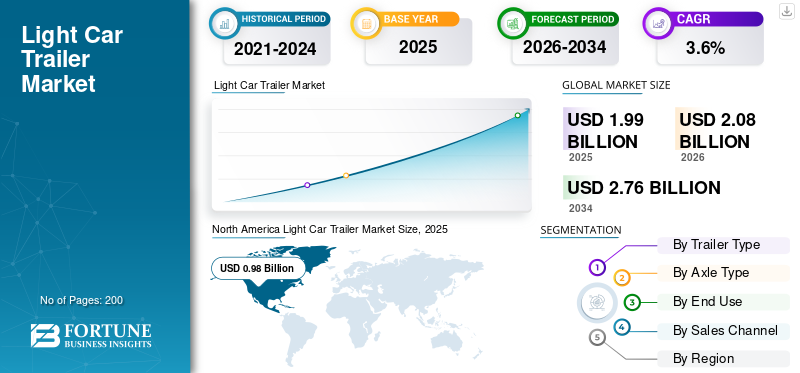
The global light car trailer market size was valued at USD 1.99 billion in 2025. The market is projected to grow from USD 2.08 billion in 2026 to USD 2.76 billion by 2034, exhibiting a CAGR of 3.6% during the forecast period. North America dominated the light car trailer market with a market share of 49.24% in 2025.
The light car trailer market covers non-motorized trailers typically towed by passenger cars, SUVs, and light pickups, usually under 3,500 kg GVWR. These products range from an open trailer used for everyday hauling to an enclosed trailer designed for secure cargo movement and specialty formats such as motorcycle, light car trailers, and small boat carriers. The market growth is closely tied to household mobility needs, small-business logistics, and leisure-led towing demand.
Over the forecast period, industry expansion is expected to be shaped by four practical forces. First, higher participation in recreational activities and weekend mobility supports steady demand for trailers used in camping, boating, and road trips. Second, ongoing technological advancements, such as lighter frames, improved corrosion protection, stronger couplers, and smarter tie-down systems, raise product appeal and lift replacement demand. Third, the rising demand for light car towing solutions from SMEs (landscaping, maintenance, and last-mile deliveries) supports purchases of the utility light car trailer as a cost-effective alternative to a second commercial vehicle. Fourth, local compliance requirements (lighting, braking, and type approvals) continue to influence designs and promote higher-quality builds.
In applications, trailers support home improvement and equipment transport, small business hauling, outdoor sports, and event logistics. As product choices widen, buyers increasingly compare configurations and the mix between single axle light car trailers and multi axle light car trailers, balancing price, load stability, and total cost of ownership.
Looking ahead, expansion of the global light car trailer industry will also depend on how manufacturers standardize platforms while offering customization. Key players such as Indespension and Brenderup Group are investing in new products, dealer reach, and brand differentiation, improving what their trailers offer in durability, safety features, and usability.
Download Free sample to learn more about this report.
Light Car Trailer Market Takeaways
 Market Size & Forecast
- 2025 Market Size: USD 1.99 billion
- 2026 Market Size: USD 2.08 billion
- 2034 Forecast Market Size: USD 2.76 billion
- CAGR: 3.6% from 2026–2034
 Market Share
- North America dominated the light car trailer market with a 49.24% share in 2025.
- The recreational trailers segment is expected to grow at a CAGR of 5.2% during the forecast period.
- The tandem axle segment is projected to grow at a CAGR of 4.4% through 2034.
 Key Regional Highlights
North America
North America led the global market with a valuation of USD 0.98 billion in 2025, supported by strong demand for utility, recreational, and commercial trailers.
Europe
Europe is projected to reach USD 0.69 billion in 2026, securing its position as the second-largest regional market.
Asia Pacific
Asia Pacific is expected to grow at a CAGR of 4.3% and reach a market value of USD 0.20 billion by 2026.
U.S.
The market is estimated at approximately USD 0.80 billion, accounting for around 40.6% of global market revenue, driven by widespread trailer ownership and recreational vehicle usage.
Japan
The market is expected to witness steady growth, supported by increasing demand for compact towing solutions and recreational transport applications.
Read More

LIGHT CAR TRAILER MARKET TRENDS
Faster Product Cycles and Modular Platforms Improve Buyer Choice
Manufacturers are increasingly launching family platforms where one core structure supports multiple use cases, utility, enclosed, or specialty through modular ramp, rail, and body options. This shortens development time, improves parts commonality for service, and allows more tailored products at scale. The trend strengthens dealer propositions and supports premiumization through feature bundles rather than full redesigns.
- For instance, in March 2025, Brian James Trailers launched a Box Van range, applying transporter expertise to enclosed formats and signaling faster expansion into adjacent body styles using shared engineering foundations.
MARKET DYNAMICS
MARKET DRIVERS
Download Free sample to learn more about this report.
Growing Leisure Travel and Outdoor Towing Demand Accelerates Trailer Purchases
Rising participation in road-based leisure encourages more consumers to buy trailers for gear, boats, and small campers. As families prioritize flexible travel, trailers become an affordable way to expand vehicle utility without upgrading to larger vehicles. This supports steady sales of utility and recreational formats, and lifts demand for higher-capability axle configurations and safety features, boosting the light car trailer market growth.
- For instance, in December 2025, RVIA reported 2025 RV shipments of 342,220 units, up 2.5% year-over-year, supporting continued activity in towable leisure categories and related towing equipment.
MARKET RESTRAINTS
Steel and Input-Cost Volatility Pressures Pricing and Slows Replacement Cycles
Trailer manufacturing relies heavily on steel, tires, axles, and lighting components. When input costs fluctuate, manufacturers either absorb margin pressure or raise prices, which can delay purchases for price-sensitive buyers. Dealers may also tighten inventory positions during volatile periods, reducing the availability of entry-level models and slowing unit sell-through, especially in emerging regions.
- For instance, in November 2024, the U.K. ONS producer price inflation reporting highlighted ongoing movement in manufacturers’ input and output prices, reinforcing cost uncertainty for fabricated metal products used across trailer builds.
MARKET OPPORTUNITIES
Cargo-Bike and Last-Mile Logistics Create a New Lightweight Trailer Adjacency
Urban deliveries and short-haul commercial tasks are driving interest in compact, modular trailer concepts that expand payload without adding a motor vehicle. This opens growth opportunities for manufacturers and component suppliers to adapt proven chassis, braking, and coupling know-how into new formats, while tapping commercial fleets and city logistics providers seeking low-emission solutions.
- For instance, in September 2024, AL-KO highlighted CarryNex modular chassis systems for cargo-bike trailers designed for up to 300 kg GVW, signaling investment in lightweight commercial trailer components.
MARKET CHALLENGES
EV Towing Range Loss Complicates Long-distance Trailer Use
As EV adoption grows, towing performance becomes a practical barrier: towing increases energy consumption, reduces range, and can make charging logistics harder when a trailer is attached. For consumers who tow over long distances, range anxiety may delay a switch to EV tow vehicles or reduce the frequency of towing trips, limiting trailer usage growth in EV-heavy regions until infrastructure and vehicle capability improve.
- For instance, in March 2024, Arval research reported towing can reduce EV real-world range by about 23-31%, highlighting usability challenges for towing-dependent users and fleets.
Segmentation Analysis
By Trailer Type
Utility Trailers Dominate as They are Easy to Maintain and Widely Available
On the basis of trailer type, the market is segmented into utility trailers, enclosed cargo trailers, recreational trailers, boat trailers, and others.
Utility trailers dominate as they serve households and SMEs for landscaping, construction materials, appliances, and equipment transport. They are easy to maintain, widely available, and adaptable through rails, ramps, and tie-down upgrades. Their broad applicability keeps demand resilient even when recreational purchases soften, supporting stable growth across mature and emerging markets.
- For instance, in January 2025, Carry-On announced SmartFold utility trailers with fold-down rails to increase versatility, reflecting continued innovation and demand in utility configurations.
The recreational trailers segment is expected to grow at a CAGR of 5.2% over the forecast period.
To know how our report can help streamline your business, Speak to Analyst
By Axle Type
Single Axle Dominates as It Delivers Sufficient Capacity for Everyday Towing at a Lower Price and Weight
On the basis of axle type, the market is segmented into single axle and tandem axle.
Single axle dominates, as for most household loads and light commercial tasks, they provide acceptable stability and payload at a simpler bill of materials. Lower curb weight improves towing ability for smaller vehicles, and easier storage appeals to residential buyers. This keeps single axle share high, while tandem grows mainly in heavier recreational and commercial niches.
- For instance, in March 2025, Brian James’ new Box Van range emphasized engineered enclosed transport solutions, a use case where single-axle configurations remain common for lighter, compact enclosed builds.
The tandem axle segment is expected to grow at a CAGR of 4.4% over the forecast period.
By End Use
Personal Use Dominates as Trailers Extend Vehicle Utility for Lifestyle and Home Projects
On the basis of end use, the market is segmented into personal use and commercial use.
Personal use dominates as buyers use trailers for moving bulky items, DIY projects, hobby equipment, and leisure gear. A trailer often costs far less than upgrading to a larger vehicle, making it a practical ownership choice. As leisure travel and outdoor hobbies remain popular, personal users continue to drive consistent baseline demand, particularly for utility and small enclosed formats.
- For instance, in early 2025, ECF published registrations for new leisure vehicles in Europe, reinforcing ongoing consumer interest in towable leisure formats that support personal travel and outdoor lifestyles.
The commercial use segment is expected to grow at a CAGR of 4.2% over the forecast period.
By Sales Channel
Aftermarket Dominates as Trailers are Usually Purchased Separately from Tow Vehicle
On the basis of sales channel, the market is segmented into OEM and aftermarket.
Aftermarket dominates as most buyers add a trailer after selecting the towing vehicle, so purchases flow through dealers, retail chains, and specialty distributors. The aftermarket also offers more configuration choices, faster availability, and add-on customization. Service, parts, and local compliance support further strengthen dealer-led selling, reinforcing aftermarket share across regions.
- For instance, in December 2024, Carry-On reported SmartFold would debut through Tractor Supply stores nationwide from January 2025, illustrating dealer/retail-led distribution typical of the aftermarket channel.
The aftermarket segment is expected to grow at a CAGR of 3.8% over the forecast period.
Light Car Trailer Market Regional Outlook
By geography, the market is categorized into North America, Europe, Asia Pacific, and the Rest of the World.
North America
North America Light Car Trailer Market Size, 2025 (USD Billion)
To get more information on the regional analysis of this market, Download Free sample
North America held the largest light car trailer market share in 2025, valued at USD 0.98 billion, and also maintained the leading share in 2024, with USD 0.95 billion. North America leads due to a strong towing culture, high pickup/SUV ownership, dense dealer networks, and steady leisure travel demand. A broad range of utility and enclosed products is widely stocked through retail and specialty dealerships, making ownership accessible. The region also benefits from strong participation in boating and RV-related travel, which supports recurring replacement and upgrades. As product feature content rises, value growth remains solid even with moderate unit growth.
- For instance, in November 2025, NMMA highlighted 2024 U.S. recreational boating statistics and related trailer sales coverage in its annual Statistical Abstract, supporting sustained boating-driven towing demand.
U.S. Light Car Trailer Market
Based on North America’s strong contribution and the U.S. dominance within the region, the U.S. market can be analytically approximated at around USD 0.80 billion, representing roughly 40.6% of the global market.
Europe
Europe is estimated to reach USD 0.69 billion in 2026 and secure the position of the second-largest region in the market. Europe is expected to grow through steady caravanning activity, expanding lightweight logistics needs, and stricter safety expectations that support higher-spec products. Registration tracking by ECF and national bodies reinforces a resilient leisure vehicle base that supports towing ecosystems. In the U.S., growth remains linked to dealer-led utility demand and leisure-led upgrades, supported by steady RV shipment reporting.
Germany Light Car Trailer Market
The Germany market in 2025 is estimated at around USD 0.14 billion, accounting for roughly 7.2% of global revenues.
U.K. Light Car Trailer Market
The U.K. market in 2025 is estimated at around USD 0.12 billion, accounting for roughly 5.9% of global revenues.
Asia Pacific
Asia Pacific is projected to record a growth rate of 4.3% in the coming years and reach a valuation of USD 0.20 billion by 2026. Asia Pacific growth is driven by expanding vehicle ownership, rising SME activity, and increasing adoption of practical hauling solutions. Utility-led demand remains central, while enclosed formats grow in organized logistics and higher-income markets. Over time, standardization and safety awareness support better-quality products and gradual value uplift.
China Light Car Trailer Market
China’s market is projected to be one of the largest globally, with 2025 revenues estimated at around USD 0.07 billion, representing roughly 3.4% of the global market.
India Light Car Trailer Market
The Indian market in 2025 is estimated at around USD 0.04 billion, accounting for roughly 2.1% of global revenues.
Rest of the World
The rest of the world's growth in regions, including the Middle East & Africa, is supported by basic transport needs, construction and maintenance services, and localized fabrication markets. Demand is often utility-heavy and price-sensitive, but improving regulation and cross-border trade gradually favor more standardized products. As dealer networks deepen, availability and service improve, supporting higher conversion from informal to organized purchases.
COMPETITIVE LANDSCAPE
Key Industry Players
Competition is Shaped by Design, Reach, and Reliability
The competitive landscape spans high-volume regional manufacturers, premium specialist brands, and component leaders that influence performance and compliance. In developed markets, competition often centers on build quality, corrosion resistance, suspension and braking options, and dealer coverage. In emerging markets, pricing, availability, and basic robustness matter more, but standardization and safety compliance are gaining importance.
Large players aim to reduce complexity by creating shared chassis platforms across multiple trailer families, then differentiating through deck layouts, ramps, gates, and accessory ecosystems. This approach lowers manufacturing cost, shortens lead time, and supports consistent quality. Many manufacturers also compete through channel strategy: stronger partnerships with farm-and-ranch retail, equipment dealers, and specialty distributors help widen access and improve service response times.
Another key battleground is product innovation. Folding rail systems, modular tie-down points, improved loading angles, and upgraded sealing/hinges in enclosed products are examples of features used to justify premium pricing. Brands also use warranties and certification participation to build trust, especially where safety requirements are strict. Finally, acquisitions and partnerships help companies enter new niches, especially in micro-mobility cargo platforms and light trailer accessories, without building capabilities from scratch.
- For instance, in July 2024, Thule acquired Germany’s Reacha, expanding into modular bike trailers that move sports gear and everyday cargo, strengthening its position in lightweight trailer categories.
LIST OF KEY LIGHT CAR TRAILER COMPANIES PROFILED
- Brian James Trailers (U.K.)
- Ifor Williams Trailers (U.K.)
- Indespension (U.K.)
- Nugent Engineering (Ireland)
- Brenderup Group (Sweden)
- Humbaur (Germany)
- Böckmann (Germany)
- Anssems (Netherlands)
- Saris Aanhangers (Netherlands)
- Eduards Trailer Factory (Belgium)
KEY INDUSTRY DEVELOPMENTS
- July 2025: Montracon was acquired by private investment firm Martin Group, creating a new ownership platform to support U.K. manufacturing and continuity. The transaction reflects ongoing restructuring and investment in trailer manufacturing assets.
- May 2025: Brian James Trailers officially launched its new Race Box trailer range, strengthening its position in the enclosed performance transport segment. The range focuses on enhanced aerodynamics, improved structural rigidity, and upgraded loading systems for motorsport This product expansion allows the company to serve premium vehicle transport customers while reinforcing brand leadership in high-spec enclosed trailer solutions.
- March 2025: Brian James Trailers launched its Box Van trailer range, entering a new enclosed format category with an emphasis on transporter-grade engineering. The move broadens its addressable customer base beyond car transport.
- March 2025: TerraVest Industries announced the acquisition of EnTrans International, a manufacturer of tank trailers and transportation equipment. Although EnTrans primarily operates in heavier-duty segments, the transaction reflects continued consolidation across the broader trailer manufacturing industry. The acquisition strengthens TerraVest’s production capabilities and geographic footprint, reinforcing long-term investment momentum within the trailer and transport equipment sector.
- January 2025: Carry-On introduced the SmartFold utility trailer with fold-down rails to increase versatility and handling. The launch expanded availability through a major retail network, improving consumer access.
- July 2024: Thule completed the acquisition of Reacha, entering modular bike-trailer solutions for sports gear and daily cargo. The deal broadens Thule’s coverage of lightweight trailer adjacencies.
- January 2024: DexKo announced it had completed the acquisition of Cerka Industries Ltd. The move expands the manufacturing footprint and component capability supporting trailer OEM supply.
REPORT COVERAGE
The global light car trailer market analysis provides an in-depth study of market size & forecast by all the market segments included in the report. It includes details on the market dynamics and market trends expected to drive the market in the forecast period. It offers information on the technological advancements, new product launches, key industry developments, and details on partnerships, mergers & acquisitions. The research report also encompasses a detailed competitive landscape with information on the market share and profiles of key operating players.
Request for Customization to gain extensive market insights.
Report Scope & Segmentation
| ATTRIBUTE | DETAILS |
| Study Period | 2021-2034 |
| Base Year | 2025 |
| Estimated Year | 2026 |
| Forecast Period | 2026-2034 |
| Historical Period | 2021-2024 |
| Growth Rate | CAGR of 3.6% from 2026 to 2034 |
| Unit | Value (USD Billion) |
| Segmentation | By Trailer Type, Axle Type, End Use, Sales Channel, and Region |
| By Trailer Type |
|
| By Axle Type |
|
| By End Use |
|
| By Sales Channel |
|
| By Region |
|
Frequently Asked Questions
Fortune Business Insights says that the global market value stood at USD 1.99 billion in 2025 and is projected to reach USD 2.76 billion by 2034.
In 2025, the market value of North America stood at USD 0.98 billion.
The market is expected to exhibit a CAGR of 3.6% during the forecast period.
The utility trailers segment led the market by trailer type.
Growing leisure travel and outdoor towing demand is accelerating trailer purchases, driving the market.
Brian James Trailers, Ifor Williams Trailers, Indespension, and Nugent Engineering are some of the top players in the market.
North America dominated the market in 2025.



- 2021-2034
- 2025
- 2021-2024
- 200
-
(Offer valid till 15th Oct 2026)
Get 30-60 hrs Free Customization
Expand Regional and Country Coverage, Segments Analysis, Company Profiles, Competitive Benchmarking, and End-user Insights.




















Related Reports
-
US +1 833 909 2966 ( Toll Free )
-
Get In Touch With Us