Light Detection and Ranging (LiDAR) Market Size, Share & Industry Analysis, By Component (Hardware and Software), By Type (Mechanical and Solid-state), By Deployment (Ground-based and Airborne), By Range (Short Range, Medium Range, and Long Range), By Industry (Automotive, Aerospace and Defense, Smart Infrastructure, Environment Sector, Oil and Gas, and Others), and Regional Forecast, 2026–2034
 Download Free Sample
LiDAR Market Size Overview
 Listen to Audio Version
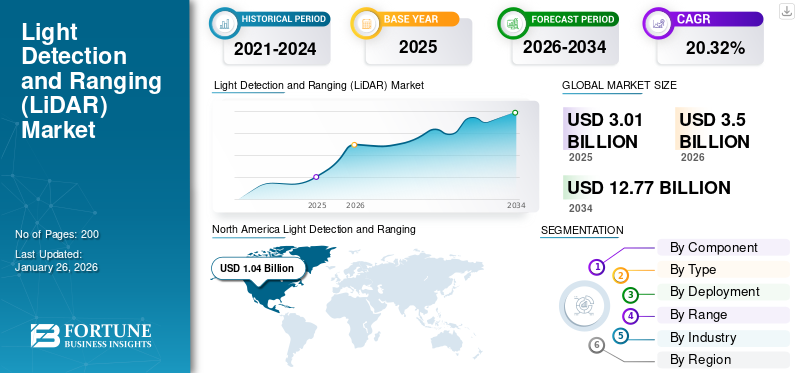
The global light detection and ranging (LiDAR) market size was valued at USD 3.01 billion in 2025. The market is projected to grow from USD 3.50 billion in 2026 to USD 12.77 billion by 2034, exhibiting a CAGR of 20.32% during the forecast period. North America dominated the light detection and ranging market with a market share of 34.65% in 2025.
Light detection and ranging is a remote sensing method that uses light as a pulsed laser scanner to measure ranges (variable distances) to the earth. These light pulses generate precise, two-dimensional, and three-dimensional information about the shape of the earth and its surface properties combined with other data recorded by the airborne system.
The Light Detection and Ranging (LiDAR) market growth is driven by the increasing demand for automated cars and various industries for gathering accurate data. With the help of a high-intensity laser tool, a mini electro-mechanical system, a MEMS scanner, and a global navigation satellite system transceiver, light ranging can be applied to generate 2D, 3D, or 4D images.
This system has wide applications in various areas, such as seismology, geomatics, airborne laser track mapping, meteorological physics, archeology, and geomorphology. In addition, LiDAR is used in various applications by automotive, aerospace & defense, healthcare, and other industries. Further, according to the National Oceanic and Atmospheric Administration (NOAA), LiDAR is used for coastal geospatial service and coastal remote sensing. Some of the top players in the market are Hexagon AB, Sick AG, Teledyne Technologies, and Leica Geosystems. These companies are actively seeking major long term contracts with Asian companies.
Download Free sample to learn more about this report.
Light Detection and Ranging Market Key Takeaways
 Global Market Size & Forecast
- 2025 Market Size: USD 3.01 billion
- 2026 Market Size: USD 3.50 billion
- 2034 Forecast Market Size: USD 12.77 billion
- CAGR: 20.32% from 2026–2034
 Market Share
- North America dominated the market with a 34.65% share in 2025.
- Ground-based segment is expected to lead with a 70.51% share in 2026.
- The hardware segment is projected to dominate the market with a share of 55.15% in 2026.
 Key Regional Highlights
North America
The market was valued at USD 1.04 billion in 2025 and is projected to reach USD 1.23 billion in 2026.
Asia Pacific
The market was valued at USD 0.80 billion in 2025 and is projected to reach USD 0.94 billion in 2026.
Europe
The market was valued at USD 0.57 billion in 2025 and is projected to reach USD 0.66 billion in 2026.
U.S.
The market is projected to reach USD 0.94 billion by 2026.
Japan
The market is projected to reach USD 0.15 billion by 2026.
Read More

IMPACT OF RUSSIA-UKRAINE WAR
Russia-Ukraine Conflict Could Disrupt Supply Chain of Imaging Ranging Solutions
The Russia-Ukraine war profoundly affects the global supply chain relationship and raw material price system. Further, the supply chains of the components or equipment could result in delays or shortages in the market. Besides, Ukraine is known for producing electronic components, and the war may lead to disturbances in its manufacturing capabilities, which could affect the overall supply chain.
The conflict can create an atmosphere of instability in Europe and globally, which might deter investment and slow infrastructure development projects. This technology is extensively used in mapping, surveying, and infrastructure or urban planning. Therefore, a decline in such activities could impact the demand for light detection and ranging solutions for various industry verticals.
LIGHT DETECTION AND RANGING (LIDAR) MARKET TRENDS
Offshore Wind Energy Targets to Attract Enormous Investments to Bolster Market Growth
With the increasing adoption of this imaging technology for various mapping and 3D imaging applications, there is exponential growth in its volume and revenue share. Due to the negligible performance, the dimension of specific existing mapping and imaging solutions is necessary. This ranging technology uses fewer wavelengths and can detect more tiny objects, making it far more precise than conventional methods.
The imaging system technology is also used in the environment to provide vivid applications. These trends can be attributed to the use of technology internally used for various geoscience applications to produce precise and high-quality 3D data while studying different types of wildlife ecosystems. North America witnessed light detection and ranging (LiDAR) market growth from USD 0.76 Billion in 2023 to USD 0.90 Billion in 2024.
Download Free sample to learn more about this report.
MARKET DYNAMICS
Market Drivers
Increasing Demand for 4D LiDAR Solutions for Several Industrial Verticals to Propel Market Growth
Light detection and ranging measures the time of flight of laser points to build a 3D real-time information model about the real world. The system sensor can calculate the distance to each object precisely based on the speed of light by the time the output laser pulse and the reflected pulse overlap. To produce a 3D matrix of its surroundings, the system collects millions of precise distance measurements every second. All the features of a 3D System, plus a camera, are available in 4D System. The camera uses depth perception for each pixel, providing precise data by capturing actual time images.
The use of 4D technology for autonomous vehicles, machine vision, and factory automation is expected to propel product demand. 4D technology is foreseen to grow as autonomous cars evolve. It is expected that the 4D system will help to increase the autonomy of the Autonomous Driving Assistance System (ADAS), which can speed up and simplify decisions on how to drive.
For instance, in January 2024, Aeva, a leader in next-generation sensing and perception systems and a global provider of autonomous driving solutions, announced the unveiling of a design for the next-generation PlusDrive highly automated driving solution integrated with Aeva’s Aeries II 4D sensor.
In addition, for instance, in May 2024, Lumotive, a trailblazer in optical semiconductor technology, and Hokuyo Automatic Co., Ltd., a worldwide leader in sensors and automation, unveiled the YLM-10LX 3D lidar sensor for commercial use. This innovative product, driven by Lumotive's Light Control Metasurface (LCM) optical beamforming technology, signifies a significant advancement in the use of solid-state, programmable optics for revolutionizing 3D sensing in industrial automation and service robotics applications.
Increased Demand for LiDAR from Unmanned Aircraft Systems, Engineering, Construction, and Other Applications to Aid Market Growth
Wind energy is the fastest-growing renewable energy with low carbon emissions and less pollution. The global wind energy market has grown in recent years, as per the Global Wind Energy Council. The development and management of wind farms, power generation by wind energy, and distribution boost investment in energy development. Ground-based systems have been extensively used in a wide range of applications, including unmanned aircraft systems, advanced driving assistance systems, measurement, and others.
The demand for this technology would increase with the growing product deployment for these applications. For instance, in January 2024, Aeva Technologies Inc. secured a multi-year deal to provide Daimler Truck Holding AG with technology aimed at enhancing autonomous driving on highways. The Silicon Valley company will act as a tier 1 supplier, engaging directly with the major automotive manufacturers, and will offer both the hardware and software for its 4D LiDAR system.
Further, the construction industry uses these solutions to generate precise 3D replicas of buildings and cities without obstacles. Moreover, big companies dominate the global market, focusing on developing and delivering advanced ranging and imaging systems for various applications. Governments have permitted autonomous vehicles to be operated by themselves across countries such as the U.S., Japan, China, and others. These vehicles are equipped with state-of-the-art technology that allows objects to be detected at a microscopic level, providing a precise 4D replica of the object.
Market Restraints
Easy Availability of Low-Cost Light Photogrammetry Systems may Hamper Market Growth
Market growth is expected to be slowed by the use of low-cost and transportable photogrammetry for mapping and surveying purposes. With active sensors, the LiDAR drone identifies objects in the field and then emits a laser beam to determine how far it is from ground targets. In order to allow users to see and calculate the distance of objects in 3D, photogrammetry systems use photographs transmitted from 2D and 3D cartographic models, allowing them to perceive objects below the surface of the ground.
The cost of raging and imaging system drones was almost as high as that of photogrammetry systems. They shall bear the low cost of using drones with a single camera to carry photogrammetry equipment.
This heavy equipment makes it more expensive to fly the laser sensing drones. Consequently, the expansion of the market is hampered by easy accessibility to low-cost and light photogrammetry systems.
Market Opportunities
Rising Demand of LiDAR Systems for Autonomous Driving Vehicle Creates Market Opportunities
The automotive sector is a major driver, with LiDAR essential for self-driving and Advanced Driver-Assistance Systems (ADAS). As more automakers invest in autonomous technology, the demand for LiDAR will continue to rise. Automakers such as Valeo integrate LiDAR in production vehicles for features such as emergency braking, collision avoidance, and highway autopilot. Solid-state LiDAR (compact, cost-effective) is emerging as a scalable solution for mass-market adoption.
Market Challenges
High Initial and Ongoing Cost of LiDAR Sensors and Systems is a Major Challenge
The most significant barrier to the system’s widespread adoption is the high initial and ongoing cost of LiDAR sensors and systems. Advanced components, precision manufacturing, and integration requirements make LiDAR expensive, especially for small and medium-sized businesses or cost-sensitive sectors such as agriculture and construction. Moreover, limited economies of scale, especially in regions without local manufacturing, keep prices high. As adoption grows and production scales up, costs are expected to decrease, but the gap remains significant for now.
SEGMENTATION ANALYSIS
By Component
Increasing Demand for Hardware in Different Industries to Propel Segment Growth
Based on component, the market is segmented into hardware and software.
Hardware held a major market share in 2024 and is expected to be the fastest-growing segment during the forecast period. New upgrades in hardware are expected to witness significant growth in the future. The LiDAR market is expanding rapidly, driven by advancements in hardware technology, increasing adoption across industries, and emerging applications. In addition, rising demand for urban planning, construction mapping, and infrastructure monitoring fuels adoption hardware segment. For instance, in April 2022, according to a published report, Velodyne, Luminar, Innoviz Technologies Ltd., and AEye, Inc. spent USD 287 million on research and development of systems sensors for better advancement features. The hardware segment is projected to dominate the market with a share of 55.15% in 2026.
The software segment witnessed parallel growth with the hardware segment. The increasing use of software in industries such as mapping and surveying, construction, and others for creating and developing 3D and 4D images for creating significant models is driving segmental growth.
By Type
Increasing Need for Advanced and Hightech Laser-Based Sensors to Impel Demand for Mechanical System
Based on type, the market is categorized into mechanical and solid-state.
The mechanical segment dominated the market in 2024 due to increasing demand for automotive imaging systems for Advanced Driving Assistance Systems (ADAS). With its high reliability and precision, mechanical systems have been extensively used in self-driving vehicles. The mechanical segment is projected to dominate the market with a share of 67.53% in 2026.
The solid-state segment is set to emerge as the fastest-growing segment from 2025 to 2032. The solution can be flexibly and commercially deployed in different sectors. A solid-state ranging system is fabricated on a silicon chip and does not need moving parts. The devices are available in various types, such as microelectro mechanical systems, electromagnetic light phase array ORPOPA, and flash. These systems are at an advanced stage and are mainly preferred by different industry and defense sectors.
By Deployment
Increased Acceptance of Corridor Mapping and Environmental Applications to Boost Demand for Ground-based LiDAR Solutions
On the basis of deployment, the market is classified into ground-based and airborne.
Ground-based is expected to be the fastest-growing segment during the forecast period. This technology is adopted in a broad range of applications such as ADAS and autonomous vehicles, meteorological, and corridor mapping. The most common use of a ground-based system is to scan, detect, and generate projections such as flat hills and rocky cliffs on hillsides or canyon walls. The ground-based segment is expected to lead the market, contributing 70.51% globally in 2026.
The airborne segment is projected to exhibit steady growth as it is considered an accurate method for creating digital elevation models. The solution offers enhanced precision and a larger area, providing wider-area mapping in moderately fewer time intervals.
By Range
Increased Demand for Medium Range Solutions in Various Applications to Fuel Market Growth
By range, the market is categorized into short range, medium range, and long range.
The medium range segment is expected to hold a 32.14% share in 2024. The medium range segment is expected to be the fastest-growing segment during the forecast period of 2025-2032. The increasing adoption of medium range solutions in mapping, exploration, environment, engineering, and other applications is expected to fuel segmental growth during the forecast period.
The long range segment is expected to be the second fastest-growing segment during the forecast period and accounted for the largest market share in 2024. The increasing adoption is due to the ability to detect small objects at long distances and ensure comfortable braking and safe and predictable automated driving at higher speeds in the automotive industry. The long range segment will account for 44.13% market share in 2026.
Further, the short-range segment is slated to exhibit moderate growth during the forecast period due to the increasing adoption of short range LiDAR in small robots and vehicles to enhance safety and enable new capabilities.
To know how our report can help streamline your business, Speak to Analyst
By Industry
Requirement of Driver Safety Systems in Automotive Sector to Create Lucrative Opportunities for Market Growth
Based on industry, the market is divided into automotive, aerospace and defense, smart infrastructure, environment sector, oil and gas, and others.
The automotive industry held the largest market share in 2024 and is expected to be the fastest-growing segment during the forecast period. The growth in this segment reflects the increasing demand for applications such as ADAS and autonomous vehicles. The emerging technologies are driver assistance systems and low-speed collision avoidance systems, which are widely used in the automotive industry.
The technologies can enhance monitoring and guidance capabilities for drivers who wish to drive autonomous vehicles despite the absence of a human driver. For instance, in August 2022, Cariad SE chose Innoviz Technologies Ltd. to directly supply sensors for the upcoming automated vehicles within the Volkswagen Brands. Innoviz Technologies Ltd. will assist in the latest design of sensors and will deliver InnovizTwo next-generation sensor and perception software.
Further, the aerospace and defense segment is expected to be the second fastest-growing segment during the forecast period. Increasing use of ranging systems for battlefield mapping aids in mine countermeasure, autonomous navigation, and determines the line of sight in the military and defense sector. The rising demand for 3D system sensors in the construction field to enhance building designs and civil engineering has potential opportunities in the coming years.
For instance, in March 2024, Thale Alenia Space, the joint venture between Thales and Leonardo, signed a contract with the European Commission to launch the project known as EuroHAPS (High-Altitude Platform Systems). The project will test a range of missions with observation and categorize targets on land or at sea.
LIGHT DETECTION AND RANGING (LIDAR) MARKET REGIONAL OUTLOOK
Based on region, this market is analyzed across North America, Europe, Asia Pacific, the Middle East & Africa, and Latin America.
North America
North America Light Detection and Ranging (LiDAR) Market Size, 2025 (USD Billion)
To get more information on the regional analysis of this market, Download Free sample
The North America market accounted for USD 1.04 billion in 2025, representing 34.65% of the global industry, and is expected to reach USD 1.23 billion in 2026. The North America Light Detection and Ranging (LiDAR) market share is predicted to be the dominant and fastest-growing regional market during the forecast period. The growth is attributed to an increasing number of new businesses, with a rise in the adoption of core 3D and 4D technologies and the emerging use of solid-state systems in all industries, such as automotive, smart infrastructure, mapping and surveillance, and so on. Major firms in this region invest strongly in different projects and focus on mergers and acquisitions that could drive the market in the region.
For instance, in October 2024, The Indoor Lab, a company specializing in LiDAR technologies, partnered with Aeva, which offers sensing and perception systems for Aeva to supply LiDAR for The Indoor Lab's analytics platform. This platform aims to enhance safety, security, and operational efficiency in major airports, mass transit railways, agriculture, and "smart infrastructure" facilities throughout the U.S.The U.S. market is valued at USD 0.94 billion by 2026.
Asia Pacific
In 2025, Asia Pacific represented USD 0.8 billion, accounting for 26.67% of the worldwide market, and is projected to grow to USD 0.94 billion in 2026. Asia Pacific is expected to hold the second-largest market share during the study period. The increase in survey and mapping activities due to growing infrastructure development and the rise in focus on forestry management and mining operations in this region are driving the market. The product demand is expected to surge by an increase in airborne and ground-based systems. Growing demand for vehicles equipped with automated driving technology is expected to aid the LiDAR market growth in the region. The Japan market is forecast to attain USD 0.15 billion by 2026, the China market is poised to reach USD 0.28 billion by 2026, and the India market is set to achieve USD 0.14 billion by 2026.
Europe
Europe recorded a market size of USD 0.57 billion in 2025, capturing 19.04% of the global market share, and is projected to reach USD 0.66 billion in 2026. In Europe, the market is driven by an increasing number of major companies that have established themselves in emerging economies such as the U.K., Germany, France, and others. The market growth is driven by increasing demand in industries such as car production, machinery, and hydraulic systems for industrial purposes. In addition, the presence of major players such as Hexagon AB, Sick AG, Leosphere, and others is also a factor contributing to market growth in this region. The UK market is expected to reach USD 0.15 billion by 2026, while the Germany market is estimated at USD 0.13 billion by 2026.
Rest of The World
The light detection and ranging market growth in Latin America and the Middle East & Africa is expected to be sustained with a steady CAGR during the forecast period. The Latin America market was valued at USD 0.2 billion in 2025, capturing 6.78% of global revenue, and is estimated to reach USD 0.23 billion in 2026. Middle East & Africa contributed 12.86% to the global market in 2025, with a valuation of USD 0.39 billion, and is projected to reach USD 0.44 billion in 2026. The growing initiatives and investments made by the government and key players in municipalities contribute to the market growth.
COMPETITIVE LANDSCAPE
KEY INDUSTRY PLAYERS
Companies Focus on Mergers and Acquisitions and Partnerships to Gain Competitive Edge
Various regional and international key players are consistently working on formulating advanced strategies to take a competitive advantage. Many companies are forming mergers, acquisitions, partnerships, and collaboration strategies to enable market growth. For instance, in February 2021, Seoul Robotics partnered with LeddarTech. Seoul Robotics and LeddarTech will collaborate to provide advanced perception solutions and real-time solutions for sensors using 3D perception software.
List of Key Light Detection and Ranging (LiDAR) Companies
- FARO Technologies, Inc. (U.S.)
- Hexagon AB (Sweden)
- Innoviz Technologies Ltd. (Israel)
- LeddarTech Inc. (Canada)
- Leica Geosystems (Switzerland)
- Ouster Inc. (U.S.)
- Sick AG (Germany)
- Teledyne Technologies (U.S.)
- Trimble Inc. (U.S.)
- Valeo S.A. (France)
KEY INDUSTRY DEVELOPMENTS
- January 2025 – Ouster’s BlueCity Lidar system will be implemented at over 120 intersections throughout downtown Chattanooga, Tennessee. The USD 2 million agreement with the City of Chattanooga comes after a successful test at 12 intersections. According to Ouster, this marks the largest implementation of LiDAR detection technology aimed at enhancing traffic and pedestrian safety in the U.S. Digital Lidar sensors and edge AI will be installed at every intersection to optimize traffic flow, identify and analyze safety incidents, and facilitate Vehicle to Everything (V2X) communications.
- March 2025 – Hesai Technology, a frontrunner in lidar technology for automotive and robotics applications worldwide, revealed an exclusive design partnership with a prominent European Original Equipment Manufacturer (OEM). Hesai will supply cutting-edge ultra-long-range automotive lidars for the OEM's forthcoming platform, which will feature both Internal Combustion Engine (ICE) and Electric Vehicle (EV) models.
- October 2024 – LeddarTech Holdings Inc., an automotive software firm that offers patented, groundbreaking AI-driven low-level sensor fusion and perception software technology known as LeddarVision™, for Advanced Driver Assistance Systems (ADAS), Autonomous Driving (AD), and parking solutions, is excited to reveal the completion of a strategic licensing agreement with Solid State LiDAR Protection Inc.
- October 2024 – In a major effort to enhance the safety of its rail system, Indian Railways released a USD 3.67 billion tender to introduce advanced Light Detection and Ranging (LiDAR) technology. This initiative seeks to strengthen track safety and minimize the likelihood of train derailments, which is a significant concern for the railway authority. LiDAR technology will play a crucial role in detecting fractures, faults, and absent sections on railway tracks. By generating detailed 3D representations of the rail infrastructure through sensor images, this system reduces the necessity for human involvement and aims to avert potential accidents.
- May 2024 – Ouster Inc. was awarded a production contract from Motional, a global leader in driverless technology. Under the agreement, Ouster will provide Motional with Alpha Prime VLS-128 sensors through 2026 with the serial production.
REPORT COVERAGE
The report provides a detailed analysis of the market and focuses on key aspects such as leading companies, product types, and leading applications of the product. Besides, it offers insights into light detection and ranging market share, trends, and highlights key industry developments. In addition to the factors above, it encompasses several factors that contributed to the growth of the market in recent years.
Request for Customization to gain extensive market insights.
REPORT SCOPE & SEGMENTATION
|
ATTRIBUTE |
DETAILS |
|
Study Period |
2021-2034 |
|
Base Year |
2025 |
|
Estimated Year |
2026 |
|
Forecast Period |
2026-2034 |
|
Historical Period |
2021-2024 |
|
Growth Rate |
CAGR of 20.32% from 2026 to 2034 |
|
Unit |
Value (USD Billion) |
|
Segmentation |
By Component
|
|
By Type
|
|
|
By Deployment
|
|
|
By Range
|
|
|
By Industry
|
|
|
By Region
|
Frequently Asked Questions
As per a study by Fortune Business Insights, the market size was USD 3.01 billion in 2025.
The market is likely to grow at a CAGR of 20.32% during the forecast period of 2026-2034.
The medium range segment is expected to lead the market.
Some of the top players in the market are Hexagon AB, Sick AG, Teledyne Technologies, and Leica Geosystems.
Asia Pacific is expected to be the fastest growing region in the market.
Offshore wind energy targets for attracting enormous investments is the recent market trend.



- 2021-2034
- 2025
- 2021-2024
- 200
Get 30-60 hrs Free Customization
Expand Regional and Country Coverage, Segments Analysis, Company Profiles, Competitive Benchmarking, and End-user Insights.




















Related Reports
-
US +1 833 909 2966 ( Toll Free )
-
Get In Touch With Us