Luxury Leisure Travel Market Size, Share & Industry Analysis, By Type (Airfares & Lodging, Culinary, Cultural Activities, and Others), By Passenger (Domestic and International), By Target Clientele (High Net Worth Individuals and Non-High Net Worth Individuals), and Regional Forecast, 2026-2034
 Download Free Sample
(Offer valid till 15th Oct 2026)

KEY MARKET INSIGHTS
 Listen to Audio Version
The global luxury leisure travel market size was valued at USD 2,190.32 billion in 2025 and is projected to grow from USD 2,374.05 billion in 2026 to USD 4,547.19 billion by 2034, exhibiting a CAGR of 8.46% during the forecast period. North America dominated the luxury leisure travel market with a market share of 32.13% in 2024.
The global luxury travel market is growing rapidly with rising disposable income levels, increased demand for wellness and experiential travel, and technological advancements enabling seamless, tailored itineraries. Growing demand for authentic cultural experiences and exclusive services such as private tours, safaris, culinary travel, and shopping further leads market growth. Many governments invest in tourism infrastructure, launch promotional campaigns, and restore heritage sites to attract luxury travelers. Moreover, private jets, luxurious accommodations, dedicated concierge services, and immersive activities set a luxury travel experience apart and drive market expansion.
Key market players include Abercrombie & Kent USA, LLC, TCS World Travel, Scott Dunn Ltd., Butterfield & Robinson Inc., and Micato Safaris. These companies primarily focus on leveraging advanced technology and AI for seamless, tailored itineraries along with comprehensive rebranding and enhanced digital presence. Furthermore, they emphasize launching new luxury hospitality brands and modular, all-inclusive experiences, and creating unique, deeply immersive tours with keen attention to social responsibility and insider access.
The COVID-19 pandemic caused an unprecedented decline in luxury leisure travel, with global revenues dropping by more than 50% in 2020, owing to travel restrictions and lockdowns implemented to contain the spread of the virus. Revenue generated from luxury cruises, hospitality, and fine dining was badly impacted, declining industry growth. According to the UNWTO (United Nations World Tourism Organization), a whopping 74% drop was recorded in international tourist arrivals. In addition, trips and tourism nights spent by Europeans dropped by 37%, according to the European Union, a government agency, leading to decreased revenue generation.
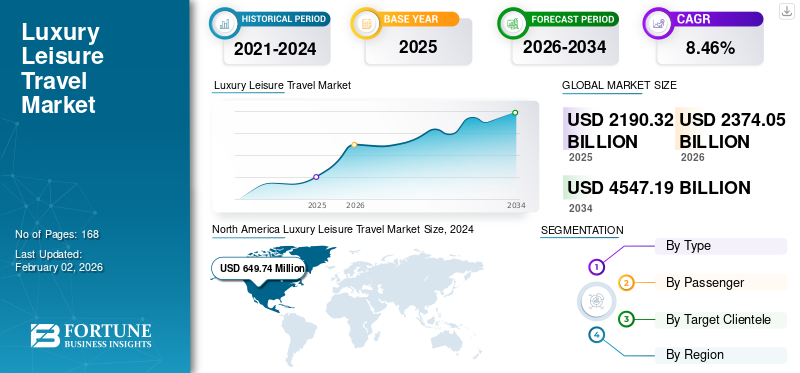
Download Free sample to learn more about this report.
Luxury Leisure Travel Market Key Takeaways
 Global Market Size & Forecast
- 2025 Market Size: USD 2,190.32 billion
- 2026 Market Size: USD 2,374.05 billion
- 2034 Forecast Market Size: USD 4,547.19 billion
- CAGR: 8.46% from 2026–2034
 Market Share
- North America dominated the luxury leisure travel market with a market share of 32.13% in 2024.
- The airfares & lodging segment accounted for the largest luxury leisure travel market share in 2024.
- The high net worth individuals (HNWIs) segment is anticipated to expand at a considerable CAGR in the coming years.
 Key Regional Highlights
North America
The region led the global market in 2024, supported by a large high-net-worth population and growing demand for personalized, wellness-focused, and experiential luxury travel.
Europe
Europe held the second-largest market share in 2024, driven by its rich cultural heritage, premium hospitality, luxury tourism infrastructure, and exclusive travel experiences.
Asia Pacific
The region is projected to register the fastest growth during the forecast period, fueled by rising disposable incomes, stronger outbound tourism, improved connectivity, and government support for tourism development.
U.S.
The U.S. remains the leading contributor in North America, supported by strong demand for adventure travel, private tours, exclusive resorts, and technology-enabled personalized travel experiences.
Japan
Japan is expected to benefit from the rapid expansion of luxury tourism across Asia Pacific, supported by its premium hospitality, cultural attractions, luxury accommodations, and growing appeal among high-spending international travelers.
Read More

MARKET DYNAMICS
MARKET DRIVERS
Growing Demand for Adventure and Experiential Travel Driving Market Expansion
Affluent travelers seek transformative and immersive travel experiences beyond traditional luxury, such as remote explorations, cultural immersion, and wildlife encounters. Luxury operators respond by offering personalized itineraries, exceptional service, and exclusive access to unique destinations and activities. This factor is further supplemented by a significant rise in adventure and travel participation, reflecting luxury leisure travel’s shift toward meaningful, experience-driven journeys. Moreover, a rise in international and domestic tourism, coupled with the appeal of unexplored or off-beaten-path destinations, continues to expand the luxury leisure travel.
MARKET RESTRAINTS
Geopolitical Instability and Climate Disruptions to Hinder Market Growth
Geopolitical uncertainty and climate disruptions significantly hamper the luxury leisure travel market growth. Political unrest, conflicts, and sudden changes in visa regulations can deter travelers from visiting certain destinations, causing abrupt shifts in demand and itinerary planning. Additionally, extreme weather events such as wildfires, heatwaves, and natural disasters can force cancellations, evacuations, and seasonal adjustments, impacting traveler safety and destination appeal. These unpredictable factors create ambiguity for travelers and operators, limiting luxury leisure travel market expansion and requiring continuous adaptation to changing global conditions.
MARKET OPPORTUNITIES
Expansion of Sustainable and Eco-Luxury Travel to Offer Potential Growth Opportunities
A major opportunity in the luxury leisure travel lies in the expansion of sustainable and eco-luxury travel offerings. Increasing environmental awareness among affluent travelers is driving demand for experiences that blend luxury with responsible tourism, such as eco-friendly resorts, carbon-neutral transportation, and conservation-focused activities. Operators who invest in green infrastructure, partner with local communities, and promote authentic, low-impact experiences can attract a growing segment of eco-conscious clients. This differentiates brands in a competitive market and aligns with global sustainability goals, opening new revenue streams and enhancing long-term brand loyalty.
LUXURY LEISURE TRAVEL MARKET TRENDS
Download Free sample to learn more about this report.
Hobby and Interest-Based Travel Personalization Driving Market Trend
A notable trend in the luxury leisure travel is the rise of hobby and interest-based travelers increasingly seeking highly personalized services and getaways that align with their passions. The activities could include gourmet culinary journeys with Michelin-starred chefs, private ski retreats with elite coaching, exclusive wine tours, or bespoke adventure experiences such as deep-sea diving and equestrian escapes. Key players are creating every detail to match individual interest, offering immersive, skill-building, and passion-driven itineraries to meet luxury leisure travel market trends. This trend reflects a shift from generic luxury to meaningful, tailored experiences, making each journey unique and deeply personal for affluent clients.
Segmentation Analysis
By Type
Expanding Airlines and Hospitality Industry Boosted Airfares & Lodging Segment Growth
Based on type, the market is segmented into airfares & lodging, culinary, cultural activities, and others.
The airfares & lodging segment accounted for the largest luxury leisure travel market share in 2024. Affluent travelers seek privacy, exclusivity, wellness, and bespoke services, prompting hotels and airlines to offer enhanced offerings with travelers willing to pay premium rates for exceptional experiences, which drives the segment’s growth. Also, luxury hotels and airlines invest heavily in advanced amenities, wellness programs, and digital personalization, further elevating segmental revenue.
The culinary segment is expected to grow at the fastest CAGR over the forecast period. The growth is attributed to travelers’ desire to immerse themselves in the destination’s local culture through its cuisine, attend cooking classes and food festivals, and dining at local establishments. Moreover, food-focused digital platforms and the influence of social media and food bloggers, which popularize culinary destinations, also supplement market growth.
By Target Clientele
Growing Aspiration Among Middle-Class Population Fueled Non-High Net Worth Individuals Segment Expansion
Based on target clientele, the market is segmented into high net worth individuals (HNW) and non-high net worth individuals.
The non-high net worth individual’s segment contributed the highest revenue share in 2024. Rising disposable income among a growing middle-class population and the rising popularity of affordable luxury offerings boost segmental growth.
Meanwhile, the high net worth individuals (HNWIs) segment is anticipated to expand at a considerable CAGR in the coming years. The segment's growth is likely to be driven by the rising number of billionaires and millionaires globally. According to the Forbes data published in 2023, the number of billionaires globally reached 2,781, with a spike of more than 141 billionaires compared to 2022.
By Passenger
Rising Popularity of Weekend Homes and Weekend Escapes Propelled Domestic Segment Growth
Based on the passenger, the global market is bifurcated into domestic and international.
The domestic segment dominated the luxury leisure travel market in terms of revenue share in 2024. The frequency of traveling locally, with the increasing popularity of weekend getaways and short trips, is propelling the luxury travel market growth. Individuals also focus on reducing travel time and prefer to spend that additional quality time with family, which consolidates the dominant position of the segment.
The international segment is projected to grow at the fastest CAGR over the forecast period. The segment growth is likely to be uplifted by the growing trend of international travel, fueled by the desire for diverse experiences, increased affordability, and the influence of social media. Moreover, increased accessibility of flight and travel options, improved connectivity, and competitive pricing offered by airlines are expected to make international travel more economical and accessible than ever before, which in turn is likely to drive the segment’s growth.
Luxury Leisure Travel Market Regional Outlook
By region, the market is categorized into North America, Europe, Asia Pacific, South America, and the Middle East & Africa.
North America
North America Luxury Leisure Travel Market Size, 2024 (USD Million)
To get more information on the regional analysis of this market, Download Free sample
North America dominated the global market share with the highest revenue incurred in 2024. Factors supporting the growth of the region include a large population of high-net-worth individuals and evolving consumer preferences for unique, personalized, and experiential travel. Particularly, post-pandemic, the consumer interest in wellness and luxury travel has grown multifold, driving the regional market growth.
The U.S. is the primary contributor in the North America market as people’s appetite for adventure and unique, fun experiences is high in the country. In addition, expansion of luxury services such as private tours and exclusive resorts, and technological advancements enabling seamless, tailored experiences further amplify U.S. market growth.
Europe
Europe accounted for the second-largest market share in 2024. The growth of the region is driven by its rich cultural heritage, iconic landmarks, and diverse landscape, supported by world-class hospitality, fine dining, and high-end shopping. Strong infrastructure, well-established tourism networks, and tailored, personalized experiences for affluent travelers further boost demand. The region's focus on exclusive heritage tourism, opulent train journeys, wellness retreats, and private villa rentals also attracts wealthy tourists seeking authenticity, privacy, and unique outdoors.
Asia Pacific
The Asia Pacific market is expected to expand at the fastest CAGR over the assessment period. The market's growth is propelled by rising disposable incomes, robust economic expansion, and increased travel among younger, affluent consumers. The region benefits from China’s reopening and strong outbound tourism, enhanced air connectivity, and government initiatives promoting tourism & infrastructure development. Unique cultural attractions, luxury resorts, and adventure-based experiences further attract high-spending travelers, while relaxed visa policies and targeted marketing campaigns bolster international arrivals and luxury tourism demand.
South America and Middle East & Africa
The market growth in South America is anticipated to be led by the rising middle class with increased disposable income, improved tourism infrastructure, and government initiatives promoting cultural and natural attractions. Trends such as adventure travel, sustainable tourism, and customized travel experiences also boost demand. In the Middle East & Africa, growth is driven by investments in high-end hospitality, iconic destinations, and luxury experiences, alongside government-backed tourism campaigns and infrastructure upgrades, attracting affluent international travelers seeking exclusivity, heritage, and serene landscapes.
COMPETITIVE LANDSCAPE
Key Industry Players
Continuous Innovation in Product Offerings and Strategic Collaborations Likely to Help Key Players Gain Market Share
The market is consolidated with the presence of some of the international giants, including Abercrombie & Kent USA, LLC, TCS World Travel, Scott Dunn Ltd., Butterfield & Robinson Inc., and Micato Safaris, focusing on ultra-personalized experiences, exclusive destinations, and immersive cultural engagements. Players are leveraging AI for personalized itineraries and investing in suitable, eco-conscious travel to appeal to affluent, socially aware travelers. They are also collaborating with luxury hotels, private jet charters, and wellness brands to enhance exclusivity. Digital platforms and mobile-first strategies are being used to enhance booking ease and customer engagement. Additionally, companies are targeting ultra-high net worth individuals (HNWIs), baby boomers, and Gen Z through curated adventures and social media storytelling. The market is witnessing a shift toward transformational travel, where experiences are tailored for emotional, intellectual, or spiritual growth, providing companies a new angle to differentiate their offerings in an increasingly experience-driven luxury landscape.
LIST OF KEY LUXURY LEISURE TRAVEL COMPANIES PROFILED
- Abercrombie & Kent (U.S.)
- TCS World Travel(U.S.)
- Black Tomato (U.K.)
- Belmond Ltd. (U.K.)
- Scott Dunn (U.K.)
- Butterfield & Robinson (Canada)
- Tauck (U.S.)
- Virtuoso Ltd. (U.S.)
- Kensington Tours (Canada)
- Aman Resorts (Singapore)
KEY INDUSTRY DEVELOPMENTS
- February 2025: Virtuoso Ltd., a company specializing in luxury and experiential travel, expanded its footprint by accepting more than 30 travel agency members since January 2024, underlining its commitment to expand globally. These additions enhance Virtuoso’s global connectivity and highlight the company’s commitment to catering to elite advisors and travelers in the entire world.
- December 2024: Abercrombie & Kent rebranded its Sanctuary Retreats collection of safari camps and lodges under the name A&K Sanctuary. This move by the company includes a redesigned website and reconstruction of two existing properties- Gorilla Forest Lodge in Uganda's Bwindi National Park and Baines' Lodge in Botswana's Okavango Delta, with both scheduled to reopen in mid-2025. The company has appointed Luxury Frontiers for the refurbishment of these African properties.
- August 2024: Abercrombie & Kent, a U.S.-based travel company, secured and signed a financial agreement for up to USD 500 million. This funding is raised for the company’s continued expansion of the business operations and to improve the end-to-end product experience for consumers.
- July 2024: TCS World Travel announced its acceptance into Virtuoso's exclusive portfolio of luxury travel partners that includes more than 2,300 preferred suppliers in over 100 countries. This inclusion in the Virtuoso portfolio offers TCS World travel with added sales and marketing opportunities, further consolidating TCS’s position as a jet expedition company with a global focus.
- May 2024: Tauck, a U.S.-based operator of guided tours and cruises, expanded its cruise program with the addition of new itineraries and a river cruise academy for advisors specializing in river cruising. This academy offers a variety of educational and training activities, together with immersive excursion experiences while on the trip.
REPORT COVERAGE
The global luxury leisure travel market report provides the market size & forecast by all the segments included in the report. It details the market trends and dynamics expected to lead the growth, along with the luxury travel market size over the forecast period. In addition, it provides information on key industry developments, new product launches, and details on partnerships, mergers & acquisitions. It covers a detailed competitive landscape with information on the market share and profiles of key players.
Request for Customization to gain extensive market insights.
Report Scope & Segmentation
|
ATTRIBUTE |
DETAILS |
|
Study Period |
2021-2034 |
|
Base Year |
2025 |
|
Estimated Year |
2026 |
|
Forecast Period |
2026-2034 |
|
Historical Period |
2021-2024 |
|
Growth Rate |
CAGR of 8.46% from 2026-2034 |
|
Unit |
Value (USD Billion) |
|
Segmentation |
By Type
|
|
By Passenger
|
|
|
By Target Clientele
|
|
|
By Region
|
Frequently Asked Questions
Fortune Business Insights says that the global market value stood at USD 2,374.05 billion in 2026 and is projected to record a valuation of USD 4,547.19 billion by 2034.
In 2025, the market value stood at USD 2,190.32 billion.
The market is projected to grow at a CAGR of 8.46% during the forecast period of 2026-2034.
By type, the airfares & lodging segment led the market.
Rising disposable income levels, increased demand for wellness and experiential travel, and technological advancements enabling seamless, tailored itineraries drive the market's growth.
Abercrombie & Kent USA, LLC, TCS World Travel, Scott Dunn Ltd., Butterfield & Robinson Inc., and Micato Safaris are the top players in the market.
North America dominated the market in 2024.
Consumer hobby and interest-based travel personalization, along with the expansion of sustainable and eco-luxury travel, is likely to favor product adoption.



- 2021-2034
- 2025
- 2021-2024
- 168
-
(Offer valid till 15th Oct 2026)
Get 30-60 hrs Free Customization
Expand Regional and Country Coverage, Segments Analysis, Company Profiles, Competitive Benchmarking, and End-user Insights.



















Related Reports
-
US +1 833 909 2966 ( Toll Free )
-
Get In Touch With Us