Magnesium Hydroxide Market Size, Share & Industry Analysis, By Form (Slurry, Powder, and Granules), By End-Use Industry (Chemicals, Plastics and Polymers, Water and Wastewater Treatment, Pharmaceuticals, and Others), and Regional Forecast, 2026-2034
 Download Free Sample
Magnesium Hydroxide Market Size and Future Outlook
 Listen to Audio Version
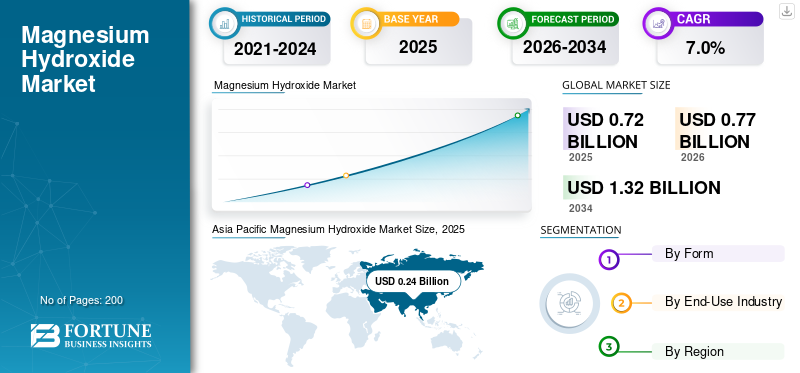
The global magnesium hydroxide market size was valued at USD 0.72 billion in 2025 and is projected to grow from USD 0.77 billion in 2026 to USD 1.32 billion by 2034, exhibiting a CAGR of 7.0% during the forecast period. Asia Pacific dominated the magnesium hydroxide market with a market share of 33.33% in 2025.
The magnesium hydroxide (Mg(OH)₂) market is expanding steadily due to its wide use across essential industrial and commercial applications. Demand is rising because Mg(OH)₂ is extensively used in chemical manufacturing, plastics and polymers, pharmaceuticals, wastewater treatment, flame retardants, and environmental applications. Its alkaline properties, thermal stability, and effective neutralizing performance make it a preferred material in industries that require reliable processing efficiency and product consistency. In addition, expansion in industrial processing activities, higher consumption by the chemical industry, and the increasing need for efficient, versatile inorganic compounds are further driving the growth of the magnesium hydroxide market.
Key companies such as Huber Advanced Materials, Kisuma Chemicals, Konoshima Chemical Co., Ltd., Nedmag B.V., and Martin Marietta Magnesia Specialties are reinforcing their presence in the market by advancing product development, enhancing processing and manufacturing capacities, and strengthening their global supply.
Download Free sample to learn more about this report.
Magnesium Hydroxide Market Key Takeaways
 Global Market Size & Forecast
- 2025 Market Size: USD 0.72 billion
- 2026 Market Size: USD 0.77 billion
- 2034 Forecast Market Size: USD 1.32 billion
- CAGR: 7.0% (2026–2034)
 Market Share
- Asia Pacific dominated the market with a 33.33% share in 2025.
- The powdered segment is projected to grow at a 6.8% CAGR during the forecast period.
- The plastics and polymers segment is expected to register the fastest growth, expanding at a 7.4% CAGR during the forecast period.
 Key Regional Highlights
Asia Pacific
Asia Pacific generated USD 0.24 billion in 2025 and is projected to reach USD 0.25 billion in 2026.
North America
North America generated USD 0.17 billion in 2025, representing a significant regional market.
Europe
Europe accounted for USD 0.19 billion in 2025 and is expected to witness steady growth during the forecast period.
U.S.
U.S. market reached USD 0.14 billion in 2025.
Japan
Japan market is projected to witness steady growth during the forecast period.
Read More

MAGNESIUM HYDROXIDE MARKET TRENDS
Rising Preference for Halogen-Free Flame Retardant Materials to Curate Market Trend
A major trend in the market is the growing preference for halogen-free flame-retardant materials across modern manufacturing industries. Manufacturers are increasingly shifting toward safer additive systems that improve fire resistance while supporting cleaner product formulations and lower smoke generation during combustion. The product is gaining attention because it serves as both a flame retardant and a smoke suppressant, making it useful for materials that require higher safety standards. Its increasing use in wire and cable compounds, construction materials, automotive parts, and polymer products is strengthening this trend.
- According to an MDPI Coatings review, Mg(OH)₂ is a non-toxic, environmentally friendly, halogen-free flame retardant that effectively reduces smoke and toxic fumes during fire, supporting the trend toward safer flame-retardant materials.
MARKET DYNAMICS
MARKET DRIVERS
Download Free sample to learn more about this report.
Strong Demand for Magnesium Hydroxide From the Chemicals Industry Leads to Significant Market Growth
The market is being strongly driven by the high demand for magnesium hydroxide from the chemicals industry. Mg(OH)₂ is widely used in chemical processing, neutralization applications, and the production of various intermediates and specialty formulations. Its alkaline nature, stable performance, and broad processing value make it an important input across multiple chemical manufacturing operations. As the chemicals industry continues to expand with rising production needs and increasing demand for efficient processing materials, the demand for Mg(OH)₂ is growing steadily. Thus, it creates a positive impact on the magnesium hydroxide market growth.
- According to the International Conference on Advances in IT, Mg(OH)₂ is used in the production of detergents, cosmetics, and sugar, as well as in the chemical and pharmaceutical industries, supporting its strong demand in the chemicals industry.
MARKET RESTRAINTS
Processing and Handling Challenges in Industrial Applications to Restrict Market Adoption
The market faces a key restraint due to processing and handling challenges associated with Mg(OH)₂ in industrial applications. Although it is considered safer than many highly reactive alkaline chemicals, its use can still create operational difficulties related to dust generation, dispersion, storage, and consistent incorporation into formulations. Industries that use Mg(OH)₂ often require controlled handling systems, suitable processing conditions, and additional formulation support to maintain product performance and operational efficiency.
- According to a Polymers (MDPI) study, Mg(OH)₂ is difficult to disperse in epoxy resin and exhibits poor flame-retardant performance, supporting the restraint due to processing limitations and formulation challenges.
MARKET OPPORTUNITIES
Growing Demand for Plastics and Polymers to Create Significant Market Opportunities
The market is creating strong growth opportunities due to the rising demand for magnesium hydroxide in plastics and polymers applications. Mg(OH)₂ is widely valued for its role as a halogen-free flame retardant and smoke suppressant in polymer formulations where product safety, thermal stability, and regulatory compliance are becoming increasingly important. As the plastics and polymers sector continues to focus on safer material systems and improved fire performance, the demand for reliable non-halogenated additive solutions is increasing.
- According to ScienceDirect, Mg(OH)₂ is one of the most commonly used inorganic flame retardants for halogen-free compounds in the wire and cable industry, supporting growth opportunities in plastics and polymer applications.
MARKET CHALLENGES
Fluctuations in Raw Material and Processing Costs Lead to Market Challenges
The market faces challenges due to fluctuations in raw materials and processing costs involved in Mg(OH)₂ production. Manufacturing Mg(OH)₂ depends on stable availability of magnesium-bearing feedstocks and cost-efficient processing conditions, and any rise in these input costs can directly affect overall production expenses. Producers often face pressure to maintain pricing stability, especially when raw material markets remain uncertain and operating costs shift frequently. These cost-related challenges can affect profit margins, create pricing pressure for end users, and make market growth more difficult in price-sensitive applications.
- According to an MDPI Water study, Mg(OH)₂ from brine can be produced at a cost comparable to magnesite mining and calcining, showing that changes in feedstock and processing economics can affect Mg(OH)₂ production costs.
Segmentation Analysis
By Form
High Suitability for Industrial Treatment and Chemical Applications Supports the Dominance of the Slurry Segment
Based on the form, the market is segmented into slurry, powder, and granules.
The slurry segment holds the largest magnesium hydroxide market share due to its wide use across industrial treatment and chemical processing applications. Slurry Mg(OH)₂ is widely preferred as it is easy to pump, convenient for controlled dosing, and suitable for continuous-use systems in large-scale operations. It is commonly used in wastewater treatment, flue gas treatment, chemical processing, and other applications where uniform distribution, efficient handling, and consistent performance are important.
- According to a Martin Marietta technical resource, Mg(OH)₂ slurry is widely used for heavy metal precipitation, acid neutralization, and biological wastewater treatment, supporting the dominance of the slurry segment in large-scale industrial use.
The powdered segment is expected to grow at a CAGR of 6.8% over the forecast period.
By End-Use Industry
Strong Demand for Industrial Processing and Specialty Formulations Supports the Dominance of the Chemicals Segment
In terms of end-use industry, the market is categorized into chemicals, plastics and polymers, water and wastewater treatment, pharmaceuticals, and others.
To know how our report can help streamline your business, Speak to Analyst
The chemicals segment holds the largest share of the market due to its wide use in industrial processing, neutralization applications, and specialty chemical formulations across multiple operations. Mg(OH)₂ is commonly used in chemical manufacturing due to its alkaline nature, stability, and effectiveness in supporting a range of treatment and formulation functions. It plays an important role in applications where reliable chemical behavior, controlled processing conditions, and consistent product performance are essential.
- According to a Physicochemical Problems of Mineral Processing paper, Mg(OH)₂ is used in chemical production, pharmaceuticals, and polymer applications, supporting its broad demand across the chemicals segment.
The plastics and polymers segment is expected to grow at a CAGR of 7.4% over the forecast period.
Magnesium Hydroxide Market Regional Outlook
By region, the market is categorized into North America, Europe, Asia Pacific, Latin America, and the Middle East and Africa.
Asia Pacific
Asia Pacific Magnesium Hydroxide Market Size, 2025 (USD Billion)
To get more information on the regional analysis of this market, Download Free sample
Asia Pacific held the dominant position in the magnesium hydroxide market in 2025, valued at USD 0.24 billion, and is expected to maintain its leading role in 2026, reaching USD 0.25 billion. The region’s dominance is supported by its large chemicals industry, strong manufacturing base, and rising demand for Mg(OH)₂ across flame retardants, wastewater treatment, pharmaceuticals, environmental applications, and industrial processing in major economies such as China, India, Japan, South Korea, and Southeast Asian countries. Mg(OH)₂ is widely used across chemical manufacturing, treatment systems, and polymer-related applications, all of which see high consumption across the region’s expanding production sectors.
China Magnesium Hydroxide Market
Based on Asia Pacific’s strong contribution and China’s position as a major chemical manufacturing and industrial processing hub, the China Mg(OH)₂ market was valued at USD 0.08 billion in 2025, accounting for approximately 32.1% of regional revenues. The country’s large chemical production base, extensive industrial processing, and broad use of Mg(OH)₂ in flame-retardant materials, wastewater treatment, pharmaceuticals, and specialty chemical applications support steady market demand.
To know how our report can help streamline your business, Speak to Analyst
North America
North America represented a significant regional market for magnesium hydroxide and reached a valuation of USD 0.17 billion in 2025. The region’s established chemicals industry drives demand, stringent environmental regulations, and widespread use of Mg(OH)₂ across flame retardants, wastewater treatment, pharmaceuticals, and industrial manufacturing applications. Mg(OH)₂ is widely used in neutralization, treatment, and specialty formulation processes, all of which support stable regional consumption.
U.S. Magnesium Hydroxide Market
The U.S. market in 2025 reached a valuation of USD 0.14 billion, accounting for approximately 83.3% of regional revenues. Demand for magnesium hydroxide is supported by the country’s large chemical manufacturing base and its extensive use in wastewater treatment, flame-retardant materials, pharmaceuticals, and specialty industrial applications. Strong Mg(OH)₂ consumption from chemical producers, industrial processors, and downstream manufacturing sectors continues to support market expansion.
Europe
Europe is expected to demonstrate steady growth in the Mg(OH)₂ market, reaching a valuation of USD 0.19 billion in 2025. The region’s development is supported by its well-established chemicals industry, strong manufacturing base, and widespread use of Mg(OH)₂ across wastewater treatment, flame retardants, pharmaceuticals, environmental applications, and specialty chemical uses in countries such as Germany, France, Italy, and the UK. Mg(OH)₂ is widely used in neutralization, treatment, and formulation processes, all of which are important across Europe’s diversified industrial sectors.
Germany Magnesium Hydroxide Market
Germany reached a valuation of USD 0.05 billion in 2025, accounting for approximately 28.6% of regional demand. Growth is driven by the country’s strong chemical manufacturing sector, along with its leadership in industrial processing, pharmaceuticals, specialty chemicals, and advanced manufacturing operations. Magnesium hydroxide is extensively used in chemical production, treatment applications, flame-retardant formulations, and process operations, supported by Germany’s advanced industrial capabilities and strong focus on production efficiency.
Latin America and the Middle East & Africa
Latin America and the Middle East & Africa are projected to witness steady growth in the magnesium hydroxide market during the forecast period. The Latin America market reached a valuation of USD 0.07 billion in 2025, supported by expanding chemical processing activity, rising demand for wastewater treatment solutions, and increasing use of Mg(OH)₂ across flame retardants, pharmaceuticals, and industrial applications. The Middle East & Africa market was valued at USD 0.05 billion in 2025, driven by growing industrial development, expansion of treatment and chemical sectors, and rising use of Mg(OH)₂ in environmental applications, specialty formulations, and manufacturing operations.
Brazil Magnesium Hydroxide Market
The Brazilian market in 2025 was valued at USD 0.03 billion, accounting for approximately 48.6% of revenues. Demand is supported by the country’s growing industrial base, rising chemical processing activity, and increasing use of magnesium hydroxide in wastewater treatment, flame-retardant formulations, and downstream manufacturing operations. Its use across plastics and polymers, chemicals, pharmaceuticals, and industrial processing is further supported by Brazil’s expanding production and manufacturing activities.
COMPETITIVE LANDSCAPE
Key Industry Players
Strong Processing Capabilities and Application-Focused Supply Shape Market Competition
The Mg(OH)₂ market remains moderately consolidated, with supply concentrated among established producers that have strong mineral processing capabilities, dependable raw material access, and developed distribution networks. Participation in this market requires investment in production infrastructure, quality control systems, application-specific processing, and consistent supply management, which creates higher entry barriers for new participants.
Leading companies such as Huber Advanced Materials, Kisuma Chemicals, Konoshima Chemical Co., Ltd., Nedmag B.V., and Martin Marietta Magnesia Specialties compete by focusing on product quality, processing efficiency, supply reliability, and broad customer support across end-use industries. Their established manufacturing base and specialized product capabilities continue to strengthen their position in the magnesium hydroxide market.
LIST OF KEY MAGNESIUM HYDROXIDE COMPANIES PROFILED
- Huber Advanced Materials (U.S.)
- Kisuma Chemicals (Netherlands)
- Konoshima Chemical Co., Ltd. (Japan)
- Nedmag B.V. (Netherlands)
- Premier Magnesia, LLC (U.S.)
- Martin Marietta Magnesia Specialties (U.S.)
- SPI Pharma (U.S.)
- Lehmann&Voss&Co. (Germany)
- Elementis PLC. (U.K.)
- Garrison Minerals, LLC. (U.S.)
KEY INDUSTRY DEVELOPMENTS
- October 2025: Kisuma Chemicals launched KISUMA X, a next-generation synthetic magnesium hydroxide flame retardant for halogen-free polymer formulations, targeted at polyolefin, EVA, and nylon compounds.
- October 2025: Kisuma Chemicals also introduced Zenthos FR, a new flame-retardant product family for PVC formulations, alongside its broader magnesium-based additives portfolio for safer halogen-free systems.
- January 2022: Huber Engineered Materials completed the acquisition of the remaining 50% stake in MAGNIFIN, bringing the premium magnesium hydroxide (MDH) business fully into Huber Advanced Materials and strengthening its position in halogen-free flame retardants.
REPORT COVERAGE
The global market analysis provides an in-depth study of the market size and forecast for all the market segments included in the report. It includes details on the market dynamics and market trends expected to drive the market over the forecast period. It offers information on technological advancements, new product launches, key industry developments, and details on partnerships, mergers, and acquisitions. The market research report also encompasses a detailed competitive landscape with information on the market share and profiles of key operating players.
Request for Customization to gain extensive market insights.
Report Scope & Segmentation
| ATTRIBUTE | DETAILS |
| Study Period | 2021-2034 |
| Base Year | 2025 |
| Estimated Year | 2026 |
| Forecast Period | 2026-2034 |
| Historical Period | 2021-2024 |
| Growth Rate | CAGR of 7.0% from 2026-2034 |
| Unit | Value (USD Billion) Volume (Kiloton) |
| Segmentation | By Form, End-Use Industry, and Region |
| By Form |
|
| By End-Use Industry |
|
| By Region |
|
Frequently Asked Questions
Fortune Business Insights says that the global market size was valued at USD 0.72 billion in 2025 and is projected to reach USD 1.32 billion by 2034.
Recording a CAGR of 7.0%, the market is slated to exhibit steady growth during the forecast period.
The chemicals end-use industry segment led in 2025.
Asia Pacific held the highest market share in 2025.
Rising demand from the chemicals industry, where magnesium hydroxide is used in chemical processing and specialty formulations, is driving the growth.



- 2021-2034
- 2025
- 2021-2024
- 200
Get 30-60 hrs Free Customization
Expand Regional and Country Coverage, Segments Analysis, Company Profiles, Competitive Benchmarking, and End-user Insights.


















-
US +1 833 909 2966 ( Toll Free )
-
Get In Touch With Us