Magnetic Sensor Market Size, Share & Industry Analysis, By Sensor Type (Hall Effect, AMR Sensors, GMR Sensors, Fluxgate, SQUID, and Others (TMR, etc.)), By Measurement Range (Low, Medium, High, and Ultra-Low/Specialized), By Output Signal (Analog, Digital, Linear, and Incremental), By Package Type (Through-Hole, Surface-Mount, Miniature, and Other Packages), By Application (Automotive, Consumer Electronics, Industrial, Healthcare, Aerospace & Defense, and Others (BFSI, etc.)), and Regional Forecast, 2026-2034
 Download Free Sample
MAGNETIC SENSOR MARKET SIZE AND FUTURE OUTLOOK
 Listen to Audio Version
The global magnetic sensor market size was valued at USD 5.50 billion in 2025. The market is projected to grow from USD 6.00 billion in 2026 to USD 11.80 billion by 2034, exhibiting a CAGR of 8.80% during the forecast period. Asia Pacific dominated the global market with a share of 39.70% in 2025.
The market is experiencing significant expansion, which is powered by magnetic sensors’ diverse applications in motor vehicle, consumer electronics, industrial and healthcare.
Increasing demand for magnetic sensors, smart technologies, widely adopting electric vehicles and continuous progress in automation further enhances market growth. Additionally, renewable energy, short sensor design, and push for safety-intelligent applications are the significant contributions to this above trend.
A few prominent players operating in the market are Allegro MicroSystems, Inc., Infineon Technologies AG, TDK Corporation, Asahi Kasei Microdevices (AKM), LEM International SA, and others.
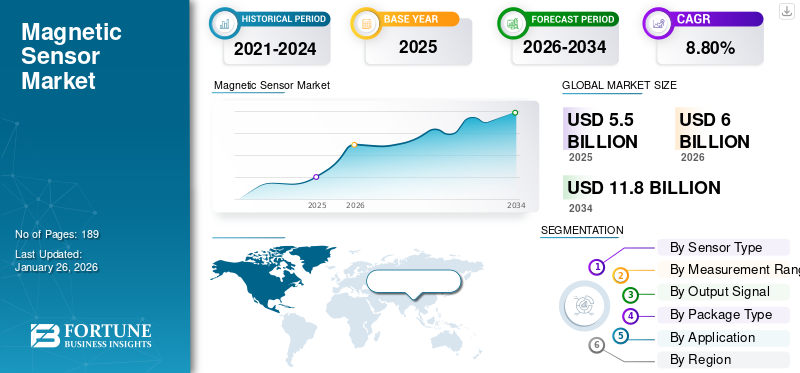
Download Free sample to learn more about this report.
MARKET DYNAMICS
Market Drivers
EV Adoption and Demand for Precise Motion Sensing Drives the Market Development
The growing EV adoption and demand for precise motion sensing are driving the global magnetic sensor market growth. The demand for magnetic sensors are expected to increase significantly, driven by the adjacent requirement for increased adoption and accurate speed sensing in electric vehicles (EVS). As the automobile industry transitions from internal combustion engines to electric motor trains, the number of sensors required by the vehicle increases. Magnetic sensors are crucial for enabling a wide range of EV characteristics, including precise motor control, enhanced security systems, and reliable battery management.
For example, Tata Motors in India introduced a new EV in mid-2025, which included a new EV with complex magnetic sensors to refine the driver evaluation system to avoid accidents and collisions. Furthermore, there is a general industry movement toward more advanced sensor technologies. Compared to conventional hall effect sensors, TDK Corporation is creating sophisticated Tunnel Magnetoresistance (TMR) sensors with increased sensitivity and reduced power consumption, ideal for complex EV drivetrains.
Market Restraints
High Sensor Costs and Interference Issues Hampers the Market Growth
The market for magnetic sensors is considerably limited by the great initial costs and operational hurdles. A key impediment is the problem of excessive prices. Although commodity-grade sensors are getting more inexpensive, high-precision applications like manufacturing autonomous vehicles and EV battery management systems costs considerably more. Because of the sophisticated fabrication processes, need of specialized materials, and strict quality control standards, the ultimate cost per unit rises, therefore reducing their appeal for high-volume, low-margin goods.
Market Opportunities
Growth in Renewable Energy and Smart Electronics Offers Lucrative Growth Opportunities
Smart gadgets and renewable energy are two rapidly growing fields where the magnetic sensor sector presents enormous opportunities. These industries are creating a great demand for precise detection capacities, without contact and reliable, offered by magnetic sensors as the world advances towards a more sustainable and linked future.
In the renewable energy sector, magnetic sensors help increase the efficiency and reliability of machines such as solar panels and wind turbines. For rotor speed and angle detection in wind turbines, they enable a higher level of control and more efficient energy generation.
By late 2025, companies like TDK Corporation and Analogue Devices will focus on new, highly sensitive TMR sensors, perfect for achieving great accuracy finds applications in renewable energy systems as well as smart consumer devices.
Download Free sample to learn more about this report.
MAGNETIC SENSOR MARKET TRENDS
Increasing Use in Automotive Safety and Industrial Automation Has Emerged as a Prominent Market Trend
Anti-lock braking systems (ABS), electric power steering (EPS), and Advanced Driver Assistance Systems (ADAS) all rely on magnetic sensors in the automotive industry; therefore, they provide an essential angle, velocity, and location data. Their great temperature and oil and dirt tolerance make them well-suited for these uses. Magnetic sensors are also vital in improving the productivity and safety of industrial automation manufacturing floors.
Many instances in late 2025 confirm this trend by showing a strong impetus toward invention and acceptance. A new industrial multi-sensor reference design from STMicroelectronics simplifies the incorporation of high-precision magnetic sensors into automation systems, therefore making the adoption of modern technology easier for producers.
SEGMENTATION ANALYSIS
By Sensor Type
Hall-Effect Sensors Lead Due to Their Versatility and Cost-Effectiveness
Based on the sensor type, the market is segmented into hall effect, AMR Sensors, GMR Sensors, fluxgate, SQUID, and others (TMR, etc.).
The hall-effect segment is projected to dominate the market with a share of 34.52% in 2026, with revenue of USD 1.83 billion. This dominance is attributed to its generalized adoption, high durability, and reliability in a multitude of applications, including automotive, industrial and consumer electronics, which makes it a low-cost and high-volume solution.
It is expected that the others segment, which includes advanced technologies such as Fluxgate and SQUID sensors, will grow at the highest CAGR of 12.62%. This growth is driven by the increasing demand for highly specialized and sensitive sensors in niche applications, such as geophysical exploration, medical diagnosis, and scientific research.
By Measurement Range
Medium-Range Measurement Dominates Due to Its Broad Application in Automotive and Industrial Sectors
Based on the measurement range, the market is segmented into low, medium, high, and ultra-low/specialized.
The medium measurement range segment is projected to dominate the market with a share of 47.07% in 2026, with a revenue of USD 2.38 billion. This is because this range is more suitable for a wide variety of industrial and automotive applications, including the detection of position in electric motors and speed detection in factory automation, which constitute a significant part of the market.
It is projected that the ultra-low/specialized measurement range will grow with the annual compound rate of 11.76%. This growth is driven by the increasing demand for highly sensitive sensors in critical applications, including advanced medical imaging, biosensors, and high-precision scientific instruments.
By Output Signal
Digital Output Segment Holds the Largest Share Due to Ease of Integration
Based on the output signal, the market is segmented into analog, digital, linear, and incremental.
The digital segment is projected to dominate the market with a share of 56.40% in 2026, with a revenue of USD 2.79 billion. This is because digital signals are less susceptible to electrical noise and can easily be integrated with microcontrollers and other digital circuits, simplifying system design and improving reliability.
The digital linear segment is expected to grow with the highest CAGR of 10.42%. This growth is driven by the increasing demand for smart components in IoT devices, as well as industrial and electronic consumption automation, which relies on digital communication for efficient data processing and real-time control.
By Package Type
Surface-Mount Segment Leads Due to Its Suitability for Miniaturization
Based on the package type, the market is segmented into through-hole, surface-mount, miniature, and other packages.
The surface-mount segment dominated the market in 2024, with revenue of USD 2.89 billion. Its leadership is due to its compatibility with the automated high-volume manufacturing processes and its small footprint, which is essential for the miniaturization trend in modern electronics.
It is projected that surface assembly a sub segment, will grow with a CAGR of 10.61%. This rapid growth is driven by the industry's demand for more compact systems, which are integrated into consumer electronics, medical devices, and industrial robots, where space and weight are crucial.
By Application
Automotive Leads the Market Due to Rising Demand for Safety and Efficiency Features
Based on the application, the market is segmented into automotive, consumer electronics, industrial, healthcare, aerospace & defense, and others (BFSI, etc.).
The automotive sector held the largest market share in 2024, with a revenue of USD 2.21 billion. This domain is attributed to the generalized use of magnetic sensors in critical vehicle systems such as ADAS, anti-lock braking and electric-assisted steering, which are essential for safety and efficiency.
The healthcare segment is expected to grow with the highest CAGR of 12.28%. This is driven by the growing adoption of magnetic sensors in medical devices, including implantable devices, diagnostic equipment, and portable health monitors, which require highly precise and non-invasive detection capabilities.
To know how our report can help streamline your business, Speak to Analyst
MAGNETIC SENSOR MARKET REGIONAL OUTLOOK
Geographically the market is segmented into North America, Europe, Asia Pacific, South America and Middle East & Africa.
North America
In 2025, North America held 29.60% of the global market share, reaching a valuation of USD 1.63 billion, and is projected to grow to USD 1.78 billion in 2026. Electric Vehicles (EVS) require several magnetic sensors for the rapid adoption of electric motor control and battery management systems (BMS). In addition, increasing attention to autonomous driving and advanced driver assistance systems ADAS is demanding reliable and accurate sensors. The U.S. market is projected to reach USD 1.05 billion by 2026.
Europe
The market in Europe reached USD 1.18 billion in 2025, representing 21.40% of total market revenue, and is projected to reach USD 1.27 billion in 2026, the European market is strong. The region's strong automobile manufacturing base, particularly in luxury and high-end cars, as well as its leadership in industrial automation, largely accounts for this development. Germany is a prominent player due to its strong automobile industry and Industry 4.0, with an expected revenue of about USD 0.25 billion in 2025. France and the U.K. also contribute significantly, spending on smart grid infrastructure and aerospace applications, respectively, with valuation of USD 0.28 billion and USD 0.22 billion, respectively in 2025. The UK market is projected to reach USD 0.31 billion by 2026, while the Germany market is projected to reach USD 0.27 billion by 2026.
Asia Pacific
Asia Pacific contributed approximately USD 2.19 billion to the global market in 2025, accounting for 39.70% share, and is expected to reach USD 2.4 billion in 2026. This makes it the largest and fastest-growing market globally. Especially in China and India, the region's strong motor vehicle and power manufacturing centers provide strength to their economies. With USD 0.63 billion, China is the largest market in the region, followed by India with USD 0.41 billion. This growth is supported by EV production, rapid industrial automation and an increase in consumer dominance. Smartphones, as well as the electronic devices industry, in which magnetic sensors play an important role in other devices. The Japan market is projected to reach USD 0.58 billion by 2026, the China market is projected to reach USD 0.68 billion by 2026, and the India market is projected to reach USD 0.46 billion by 2026.
For example, manufacturers are investing a significant amount in research and development to produce more accurate and compact sensors for smart grid applications, as well as for consumer electronics. Thanks to its strong manufacturing ecosystem, government support, and technological innovation, the Asia Pacific market leads globally.
Asia Pacific Magnetic Sensor Market Size, 2025 (USD Billion) To get more information on the regional analysis of this market, Download Free sample
Latin America
In 2025, Latin America generated USD 0.19 billion, contributing 3.40% to global market revenue, and is projected to grow to USD 0.2 billion in 2026.
South America and Middle East & Africa
The Middle East & Africa region captured 5.80% of the global market in 2025, generating USD 0.32 billion in revenue, and is projected to reach USD 0.34 billion in 2026. respectively. Increased urbanization, improvement in infrastructure, and increasing emphasis on industrial automation and smart city projects are some factors driving this development. In 2025, GCC countries are holding a significant sub-block within the Middle East and Africa, with the expected market share of USD 0.11 billion. They invest in high-tech industries as well as economic diversification.
COMPETITIVE LANDSCAPE
Key Industry Players
Market Leadership By Prominent Players is Strengthened by Strategic Innovation and Product Launches
The global magnetic sensor market is highly fragmented, with several leading companies competing actively across various regions. Key players include Allegro MicroSystems, Inc., Infineon Technologies AG, TDK Corporation, Asahi Kasei Microdevices (AKM), LEM International SA, Melexis NV, Honeywell International Inc., NVE Corporation, Pepperl+Fuchs, and Omron Corporation. These companies are focusing on strategic initiatives, including new product launches, mergers and acquisitions, technological advancements, and investments in research and development. Such efforts enable them to strengthen their market presence and maintain a competitive edge in the global landscape.
LIST OF KEY MAGNETIC SENSOR COMPANIES PROFILED:
· Allegro MicroSystems, Inc. (U.S.)
· Infineon Technologies AG (Germany)
· TDK Corporation (Japan)
· Asahi Kasei Microdevices (AKM) (Japan)
· LEM International SA (Switzerland)
· Melexis NV (Belgium)
· Honeywell International Inc. (U.S.)
· NVE Corporation (U.S.)
· Pepperl+Fuchs (Germany)
· Omron Corporation (Japan)
KEY INDUSTRY DEVELOPMENTS:
- September 2025- STMicroelectronics launched a new industrial multi-sensor reference design that includes a high-compatibility, Ultra-Low-Power 3-axis magnetic sensor. This development is part of a broader effort to simplify the design and development of industrial sensor networks, making it easier for manufacturers to integrate advanced magnetic sensors into their automation processes for Industry 4.0 applications.
- June 2025 - TDK Corporation introduced the TAS8240, a compact, fruitless tunnel magnetoresistance (TMR) angle sensor designed for automotive and industrial safety-critical applications.
- May 2025- Continental, a major automotive supplier, announced that it has produced 200 million radar sensors. While radar is a distinct technology, this milestone underscores the company's leading role in vehicle sensing systems and its expertise in integrating various sensors.
- April 2025- TDK Corporation developed the world's first "Spin Photo Detector," a device that combines optical, electronic, and magnetic elements. The device can respond at ultra-high speeds, making it a potential game-changer for AI applications by improving data transmission and processing speeds while reducing power consumption.
- February 2025 - CTS Corporation acquired Maglab AG, a provider of magnetic system design and current measurement solutions. This strategic acquisition demonstrates how companies are consolidating to expand their product portfolios and gain expertise in specialized magnetic sensing solutions for high-growth sectors, such as electric mobility, renewable energy, and industrial automation.
REPORT COVERAGE
The global report provides a detailed analysis of the market and focuses on key aspects such as prominent companies, deployment modes, types, and end users of the product. Besides this, it offers insights into the magnetic sensor market trends and highlights key industry developments and market share analysis for key companies. In addition to the aforementioned factors, the report encompasses several factors that have contributed to the growth of the market over recent years.
Request for Customization to gain extensive market insights.
Report Scope & Segmentation
| ATTRIBUTE |
DETAILS |
| Study Period | 2021-2034 |
| Base Year | 2025 |
| Forecast Period | 2026-2034 |
| Estimated Year | 2025 |
| Growth Rate | CAGR of 8.80% from 2026-2034 |
| Historical Period | 2021-2024 |
| Unit | Value (USD Billion) |
| Segmentation | By Sensor Type, Measurement Range, Output Signal, Package Type, Application, and Region |
| By Sensor Type |
|
| By Measurement Range |
|
| By Output Signal |
|
| By Package Type |
|
| By Application |
|
| By Region |
|
Frequently Asked Questions
Fortune Business Insights says that the global market stood at USD 5.50 billion in 2025 and is projected to reach USD 11.80 billion by 2034.
The market is expected to exhibit steady growth at a CAGR of 8.80% during the forecast period.
EV adoption and demand for precise motion sensing drives the market growth.
Allegro MicroSystems, Inc., Infineon Technologies AG, TDK Corporation, Asahi Kasei Microdevices (AKM), LEM International SA, Melexis NV, Honeywell International Inc., NVE Corporation are the top players in the market.
Asia Pacific region held the largest market share.
Asia Pacific was valued at USD 2.19 billion in 2025.



- 2021-2034
- 2025
- 2021-2024
- 189
Get 30-60 hrs Free Customization
Expand Regional and Country Coverage, Segments Analysis, Company Profiles, Competitive Benchmarking, and End-user Insights.




















-
US +1 833 909 2966 ( Toll Free )
-
Get In Touch With Us