Magnetometer Market Size, Share & Industry Analysis, By Platform (Airborne, Ground, Maritime, and Space), By End User (Aerospace & Defense, Consumer Electronics, Marine/Naval, Automotive, and Others), and Regional Forecast, 2026-2034
 Download Free Sample
Magnetometer Market Size and Industry Overview
 Listen to Audio Version
The global magnetometer market size was valued at USD 3.94 billion in 2025 and is projected to grow from USD 4.32 billion in 2026 to USD 8.84 billion by 2034, exhibiting a CAGR of 9.38% during the forecast period. North America dominated the magnetometer market with a market share of 38.76% in 2025.
Magnetometers are devices used to measure magnetic fields through their strength, direction, and variations. In the aerospace and defense sector, they are critical for navigation, attitude control, and high-precision measurements in space missions. They are employed in applications such as GPS tracking, planetary exploration, and detecting magnetic anomalies. Advanced types include fluxgate, optically pumped, and atomic, which offer high sensitivity and reliability. These instruments are essential for satellite operations, UAVs, and military applications, including submarine detection.
The market is experiencing significant growth due to magnetometers’ expanding applications across various industries. They are increasingly being used for navigation, guidance, and control systems in aircraft, spacecraft, and missiles, driving demand in these sectors. Moreover, advancements in technology, such as miniaturized and quantum-based magnetometers, are enhancing precision and broadening their use in emerging fields, including autonomous vehicles, robotics, and augmented reality.
The market in aerospace, defense, and automotive industries is driven by rising demand for precise navigation, guidance, and control systems, especially in aircraft, missiles, UAVs, and autonomous vehicles. Increasing investments in space exploration and next-generation aircraft further fuel growth, while advancements in miniaturization and sensor sensitivity enable broader adoption. Key players include Honeywell International Inc., Geometrics, Inc., Billingsley Aerospace & Defense, AlphaLab, Inc. (U.S.), Applied Physics Systems, and Metrolab Technology SA (Switzerland). These companies are expanding through innovation, partnerships, and product development to meet evolving industry needs.
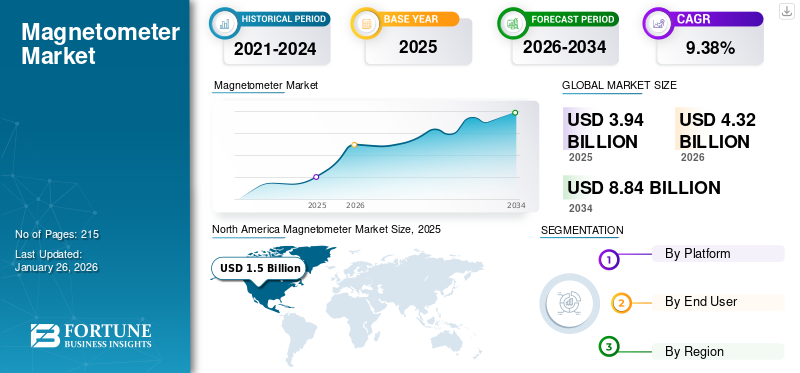
Download Free sample to learn more about this report.
MAGNETOMETER Market Key Takeaways
 Global Market Size & Forecast
- 2025 Market Size: USD 3.94 billion
- 2026 Market Size: USD 4.32 billion
- 2034 Forecast Market Size: USD 8.84 billion
- CAGR: 9.38% from 2026–2034
 Market Share
- North America dominated the magnetometer market with a 38.76% share in 2025.
- The airborne segment dominated the market, driven by its critical role in navigation, guidance.
- The aerospace and defense segment dominated the market due to the widespread use of magnetometers in navigation.
 Key Regional Highlights
North America
The market was valued at USD 1.50 billion in 2025 and is projected to reach USD 1.65 billion in 2026.
Europe
The market was valued at USD 1.14 billion in 2025 and is projected to reach USD 1.25 billion in 2026.
Asia Pacific
The market was valued at USD 0.91 billion in 2025 and is projected to reach USD 1.00 billion in 2026.
U.S.
The U.S. dominates the North American market, supported by significant R&D investments.
Japan
Japan is contributing to Asia Pacific market growth through investments in advanced navigation systems.
Read More

MAGNETOMETER MARKET TRENDS
Demand For Precise Navigation And Positioning Systems for Various Applications
As the demand for more precise navigation and positioning systems grows, particularly in applications such as unmanned aerial vehicles (UAVs), satellites, and advanced military systems, there is a push towards integrating magnetometers with other sensor technologies. This integration often includes combining magnetometers with accelerometers, gyroscopes, and GPS systems to create more robust and accurate inertial measurement units (IMUs). The integration of multiple sensors allows for improved accuracy and reliability in navigation and orientation, which is critical for both civilian and military applications. This trend is leading to the development of more sophisticated and versatile magnetometer systems that can meet the stringent requirements of modern A&D applications.
MARKET DYNAMICS
MARKET DRIVERS
Rising Use of Magnetometers in Unmanned Aerial Vehicles (UAVs) and Autonomous Systems to Stimulate Market Growth
There has been a rise in the adoption of Unmanned Aerial Vehicles (UAVs) and drones across various sectors. In defense, UAVs are increasingly being used for surveillance, reconnaissance, and combat operations due to their versatility and cost-effectiveness. In commercial sectors, drones are being used for applications such as agriculture, construction, logistics, and aerial photography.
This widespread adoption is driven by advancements in technology, reduced costs, and regulatory support. A magnetometer is one of the important components in a UAV system to navigate accurately. This device measures the Earth's magnetic field, providing essential data for orientation and navigation, particularly in situations where GPS signals are weak or unreliable, such as in urban canyons or under dense foliage. These systems are installed in UAVs or drones to maintain stable flight paths and execute precise maneuvers.
In the aerospace sector, they are used for satellite attitude control, space exploration missions, and geomagnetic surveys, enabling precise orientation and positioning. In defense, they are popularly used for detecting submarines, unexploded ordnance, and magnetic anomalies, which are vital for military operations. Thus, the increasing adoption of unmanned aerial vehicles (UAVs) and autonomous systems will drive the magnetometer market growth during the forecast period.
MARKET RESTRAINTS
Interference and Calibration Issues to Limit Market Expansion
One of the significant restraints that hamper the magnetometer market in aerospace and defense is the challenge posed by interference and calibration issues. Magnetometers are highly sensitive instruments that measure magnetic fields, but their accuracy can be compromised by external factors such as nearby metallic objects, electrical equipment, or natural geological features. These interferences may lead to significant errors in applications such as navigation in GPS-denied environments or detecting magnetic anomalies.
Moreover, they require frequent upgrades to maintain their precision, which is time-consuming and resource-intensive. This demands regular correction, increases operational costs, and can deter adoption in scenarios where consistent reliability and low maintenance are essential. As a result, addressing these challenges is crucial for expanding the use of magnetometers in aerospace and defense applications.
MARKET OPPORTUNITIES
Integration of Quantum Technology into Magnetometers Expected to Positively Impact Market Growth
The integration of quantum technologies into magnetometers presents a significant opportunity for growth in the aerospace and defense (A&D) sector. Quantum magnetometers offer exceptional sensitivity and accuracy, surpassing traditional magnetometers. This enhanced capability makes them ideal for high-precision applications such as advanced navigation systems, satellite attitude control, and detailed geomagnetic surveys. Additionally, there has been a rise in research and development related to quantum technology and its integration in designing such systems to enhance navigation and detect magnetic anomalies.
For instance, in December 2024, SBQuantum, a Canadian leader in quantum sensing technology, revolutionized quantum diamond magnetometers with applications in space, defense, and minerals exploration. Recent collaborations include testing its sensors with the European Space Agency for satellite-based monitoring of Earth's magnetic field and the Canadian Space Agency under extreme conditions in the STRATOS Program.
In defense, they can significantly improve the detection of magnetic anomalies, such as submarines, and enhance the precision of missile guidance systems. The potential for these advanced systems to revolutionize various A&D applications is substantial, as they can provide unmatched accuracy and reliability in critical operations. As research and development in quantum technologies continue to advance, the integration of these technologies into magnetometers is expected to open new avenues for innovation and market expansion in the A&D industry.
Download Free sample to learn more about this report.
Segmentation Analysis
By Platform
Airborne Segment Dominates Due to Advanced Magnetometer Applications in Aerospace & Defense
By platform, the market is segmented into airborne, ground, maritime, and space.
The airborne segment dominates the magnetometer market due to its critical role in navigation, guidance, and magnetic anomaly detection for aircraft, UAVs, and satellites. Magnetometers are integral to ensure precise heading and altitude control, especially in GPS-denied environments. Also, their use in detecting magnetic anomalies for military reconnaissance and surveillance has further driven the product adoption. There is a rise in research and development of these systems to reduce reliance on GPS in the military.
- For instance, in May 2023, the Department of the Air Force-MIT AI Accelerator performed real-time magnetic navigation (MagNav) on the C-17A Globemaster III during Exercise Golden Phoenix, marking the first such demonstration on a Department of Defense aircraft. They developed magnetic navigation (MagNav) using magnetometers to measure Earth's magnetic field and compare it with known magnetic maps for precise positioning.
By End User
Aerospace & Defense Dominated the Market Due to Its Critical Role in Navigation and Detection Applications
Based on end-user, the market is segmented into aerospace & defense, consumer electronics, marine/naval, automotive, and others.
The aerospace and defense segment dominated the market due to its critical role in navigation, guidance, and detection systems. Magnetometers are essential for determining aircraft orientation, missile guidance, and spacecraft positioning, especially in GPS-denied environments. Additionally, they are widely used in detecting magnetic anomalies for military reconnaissance and surveillance operations. Increasing investments in advanced aerospace technologies and defense modernization programs globally bolster segmental growth.
Magnetometer Market Regional Outlook
By geography, the market is categorized into North America, Europe, Asia Pacific, and the Rest of the World.
North America
North America Magnetometer Market Size, 2025 (USD Billion)
To get more information on the regional analysis of this market, Download Free sample
North America dominated the market, driven by its robust aerospace and defense industries, advanced technological infrastructure, and increasing applications across multiple sectors. In 2025, North America represented USD 1.5 billion, accounting for 38.76% of the worldwide market, and is projected to grow to USD 1.65 billion in 2026. The U.S., in particular, dominates the region due to significant investments in research and development, a strong presence of leading manufacturers such as Honeywell and Lockheed Martin, and a growing demand for magnetometers in satellite navigation, missile guidance, and GPS-independent systems. North America is advancing in space exploration, which further boosts product adoption in planetary studies and geomagnetic mapping. Additionally, advancements in quantum magnetometers are enhancing precision for detecting magnetic anomalies in defense and environmental monitoring. Scalar magnetometers are in high demand for natural calamities research and tracking, aiding in detecting magnetic anomalies linked to tectonic activities.
Europe
The Europe market generated USD 1.14 billion in 2025, representing 28.85% of the global market landscape, and is expected to reach USD 1.25 billion in 2026. The European market is experiencing significant growth, particularly in the aerospace and defense (A&D) and automotive sectors. In A&D, magnetometers are crucial for navigation, orientation, and detection tasks, driving demand due to their precision and reliability in GPS-denied environments. The European Space Agency's involvement in satellite-based magnetometer projects further boosts market growth by enhancing navigation and Earth's magnetic field monitoring capabilities. In the automotive sector, they are used for sensing applications such as gear stick position and pedal/valve position sensing, contributing to the market's expansion.
Asia Pacific
Asia Pacific contributed 23.02% to the global market in 2025, with a valuation of USD 0.91 billion, and is projected to reach USD 1 billion in 2026. The Asia Pacific region is the fastest-growing market for magnetometers, driven by its growing consumer electronics and automotive sectors. In aerospace and defense, countries such as China and Japan are investing heavily in advanced navigation systems and satellite technologies, where magnetometers play a crucial role. The increasing demand for precision navigation in GPS-denied environments and the development of autonomous systems further boost the adoption of these systems in A&D. In the automotive sector, the rapid growth of electric vehicle production and advancements in autonomous driving technologies are propelling the demand for magnetometers for precise navigation and safety features. Vector magnetometers are increasingly used for accurate navigation and orientation in aerospace, defense, and automotive sectors.
Rest of the World
Rest of the World contributed approximately USD 0.38 billion to the global market in 2025, accounting for 9.36% share, and is expected to reach USD 0.42 billion in 2026. The magnetometer market in the Rest of the World, including regions such as South America, the Middle East & Africa, is witnessing steady growth driven by increasing applications in aerospace and defense (A&D) and automotive sectors. Countries in the Middle East are investing in advanced navigation systems and defense modernization programs, leveraging magnetometers for GPS-independent navigation and detection of magnetic anomalies. South America, with its well-established mining industry, uses such systems for mineral exploration, which complements its role in defense applications such as submarine detection.
COMPETITIVE LANDSCAPE
Key Industry Players
Continuous Development and Introduction of New Products by Key Companies Resulted in Their Dominating Positions in the Market
The market is competitive, with key players such as Honeywell International Inc., Lockheed Martin Corporation, Bartington Instruments Ltd., and Metrolab Technology SA leading the industry through innovations and strategic collaborations. Companies are focusing on product launches, partnerships, and acquisitions to expand the magnetometer market share, such as Honeywell's launch of a 3-axis space magnetometer for small satellites in 2021. Emerging technologies, including quantum systems are reshaping competition, offering enhanced precision and reliability for aerospace and defense applications.
LIST OF KEY MAGNETOMETER COMPANIES PROFILED
- Honeywell International Inc. (U.S.)
- Geometrics, Inc. (U.S.)
- Billingsley Aerospace & Defense (U.S.)
- AlphaLab, Inc. (U.S.)
- Applied Physics Systems (U.S.)
- Metrolab Technology SA (Switzerland)
- Bartington Instruments Ltd. (U.K.)
- FOERSTER Holding GmbH (Germany)
- Lake Shore Cryotronics, Inc. (U.S.)
- Marine Magnetics Corp. (Canada)
KEY INDUSTRY DEVELOPMENTS
- December 2024- MDA Space selected Honeywell to provide a satellite Attitude Control System and Magnetometers Unit components, including Reaction Wheel Assemblies and 3-axis Space Rate Sensors, for the MDA AURORA product line supporting Telesat's LEO satellite constellation. The system is crucial for maintaining satellite orientation and position, ensuring efficient signal communication and solar power generation.
- September 2021- Honeywell fully qualified its latest 3-axis Space Magnetometer designed for small satellites in the emerging New Space segment. It offers cost-effective, radiation-tolerant solutions tailored for proliferated low Earth orbit (LEO) constellations.
REPORT COVERAGE
The global magnetometer market research report provides an in-depth technical analysis of the market, covering its size, growth trends, and future projections. It explores the various types of magnetometers, including mechanical, ring laser, and fiber optic, and their applications across different industries. The report discusses key drivers such as technological advancements and increasing demand for precision navigation systems. It also examines their role in emerging technologies such as autonomous vehicles and drones. It also identifies factors contributing to market growth during the helicopter market forecast period.
Request for Customization to gain extensive market insights.
Report Scope & Segmentation
|
ATTRIBUTE |
DETAILS |
|
Study Period |
2021-2034 |
|
Base Year |
2025 |
|
Estimated Year |
2026 |
|
Forecast Period |
2026-2034 |
|
Historical Period |
2021-2024 |
|
Growth Rate |
CAGR of 9.38% from 2026-2034 |
|
Unit |
Value (USD Billion) |
|
Segmentation |
By Platform
|
|
By End-User
|
|
|
By Region
|
Frequently Asked Questions
Fortune Business Insights says that the global market value stood at USD 4.32 billion in 2026 and is projected to reach USD 8.84 billion by 2034.
In 2025, the market value in North America stood at USD 1.5 billion.
The market is expected to exhibit a CAGR of 9.38% during the forecast period of 2026-2034.
The airborne segment leads the market by platform.
The key factor driving the market is the rising use of magnetometers in unmanned aerial vehicles (UAVs) and autonomous systems.
Honeywell International Inc., Geometrics, Inc. (U.S.), and Billingsley Aerospace & Defense are the top players in the market.
North America dominated the market in 2025.



- 2021-2034
- 2025
- 2021-2024
- 215
Get 30-60 hrs Free Customization
Expand Regional and Country Coverage, Segments Analysis, Company Profiles, Competitive Benchmarking, and End-user Insights.




















-
US +1 833 909 2966 ( Toll Free )
-
Get In Touch With Us