Malaria Drugs Market Size, Share & Industry Analysis, By Drug (Artemisinin-based Therapies, Non-artemisinin Combination Therapies, Quinoline-based Drugs, Antifolate Antimalarials, 8-Aminoquinolines / Anti-relapse Drugs, Antibiotic Antimalarials), By Disease Type (Uncomplicated Malaria, Severe / Complicated Malaria), By Age Group (Pediatric, and Adults), By Type (Branded and Generics), By Route of Administration (Oral and Others), By Distribution Channel (Public Health Programs & Government Facilities, Hospital Pharmacies, Retail Pharmacies & Drug Stores), and Regional Forecast, 2026-2034
 Download Free Sample
Malaria Drugs Market Size and Future Outlook
 Listen to Audio Version
The global malaria drugs market size was valued at USD 1.08 billion in 2025. The market is projected to grow from USD 1.14 billion in 2026 to USD 1.78 billion by 2034, exhibiting a CAGR of 5.74% during the forecast period. Middle East & Africa dominated the malaria drugs market with a market share of 70.37% in 2025.
The global market for malaria drugs comprises of antimalarial medicines used for both treatment and prevention, with strong demand from endemic regions across Africa, Asia Pacific, and Latin America. The market is growing as public health agencies, governments, and pharmaceutical companies are focusing on improving access to effective therapies, reducing malaria-related deaths, and addressing treatment gaps in vulnerable groups such as children, pregnant women, travelers, and infants. As a result, companies are investing in improved formulations, pediatric-friendly medicines, single-dose therapies, and next-generation antimalarials that can support better compliance and help manage rising drug resistance.
- For instance, in July 2025, Novartis AG received Swissmedic approval for Coartem Baby as the first malaria medicine for newborns and young infants. The treatment for malaria was developed with Medicines for Malaria Venture and would be introduced largely on a not-for-profit basis in malaria-endemic areas, supporting wider access for one of the most vulnerable patient groups.
Furthermore, major players, such as Novartis AG, Guilin Pharmaceutical Co., Ltd., Macleods Pharmaceuticals Ltd., and Ipca Laboratories Ltd., are allocating resources to enhance market access, launch new products, and collaborate with governments and other partners to strengthen their market presence.
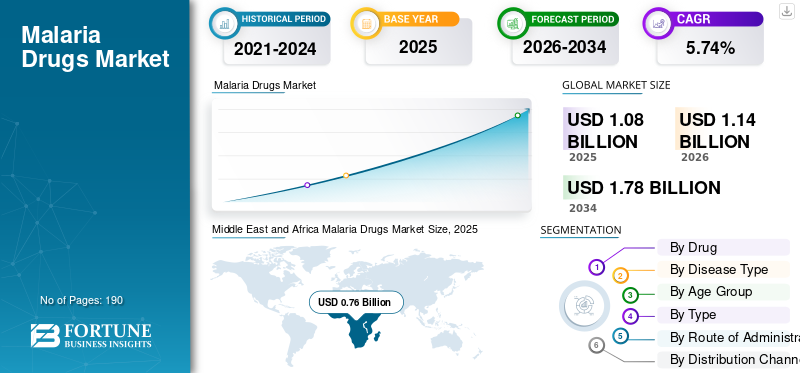
Download Free sample to learn more about this report.
MALARIA DRUGS MARKET KEY TAKEAWAYS
 Global Market Size & Forecast
- 2025 Market Size: USD 1.08 Billion
- 2026 Market Size: USD 1.14 Billion
- 2034 Forecast Market Size: USD 1.78 Billion
- CAGR: 5.74% from 2026–2034
 Market Share
- Middle East & Africa dominated the malaria drugs market with a market share of 70.37% in 2025.
- The 8-Aminoquinolines/Anti-relapse drugs segment is expected to grow at a CAGR of 6.73% over the forecast period.
- The severe/complicated malaria segment is projected to grow at a 6.83% CAGR during the forecast period.
 Key Regional Highlights
North America
The market is growing steadily due to increasing demand for malaria prophylaxis among travelers, military personnel, and immigrants, supported by strong healthcare infrastructure.
Europe
Europe is projected to grow at 4.80% over the coming years, the third-highest among all regions, and reach a valuation of USD 0.05 billion by 2026.
Asia Pacific
Asia Pacific is estimated to reach USD 0.18 billion in 2026.
U.S.
The U.S. market is estimated at around USD 0.03 billion in 2026, accounting for roughly 3.02% of the global market.
Japan
The Japanese market in 2026 is estimated at around USD 0.01 billion, accounting for approximately 1.05% of the global market.
Read More

MALARIA DRUGS MARKET TRENDS
Expansion of Public–Private Partnerships to Improve Access in Endemic Regions Is a Prominent Trend Observed
The global market is witnessing a significant trend toward stronger public–private partnerships, as access to malaria treatment remains highly dependent on coordinated efforts among pharmaceutical companies, global health organizations, governments, and non-profit partners. Many malaria endemic countries face affordability, supply, and distribution challenges, which limit timely access to effective antimalarial drugs. As a result, companies are increasingly working with partners such as Medicines for Malaria Venture, WHO-linked access programs, and national health agencies to develop affordable formulations, support regulatory pathways, and expand access to medicines in high-burden regions.
- For instance, in December 2024, GSK plc and Medicines for Malaria Venture announced that tafenoquine became the first single-dose medicine for prevention of P. vivax malaria relapse to receive WHO prequalification and inclusion in WHO malaria guidelines. The development supported access in endemic countries and help address adherence challenges linked to longer treatment regimens.
MARKET DYNAMICS
MARKET DRIVERS
Download Free sample to learn more about this report.
Rising Global Malaria Burden to Drive Demand for Effective Antimalarial Drugs, Driving Market Growth
The global market is growing steadily as malaria continues to create a major treatment burden in endemic regions, especially across Africa, Asia Pacific, and parts of Latin America. High infection rates, recurring transmission, and greater vulnerability among children and infants are increasing the need for reliable antimalarial medicines. This is pushing governments, global health agencies, and pharmaceutical companies to improve access to effective therapies, expand treatment coverage, and support the development of age-appropriate formulations. As the patient pool remains large and treatment gaps continue in low-resource settings, demand for artemisinin-based combination therapies, relapse-prevention drugs, and pediatric antimalarial products is expected to rise.
- For instance, in December 2025, the WHO reported that in 2024, there were an estimated 282 million malaria cases globally. The continued global malaria burden is directly driving drug procurement, product innovation, and access-focused partnerships in the market.
MARKET RESTRAINTS
High Dependence on Donor-Funded Procurement to Limit Stable Drug Access, Restraining Market Growth
The global malaria drugs market growth is highly dependent on donor-funded procurement. Most malaria cases occur in low- and middle-income countries where public healthcare budgets are limited. This creates a restraint on the market, as antimalarial drug purchases often depend on funding from international donors, global health agencies, and government-backed aid programs rather than on stable commercial demand. When donor funding slows or becomes uncertain, procurement cycles can be delayed, medicine availability can weaken, and companies may experience reduced predictability in supply planning. As a result, despite high disease burden, market growth can remain restricted because access to treatment is closely linked to external financing and public-sector tenders.
- For instance, in April 2025, the World Health Organization (WHO) warned that progress against malaria was in jeopardy due to foreign aid cuts. WHO highlighted that reduced funding could disrupt malaria programs, weaken access to prompt diagnosis and treatment, and put millions of additional lives at risk. This directly supports the restraint that heavy dependence on donor-funded procurement can limit stable access to malaria drugs, especially in low-income and high-burden countries.
MARKET OPPORTUNITIES
Increasing Focus on P. vivax Relapse Prevention to Create New Treatment Opportunities to Offer Lucrative Growth Opportunities
The global malaria drugs market is expected to gain from the increasing focus on P. vivax relapse prevention, as this malaria type can persist in the liver and cause recurrent infections after initial treatment. In many endemic regions, relapse increases the treatment burden, affects patient productivity, and creates repeated demand for healthcare resources. This is creating a strong need for radical-cure therapies that can clear dormant liver-stage parasites and reduce recurrence. As a result, companies are focusing on single-dose and shorter-course treatment options that can improve patient adherence compared to longer regimens. This opportunity is also supported by growing use of companion G6PD testing, WHO prequalification pathways, and public-private partnerships aimed at expanding access in endemic countries.
- For instance, in April 2026, GSK plc and Medicines for Malaria Venture announced that the first children in Brazil’s Yanomami community received single-dose tafenoquine for relapsing malaria. The rollout focused on improving access to a shorter radical-cure treatment for P. vivax malaria in a remote Indigenous community, where repeated malaria infections create a major treatment burden. This is a recent, non-repeated instance supporting the opportunity for relapse-prevention drugs and child-focused malaria treatment access.
MARKET CHALLENGES
Rising Treatment Uncertainty Due to Antimalarial Drug Resistance is Challenging Market Growth
The global market faces a major challenge from rising antimalarial drug resistance, as artemisinin-based combination therapies remain the main treatment option for uncomplicated P. falciparum malaria in many endemic countries. When malaria parasites become less responsive to these therapies, the risk of treatment failure increases, recovery becomes slower, and healthcare systems may need to shift to alternative drug combinations. This creates uncertainty around national treatment guidelines, increases surveillance costs, and puts pressure on companies to develop newer drugs with stronger resistance profiles. As a result, drug resistance can erode confidence in existing therapies and slow market growth by complicating treatment planning, procurement, and product development.
- For instance, a 2025 review published in Malaria Journal highlighted that P. falciparum resistance to artemisinin is critically undermining malaria elimination efforts. The article noted that artemisinin resistance has become a key challenge for malaria control and emphasized the need for countermeasures to protect the effectiveness of current treatment options. This supports the challenge that rising drug resistance can reduce the long-term effectiveness of existing antimalarial medicines and increase pressure to develop new products.
Segmentation Analysis
By Drug
Strong Guideline Acceptance and Fast Parasite Clearance to Support Artemisinin-based Therapy Dominance
Based on the drug, the market is categorized into artemisinin-based therapies, non-artemisinin combination therapies, quinoline-based drugs, antifolate antimalarials, 8-aminoquinolines/anti-relapse drugs, antibiotic antimalarials, and others.
By drug, artemisinin-based therapies dominated the market as they are widely used as the standard treatment approach for uncomplicated P. falciparum malaria in many endemic countries. These therapies offer faster parasite clearance, improved treatment outcomes, and strong acceptance in national malaria treatment guidelines. As a result, governments and public health programs continue to procure artemisinin-based combination therapies in large volumes. Their availability in fixed-dose and pediatric-friendly formats further supports wider use across both public and private treatment channels.
- For instance, in November 2022, Medicines for Malaria Venture and Shin Poong Pharmaceutical announced that Pyramax (pyronaridine-artesunate) had been formally included in the WHO malaria treatment guidelines. The companies stated that this inclusion would help malaria-endemic countries consider Pyramax with confidence as a first-line artemisinin-based treatment option.
The 8-Aminoquinolines/Anti-relapse drugs segment is expected to grow at a CAGR of 6.73% over the forecast period.
To know how our report can help streamline your business, Speak to Analyst
By Disease Type
Early Treatment in High Case Volumes to Drive Uncomplicated Malaria Segment Leadership
Based on disease type, the market is segmented into uncomplicated malaria, severe/complicated malaria, and others.
In 2025, uncomplicated malaria dominated the market because most malaria cases are diagnosed and treated before they progress into severe or complicated disease. Since uncomplicated malaria can usually be managed with oral antimalarial medicines, therefore, treatment volumes remain high across community clinics, government health centers, and public health programs. This creates steady demand for easy-to-administer therapies that can be used quickly after diagnosis. As a result, companies continue to focus on therapies for uncomplicated malaria, where patient reach and procurement volumes are much larger.
- For instance, in November 2025, Novartis announced that its Phase III trial for ganaplacide-lumefantrine (KLU156) met the primary endpoint in patients with uncomplicated malaria. The company highlighted the treatment’s potential to combat antimalarial resistance, supporting continued innovation in the high-volume uncomplicated malaria segment.
The severe/complicated malaria segment is projected to grow at a 6.83% CAGR during the forecast period.
By Age Group
High Risk of Infection Among Children to Support Pediatric Segment Dominance
Based on age group, the market is segmented into pediatric and adult.
The pediatric segment dominated the market because children remain one of the most affected and vulnerable groups in malaria-endemic countries. High infection risk, lower immunity, and greater mortality among young children increase the need for age-appropriate antimalarial formulations. As a result, companies and global health partners are developing dispersible, taste-masked, and weight-adjusted medicines that improve dosing accuracy and treatment adherence. This makes pediatric antimalarial drugs a major focus area for procurement, innovation, and access programs.
- For instance, in November 2025, Medicines for Malaria Venture and Unitaid announced that WHO had prequalified the first child-friendly primaquine formulations for malaria treatment. The announcement stated that these pediatric formulations would help improve access for children in malaria-endemic regions and support prevention of relapse and transmission.
The adults segment is projected to grow at a CAGR of 6.06% during the forecast period.
By Type
Affordability and Public-Sector Procurement to Strengthen Generic Drug Dominance
Based on the type, the market is segmented into branded and generics.
Based on the type, generics dominated the malaria drugs market share because majority demand for treatment comes from low- and middle-income endemic countries where affordability is a key purchasing factor. Public tenders, donor-funded programs, and government procurement agencies prefer quality-assured generic medicines that can be supplied at scale. As a result, generic antimalarial products support wider treatment coverage, especially in rural and high-burden areas. Their lower cost also allows health systems to maintain larger stocks and treat more patients within limited budgets.
- For instance, in August 2022, Strides Pharma Science announced that Universal Corporation Ltd., a Strides enterprise, became the first African manufacturer to receive WHO quality approval for a malaria prevention medicine for pregnant women and infants. The announcement supported the role of quality-assured, affordable antimalarial supply in expanding access across public health programs.
The branded segment is projected to grow at a CAGR of 4.04% during the forecast period.
By Route of Administration
Ease of Administration and Wide Community-Level Use to Drives Oral Segment’s Leadership
Based on route of administration, the market is segmented into oral and other routes.
Based on route of administration, the oral segment dominated the market as majority malaria cases are treated outside hospital settings and require simple-to-administer medicines. Oral tablets, dispersible tablets, and granules are easier to distribute, store, and use in community-level healthcare programs compared with injectable therapies. This improves treatment reach in remote areas and supports faster initiation of therapy after diagnosis. As a result, oral antimalarial drugs remain the preferred option for uncomplicated malaria and large-scale public procurement.
- For instance, in June 2025, 60 Degrees Pharmaceuticals, Inc., a company focused on developing new medicines for infectious diseases, launched a new 8-count bottle format for ARAKODA (tafenoquine). The 8-count bottle format may be suitable for patients making shorter trips to areas of the world where malaria is endemic.
The others segment is projected to grow at a CAGR of 6.56% during the forecast period.
By Distribution Channel
Large-Scale Government Procurement and Donor Funding to Support Public Health Program Dominance
Based on distribution channel, the market is segmented into public health programs & government facilities, hospital pharmacies, retail pharmacies & drug stores, and others.
In 2025, public health programs and government facilities dominated the market as malaria treatment in high-burden countries is mainly delivered through national malaria control programs, donor-funded procurement, and public-sector distribution. These channels help ensure broad access to antimalarial drugs for low-income and rural populations where private affordability remains limited. As a result, large-volume purchasing, guideline-based treatment, and government-led distribution make public health programs the strongest route for market supply. This also encourages companies to align their malaria portfolios with global procurement and public-sector access requirements.
- For instance, in November 2024, Shin Poong Pharmaceutical announced that Pyramax was selected as an optimal supplier for the U.S. President’s Malaria Initiative public procurement tender. The selection supported its role in global public procurement and strengthened Pyramax’s position as an antimalarial option for large-scale malaria control programs.
The hospital pharmacies segment is projected to grow at a CAGR of 6.07% over the forecast period.
Malaria Drugs Market Regional Outlook
By geography, the market is categorized into Europe, North America, Asia Pacific, Latin America, and the Middle East & Africa.
Middle East & Africa
Middle East and Africa Malaria Drugs Market Size, 2025 (USD Billion)
To get more information on the regional analysis of this market, Download Free sample
Middle East & Africa region is expected to dominate this market during the forecast period. The Middle East & Africa region was valued at USD 0.69 billion in 2024 and USD 0.76 billion in 2025. In the Middle East & Africa, the GCC is set to reach USD 0.04 billion in 2026. Middle East’s dominance is attributed to the highest malaria burden, especially across Sub-Saharan Africa. Large-scale government procurement, donor-funded programs, and public health campaigns are increasing access to antimalarial medicines.
Latin America
The market in Latin America is estimated to reach a valuation of USD 0.07 billion in 2026. Latin America is growing as countries continue to manage malaria transmission in the Amazon basin and rural areas. Public health programs, cross-border surveillance, and treatment access initiatives for vulnerable community’s support demand.
South Africa Malaria Drugs Market
The South African market is projected to reach approximately USD 0.03 billion by 2026, accounting for roughly 2.69% of global revenue.
North America
North America is set to grow at a stable CAGR in the forecast period. The market in North America is growing due to steady demand for malaria prophylaxis among travelers, military personnel, and immigrants visiting endemic regions. Strong healthcare access and availability of branded antimalarial drugs support timely diagnosis and treatment.
U.S. Malaria Drugs Market
The U.S. market is estimated at around USD 0.03 billion in 2026, accounting for roughly 3.02% of the global market.
Europe
Europe is projected to grow at 4.80% over the coming years, the third-highest among all regions, and reach a valuation of USD 0.05 billion by 2026. Europe is witnessing growth in travel-related malaria cases and increased use of preventive antimalarial medicines among international travelers. The region also supports malaria drug development through research funding, regulatory support, and partnerships with global health agencies. As a result, companies use Europe as an important base for clinical research and access-focused malaria programs.
U.K. Malaria Drugs Market
The U.K. market is estimated at USD 0.01 billion in 2026, accounting for roughly 0.83% of the global market.
Germany Malaria Drugs Market
Germany's market is projected to reach approximately USD 0.01 billion in 2026, equivalent to around 0.72% of the global market.
Asia Pacific
Asia Pacific is estimated to reach USD 0.18 billion in 2026. Asia Pacific is growing due to the continued malaria burden in countries such as India, Indonesia, Myanmar, and Papua New Guinea. Government elimination programs, wider use of artemisinin-based therapies, and demand for affordable generics are supporting market expansion. The region also has strong manufacturing capacity for low-cost antimalarial drugs.
Japan Malaria Drugs Market
The Japanese market in 2026 is estimated at around USD 0.01 billion, accounting for approximately 1.05% of the global market.
China Malaria Drugs Market
China's market has 2026 revenues estimated at around USD 0.02 billion, accounting for approximately 1.35% of global sales.
India Malaria Drugs Market
The Indian market in 2026 is estimated at around USD 0.06 billion, accounting for roughly 5.55% of global revenue.
COMPETITIVE LANDSCAPE
Key Industry Players
Increasing Focus of Key Players Toward Regulatory Approval to Boost Their Market Positions
The global malaria drugs market is moderately fragmented, with competition led by companies offering approved antimalarial therapies, quality-assured generics, and pipeline-stage products for resistant and relapsing malaria. Major players such as Novartis AG, GSK plc, Sanofi, Shin Poong Pharmaceutical Co., Ltd., Guilin Pharmaceutical Co., Ltd., Macleods Pharmaceuticals Ltd., Ipca Laboratories Ltd., Strides Pharma Science Ltd., Cipla Ltd., and Ajanta Pharma Ltd. are strengthening their market positions through product approvals, WHO prequalification, public procurement participation, access partnerships, and clinical development programs.
- For instance, in April 2026, Novartis AG received prequalification from the WHO for Coartem Baby for the treatment of malaria in newborns and young infants weighing 2 kg or more. The approval marked an important milestone for the market, as Coartem Baby became the first malaria treatment developed specifically for this vulnerable patient group and helped strengthen Novartis’ position in pediatric antimalarial therapy.
Other notable participants in the market include Fosun Pharma/Guilin Pharmaceutical, Macleods Pharmaceuticals, Ipca Laboratories, Strides Pharma Science, Cipla, Ajanta Pharma, Zydus Lifesciences, Viatris, Artepharm, and Zuventus Healthcare. These companies are expected to focus on expanding WHO-prequalified generic portfolios, improving access in endemic countries, developing child-friendly and relapse-prevention formulations, and participating in large public-sector tenders to improve their competitive positions. The market remains strongly access-driven, with approved and prequalified products holding near-term share. At the same time, companies developing next-generation therapies for drug resistance, P. vivax relapse prevention, and infant-specific treatment are expected to capture future opportunities.
LIST OF KEY MALARIA DRUGS MARKET COMPANIES PROFILED
- Novartis AG (Switzerland)
- Guilin Pharmaceutical Co., Ltd. (China)
- Macleods Pharmaceuticals Ltd. (India)
- Ipca Laboratories Ltd. (India)
- GSK plc (U.K.)
- Shin Poong Pharmaceutical Co., Ltd. (South Korea)
- Sanofi (France)
- Strides Pharma Science Ltd. (India)
- Cipla Ltd. (India)
- Ajanta Pharma Ltd. (India)
KEY INDUSTRY DEVELOPMENTS
- April 2026: Daiichi Sankyo Company collaborated with Medicines for Malaria Venture (MMV) to conduct research aimed at identifying inhibitors of PfPFN (Plasmodium falciparum Profilin), a novel therapeutic target molecule in malaria parasites, for the development of new antimalarial treatments.
- April 2026: Novartis announced that the World Health Organization (WHO) has prequalified Coartem (artemether-lumefantrine) Baby, the first and only antimalarial developed specifically for newborns and young infants weighing from 2 to 5 kilograms.
- November 2025: Guilin Pharmaceutical Co., Ltd. awarded prequalification to two child-friendly formulations of primaquine, which were independently developed by Guilin Pharmaceutical Co., Ltd., a subsidiary of Fosun Pharma. These are the first pediatric formulations of primaquine phosphate prequalified by WHO.
- November 2025: Novartis AG announced positive results from KALUMA, a Phase III study for the new malaria treatment KLU156 (ganaplacide/lumefantrine, or GanLum). The novel non-artemisinin antimalarial, which was developed with Medicines for Malaria Venture (MMV), met the study’s primary endpoint of non-inferiority to the current standard of care.
REPORT COVERAGE
The report provides a detailed global malaria drugs market analysis, including market size, growth trends, disease burden, treatment demand, and the role of public health programs in improving access to malaria therapies. In addition, the report highlights key market drivers, restraints, challenges, and growth opportunities shaping the global adoption. The report also focuses on the competitive landscape of leading companies operating in the market, including their key antimalarial products, product development strategies, access programs, partnerships, and regulatory approvals. Regional analysis is included for North America, Europe, Asia Pacific, Latin America, and the Middle East & Africa to understand how disease prevalence, funding support, public-sector distribution, and healthcare infrastructure are influencing market growth. Overall, the report helps stakeholders understand current market dynamics, future opportunities, and strategic investment areas in the global market.
Request for Customization to gain extensive market insights.
Report Scope & Segmentation
| ATTRIBUTE | DETAILS |
| Study Period | 2021-2034 |
| Base Year | 2025 |
| Estimated Year | 2026 |
| Forecast Period | 2026-2034 |
| Historical Period | 2021-2024 |
| Growth Rate | CAGR of 5.74% from 2026 to 2034 |
| Unit | Value (USD Billion) |
| Segmentation | By Drug, Disease Type, Age Group, Type, Route of Administration, Distribution Channel, and Region |
| By Drug |
|
| By Disease Type |
|
| By Age Group |
|
| By Type |
|
| By Route of Administration |
|
| By Distribution Channel |
|
| By Region |
|
Frequently Asked Questions
According to Fortune Business Insights, the global market value stood at USD 1.08 billion in 2025 and is projected to reach USD 1.78 billion by 2034.
In 2025, the market value for Middle East & Africa stood at USD 0.76 billion.
The market is expected to grow at a CAGR of 5.74% over the forecast period.
The artemisinin-based therapies segment is expected to lead the market.
Rising global malaria burden to drive demand for effective antimalarial drugs and drive market growth.
Novartis AG, Guilin Pharmaceutical Co., Ltd., Macleods Pharmaceuticals Ltd., and Ipca Laboratories Ltd. are among the major players in the global market.
Middle East & Africa dominated the market in 2025.



- 2021-2034
- 2025
- 2021-2024
- 190
Get 30-60 hrs Free Customization
Expand Regional and Country Coverage, Segments Analysis, Company Profiles, Competitive Benchmarking, and End-user Insights.













.webp)






Related Reports
-
US +1 833 909 2966 ( Toll Free )
-
Get In Touch With Us