Marine Biostimulants Market Size, Share & Industry Analysis, By Ingredient (Seaweed Extracts, Fish Protein Hydrolysates), By End Use, By Mode of Application, and Regional Forecast, 2026-2034
 Download Free Sample
Marine Biostimulants Market Size & Industry Overview
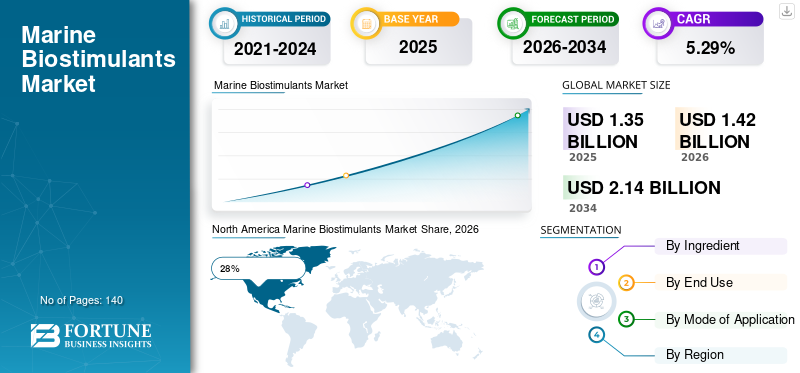
The global marine biostimulants market size was valued at USD 1.35 billion in 2025. The market is projected to grow from USD 1.42 billion in 2026 to USD 2.14 billion by 2034, exhibiting a CAGR of 5.29% during the forecast period.

The marine biostimulants market is gaining significant traction across global agriculture due to rising demand for sustainable crop enhancement solutions. Marine-derived products extracted from seaweed, algae, and fish-based sources are increasingly used to improve nutrient uptake, plant resilience, root development, and crop quality. The marine biostimulants market report indicates strong adoption across horticulture, cereals, fruits, vegetables, and specialty crops as growers seek alternatives to conventional chemical inputs. Regulatory support for environmentally responsible farming practices is encouraging manufacturers to expand product portfolios. marine biostimulants market analysis also highlights increasing integration with precision agriculture systems and advanced crop management programs.
The United States marine biostimulants market continues to expand due to increasing organic farming acreage and rising demand for sustainable agricultural inputs. Farmers across California, Florida, Iowa, and Texas are adopting marine-based crop enhancement products to improve drought tolerance, nutrient efficiency, and crop productivity. Marine Biostimulants Industry Analysis shows growing interest in seaweed-based formulations for fruits, vegetables, corn, and soybean cultivation. Agricultural distributors are expanding product availability through digital farming platforms and retail channels. Research institutions and commercial growers are also investing in biological crop enhancement technologies that support soil regeneration and climate-resilient farming operations.
Download Free sample to learn more about this report.
Marine Biostimulants Market Key Takeaways
 Global Market Size & Forecast
- 2025 Market Size: USD 1.35 Billion
- 2026 Market Size: USD 1.42 Billion
- 2034 Forecast Market Size: USD 2.14 Billion
- CAGR: 5.29% from 2026-2034
 Market Share
- The market in Europe dominated with a revenue share of 36% in 2025.
- Seaweed extracts dominated by ingredient with a market share of approximately 70%.
- Foliar treatment dominated by mode of application with a market share of approximately 79%.
 Key Regional Highlights
Europe
Europe led the market with a 36% share, supported by strong adoption of sustainable agricultural practices and biostimulant products.
North America
North America accounted for 28% of the market, driven by increasing demand for crop productivity and stress-resistance solutions.
Asia-Pacific
Asia-Pacific held a 25% share, supported by expanding agricultural activities and growing adoption of sustainable farming practices.
U.S
The U.S. remains a key market, supported by advanced agricultural practices and rising demand for sustainable crop inputs.
Japan
Japan accounted for approximately 19% of the Asia-Pacific market, supported by advanced agricultural technologies and growing interest in sustainable crop production.
Read More

marine biostimulants market Latest Trends
The marine biostimulants market trends indicate a strong shift toward biological crop management systems. Seaweed extracts remain the dominant ingredient category due to their natural growth-promoting compounds, amino acids, and micronutrients. Farmers are increasingly combining marine biostimulants with precision irrigation systems to improve nutrient absorption efficiency and reduce environmental impact. The marine biostimulants market research report identifies growing demand for foliar spray formulations because of their rapid plant uptake and visible crop performance benefits.
Another major trend involves the development of customized marine biostimulant formulations for specific crops and climatic conditions. Manufacturers are introducing products targeting drought resistance, salinity tolerance, heat stress management, and improved root architecture. Digital agriculture platforms are supporting adoption by providing application recommendations based on crop stage and soil conditions. The marine biostimulants market Outlook also reflects increasing collaborations between biotechnology companies and agricultural input suppliers to commercialize advanced seaweed-derived products. Sustainable farming certifications and regulatory restrictions on synthetic agrochemicals continue to strengthen demand for marine-based biological solutions across developed and emerging agricultural economies.
marine biostimulants market Dynamics
DRIVER
Rising Demand for Sustainable and Organic Agriculture
The primary growth driver for the marine biostimulants market is the increasing global transition toward sustainable agriculture. Farmers are under pressure to maintain productivity while reducing dependence on synthetic fertilizers and chemical growth regulators. Marine biostimulants improve nutrient efficiency, enhance root growth, stimulate microbial activity, and support crop resilience under environmental stress conditions. The marine biostimulants market growth is further supported by growing consumer preference for residue-free food production. Agricultural producers are adopting seaweed-based products to improve crop quality and increase resistance against temperature fluctuations. Expanding awareness regarding soil health restoration and regenerative farming practices is accelerating product demand across commercial agriculture. Large-scale farming operations increasingly view marine biostimulants as essential components of integrated crop management systems.
RESTRAINT
Variability in Product Performance Across Crops and Regions
A significant restraint within the marine biostimulants market is inconsistency in product performance caused by climatic variations, soil composition differences, and crop-specific responses. While marine biostimulants provide measurable benefits in many agricultural environments, outcomes may vary depending on application timing, dosage, irrigation practices, and regional conditions. This variability can reduce grower confidence and slow adoption among traditional farming communities. Marine Biostimulants Industry Report findings indicate that some producers remain dependent on conventional fertilizers due to predictable performance characteristics. Limited awareness regarding correct application techniques also impacts product effectiveness. In several developing agricultural markets, inadequate technical support and insufficient field demonstrations continue to restrict widespread commercial utilization of marine-derived crop enhancement products.
OPPORTUNITY
Expansion of climate-resilient farming technologies
The growing need for climate-resilient agriculture presents a major opportunity for the marine biostimulants market. Increasing occurrences of drought, salinity stress, irregular rainfall patterns, and temperature extremes are encouraging farmers to adopt biological solutions that strengthen crop tolerance. Marine biostimulants contain bioactive compounds capable of stimulating plant defense mechanisms and improving stress recovery. marine biostimulants market opportunities are expanding through precision farming integration, greenhouse cultivation, controlled-environment agriculture, and high-value horticulture production. Manufacturers are investing in research programs focused on developing targeted formulations for specific environmental challenges. Emerging agricultural economies are also creating substantial opportunities as governments promote sustainable farming inputs to improve food security and agricultural productivity without increasing chemical dependency.
CHALLENGE
Regulatory Standardization and Product Validation
One of the major challenges affecting the marine biostimulants market is the lack of universal regulatory standards governing product classification, efficacy testing, and labeling requirements. Different countries maintain varying regulations regarding biostimulant registration and commercialization. This creates complexities for manufacturers operating across multiple regions. marine biostimulants market forecast assessments indicate that extensive validation studies and compliance procedures can increase product development timelines. Smaller companies often face difficulties securing resources required for regulatory approvals and scientific documentation. In addition, concerns regarding product quality consistency and formulation transparency remain important industry issues. Establishing globally accepted standards and performance benchmarks will be essential for strengthening market credibility and accelerating commercial adoption.
marine biostimulants market Segmentation
By Ingredient
Seaweed extracts account for approximately 70% market share within the marine biostimulants market. These products are derived primarily from brown seaweed species and contain natural growth regulators, polysaccharides, amino acids, and micronutrients. marine biostimulants market research report findings show strong adoption among fruit growers, vegetable producers, and cereal farmers seeking enhanced crop quality and stress resistance. Seaweed extracts support root development, improve nutrient uptake efficiency, and increase tolerance to drought and salinity conditions. Manufacturers continue expanding extraction technologies to preserve bioactive compounds and improve formulation stability.
Fish protein hydrolysates represent nearly 30% market share in the Marine Biostimulants Industry. These products contain bioavailable amino acids, peptides, and nitrogen-rich compounds that stimulate plant metabolism and growth. marine biostimulants market analysis indicates increasing demand among commercial farming operations focused on yield optimization and nutrient management. Fish-derived biostimulants are commonly used in horticulture, greenhouse cultivation, and specialty crop production. Technological advancements in enzymatic hydrolysis processes are improving product consistency and effectiveness.
To know how our report can help streamline your business, Speak to Analyst
By End Use
End-use agriculture accounts for approximately 60% market share in the marine biostimulants market. Row crops, cereals, fruits, vegetables, and ornamental plants constitute major demand centers. marine biostimulants market size expansion is closely linked to increasing cultivation of high-value crops requiring superior quality and stress tolerance characteristics. Commercial growers are utilizing marine biostimulants to improve nutrient efficiency, crop uniformity, and harvest quality. Organic farming operations represent a particularly important customer segment because marine-derived products align with sustainable cultivation objectives. Increased emphasis on soil health restoration and environmental stewardship is driving broader adoption across diverse agricultural systems.
By Mode of Application
Mode of application segmentation shows foliar treatment commanding approximately 79% market share, while soil and seed applications account for the remaining portion. marine biostimulants market insights indicate that foliar spraying remains the preferred method due to rapid absorption and immediate physiological responses. Farmers can integrate foliar applications with existing crop protection and fertilization schedules, reducing operational complexity. Precision agriculture technologies are further improving application efficiency through targeted delivery systems. Soil-based applications are gaining interest in regenerative agriculture programs focused on microbial enhancement and root-zone optimization. Seed treatment applications also continue expanding as growers seek early-stage plant vigor and improved germination performance.
marine biostimulants market Regional Outlook
North America
North America Marine Biostimulants Market Share, 2026 (%)
To get more information on the regional analysis of this market, Download Free sample
North America holds approximately 28% market share in the marine biostimulants market. The region benefits from advanced agricultural practices, strong organic farming adoption, and increasing awareness regarding soil health management. The United States dominates regional demand due to extensive cultivation of corn, soybean, fruits, vegetables, and specialty crops. marine biostimulants market research report findings indicate strong product adoption among large commercial farms seeking higher nutrient-use efficiency and climate resilience. Agricultural distributors continue expanding biological product portfolios to meet grower requirements. Canada represents another significant market due to its connection with marine resource availability and biostimulant manufacturing capabilities. Research institutions across North America are conducting extensive field trials evaluating marine-derived products under diverse climatic conditions. Regulatory support for environmentally sustainable agricultural practices is encouraging investment in biological crop inputs.
Europe
Europe accounts for nearly 36% market share and remains the leading regional market for marine biostimulants. Strong environmental regulations, sustainable farming policies, and restrictions on synthetic agricultural inputs have accelerated adoption across major agricultural economies. marine biostimulants market growth in Europe is supported by extensive organic farming acreage and advanced research infrastructure. Countries including Spain, France, Italy, Germany, and the United Kingdom are significant consumers of seaweed-based agricultural products. European farmers increasingly utilize marine biostimulants to improve crop performance under drought and temperature stress conditions. Agricultural cooperatives and distributors actively promote biological crop enhancement solutions. The region also hosts numerous manufacturers specializing in seaweed extraction technologies and advanced biostimulant formulations. Marine Biostimulants Industry Analysis shows strong demand from horticulture, viticulture, and specialty crop sectors. Continued investment in sustainable food production systems is expected to support long-term market expansion throughout the region.
Germany marine biostimulants market
Germany represents approximately 35% share of the European marine biostimulants market. The country benefits from strong agricultural technology adoption, advanced research capabilities, and growing demand for environmentally responsible farming practices. marine biostimulants market trends in Germany include increasing utilization of seaweed extracts within vegetable cultivation, greenhouse production, and specialty crop farming. Agricultural producers are emphasizing nutrient efficiency and soil biodiversity improvement. Government sustainability initiatives and strong organic agriculture participation continue supporting commercial demand. German distributors are also expanding partnerships with international biostimulant manufacturers to introduce advanced marine-based crop enhancement products.
United Kingdom marine biostimulants market
The United Kingdom contributes nearly 24% share to the European marine biostimulants market. Farmers are increasingly adopting marine-derived agricultural inputs to address soil degradation and climate-related production challenges. marine biostimulants market insights indicate growing use across cereal production, horticulture, and protected cultivation systems. Seaweed availability around coastal regions supports industry awareness and product acceptance. Agricultural technology companies continue promoting biological solutions that improve crop resilience and nutrient uptake efficiency. Demand is also supported by sustainability initiatives encouraging reduced dependence on synthetic fertilizers and conventional crop enhancement chemicals.
Asia-Pacific
Asia-Pacific accounts for approximately 25% market share and represents one of the fastest-expanding regions within the marine biostimulants market. Rising food demand, agricultural modernization, and increasing awareness regarding sustainable farming practices are major growth drivers. Countries including China, Japan, India, South Korea, and Australia are experiencing increased adoption of marine-derived crop enhancement products. marine biostimulants market opportunities are expanding through government-supported agricultural productivity programs and precision farming investments. The region benefits from extensive coastlines and abundant marine resources suitable for seaweed harvesting and processing activities. Commercial farming operations are increasingly incorporating biostimulants into nutrient management programs to improve crop quality and stress tolerance. Horticulture, rice cultivation, fruit production, and vegetable farming represent major demand sectors. Manufacturers continue expanding production facilities across Asia-Pacific to address growing domestic and export market requirements. Strong agricultural research initiatives further contribute to market development and product innovation.
Japan marine biostimulants market
Japan accounts for nearly 19% share of the global marine biostimulants market. The country has a long history of utilizing marine resources within agriculture and continues investing in advanced biological crop enhancement technologies. marine biostimulants market analysis indicates growing demand for premium-quality agricultural production and sustainable cultivation methods. Japanese farmers utilize seaweed-based formulations to improve crop quality, root strength, and environmental stress resistance. Controlled-environment agriculture and greenhouse cultivation systems are important application areas. Research institutions continue developing innovative marine-derived solutions tailored for high-value crops and intensive farming operations.
China marine biostimulants market
China contributes approximately 22% share to the global marine biostimulants market. Extensive agricultural production, increasing sustainability initiatives, and rising demand for biological farming inputs are supporting market expansion. marine biostimulants market Share continues increasing across fruit cultivation, vegetable production, rice farming, and export-oriented agriculture. Domestic manufacturers are investing heavily in seaweed extraction technologies and formulation development. Government policies encouraging environmentally friendly agricultural practices are strengthening adoption rates. China's extensive coastline and marine resource availability provide strategic advantages for large-scale biostimulant production and commercialization activities.
Rest of World
The Rest of World region accounts for approximately 11% market share in the marine biostimulants market. Latin America, the Middle East, and Africa represent key emerging markets with substantial long-term growth potential. Agricultural producers in Brazil, Argentina, South Africa, and several Gulf countries are increasingly adopting marine-derived crop enhancement technologies to improve productivity and resource efficiency. marine biostimulants market opportunities are expanding through export-oriented agriculture and climate adaptation strategies. Latin America benefits from large-scale cultivation of soybeans, sugarcane, fruits, and vegetables requiring advanced nutrient management solutions. The Middle East is witnessing growing demand for biostimulants that improve crop performance under water scarcity and salinity conditions. African agricultural sectors are also exploring biological inputs to support soil fertility restoration and food security initiatives. Increasing investment in agricultural modernization programs and sustainable farming infrastructure continues creating favorable conditions for marine biostimulant adoption across emerging markets.
List of Top Marine Biostimulants Companies
- Acadian Plant Health
- ASL (Acadian Seaplants Limited)
- BASF SE
- UPL
- BioAtlantis Ltd.
- Algea
- Qingdao Blue Treasure Seaweed Biotech. Co., Ltd
- Qingdao Seawin Biotech Group Co., Ltd.
- ClimaCrew Pvt Ltd
- Uist Asco Ltd.
- ARRAMARA
- Thorvin, Inc.
- Futureco Bioscience
- Brandt, Inc.
- Haifa Negev technologies LTD
- Corteva
- FMC Corporation
Top Two Companies with Highest Market Share
- Acadian Plant Health – 14% market share
- BASF SE – 11% market share
Investment Analysis and Opportunities
The marine biostimulants market is attracting increasing investment from agricultural technology firms, biological input manufacturers, and venture capital groups focused on sustainable agriculture. Significant capital is being directed toward seaweed harvesting infrastructure, extraction technologies, formulation development, and international distribution networks. marine biostimulants market Investment Analysis highlights growing interest in biological crop enhancement products capable of improving agricultural productivity under changing climatic conditions.
Strategic partnerships between biotechnology companies and agricultural input suppliers are expanding commercial opportunities. Investment activity is particularly strong in North America, Europe, and Asia-Pacific where sustainable agriculture initiatives continue gaining momentum. marine biostimulants market opportunities are also emerging through digital agriculture integration, precision application technologies, and customized crop-specific formulations. Expansion of organic farming acreage creates additional demand for certified biological inputs. Research and development programs focused on stress tolerance enhancement, nutrient-use efficiency, and soil microbiome optimization are expected to generate new commercial opportunities for market participants through the forecast period.
New Product Development
Product innovation remains a central competitive strategy within the marine biostimulants market. Manufacturers are developing advanced formulations containing concentrated seaweed extracts, amino acid complexes, marine polysaccharides, and bioactive compounds designed to improve plant performance. New products increasingly target specific agronomic challenges including drought stress, salinity management, root development, flowering enhancement, and nutrient efficiency optimization.
marine biostimulants market trends show growing emphasis on liquid formulations compatible with precision agriculture equipment and foliar application systems. Several companies are introducing crop-specific solutions tailored for cereals, fruits, vegetables, vineyards, and greenhouse production environments. Research programs are focusing on extraction technologies that preserve biologically active marine compounds while improving shelf stability and formulation consistency. Manufacturers are also integrating marine biostimulants with microbial technologies and biological crop protection products to create comprehensive crop management solutions. Innovation efforts continue supporting differentiation, premium positioning, and broader adoption across commercial agriculture markets.
Five Recent Developments (2023-2025)
- BASF expanded its biological solutions portfolio through collaboration with Acadian Plant Health to commercialize advanced seaweed biostimulant technologies in multiple agricultural markets during 2024.
- Acadian Plant Health increased focus on Ascophyllum nodosum-based technologies targeting drought tolerance and crop stress management applications during 2024.
- Multiple marine biostimulant manufacturers expanded production capacity in Asia-Pacific during 2024 and 2025 to address rising agricultural demand.
- Industry participants introduced enhanced foliar biostimulant formulations with improved nutrient uptake efficiency and crop-specific performance characteristics during 2023 and 2024.
- Research initiatives across Europe and North America accelerated development of climate-resilient marine-derived crop enhancement products between 2023 and 2025.
Report Coverage of marine biostimulants market
The marine biostimulants market report provides comprehensive evaluation of industry structure, product categories, application trends, competitive positioning, and regional performance. The report covers key market segments including seaweed extracts, fish protein hydrolysates, end-use agriculture, and application methods. marine biostimulants market research report analysis includes assessment of demand patterns across cereals, fruits, vegetables, horticulture crops, and specialty agricultural production systems.
Request for Customization to gain extensive market insights.
The report examines major growth drivers, restraints, opportunities, challenges, investment trends, and technological developments influencing industry expansion. Detailed regional analysis covers North America, Europe, Asia-Pacific, and Rest of World markets with emphasis on market share distribution and adoption patterns. marine biostimulants market forecast insights evaluate changing agricultural practices, sustainability initiatives, biological input demand, and innovation strategies. Competitive landscape assessment highlights major manufacturers, product development activities, strategic collaborations, and commercialization initiatives. The report also analyzes regulatory trends, precision agriculture integration, climate-resilient farming technologies, and emerging opportunities shaping the future direction of the Marine Biostimulants Industry.
Frequently Asked Questions
Fortune Business Insights says that the global market value stood at USD 1.35 billion in 2025 and is projected to reach USD 2.14 billion by 2034.
The market is expected to exhibit a CAGR of 5.29% during the forecast period of 2026-2034.
Seaweed extracts were the leading ingredient segment, accounting for approximately 70% of the market, supported by their growth-promoting compounds and ability to improve nutrient uptake and stress tolerance.
Key players include Acadian Plant Health, ASL (Acadian Seaplants Limited), BASF SE, UPL, BioAtlantis Ltd., and Algea.
Major trends include increasing adoption of seaweed extracts with precision irrigation and growing demand for customized formulations targeting drought, salinity, and heat stress. Europe led the market with a 36% share.



- 2021-2034
- 2025
- 2021-2024
- 140
-

(Offer valid till 15th Oct 2026)
Get 30-60 hrs Free Customization
Expand Regional and Country Coverage, Segments Analysis, Company Profiles, Competitive Benchmarking, and End-user Insights.














-
US +1 833 909 2966 ( Toll Free )
-
Get In Touch With Us