Acoustic Insulation Market Size, Share & Industry Analysis, By Material Type (Glass Wool, Mineral Wool, Polymeric Foam, and Others), By Application (Building & Construction, Transportation, Industrial, and Others), and Regional Forecast, 2026-2034
 Download Free Sample
Acoustic Insulation Market Size and Future Outlook
 Listen to Audio Version
The global acoustic insulation market size was valued at USD 21.57 billion in 2025. The market is projected to grow from USD 22.46 billion in 2026 to USD 32.27 billion by 2034, exhibiting a CAGR of 4.7% during the forecast period. Asia Pacific dominated the global acoustic insulation market with a market share of 34.39% in 2025.
Acoustic insulation comprises materials and systems designed to reduce the transmission of airborne and impact sound, or to absorb sound within a space, thereby improving comfort, privacy, and regulatory compliance in buildings, vehicles, and industrial settings. Core product families include mineral wool and glass wool (porous absorbers with strong fire and durability profiles), polymeric foams (e.g., melamine, polyurethane, and elastomeric), and hybrid solutions integrated into assemblies such as partitions, façades, HVAC ductwork, ceilings, and floors.
The market growth is driven by urban densification and multi-family construction, stricter noise management policies in transport corridors, and a broader ‘healthy buildings’ agenda that treats acoustic comfort as a key wellbeing metric. Standardized testing and performance metrics (e.g., ISO laboratory methods for sound insulation) are supporting clearer specification and wider adoption in engineered assemblies.
Furthermore, the market comprises several major players, including ROCKWOOL, Saint-Gobain, Knauf Insulation, Johns Manville, and 3M. A broad portfolio, innovative product launches, and strong geographic presence expansion have supported the dominance of these companies in the global market.
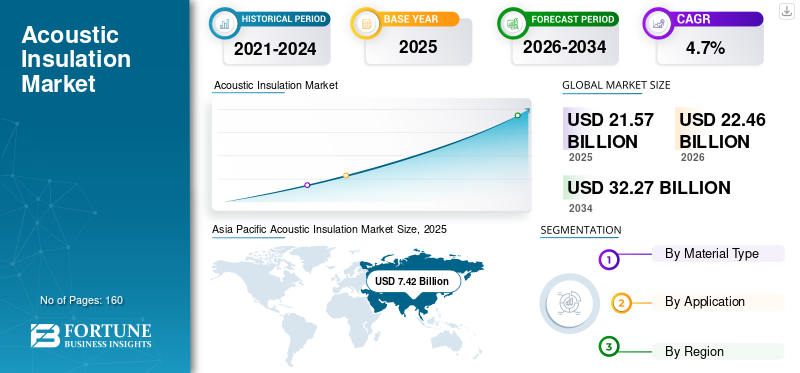
Download Free sample to learn more about this report.
ACOUSTIC INSULATION MARKET KEY TAKEAWAYS
 Market Size & Forecast
- 2025 Market Size: USD 21.57 billion
- 2026 Market Size: USD 22.46 billion
- 2034 Forecast Market Size: USD 32.27 billion
- CAGR: 4.70% from 2026–2034
 Market Share
- Asia Pacific dominated the global acoustic insulation market with a market share of 34.39% in 2025.
- The glass wool segment accounted for the largest acoustic insulation market share in 2025.
- The segment is expected to grow at a CAGR of 4.3% over the forecast period.
 Key Regional Highlights
North America
North America is also a significant contributor to the market, with the market estimated to reach USD 4.99 billion by 2026.
Europe
European region is projected to record a growth rate of 4.7% and reach a valuation of USD 6.04 billion in 2026.
Asia Pacific
Asia Pacific held the dominant share in 2025, valued at USD 7.42 billion, and is expected to maintain its leading share in 2026, valued at USD 7.77 billion.
U.S.
In 2025, the U.S. market reached USD 4.22 billion.
Japan
Rising investments in urban infrastructure, advanced transportation systems, and high-performance building materials are supporting the adoption of acoustic insulation solutions across the country.
Read More

ACOUSTIC INSULATION MARKET TRENDS
Codes, Standardized Testing, and Healthy Building Specifications are Significant Market Trends
Acoustic insulation is increasingly specified as part of measurable performance targets rather than as a discretionary add-on. Laboratory test standards and reporting conventions (e.g., ISO 10140 series for sound insulation of building elements) are helping product manufacturers, designers, and testing labs align on comparable metrics and compliance documentation. In parallel, building standards and public health research continue to elevate the perceived cost of noise exposure, linking chronic noise to sleep disturbance and cardiovascular risks, which supports stricter planning and design responses in dense cities.
- For instance, EU noise mapping and action-plan requirements (Environmental Noise Directive) reinforce demand for mitigation solutions around major roads, railways, and airports, strengthening the pull for sound-control materials in adjacent building stock.
Download Free sample to learn more about this report.
MARKET DYNAMICS
MARKET DRIVERS
Urban Densification, Multi-Family Housing, and Noise Management Policies are Expanding Acoustic Upgrades, Driving Market Growth
Growth in multi-family housing, mixed-use developments, and retrofit activity is increasing baseline acoustic requirements in walls, floors, and ceilings. Specifiers increasingly use insulation within cavity assemblies to achieve the target sound transmission performance while maintaining fire safety and thermal efficiency. Regulatory noise management in transport corridors also drives demand for higher-performing façade, roof, and partition solutions in noise-exposed zones.
- The EU Environmental Noise Directive requires periodic noise maps and action plans for large agglomerations and major transport infrastructure, institutionalizing long-term noise mitigation programs.
MARKET RESTRAINTS
Installed-Assembly Dependence, Contractor Skill Variability, and Volatile Feedstocks Can Restrict Market Expansion
Unlike many building products, acoustic insulation performance is highly dependent on the full assembly (mass layers, decoupling, sealing, penetrations, and workmanship). This creates outcome variability and can slow adoption where installers and inspectors have limited acoustics training. On the supply side, input volatility in fibers, binders, and energy can pressure margins and complicate long-term contracting, especially for commodity-grade wool products.
MARKET OPPORTUNITIES
Decarbonization and Circularity are Creating New Specification Pathways for Low-Impact Acoustic Materials
Building decarbonization programs favor envelope upgrades and deep retrofits, where acoustic insulation materials can be bundled with thermal performance improvements. Producers are also investing in recycling and scrap take-back systems to support circularity claims, improving competitiveness in public tenders and green building projects.
- For example, industry guidance on building decarbonization highlights the role of fiberglass and mineral wool insulation in reducing building carbon footprints, reinforcing retrofit-linked demand.
MARKET CHALLENGES
Substitution Pressure and Fire/Smoke Compliance Increase Cost and Qualification Burden to Hamper Market Growth
Acoustic insulation competes with alternative mitigation strategies such as heavier construction, resilient channels, damping membranes, and engineered glazing systems. In transportation and interiors, fire, smoke, and toxicity requirements can require specialized resin systems or higher-cost materials, increasing qualification time and cost. For projects driven by the lowest upfront cost, these dynamics can hamper adoption despite lifecycle comfort benefits.
Segmentation Analysis
By Material Type
Glass Wool Segment is Expected to Grow with Fastest CAGR during Forecast Period
Based on material type, the market is segmented into glass wool, mineral wool, polymeric foam, and others.
The glass wool segment accounted for the largest acoustic insulation market share in 2025. The segment is growing as it is widely preferred for cost-effective soundproofing solutions. It offers strong acoustic performance combined with lightweight properties, making installation easier. Glass wool is commonly used in residential housing and commercial construction projects. Its fibrous structure effectively traps sound waves, reducing noise transmission. Builders value its flexibility and compatibility with wall and ceiling systems. The material also contributes to thermal insulation benefits. Furthermore, the segment held a 31.8% share in 2025.
The mineral wool segment is expected to grow significantly and remains the most widely used insulation material globally. Its superior sound-absorption capability makes it highly effective at reducing airborne and impact noise. The material also provides excellent fire resistance, which is critical for meeting modern building safety standards. Mineral wool is extensively used in residential, commercial, and industrial buildings. Its durability and long service life reduce maintenance requirements. Growing adoption of green building practices further supports demand. Mineral Wool is projected to grow at a 4.4% CAGR during the study period.
Polymeric foam is widely used in specialized applications. Its flexibility and vibration-damping properties make it ideal for transportation and industrial sectors. Polymeric foam is commonly applied in automotive interiors, rail systems, and machinery enclosures. It offers excellent noise absorption in confined spaces. Lightweight structure supports design flexibility. Manufacturers favor polymeric foam for customized acoustic solutions. Advances in material technology improve durability and performance. The product demand is rising in electric vehicles due to noise reduction needs. This segment contributes to innovation-driven acoustic insulation market growth.
By Application
To know how our report can help streamline your business, Speak to Analyst
Building & Construction Segment Dominates Market Due to Extensive Use of Product
In terms of application, the market is categorized into the building & construction, transportation, industrial, and others.
The building & construction segment accounted for the largest share in 2025. The growth of the segment is driven by urban densification, higher multi-family construction, and rising expectations for indoor comfort and privacy in homes, offices, hospitality, and healthcare. Adoption increases as developers specify better-performing wall/floor/ceiling assemblies and address HVAC/duct noise. Retrofit demand (soundproofing upgrades in older buildings) further supports steady volume. Furthermore, the segment held a 68.6% share in 2025.
The transportation segment is also expected to experience favorable growth over the projected period. The demand of the segment is powered by Noise-Vibration-Harshness (NVH) engineering needs across passenger cars, commercial vehicles, rail, and aircraft interiors. OEMs continuously target lower cabin noise while balancing weight and space, which accelerates the use of engineered foams, felts, and composite acoustic layers. Electrification also raises focus on controlling high-frequency noise and improving perceived quality. The segment is expected to grow at a CAGR of 4.3% over the forecast period.
Acoustic Insulation Market Regional Outlook
By region, the market is categorized into North America, Europe, Asia Pacific, Latin America, and the Middle East & Africa.
Asia Pacific
Asia Pacific Acoustic Insulation Market Size, 2025 (USD Billion)
To get more information on the regional analysis of this market, Download Free sample
Asia Pacific held the dominant share in 2025, valued at USD 7.42 billion, and is expected to maintain its leading share in 2026, valued at USD 7.77 billion. The market’s growth is supported by the scale of new-build activity, manufacturing footprint, and continued urbanization. China is the largest market for mineral fiber insulation and transportation NVH materials, while India and parts of Southeast Asia are gaining momentum in affordable housing, commercial buildings, and industrial expansion.
China Acoustic Insulation Market
In 2025, the China market reached USD 3.08 billion and its demand is supported by high-rise residential construction, large-scale transport infrastructure, and ongoing upgrades to the commercial building stock. In noise-exposed corridors, façade and roof acoustic solutions become important complements to glazing and urban planning measures.
To know how our report can help streamline your business, Speak to Analyst
North America
North America is also a significant contributor to the market, with the market estimated to reach USD 4.99 billion by 2026. The market’s growth is driven by residential renovation, commercial builds, and technical insulation needs in industrial facilities. The U.S. dominates regional consumption given its building stock size and scale of construction activity.
U.S. Acoustic Insulation Market
In 2025, the U.S. market reached USD 4.22 billion. In the U.S., the increasing demand for better sound control in residential and commercial construction, along with the use of retrofit/remodeling methods, where tighter building codes are required for indoor comfort and multi-family housing density.
Europe
Europe is expected to experience significant growth in the coming years. During the forecast period, the European region is projected to record a growth rate of 4.7% and reach a valuation of USD 6.04 billion in 2026. The region's growth is supported by retrofit policies, higher building performance expectations, and a large installed base requiring refurbishment. Growth is also supported by industrial investment and transportation NVH demand across key automotive-producing countries.
U.K. Acoustic Insulation Market
The U.K. market in 2025 was valued at USD 0.75 billion, representing 4.0% of global market revenue.
Germany Acoustic Insulation Market
Germany’s market value reached approximately USD 1.46 billion in 2025, equivalent to around 5.1% of global sales.
Latin America
Latin America is experiencing steady growth and the market in 2026 is expected to reach a valuation of USD 2.04 billion. The region is driven by selective commercial and residential construction and project-based industrial builds, with transportation NVH demand concentrated in automotive production hubs.
Middle East & Africa
The Middle East & Africa region is gradually expanding, driven by project-based construction, industrial facilities, and selective high-spec commercial developments, with a meaningful share supplied via imports in markets with limited local manufacturing.
GCC Acoustic Insulation Market
GCC accounted for the value of USD 0.51 billion in 2025, representing 3.3% of global revenues.
COMPETITIVE LANDSCAPE
Key Industry Players
Key Players Adopting Business Expansion Strategies to Maintain Their Positions in Market
Competition spans mineral wool and glass wool leaders, polymeric foam specialists, and system integrators that sell complete acoustic assemblies. Differentiation is increasingly driven by certified fire performance, documented acoustic test data, environmental product declarations, and the ability to supply large volumes for standardized building programs. ROCKWOOL, Saint–Gobain, Knauf Insulation, Johns Manville, and 3M are the key players operating in the market. Producers are also investing in recycling and waste reduction to strengthen circularity credentials.
LIST OF KEY ACOUSTIC INSULATION COMPANIES PROFILED
- ROCKWOOL (Denmark)
- Saint-Gobain (France)
- Knauf Insulation (Germany)
- Johns Manville (U.S.)
- Armacell (Luxembourg)
- 3M (U.S.)
- TIKITAR DANOSA (India)
- The Supreme Industries Ltd (India)
- Technicon Acoustics (U.S.)
- Soudal Group (Belgium)
REPORT COVERAGE
The global market analysis provides an in-depth study of market size & forecast by all the market segments included in the report. It includes details on the market dynamics and market trends expected to drive the market in the forecast period. It offers information on the technological advancements, new product launches, key industry developments, and details on partnerships, mergers & acquisitions. The research report also encompasses a detailed competitive landscape with information on the market share and profiles of key operating players.
Request for Customization to gain extensive market insights.
Report Scope & Segmentation
|
ATTRIBUTE |
DETAILS |
|
Study Period |
2021-2034 |
|
Base Year |
2025 |
|
Estimated Year |
2026 |
|
Forecast Period |
2026-2034 |
|
Historical Period |
2021-2024 |
|
Growth Rate |
CAGR of 4.7% from 2026 to 2034 |
|
Unit |
Value (USD Billion) Volume (Kiloton) |
|
Segmentation |
By Material Type, Application, and Region |
|
By Material Type |
|
|
By Application |
|
|
By Region |
|
Frequently Asked Questions
Fortune Business Insights says that the global market size was valued at USD 21.57 billion in 2025 and is projected to reach USD 32.27 billion by 2034.
Recording a CAGR of 4.7%, the market is slated to exhibit steady growth during the forecast period.
The building & construction application segment led in 2025.
Asia Pacific held the highest market share in 2025.
ROCKWOOL, Saint-Gobain, Knauf Insulation, Johns Manville, and 3M are some of the prominent players in the market.
The growth driver is the stronger focus on acoustic comfort and sound-rated requirements in dense housing and commercial buildings, alongside transportation NVH needs.
The major factors expected to favor product adoption in the market are urbanisation, multifamily densification, code enforcement (STC/IIC), workplace noise-control requirements, and sustainability/low-carbon insulation selection criteria.



- 2021-2034
- 2025
- 2021-2024
- 160
Get 30-60 hrs Free Customization
Expand Regional and Country Coverage, Segments Analysis, Company Profiles, Competitive Benchmarking, and End-user Insights.


















-
US +1 833 909 2966 ( Toll Free )
-
Get In Touch With Us