Core Banking Software Market Size, Share & Industry Analysis, By Deployment (On-premises and Cloud), By Banking Type (Large Banks (Greater than USD 30 billion in Assets), Midsize Banks (USD 10 billion to USD 30 billion in Assets), Small Banks (USD 5 billion to USD 10 billion in Assets), Community Banks (Less than USD 5 billion in Assets), and Credit Unions), By Application (Account Management, Loan Management, Deposit Management, Customer Relationship Management (CRM), & Others), By End-user (Retail Banking, Treasury, Corporate Banking, & Wealth Management), & Regional Forecast, 2026 – 2034
 Download Free Sample
Core Banking Software Market Size
 Listen to Audio Version
The core banking software market size was valued at USD 19.30 billion in 2025. The market is projected to grow from USD 22.32 billion in 2026 to USD 80.65 billion by 2034, exhibiting a CAGR of 17.4% during the forecast period. North America dominated the core banking software market with a market share of 41.87% in 2025.
Core banking software is a centralized system that enables banks and financial institutions to manage their core operations, including account management, transactions, loans, deposits, and customer interactions. It allows banks to provide seamless banking services across multiple branches and digital channels. The market growth is driven by the rising need for banks to replace legacy core systems with cloud-enabled, API-driven, and real-time banking platforms that support digital banking, faster product launches, regulatory compliance, and improved customer experience.
Furthermore, many key market players, such as EdgeVerve Systems Limited, Temenos Headquarters SA, Oracle Corporation, Fidelity National Information Services, Inc., and Tata Consultancy Services Limited, operating in the market, are focusing on strategic partnerships, product upgrades, and SaaS-based platform expansion, as vendors are helping banks replace legacy systems, improve scalability, accelerate digital banking launches, and reduce long-term operating costs.
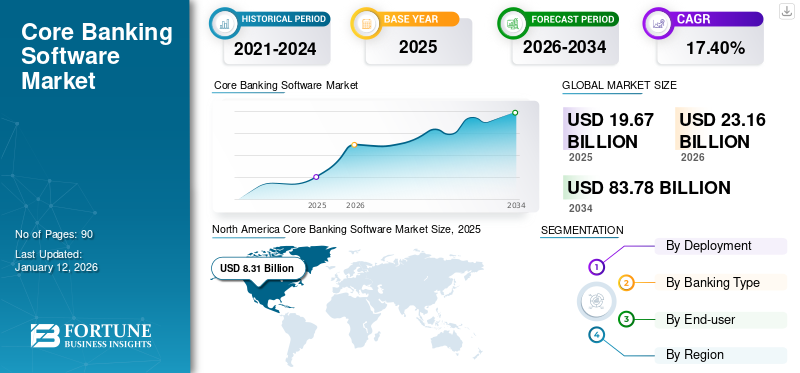
Download Free sample to learn more about this report.
IMPACT OF GENERATIVE AI
Integration of Generative AI Capabilities Has Boosted Core Banking Software Modernization
The use of generative AI is benefitting the market through streamlining banking processes including account servicing, fraud detection, compliance queries, and customer service, among others. Additionally, it enhances the performance of core banking systems by letting the employees work with the information using natural language, reducing the number of procedures done by previous-generation systems. In the case of software suppliers, generative AI will turn to be very important in shaping their product lines. However, adoption is expected to remain slow and harshly regulated. For instance,
- In May 2024, Temenos unveiled a novel Generative AI solution for the banking platform. This solution can be integrated with Temenos Core and Financial Crime Mitigation (FCM) solution. Integration of Generative AI technology will transform the way banks relate with their data, and enhance profitability and productivity to realize substantial return on investment.
CORE BANKING SOFTWARE MARKET TRENDS
Increasing Demand for Real-Time Banking and Digital Payments Integration Reshapes Market Growth
With surging real-time banking and digital payments coming to the fore as an emerging trend, banks have been forced to modernize their legacy core banking systems. The legacy systems were built for batch processing, where processing all the transactions in one step takes place. Banks now want real-time balance updates, instant funds transfers, and seamless digital transactions through mobile, internet, and branch. Banks must change their legacy core banking systems to a more modern cloud based solutions. This trend is especially important for retail banks, corporate banks, and credit unions that need faster payment processing, improved customer experience, and stronger operational resilience. For instance,
- In June 2024, Mastercard expanded its partnership with Thought Machine to deliver integrated payments and core banking capabilities to financial institutions, helping banks modernize their technology stack with cloud-native core banking and payments infrastructure.
MARKET DYNAMICS
MARKET DRIVERS
Download Free sample to learn more about this report.
Growing Adoption of SaaS and Cloud-Based Core Banking Platforms Drives Market Growth
The increasing popularity of SaaS and cloud-based core banking solutions is supporting the growth of the market as banks search for agile systems that are able to reduce their reliance on expensive on-premises solutions. With the help of cloud-based core banking systems, companies in the financial services industry can reduce time-to-market, ease product upgrades, scale their operations readily, and establish faster integration with digital banking as well as payment, lending, and compliance solutions. SaaS has also proven to be attractive for banks as it minimizes total implementation costs. For instance,
- In February 2024, Temenos announced that Lithuania’s Šiaulių Bankas selected Temenos SaaS to modernize its core banking platform in the cloud, including retail and corporate banking as well as trade finance.
Thus, this factor fuels the core banking software market growth in the coming years.
|
Rank |
Market Driver |
Expected Impact on Market Growth |
Estimated Gross Market Growth Contribution (USD Billion) |
Impact: 2026-2028 |
Impact: 2029-2031 |
Impact: 2032-2034 |
|
1 |
Increasing implementation of SaaS and cloud-based core banking platforms |
High |
16.85 |
High |
High |
High |
|
2 |
Rising modernization of legacy core banking infrastructure |
High |
15.25 |
High |
High |
High |
|
3 |
Increasing demand for real-time banking and digital payments integration |
High |
12.20 |
High |
High |
High |
|
4 |
Expansion of digital banks, neobanks, and API-driven banking models |
Medium-High |
9.45 |
Medium |
High |
High |
|
5 |
Rising regulatory compliance, cybersecurity, and reporting requirements |
Medium |
7.45 |
Medium |
Medium-High |
High |
|
6 |
Others (Increasing demand from community banks and credit unions for flexible core platforms, etc.) |
Low-Medium |
4.38 |
Low |
Medium |
Medium |
|
Total Gross Growth Contribution |
65.58 |
MARKET RESTRAINTS
High Implementation and Migration Costs of Core Banking Platforms Hinders Market Growth
Significant implementation and migration expenses associated with core banking solutions remain a substantial limitation as banks have to spend a lot on software licensing, customization, data migration, integration, testing, security, and training. Integration of core banking systems with payment systems, lending systems, deposit accounts, Client Relationship Management (CRM) software, treasury, compliance, and reporting applications adds to the cost and results in slowing down the migration process. Smaller banks, community banks, and credit unions are hesitant to modernize as they do not have enough funds in their IT budgets and have doubts concerning the return on investment. Moreover, banks usually prefer to choose phased migration, run both old and new systems simultaneously, and ask for external help in order not to stop their operations busy thus driving up the costs more.
|
Rank |
Market Restraint |
Expected Impact on Market Growth |
Estimated Reduction in Market Size (USD Billion) |
Impact: 2026-2028 |
Impact: 2029-2031 |
Impact: 2032-2034 |
|
1 |
Growing implementation and migration costs of core banking platforms |
High |
2.85 |
High |
High |
Medium |
|
2 |
Complexity of replacing legacy core banking systems |
Medium-High |
2.10 |
High |
Medium |
Medium |
|
3 |
Data security, privacy, and regulatory compliance concerns in cloud-based deployment |
Medium |
1.40 |
Medium |
Medium |
Low |
|
4 |
Others (Risk of operational disruption, regulatory and compliance challenges, vendor lock-in and integration limitations, etc.) |
Low-Medium |
0.90 |
Low |
Low |
Low |
|
Total Market Reduction |
7.25 |
MARKET OPPORTUNITIES
Increasing Demand for Core Banking Solutions from Community Banks and Credit Unions Creates New Opportunities for Market Growth
The rising demand for core banking solutions from local banks and financial cooperatives is opening up new avenues for growth as these entities require modern systems to compete with larger banks and tech-savvy financial providers. Most small banks are still using old technologies, which hinders their ability to perform banking services efficiently in real time, process payments electronically, and implement digital lending solutions and mobile banking. The introduction of cloud-based and managed core banking technology appears promising for these institutions due to its lower cost of initial investment and ease of upgrading systems in compliance with regulations, safety standards, and customer service improvements. For instance,
- In March 2024, the Federal Reserve Bank of Kansas City stated that core banking systems are the backbone of products and services offered by depository institutions, including banks and credit unions, covering account management, deposits and withdrawals, loan processing, finance, accounting, payments, and customer support.
Segmentation Analysis
By Deployment
Continued Reliance on On-premises Core Banking Systems Strengthens Segment Dominance
Based on the deployment, the market is bifurcated into on-premises and cloud.
On-premises deployment accounted for the largest market share in 2025. This is owing to banks continue to stick to supportive legacy core banking infrastructure due to data security, regulatory compliance, and customization, as well as control requirements. Since core banking systems play a critical role in key functions such as managing the system of deposits, loans, account records, payments, and customers’ data, banks usually prefer on-premises deployment in order to minimize risks during modernization.
Cloud deployment is anticipated to grow at the highest CAGR of 21.4% over the forecast period. This is owing to banks increasingly adopting scalable, SaaS-based core platforms to reduce infrastructure costs, accelerate digital banking rollouts, enable faster upgrades, and integrate more easily with APIs, payments, lending, and customer experience systems.
By Banking Type
Growing Need for Handling Millions of Transactions Per Day is Propelling Large Bank Segment Growth
Based on the banking type, the market is divided into large banks (greater than USD 30 billion in assets), midsize banks (USD 10 billion to USD 30 billion in assets), small banks (USD 5 billion to USD 10 billion in assets), community banks (less than USD 5 billion in assets), and credit unions.
Large banks (greater than USD 30 billion in assets) held largest core banking software market share in 2025. This is owing to strict adherence to diverse regulatory requirements across the European Union. Large banks are capable of handling millions of transactions per day, thus, deployment of a centralized banking system plays an important role in fueling the market growth.
Community banks (less than USD 5 billion in assets) is anticipated to grow at the highest CAGR of 19.5% over the forecast period. As they are focusing on the adoption of digital banking solutions to provide their customers with a technologically advanced financial service experience.
To know how our report can help streamline your business, Speak to Analyst
By Application
Growing Need for Centralized Customer and Account Records Supports Account Management Segment Growth
Based on the application, the market is categorized into account management, loan management, deposit management, customer relationship management (CRM), and others (digital banking integration, treasury management, etc.).
Account management dominate the market share in 2025. As it is the fundamental operational layer of the overall banking system, it enables banks to manage customer profiles, account records, balances, transactions, as well as service processes in retail, corporate, and community banking. Its extensive usage across almost every banking organization together with its strong association with deposits, loans, payments, CRM, and compliance functionalities, makes it both the essential and most prevalent application.
Customer relationship management (CRM) is anticipated to grow at the highest CAGR of 19.7% over the forecast period. This is owing to banks increasingly integrating CRM capabilities with core banking platforms to deliver personalized services, improve customer retention, automate engagement workflows, and support digital-first banking experiences across retail, wealth, and corporate banking.
By End-user
Rising Need for Scalable Core Platforms Boosts Corporate Banking Leadership
Based on the end-user, the market is classified into retail banking, treasury, corporate banking, and wealth management.
Corporate banking witnessed a dominating market share in 2025. This is owing to corporate banking operations require highly scalable core systems to manage complex accounts, high-value transactions, credit facilities, cash management, treasury linkages, and multi-entity customer relationships.
Wealth management is anticipated to grow at highest CAGR of 19.3% during the forecast period. This is owing to banks increasingly integrate core banking platforms with digital advisory, portfolio management, personalized client servicing, and real-time financial data capabilities to serve high-net-worth and mass-affluent customers more efficiently.
Core Banking Software Market Regional Outlook
By geography, the market is categorized into North America, South America, Europe, Middle East & Africa, and Asia Pacific.
North America
North America Core Banking Software Market Size, 2025 (USD Billion)
To get more information on the regional analysis of this market, Download Free sample
North America held the largest market share in 2024, valuing at USD 7.09 billion, and also maintained the leading share in 2025, with USD 8.08 billion. The market in North America is expected to increase, owing to investments done by government banks, and financial institutions. Key players in the market are focusing on developing advanced core banking software solutions to provide services across the globe. Also, government banks and financial institutions in countries such as the U.S and Canada are highly investing in adopting core banking services. These countries have a significant number of service providers of core banking software and services. For instance,
- In January 2024, Temenos AG and Deloitte US engaged in a partnership to provide technology solutions to help the U.S. financial institutions speed up core banking and payments modernization in the cloud at lower cost.
U.S. Core Banking Software Market
Based on North America’s strong contribution, the U.S. market can be analytically approximated at around USD 6.85 billion in 2026, accounting for roughly 30.7% of global sales.
To know how our report can help streamline your business, Speak to Analyst
Europe
In Europe, the market is projected to record a growth rate of 15.9% in the coming years, which is the fourth highest among all regions, and reach a valuation of USD 6.05 billion by 2026. The market in Europe is experiencing growth, owing to the move of banks to the cloud outsourcing, digital operational resilience and modernization of old platforms so that banking companies would be able to comply with the new developments in the field of regulation and cybersecurity. The countries are also taking advantage of immediate payments implementation and digital financial initiatives. For instance,
- In June 2024, the European Central Bank (ECB) launched a consultation on its cloud outsourcing guide after identifying vulnerabilities in banks’ IT outsourcing strategies.
U.K. Core Banking Software Market
The U.K. market in 2026 is estimated at around USD 1.29 billion, representing roughly 5.8% of global revenues.
Germany Core Banking Software Market
Germany’s market is projected to reach approximately USD 1.12 billion in 2026, equivalent to around 5.0% of global sales.
Asia Pacific
Asia Pacific region is estimated to reach USD 5.28 billion in 2026 and grow at the highest CAGR of 21.8% during the forecast period. This is owing to governments and banks in the region are actively modernizing their banking infrastructure to enhance operational efficiency, regulatory compliance, and customer experience. For example, governments in India, Indonesia, and the Philippines promote banking for the people who are not using the banking system. This factor increases demand for cost-effective core banking software solutions.
China Core Banking Software Market
China’s market is projected to be one of the largest worldwide, with 2026 revenues estimated at around USD 1.23 billion, representing roughly 5.5% of global sales. This is owing to the country’s strong push for financial-sector digital transformation, digital finance infrastructure, real-time payments, and e-CNY adoption, which is encouraging banks to modernize legacy core systems and strengthen cloud-ready, API-enabled banking platforms.
Japan Core Banking Software Market
The Japan market in 2026 is estimated at around USD 1.00 billion, accounting for roughly 4.5% of global revenues.
India Core Banking Software Market
The India market in 2026 is estimated at around USD 0.72 billion, accounting for roughly 3.2% of global revenues.
South America
South America is expected to witness moderate growth in this market space during the forecast period. It is set to reach a valuation of USD 0.74 billion in 2026. This is owing to rising investment done by the government and key players in sectors such as banking and finance. The banking sector in this region is undergoing a significant digital transformation, with banks modernizing their infrastructure to improve efficiency, regulatory compliance, and customer engagement. In the South America, the Brazil is set to reach a value of USD 0.38 billion in 2026.
Middle East & Africa
The Middle East & Africa is estimated to reach USD 1.02 billion in 2026 and expected to grow at a prominent growth rate in the coming years. This is owing to the increasing number of end-use banking startups and domestic financial institutions. Also, governments’ vision for economic diversification strategies such as Saudi Arabia’s Vision 2030, Kuwait’s Vision 2035, and UAE’s Smart Government Initiative are pushing banks toward digitalization. In the Middle East & Africa, the GCC is set to reach a value of USD 0.39 billion in 2026.
COMPETITIVE LANDSCAPE
Key Industry Players
Focus on Cloud-Native Core Modernization and Digital Banking Integration by Key Players to Propel Market Competition
The core banking software market holds a semi-consolidated structure, with prominent players such as EdgeVerve Systems Limited, Temenos Headquarters SA, Oracle Corporation, Fidelity National Information Services, Inc., and Tata Consultancy Services Limited holding significant positions. These companies are heavily investing in cloud-native core banking platforms, API-enabled architectures, real-time transaction processing, and modular banking solutions to help banks modernize legacy systems, improve operational agility, and support digital-first banking services.
Other notable players in the market include Fiserv, Inc., Finastra International Limited, Jack Henry & Associates, Inc., Mambu GmbH, and Thought Machine Group Limited. These companies are strengthening their market positioning through strategic partnerships, SaaS-based deployment models, core banking transformation projects, and the development of scalable platforms for retail banks, corporate banks, credit unions, and digital banks, which are expected to further accelerate market adoption over the forecast period.
LIST OF KEY CORE BANKING SOFTWARE COMPANIES PROFILED
- EdgeVerve Systems Limited (India)
- Temenos Headquarters SA (Switzerland)
- Oracle Corporation (U.S.)
- Fidelity National Information Services, Inc. (U.S.)
- Tata Consultancy Services Limited (India)
- Fiserv, Inc. (U.S.)
- Finastra International Limited (U.K.)
- Jack Henry & Associates, Inc. (U.S.)
- Mambu GmbH (Netherlands)
- Thought Machine Group Limited (U.K.)
KEY INDUSTRY DEVELOPMENTS
- September 2025: FIS launched its Bank Modernization Framework to help financial institutions modernize faster across the banking ecosystem, including core systems and connected banking operations. The framework supports component-based modernization for banks of different sizes and technology maturity levels.
- August 2025: HCLTech and Thought Machine formed a global partnership to accelerate AI and cloud-led banking modernization, with Thought Machine’s Vault platform at the core of the transformation.
- March 2025: Finastra partnered with i2c Inc. to offer debit card issuance and digital wallet solutions to North American banks and credit unions. The collaboration enhances core banking services with real-time, digital-first payment capabilities for financial institutions.
- January 2025: Infosys Finacle, a wholly-owned subsidiary of Infosys and part of EdgeVerve Systems launched the Finacle Asset Liability Management Solution which is a risk management solution that offers banks with an enterprise-wide view of balance sheet exposures.
- January 2025: Intellect Design Arena Ltd entered into a strategic partnership with Coforge. The collaboration leverages Intellect’s platforms, eMACH.ai and iTurmeric, to enable financial institutions to modernize their systems with minimal disruption.
REPORT COVERAGE
The global core banking software market analysis includes a comprehensive study of the market size & forecast by all the market segments included in the report. It includes details on the market dynamics and market trends expected to drive the market over the forecast period. It provides information on key aspects, including an overview of technological advancements, pipeline candidates, the regulatory environment, and product launches. Additionally, it details partnerships, mergers & acquisitions, as well as key industry developments and prevalence by key regions. The global market research report also provides a detailed competitive landscape with information on the market share and profiles of key operating players.
Request for Customization to gain extensive market insights.
Report Scope & Segmentation
| ATTRIBUTE | DETAILS |
| Study Period | 2021-2034 |
| Base Year | 2025 |
| Estimated Year | 2026 |
| Forecast Period | 2026-2034 |
| Historical Period | 2021-2024 |
| Growth Rate | CAGR of 17.4% from 2026-2034 |
| Unit | Value (USD Billion) |
| Segmentation | By Deployment, Banking Type, Application, End-user, and Region |
| By Deployment |
|
| By Banking Type |
|
| By Application |
|
| By End-user |
|
| By Region |
|
Frequently Asked Questions
According to Fortune Business Insights, the global market value stood at USD 19.30 billion in 2025 and is projected to reach USD 80.65 billion by 2034.
The market is growing at a CAGR of 17.4% during the forecast period of 2026-2034.
In 2025, the North America market value stood at USD 8.08 billion.
By banking type, large banks (greater than USD 30 billion in assets) are expected to lead the market.
Growing adoption of SaaS and cloud-based core banking platforms drives market growth.
EdgeVerve Systems Limited, Temenos Headquarters SA, Oracle Corporation, Fidelity National Information Services, Inc., and Tata Consultancy Services Limited are the major players in the global market.
North America dominated the market in 2025.



- 2021-2034
- 2025
- 2021-2024
- 120
Get 30-60 hrs Free Customization
Expand Regional and Country Coverage, Segments Analysis, Company Profiles, Competitive Benchmarking, and End-user Insights.




















Related Reports
-
US +1 833 909 2966 ( Toll Free )
-
Get In Touch With Us