Unit Dose Packaging Market Size, Share & Industry Analysis, By Material (Plastic, Glass, Paper & Paperboard, Metal, and Others), By Product Type (Vials & Ampoules, Blisters, Syringes & Cartridges, Sachets & Pouches, and Others), By End-use Industry (Pharmaceuticals, Food & Beverages, Personal Care & Cosmetics, Homecare, Nutraceuticals, and Others), and Regional Forecast, 2026-2034
 Download Free Sample
(Offer valid till 15th Oct 2026)

KEY MARKET INSIGHTS
 Listen to Audio Version
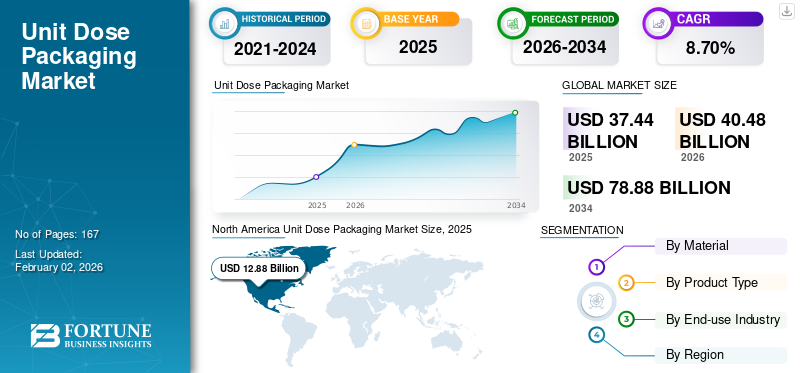
The global unit dose packaging market size was valued at USD 37.44 billion in 2025 and is projected to grow from USD 40.48 billion in 2026 to USD 78.88 billion by 2034, exhibiting a CAGR of 8.70% during the forecast period. North America dominated the global market with a share of 34.41% in 2025.
Unit dose packaging refers to a system in which a product is contained within a single, pre-measured portion. Although it is most frequently linked to pharmaceuticals, it is also utilized in food, cosmetics, and various other consumer goods. This type of packaging enhances safety, convenience, and cleanliness for both consumers and businesses.
The market encompasses several key players Amcor, Nipro Corporation, and Schott AG, at the forefront. Broad portfolio with innovative product launches and strong geographic presence expansion has supported the dominance of these companies in the global market.
Download Free sample to learn more about this report.
Unit Dose Packaging Market Key Takeaways
 Global Market Size & Forecast
- 2025 Market Size: USD 37.44 billion
- 2026 Market Size: USD 40.48 billion
- 2034 Forecast Market Size: USD 78.88 billion
- CAGR: 8.70% from 2026–2034
 Market Share
- North America dominated the market with a 34.41% share in 2025.
- Plastic segment is projected to hold the largest market share with 10.50% in 2026.
- Vials & Ampoules segment is projected to account for 11.02% of the global market share in 2026.
 Key Regional Highlights
North America
The market reached USD 12.88 billion in 2025, driven by strong pharmaceutical manufacturing and stringent regulatory standards.
Asia Pacific
The market reached USD 9.73 billion in 2025 and is expected to register the fastest regional CAGR of 9.69% during the forecast period.
Europe
The market reached USD 6.77 billion in 2025, supported by sustainable packaging initiatives and strict EU regulations.
U.S.
The market is projected to reach USD 10.61 billion by 2026.
Japan
The market is projected to reach USD 1.94 billion by 2026.
Read More

MARKET DYNAMICS
MARKET DRIVERS
Rising Focus on Patient Safety and Accurate Dosing Drives Market Growth
A significant factor driving the market for global unit dose packaging is the growing focus on patient safety, ageing populations, and dosage precision within the pharmaceutical and healthcare industries. Unit dose packaging guarantees that medications are provided in pre-measured, single-use doses, which decreases the likelihood of dosing mistakes and contamination. Healthcare providers and hospitals are increasingly implementing these systems to enhance medication adherence and reduce human errors during drug administration. Additionally, regulatory organizations such as the U.S. FDA and EMA enforce strict standards for labeling and packaging to ensure drug safety, compelling pharmaceutical companies to adopt innovative unit dose formats. As healthcare systems worldwide shift toward preventive and personalized medicine, the demand for unit dose, accurate, tamper-resistant, and hygienic packaging is rising sharply.
MARKET RESTRAINTS
High Initial Investment and Complex Packaging Processes to Hinder Market Growth
Even though unit dose packaging has its advantages, its widespread use is limited by the high costs of machinery and the complexity of operations. The machinery needed for unit dose blistering, sealing, and labeling typically requires a substantial upfront investment and ongoing maintenance. Smaller and mid-sized pharmaceutical companies, particularly in developing countries, struggle to secure funding for these advanced systems. Furthermore, stringent compliance standards for maintaining sterile packaging environments and undergoing validation processes drive up operational expenses. Additionally, limited scalability and slower production speeds compared to bulk packaging create challenges for high-volume manufacturers, hindering overall market expansion.
MARKET OPPORTUNITIES
Soaring Need for Portable and Single-Serving Items Creates Lucrative Growth Opportunities
An emerging opportunity for the unit dose packaging sector is its growing use beyond pharmaceuticals, particularly within the food, beverage, and personal care sectors. The increasing demand for portable and single-serving items such as condiments, coffee pods, detergents, and skincare samples has created new paths for growth. The convenience and hygienic advantages of unit dose packaging align seamlessly with changing consumer habits that emphasize portion control and portability. Furthermore, the incorporation of sustainable and recyclable materials into single-dose packaging offers manufacturers a strategic advantage in appealing to eco-conscious consumers, particularly in North America and Europe.
UNIT DOSE PACKAGING MARKET TRENDS
Growing Adoption of Smart & Sustainable Packaging Technologies Emerges as a Market Trend
A key trend transforming the unit dose packaging industry is the incorporation of intelligent technologies and eco-friendly materials. Current packaging advancements feature RFID tags, QR codes, and serialization systems that facilitate product traceability, prevent counterfeiting, and enhance inventory management. Moreover, there is a notable transition toward bioplastics, paper-based laminates, and recyclable mono-materials in order to achieve sustainability objectives. Companies in the pharmaceutical and consumer goods sectors are also putting resources into automation and digital printing technologies to boost production efficiency and minimize waste. The fusion of smart capabilities and environmentally responsible design is emerging as a key trend that corresponds with global sustainability efforts and the ongoing digital evolution of the packaging industry.
MARKET CHALLENGES
Sustainability and Environmental Impact Concerns to Challenge Market Growth
One of the primary challenges confronting the global unit dose packaging industry is the environmental repercussions tied to single-use packaging waste. The majority of unit dose formats, notably blisters, sachets, and ampoules, are constructed from multi-layer plastics or aluminum composites, which are hard to recycle. As global pressure to decrease plastic use increases, manufacturers encounter heightened scrutiny from both regulatory bodies and consumers. Shifting to eco-friendly or biodegradable alternatives while still upholding necessary barrier properties, shelf-life, and safety standards presents both technological hurdles and increased costs. Striking a balance between sustainability and product integrity remains a fundamental issue that companies must tackle to ensure long-term market growth.
Download Free sample to learn more about this report.
Segmentation Analysis
By Material
Remarkable Benefits Offered by Plastic Material Propelled Segment Growth
In terms of material, the market is categorized into plastic, glass, paper & paperboard, metal, and others.
The plastic segment captured the largest unit dose packaging market share in 2024. In 2026, the segment is projected to dominate the market with a share of 10.50% share. Plastic materials are pivotal in the global unit dose packaging sector due to their adaptability, lightweight nature, and outstanding barrier capabilities. Unit dose packaging, which is frequently utilized for pharmaceuticals, nutraceuticals, food, and personal care items, depends significantly on plastic to deliver accurate, single-use portions that preserve product quality, sterility, and longevity. Due to its versatility and moisture resistance, plastic offers a dependable seal and is particularly suitable for liquid and semi-solid unit doses such as oral syringes, cleaning agents, and food condiments.
The glass material segment is expected to grow rapidly at a CAGR of 8.63% over the forecast period.
By Product Type
Rising Utilization of Vials & Ampoules in Several End-use Sectors Boosted the Segment’s Growth
In terms of product type, the market is categorized into vials & ampoules, blisters, syringes & cartridges, sachets & pouches, and others.
The vials and ampoules segment captured the largest share of the market in 2024. the segment is projected to dominate the market with a share of 11.02% in 2026. Vials and ampoules are among the most commonly utilized primary packaging formats for liquid and injectable medications in the unit dose packaging category. Their use has notably increased in the pharmaceutical, biotechnology, and healthcare industries, especially with the rise of injectable therapies, vaccines, biologics, and diagnostic reagents. With the increasing importance of personalized medicine and biologic drugs, unit dose vials and ampoules have become essential for maintaining product integrity and enhancing patient safety.
The blisters product type segment is expected to grow significantly at a CAGR of 8.67% over the forecast period.
By End-use Industry
Rising Demand from the Pharmaceutical Sector Propelled Segmental Growth
Based on end-use industry, the market is segmented into pharmaceuticals, food & beverages, personal care & cosmetics, home care, nutraceuticals, and others.
To know how our report can help streamline your business, Speak to Analyst
In 2024, the global market was dominated by pharmaceuticals segment in terms of end-use industry. Furthermore, the is projected to dominate the market with a share of 8.82% in 2026. The pharmaceutical industry continues to be the largest and most powerful end-user driving the expansion of the global unit dose packaging market, representing a substantial portion of total demand. The rise in the use of single-dose packaging formats such as blister packs, ampoules, vials, pre filled syringes, sachets, and pouches can be attributed to the sector's increasing emphasis on patient safety, precise dosing, and patient adherence to medication. As the pharmaceutical field shifts toward a more patient-focused approach, unit dose packaging has become a crucial element in ensuring the safe, convenient, and regulated administration of medications across various therapeutic areas.
The food and beverages segment is projected to grow rapidly at a CAGR of 8.84% during the study period.
Unit Dose Packaging Market Regional Outlook
By geography, the market is categorized into Europe, North America, Asia Pacific, Latin America, and the Middle East & Africa.
North America
North America Unit Dose Packaging Market Size, 2025 (USD Billion) To get more information on the regional analysis of this market, Download Free sample
North America contributed approximately USD 12.88 billion to the global market in 2025, accounting for 34.41% share, and is expected to reach USD 14 billion in 2026. The region dominates the global unit dose packaging market, largely due to the robust pharmaceutical and healthcare sectors in the U.S. and Canada. Its stringent regulatory framework, governed by the FDA and Health Canada, promotes the use of unit dose formats to guarantee medication safety and traceability.
In 2026, the U.S. market is estimated to reach USD 10.61 billion.
Asia Pacific
Other regions, such as the Asia Pacific and Europe, are anticipated to witness a notable growth in the coming years. During the forecast period, the Asia Pacific region is projected to record a growth rate of 9.69%, which is the second-highest amongst all the regions, and reach the valuation of USD 9.73 billion in 2025. The unit dose packaging market growth in the Asia Pacific is driven by the fast-expanding pharmaceutical manufacturing industry in nations such as India, China, Japan, and South Korea, alongside increased healthcare awareness and urban development. Additionally, the cost-effective production foundation and the growing contract packaging sector (CPOs/CMOs) are key factors supporting this expansion.
In the region, India and China are both estimated to reach USD 2.72 and USD 3.27 billion, respectively, in 2026. Japan to record USD 1.94 billion in 2026.
Europe
In 2025, the Europe market stood at USD 6.77 billion, representing 18.08% of global demand, and is projected to grow to USD 7.29 billion in 2026. In Europe, the primary factor fueling the unit dose packaging market is the region's position as a leader in environmentally-friendly and regulatory-compliant packaging options. The EU Packaging and Packaging Waste Directive, along with REACH regulations, is urging producers to transition toward recyclable, compostable, and bio-based materials. Pharmaceutical companies in Europe are quickly adopting low-impact blister materials and paper-based dose packs to achieve their sustainability objectives.
Backed by these factors, countries including the U.K. are expected to record the valuation of USD 1.34 billion, Germany to record USD 1.79 billion in 2026, and France to record USD 0.99 billion in 2025.
Latin America and the Middle East & Africa
Over the forecast period, Latin America and the Middle East & Africa regions would witness a moderate growth in this market. Latin America recorded a market size of USD 4.59 billion in 2025, capturing 12.26% of the global market share, and is projected to reach USD 4.89 billion in 2026. In 2025, Middle East & Africa generated USD 3.47 billion, contributing 9.26% to global market revenue, and is projected to grow to USD 3.67 billion in 2026. Government-initiated healthcare reforms and the increased use of generic medications are generating fresh prospects for economical, unitized packaging options. Additionally, the growing awareness of health among consumers and the trend toward single-serving food and beverage packaging offer further growth opportunities.
In the Middle East & Africa, South Africa is set to attain the value of USD 0.40 billion in 2025.
COMPETITIVE LANDSCAPE
Key Industry Players
Key Companies Focus on Innovation to Gain Competitive Edge
The global unit dose packaging market shows a semi-concentrated structure with numerous small- to mid-size companies actively operating across the globe. These players are actively involved in product innovation, strategic partnerships, and geographic expansion.
Amcor, Nipro Corporation, and Schott AG are some of the dominating players in the market. A comprehensive range of unit-dose packaging products, global presence through a strong distribution network, and collaborations with research and academic institutes are a few characteristics of these players that support their dominance.
Apart from this, other prominent players in the market include Gerresheimer, SGD Pharma, West Pharmaceuticals Services Inc., and others. These companies are undertaking various strategic initiatives, such as investments in R&D and partnerships with pharmaceutical companies to enhance their market presence.
LIST OF KEY UNIT DOSE PACKAGING COMPANIES PROFILED
- Amcor (Switzerland)
- Nipro Corporation (Japan)
- Schott AG (Germany)
- Gerresheimer (Germany)
- SGD Pharma (France)
- West Pharmaceuticals Services Inc. (U.S.)
- Stevanato Group S.p.a. (Italy)
- Huhtamaki (Finland)
- Unit Pack Company (U.S.)
- Dordan Manufacturing Company, Incorporated (U.S.)
- Catalent Inc. (U.S.)
- Adelphi Healthcare Packaging (U.K.)
- Valmatic (U.S.)
- CordenPharma (Switzerland)
- Sonic Packaging (U.S.)
KEY INDUSTRY DEVELOPMENTS
- July 2025: Swisslog Healthcare, a provider of pharmacy automation solutions, introduced PillPick Octave, the latest model of its automated unit dose system. This updated version features enhanced functionality and improves the safety of medications tailored to individual patients. In addition, the PillPick Octave presents customers with new options for more environmentally friendly packaging.
- June 2025: Medical Packaging Inc. (MPI) offered the Auto-Print Unit Dose Packaging System, an all-in-one solution aimed at improving the efficiency and precision of oral solid medication packaging in pharmacies. This advanced system automates the packaging process, decreasing the need for manual labor and lowering the risk of medication errors.
- October 2024: Bayer introduced a groundbreaking polyethylene terephthalate (PET) blister packaging for its well-known Aleve brand, making it the first of its kind in the healthcare market. Developed in collaboration with packaging expert Liveo Research, this innovative approach decreases the packaging's carbon footprint by 38%. It represents a significant advancement in environmental responsibility by removing polyvinyl chloride (PVC) from the materials used.
- August 2022: Jones Healthcare introduced the Sustainable FlexRx One Blister Pack, specifically created for automation. This new unit-dose adherence package is perfect for retail, specialty, and long-term care pharmacies that utilize centralized fulfillment or in-house automation. These packs are also suitable for pharmacies that prepare prescriptions manually, as the sealing process maintains consistent speed and quality, irrespective of the filling method used.
- April 2022: Huhtamaki, a prominent global supplier of eco-friendly packaging solutions, introduced a groundbreaking sustainable innovation for the worldwide pharmaceutical and healthcare sector. The Push Tab® blister lid from Huhtamaki is made from mono-material PET and contains no aluminum. It is engineered to comply with the rigorous safety standards needed for pharmaceutical and healthcare packaging. It offers the industry a more sustainable option compared to conventional push-through blister packaging.
REPORT COVERAGE
Request for Customization to gain extensive market insights.
Report Scope & Segmentation
|
ATTRIBUTE |
DETAILS |
|
Study Period |
2021-2034 |
|
Base Year |
2025 |
|
Estimated Year |
2026 |
|
Forecast Period |
2026-2034 |
|
Historical Period |
2021-2024 |
|
Growth Rate |
CAGR of 8.70% from 2026-2034 |
|
Unit |
Value (USD Billion) |
|
Segmentation |
By Material, Product Type, End-use Industry, and Region |
|
By Material |
· Plastic · Glass · Paper & Paperboard · Metal · Others |
|
By Product Type |
· Vials & Ampoules · Blisters · Syringes & Cartridges · Sachets & Pouches · Others |
|
By End-use Industry |
· Pharmaceuticals · Food & Beverages · Personal Care & Cosmetics · Homecare · Nutraceuticals · Others |
|
By Geography |
· North America (By Material, Product Type, End-use Industry, and Country) o U.S. o Canada · Europe (By Material, Product Type, End-use Industry, and Country/Sub-region) o Germany o U.K. o France o Spain o Italy o Russia o Poland o Romania o Rest of Europe · Asia Pacific (By Material, Product Type, End-use Industry, and Country/Sub-region) o China o Japan o India o Australia o Southeast Asia o Rest of Asia Pacific · Latin America (By Material, Product Type, End-use Industry, and Country/Sub-region) o Brazil o Mexico o Argentina o Rest of Latin America · Middle East & Africa (By Material, Product Type, End-use Industry, and Country/Sub-region) o Saudi Arabia o UAE o Oman o South Africa o Rest of the Middle East & Africa |
Frequently Asked Questions
Fortune Business Insights says that the global market value stood at USD 40.48 billion in 2026 and is projected to reach USD 78.88 billion by 2034.
In 2025, the market value stood at USD 12.88 billion.
The market is expected to exhibit a CAGR of 8.70% during the forecast period of 2026-2034.
The vials and ampoules segment led the market by product type.
Key factor driving the market is the rising focus on patient safety and accurate dosing.
Amcor, Nipro Corporation, Schott AG, Gerresheimer, SGD Pharma, and West Pharmaceuticals Services Inc. are some of the prominent players in the market.
North America dominated the market in 2025.
Rising demand from the pharmaceutical industry is one of the factors that is expected to favor product adoption.



- 2021-2034
- 2025
- 2021-2024
- 167
-
(Offer valid till 15th Oct 2026)
Get 30-60 hrs Free Customization
Expand Regional and Country Coverage, Segments Analysis, Company Profiles, Competitive Benchmarking, and End-user Insights.







Related Reports
-
US +1 833 909 2966 ( Toll Free )
-
Get In Touch With Us