Fishmeal Market Size, Share & Industry Analysis, By Source (Salmon & Trout, Marine Fish, Carps, Crustaceans, Tilapia, and Others), By Form (Powder and Granules), By End-Use (Ruminants, Poultry, Swine, Aquatic Animals, Pets, and Fertilizers), By Industrial Application (Fertilizers, Animal Feed, and Pet Food) and Regional Forecast, 2026–2034
 Download Free Sample
(Offer valid till 15th Oct 2026)

Fish Meal Market Overview
 Listen to Audio Version
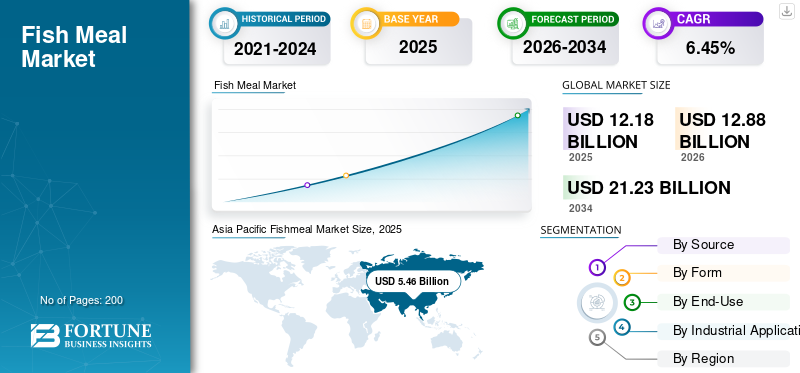
The fishmeal market size was valued at USD 12.18 billion in 2025 and is projected to grow from USD 12.88 billion in 2026 to USD 21.23 billion by 2034, exhibiting a CAGR of 6.45% during the forecast period. Asia Pacific dominated the fishmeal market with a market share of 44.82% in 2025.
Fishmeal is a high-protein feed ingredient produced mainly from small pelagic fish such as anchovies, sardines, and menhaden, as well as from fish-processing by-products. It is widely used in aquaculture, poultry, swine, and specialty livestock feed due to its high digestibility, balanced amino acid profile, and strong nutritional value. The market is closely linked with the growth of aquaculture production, rising demand for high-performance animal feed, and increasing focus on feed efficiency. At the same time, sustainability concerns, fishery regulations, and raw material availability continue to influence supply patterns and pricing trends across major producing regions.
The industry is led by players such as FF Skagen A/S, TASA, Copeinca SAC RUC, Pelagia AS, Austral Group S.A.A and other regional fishmeal manufacturers.
Download Free sample to learn more about this report.
Fishmeal Market Key Takeaways
 Market Size & Forecast
- 2025 Market Size: USD 12.18 Billion
- 2026 Market Size: USD 12.88 Billion
- 2034 Forecast Market Size: USD 21.23 Billion
- CAGR: 6.45% from 2026–2034
 Market Share
- Asia Pacific dominated the fishmeal market with a 44.82% share in 2025.
- The Marine Fish segment held the largest market share in 2025, valued at USD 3.01 billion.
- The Animal Feed segment accounted for the largest market share in 2025, reaching USD 9.32 billion.
 Key Regional Highlights
Asia Pacific
Asia Pacific generated USD 5.46 billion in 2025 and is expected to remain the fastest-growing regional market with a 7.06% CAGR.
North America
North America recorded USD 1.68 billion in 2025 and is expected to expand at a 6.60% CAGR.
Europe
Europe reached USD 2.54 billion in 2025.
U.S.
The market was valued at approximately USD 1.42 billion in 2025 and is projected to grow at a 6.43% CAGR.
Japan
The market reached USD 0.47 billion in 2025.
Read More

Fishmeal Market Trends
Focus on Sustainable Product Offerings is an Emerging Market Trend
Sustainability is emerging as a key trend in the market, as buyers increasingly prefer responsibly sourced marine ingredients with stronger traceability and environmental assurance. Producers of global fishmeal and fish oil are increasingly focusing on certified sourcing, responsible fishing practices, and greater transparency across the value chain. This trend is particularly important in export-oriented markets, where feed manufacturers and aquaculture companies are demanding sustainable inputs for premium feed applications. Thus, fishmeal manufacturers are improving sourcing systems, strengthening compliance, and expanding certification coverage to enhance customer trust and long-term competitiveness. The growing use of fish by-products from fish processing activities is also supporting sustainability goals by improving utilization efficiency and reducing dependence on whole wild catch. In future, sustainable product positioning is expected to become a stronger differentiator for key players in the global market.
- MarinTrust reported that nearly half of global fishmeal and fish oil production is currently MarinTrust-aligned, highlighting the growing industry shift toward certified and responsible marine ingredients. MarinTrust’s 2025 annual report states that by the end of 2025, 111 factories were certified under MarinTrust Version 3, with the newer standard fully taking effect for facility audits from 1 May 2025.
MARKET DYNAMICS
Market Drivers
Download Free sample to learn more about this report.
Rising Aquaculture Production to Drive Market Growth
The growth of aquaculture production is a major driver of the fishmeal market growth, as fishmeal remains a premium protein source in nutritionally balanced aquaculture feed. It is widely used in feed formulations for farmed fish and other aquatic animals due to its high digestibility, balanced amino acid profile, and functional nutritional properties. As commercial aquaculture expands across the Asia Pacific and Latin America, demand for high-performance feed ingredients continues to rise, thereby directly supporting fishmeal consumption. In intensive farming systems, fishmeal plays an important role in improving feed efficiency, growth, and survival rates in marine fish and shrimp production. The industry is also benefiting from the transition from traditional feeding practices to scientifically formulated compound feed, in which fishmeal continues to hold strategic value. As a result, rising aquaculture output is expected to remain one of the strongest long-term growth drivers for the market.
- According to the State of World Fisheries and Aquaculture (SOFIA) report published in 2024, the aquaculture production in 2022 increased 4.4% and reached 223.2 million tonnes, compared to 2020.
Market Restraints
Price Volatility and High Cost of Raw Materials to Hamper Market Growth
The market is significantly affected by limited access to raw materials, as production depends heavily on small pelagic fish such as anchovies, sardines, and menhaden. Since supply is closely tied to the availability of marine catch, the market remains vulnerable to seasonal fishing bans, biomass protection policies, quota cuts, and environmental fluctuations such as El Niño. Governments across major producing countries are increasingly implementing stricter fishery regulations to preserve marine ecosystems and maintain long-term stock sustainability. While these measures support responsible resource management, they also restrict the availability of fish suitable for processing into fishmeal and fish oil. Additionally, lower landings in key producing countries can reduce global fishmeal production, tighten supply, and increase price volatility for feed manufacturers. This creates a major challenge for processors and buyers, especially when demand remains strong from the aquaculture feed and animal nutrition industries.
- FAO reported that only 62.3% of marine fishery stocks were fished within biologically sustainable levels in 2021, supporting the need for stricter fishing control measures.
- FAO GLOBEFISH stated that global fishmeal production declined by 23% in 2023, mainly due to poor anchoveta catches in Peru.
Market Opportunities
Rising Protein-Rich Feed Demand from Poultry and Livestock Production to Drive the Market
Although aquaculture remains the primary end-use sector, rising demand for protein-rich feed from poultry and livestock production is creating additional growth opportunities for the market. Fishmeal is valued as a concentrated protein source in specialty feed applications as it provides high digestibility, strong palatability, and a favorable amino acid profile. It is particularly useful in starter feed, young animal nutrition, and premium feed formulations where nutrient density is critical. The increasing expansion of commercial poultry and livestock farming is driving demand for high-quality feed ingredients, especially in developing economies where meat and egg consumption are rising steadily. In addition, the presence of beneficial nutrients, such as omega-3 fatty acids, further underlines the value of fish-derived ingredients in selected animal nutrition applications. As feed manufacturers continue to optimize performance-oriented formulations, fishmeal is expected to benefit from broader use beyond aquaculture feed.
- According to the OECD-FAO Agricultural Outlook 2025–2034, global meat production is projected to increase by 13% by 2034, reaching 406 million tonnes cwe. Poultry is expected to account for 62% of the additional meat produced over the outlook period, indicating stronger demand for compound feed.
SEGMENTATION ANALYSIS
By Source
High Nutritional Value of Marine Fish to Hold Highest Share of Market
On the basis of source, the market is segmented into salmon & trout, marine fish, carps, crustaceans, tilapia, and others.
The marine fish segment dominated the market in 2025, valued at USD 3.01 billion, as marine fish remain the most widely used and commercially established raw material base for fishmeal production. Marine species such as anchovy, sardine, menhaden, and similar pelagic fish are preferred highly as they offer strong protein content, favorable amino acid composition, and consistent oil and nutrient value. They are also available in larger commercial volumes than many freshwater or niche aquatic sources, making them more suitable for large-scale reduction and processing. In addition, marine fish-based fishmeal has long been used in aquaculture feed, poultry feed, and livestock formulations due to its high digestibility and balanced nutritional profile. Strong supply linkages with major producing countries and broad applicability in compound animal feed are the key reasons behind the segment growth.
The crustaceans segment is projected to grow at the fastest CAGR of 7.84% during 2026–2034. Crustacean-based fishmeal is gaining traction as it can be produced from processing waste and by-products such as shrimp shells, heads, and other residue, supporting better raw material utilization and sustainability goals. It is increasingly preferred in specialty feed applications due to its protein value, mineral content, and functional benefits in feed formulations.
To know how our report can help streamline your business, Speak to Analyst
By Form
Easy Handling and Broad Feed Application of Powder Form Leads to Segment’s Dominance
On the basis of form, the market is segmented into powder and granules.
The powder segment led the market in 2025, reaching USD 11.76 billion. Powder is the most commonly used and commercially preferred form of fishmeal in the feed manufacturing industry. Powdered fishmeal is widely accepted as it blends easily with other feed ingredients, disperses uniformly in compound feed formulations, and supports precise nutritional balancing. It is especially suitable for aquafeed, poultry feed, swine feed, and pet food applications where consistency in ingredient mixing is important. In addition, powder form is convenient for large-scale processing and is compatible with modern feed production systems. Its versatility, ease of formulation, and widespread acceptance across multiple end-use industries leads to the segment’s growth.
The granules segment is expected to grow at the fastest CAGR of 7.76% during the forecast period. Granulated fishmeal is witnessing faster growth as it offers better flowability, reduced dust formation, and easier handling during storage, transportation, and feed manufacturing.
By End-Use
Strong Demand for Fishmeal from Aquatic Animals Propels the Segment’s Growth
On the basis of end-use, the market is segmented into ruminants, poultry, swine, aquatic animals, pets, and fertilizers.
The aquatic animals segment held the largest fishmeal market share in 2025, valued at USD 6.36 billion. Fishmeal is one of the most important high-quality protein ingredients used in feed for fish, shrimp, and other farmed aquatic species. It is highly valued for its digestibility, amino acid balance, palatability, and contribution to growth performance, making it a critical component in commercial aquaculture diets. Fishmeal also contains essential nutrients and marine-derived compounds that support better health and feed conversion in aquatic species. With the continued expansion of global aquaculture and rising demand for nutritionally balanced aquaculture feed, the use of fishmeal in this segment remains significantly higher than in other end-use categories. Its long-established functional role in feed for aquatic animals is encouraging the segment’s dominance.
The pets segment is projected to grow at the fastest CAGR of 7.20% during the forecast period.
By Industrial Application
Extensive Usage of the Product in Animal Feed Leads to the Segment’s Growth
On the basis of industrial application, the market is segmented into fertilizers, animal feed, and pet food.
The animal feed segment held the largest share of the market in 2025, valued at USD 9.32 billion. Fishmeal is widely used as a premium protein ingredient in feed formulations for aquaculture, poultry, swine, and young livestock. It is preferred due to its high protein concentration, balanced amino acid profile, digestibility, and nutritional efficiency in performance-oriented feed products. Fishmeal supports better growth, feed intake, and feed conversion, making it especially valuable in commercial production systems. In addition, the rising demand for meat, eggs, seafood, and other animal-based protein products continues to support the consumption of nutrient-rich feed ingredients. Its broad application across several livestock and aquaculture categories is the primary reason animal feed remains the leading industrial application segment.
The pet food segment is projected to grow at the fastest CAGR of 7.18% during the forecast period. Fishmeal is increasingly being used in pet food as it is considered a high-quality protein source and is associated with premium nutrition, digestibility, and palatability. It is also valued for the presence of marine nutrients and omega-3 fatty acids, which are widely linked with skin, coat, and overall pet health benefits. Rising pet humanization, growing spending on premium pet nutrition, and increasing demand for protein-rich functional ingredients are supporting faster growth in this segment.
Fishmeal Market Regional Outlook
Regionally, the report covers the global market analysis across North America, Europe, Asia Pacific, South America, and the Middle East & Africa.
North America
Asia Pacific Fishmeal Market Size, 2025 (USD Billion)
To get more information on the regional analysis of this market, Download Free sample
North America accounted for USD 1.68 billion in 2025 and is projected to grow at a CAGR of 6.60% over the forecast period. The region’s demand is primarily supported by its advanced aquaculture feed and pet food industries, along with increasing inclusion of high-quality marine-based ingredients in specialty animal feed formulations. The U.S. and Canada are key contributors, with strong demand from salmon farming, premium pet nutrition, and functional feed applications. Additionally, the region benefits from well-established supply chains, access to fish-processing by-products, and the increasing adoption of sustainable marine ingredients. Growing preference for high-performance feed and traceable sourcing is further strengthening regional market growth.
U.S. Fishmeal Market
The U.S. market was valued at approximately USD 1.42 billion in 2025 and is expected to expand at a CAGR of 6.43% during the forecast period. The country accounts for the largest share of the North American market due to strong demand from aquaculture, pet food, and specialty livestock feed sectors. The presence of companies such as Omega Protein Corporation, which utilizes menhaden as a key raw material, supports domestic production and supply stability. In addition, increasing demand for nutrient-rich ingredients containing omega-3 fatty acids in premium pet food and aquafeed is driving consumption. The U.S. also benefits from efficient fish processing infrastructure, enabling better utilization of by-products as feed-grade protein sources.
Europe
Europe holds a considerable share of the market and is expected to grow steadily over the forecast period. The market is valued at USD 2.54 billion in 2025 and is expected to expand at a CAGR of 6.13%., the increasing use of certified marine The region’s growth is driven by a strong regulatory focus on sustainability ingredients, and rising demand from the aquaculture and specialty livestock sectors. European countries emphasize traceability, eco-labeling, and responsible sourcing, which is influencing procurement strategies across feed manufacturers. Additionally, increasing the use of fishmeal derived from fish-processing waste supports circular-economy initiatives and decreases dependence on wild catch.
Spain Fishmeal Market
Spain accounted for approximately USD 0.54 billion in 2025, driven by high bread consumption and strong industrial baking infrastructure. The country is one of Europe’s leading aquaculture producers, particularly in marine species such as seabass and seabream, which drives strong demand for fishmeal in aquaculture feed. Spain also has a well-developed seafood processing industry, providing access to raw materials through by-products and supporting domestic fishmeal production. Growing export-oriented aquaculture production and a rising focus on feed efficiency are key factors driving market growth.
Asia Pacific
Asia Pacific region reached USD 5.46 billion in 2025 and is the fastest-growing region, with a 7.06% CAGR and dominates the market. The region’s leadership is driven by its large-scale aquaculture industry, increasing seafood consumption, and the rapid expansion of commercial fish farming. Countries such as China, India, Vietnam, and Indonesia are major consumers of fishmeal due to rising demand for compound feed for farmed fishes and shrimp. Additionally, growing urbanization, rising incomes, and dietary shifts toward protein-rich foods are accelerating aquaculture production and feed demand across the region.
China Fishmeal Market
China was valued at USD 2.63 billion in 2025. The country is the world’s largest aquaculture producer, creating substantial demand for fishmeal as a critical feed ingredient for aquatic animals. Despite limited domestic production, China is a major importer of fishmeal, particularly from Peru, to support its expanding aquafeed industry. Increasing strengthening of aquaculture farming and rising focus on feed efficiency and productivity are key drivers of market growth. In addition, growing consumption of seafood and expansion of commercial aquaculture systems continue to support demand.
Japan Fishmeal Market
Japan reached USD 0.47 billion in 2025. The country’s demand is supported by its mature aquaculture sector and strong emphasis on high-quality and nutritionally balanced feed. Japan also uses fishmeal derived from fish-processing by-products, improving resource efficiency and sustainability. The market is further driven by demand for premium feed ingredients in aquaculture and pet food sectors, where quality and traceability are critical. Moreover, stable seafood consumption and technological advancements in feed formulation contribute to steady market growth.
South America and Middle East & Africa
South America accounted for USD 2.03 billion in 2025, growing at a CAGR of 5.45%. South America is a key production hub in the market, driven by abundant marine resources and large-scale fishing operations. Countries such as Peru and Chile are among the world's largest producers of fishmeal, supported by abundant anchoveta and other pelagic fish. The region plays a crucial role in global fishmeal production and exports a significant portion of its output to Asia and Europe. However, production levels are influenced by climatic conditions such as El Niño, which can impact fish availability and supply stability. Strong export demand and established fishing infrastructure continue to support market growth across the region.
The Middle East & Africa market was valued at USD 0.47 billion in 2025, expanding at a CAGR of 4.26%. The market is expected to grow at a moderate pace over the forecast period. The region’s growth is driven by expanding aquaculture activities, increasing demand for protein-rich feed, and rising focus on food security. Countries are investing in aquaculture to reduce dependence on seafood imports, thereby supporting demand for fishmeal in feed applications. Additionally, growing awareness of high-quality feed ingredients and improvements in feed manufacturing infrastructure are contributing to market development.
South Africa Fishmeal Market
The South Africa market was valued at approximately USD 0.17 billion in 2025 and is projected to grow at a CAGR of 4.47% during the forecast period. The country’s market is supported by its established fishing industry and the availability of marine resources as raw materials for fishmeal production. Increasing aquaculture activities and demand for high-protein feed in the livestock and aquaculture sectors are driving consumption. Additionally, the country’s strategic location and export capabilities support its role in supplying fishmeal to regional markets. Rising focus on sustainable fishing practices and efficient resource utilization is further shaping the market outlook.
COMPETITIVE LANDSCAPE
Key Industry Players
Key Players Are Focused on Innovation, Portfolio Expansion, and Strategic Partnerships to Increase Market Share
The market is mederatley consolidated, dominated by a limited number of large global manufacturers and several regional players. Key players such as FF Skagen A/S, TASA, Copeinca SAC RUC, Pelagia AS, Austral Group S.A.A are dominating the market. The companies are investing in new product development, expanding their production bases and geographical reach, and engaging in mergers and acquisitions to strengthen their market share.
Key Players in the Fishmeal Market
|
Rank |
Company Name |
|
1 |
FF Skagen A/S |
|
2 |
TASA |
|
3 |
Copeinca SAC RUC |
|
4 |
Pelagia AS |
|
5 |
Austral Group S.A.A |
List of Key Fishmeal Companies Profiled
- FF Skagen A/S (Denmark)
- The Scoular Company (U.S.)
- TASA (Peru)
- Omega Protein Corporation (U.S.)
- Copeinca SAC RUC (Peru)
- Pelagia AS (Norway)
- Pesquera Diamante SA (Peru)
- Austral Group S.A.A (Norway)
- Triplenine Group A/S (Denmark)
- Oceana Group Limited (South Africa)
KEY INDUSTRY DEVELOPMENTS
- August 2023: Pelagia, one of the leading fishmeal manufacturer, launched Pro-Allo – a ground-breaking new fishmeal that delivers major benefits in the form of significantly bigger and healthier fish.
- November 2022: Scoular, Da Yang Seafood, and Bornstein Seafoods has opened a new fishmeal processing facility in Warrenton, Oregon, U.S. These companies are invested USD 17.5 million to open the new facility.
- September 2021: Scoular, one of the world’s largest feed ingredient suppliers, launched a new fishmeal brand – Encompass. The company is focusing to aggressively expand its the aquafeed sector through the new brand launch.
REPORT COVERAGE
The market report analyzes the market in depth and highlights key aspects, including global fishmeal market trends, supply chain, market dynamics, prominent companies, investment in research and development, and end-use. In addition, the research report provides insights into the global market and highlights significant industry developments.
Request for Customization to gain extensive market insights.
Report Scope & Segmentation
| ATTRIBUTE | DETAILS |
| Study Period | 2021-2034 |
| Base Year | 2025 |
| Estimated Year | 2026 |
| Forecast Period | 2026-2034 |
| Historical Period | 2021-2024 |
| Growth Rate | CAGR of 6.45% from 2026 to 2034 |
| Unit | Value (USD Billion) |
|
Segmentation |
By Source
|
|
By Form
|
|
|
By End-Use
|
|
|
By Industrial Application
|
|
|
By Region
|
Frequently Asked Questions
Fortune Business Insights says that the global market was USD 12.18 billion in 2025 and is anticipated to reach USD 21.23 billion by 2034.
At a CAGR of 6.45%, the global market will exhibit steady growth over the forecast period.
By source, the marine fish segment led the market.
Asia Pacific held the largest market share in 2025.
Rising aquaculture production drives the market.
FF Skagen A/S, TASA, Copeinca SAC RUC, Pelagia AS, and Austral Group S.A.A, are the leading companies in the market.
Emphasizing sustainable product offerings to change the industry outlook.



- 2021-2034
- 2025
- 2021-2024
- 200
-
(Offer valid till 15th Oct 2026)
Get 30-60 hrs Free Customization
Expand Regional and Country Coverage, Segments Analysis, Company Profiles, Competitive Benchmarking, and End-user Insights.




















Related Reports
-
US +1 833 909 2966 ( Toll Free )
-
Get In Touch With Us