Generative Design Market Size, Share & Industry Analysis, By Deployment (On premise and Cloud), By Application (Topology Optimization & 3D Printing, Lightweighting, Thermal Management, and Others), By Industry (Automotive, Aerospace & Defense, Architecture & Construction, Industrial Manufacturing, and Others), and Regional Forecast, 2026-2034
 Download Free Sample
KEY MARKET INSIGHTS
 Listen to Audio Version
The global generative design market size was estimated at USD 370.99 million in 2025. The market is expected to rise from USD 445.55 million in 2026 to USD 1928.61 million by 2034, expanding at a CAGR of 20.10% from 2026 to 2034. North America dominated the generative design market with a market share of 40.02% in 2025.
Generative design is a dynamic design examination process in which engineers or designers input their goals and parameters, such as performance, spatial requirements, materials, manufacturing methods, and cost constraints, into the software. This 3D Computer-Aided Design (CAD) capability utilizes Artificial Intelligence (AI) to autonomously generate numerous design alternatives, swiftly exploring all possible permutations to meet specified requirements. Engineers can interactively define their preferences, including materials and manufacturing processes, and the generative engine produces a ready-to-manufacture design. This approach accelerates product developments and innovation, allowing engineers to create superior designs efficiently.
Moreover, such design facilitates the exploration of numerous alternatives within a short timeframe, enhancing the speed of design innovation. By considering various factors, such as materials, manufacturing processes, and performance requirements, it optimizes designs for specific goals, significantly reducing the time required to design a product or component. Automating the design process and the rapid exploration of alternatives make generative design a powerful tool for creating efficient and innovative designs.
The market is driven by the rising demand for innovative and optimized design solutions and the growing need to significantly reduce time and material usage in the product development process. Moreover, the growing demand for lightweight and high-performance components and the potential for reducing material waste is driving the market in the aerospace industry. For instance, in March 2023, NASA (Space Agency) started using AI to develop and create its mission hardware with relatively stronger components than the human-designed counterparts, saving two-thirds of the weight.
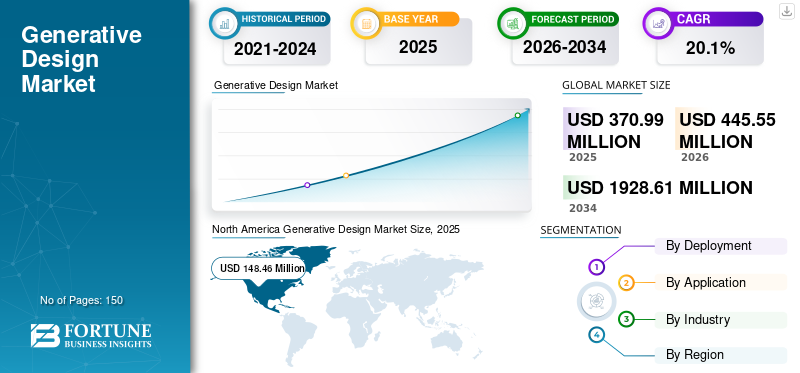
Download Free sample to learn more about this report.
Generative Design Market Key Takeaways
 Global Market Size & Forecast
- 2025 Market Size: USD 370.99 million
- 2026 Market Size: USD 445.55 million
- 2034 Forecast Market Size: USD 1,928.61 million
- CAGR: 20.10% from 2026–2034
 Market Share
- North America dominated the generative design market with a 40.02% share in 2025.
- The on-premise segment held the largest market share in 2025.
- The topology optimization & 3D printing segment accounted for the leading market share in 2025.
 Key Regional Highlights
North America
North America dominated the market with a value of USD 148.46 million in 2025 and USD 178.30 million in 2026.
Asia Pacific
Asia Pacific is expected to record the highest CAGR during the forecast period, driven by Industry 4.0 adoption and rapid urbanization.
Europe
Europe is experiencing strong growth due to increasing use of 3D printing and advanced manufacturing technologies in the automotive sector.
U.S.
Strong investments in AI-powered design tools and engineering software are supporting market growth.
Japan
Rising adoption of smart manufacturing and digital engineering solutions is contributing to market expansion.
Read More

Generative Design Market Trends
Rising Demand for Lightweight Vehicle Products to Enhance Market Growth
The rising demand for lightweight vehicle products has spurred the adoption of generative technology, emerging as a pivotal trend in the global market growth. Weight reduction is crucial for enhancing electric vehicle efficiency, as lighter vehicles require less energy for propulsion, contributing to extended range per charge – an essential factor for consumers evaluating electric vehicles.
Moreover, such design addresses structural integrity, manufacturing constraints, and material properties to create efficient, optimal, and lightweight designs. This technology empowers designers to swiftly explore diverse possibilities, resulting in minimized material usage and improved performance and functionality.
For instance, in March 2021, XponentialWorks partnered with Arcimoto (lightweight and electric fun utility vehicles provider). The joint plan worked with Paramatters’ CogniCAD generative design software to reduce the vehicle weight using lightweighted components. The team reduced the weight of a control arm (upper) by 52%, a rear swing arm by 34%, and a brake pedal by 49%.
Download Free sample to learn more about this report.
Generative Design Market Growth Factors
Rapid Advancements in AI and CAD Technologies to Drive Product Innovation and Enhance Market Growth
The market is driven by swift advancements in AI and CAD technologies, enabling engineers and designers to efficiently explore a multitude of design options. The burgeoning demand for energy-efficient, lightweight, and cost-effective products, particularly in the automotive and aerospace industries, propels the adoption of such designs. Moreover, these designs hasten the product development process and enhance overall efficiency. The increasing applications of such designs in architecture, additive manufacturing, and simulation-driven design also play a pivotal role in the market growth.
The market is further driven by the escalating demand for advanced manufacturing featuring intricate designs, pushing automotive manufacturers to intensify R&D investments and embrace generative techniques.
For instance, in August 2023, Toyota pioneered a generative AI technique to integrate engineering parameters into initial design sketches. Similarly, in June 2023, Mercedes-Benz showcased a voice assistant powered by ChatGPT.
Various players in the automotive industry are exploring this technology to expedite iterations and enhance outcomes.
RESTRAINING FACTORS
Lack of Interoperability with Other Software and Legacy Systems to Impede Market Growth
A potential obstacle to market growth is the presence of interoperability issues with other software and legacy systems. The difficulty in sharing information among stakeholders is increased by the lack of interoperability, leading to potential errors. Traditionally, information exchange relied on drawings and documents. However, the evolution of requirements, such as 2D or 3D CAD, has increased the reliance on digital solutions, such as Building Information Modeling (BIM), for efficient information sharing. The use of diverse tools by project managers for data collection, design, and analysis compounds the challenge of interoperability for design vendors in the market. Also, end-use industries exhibit hesitancy in adopting the software due to the necessity for a comprehensive infrastructure overhaul, posing a potential obstacle to market growth. These factors are expected to curtail the global generative design market growth.
Generative Design Market Segmentation Analysis
By Deployment Analysis
On Premise Segment’s Growth is Driven by its Increasing Popularity Among Large Enterprises
Based on deployment, the market is divided into on premise and cloud.
The on premise segment holds the highest share of the market owing to its popularity among large enterprises. Organizations with established IT infrastructures find deploying these solutions on premise more practical and cost-effective, allowing better integration with existing systems.
However, the cloud segment is expected to grow with the highest CAGR over the forecast period. It provides accessibility, allowing users to utilize design tools from various locations, promoting collaboration and flexibility.
By Application Analysis
Topology Optimization & 3D Printing Segment Takes the Lead Owing to Its Ability to Minimize Material Usage
Based on application, the market is studied among topology optimization & 3D printing, lightweighting, thermal management, and others.
The topology optimization & 3D printing segment holds the largest global generative design market share owing to its ability to systematically determine the optimal distribution of material within a given design space. For instance, in August 2022, Carbon acquired ParaMatters to add new topology optimization features to its 3D printing software.
However, the lightweighting segment is predicted to hold the highest CAGR over the forecast period owing to the increasing emphasis on energy efficiency and sustainability across various industries. The thermal management segment is forecast to represent 16% of total market share in 2026.
To know how our report can help streamline your business, Speak to Analyst
By Industry Analysis
Growing Need for Complex and Lightweight Structures Drives the Industrial Manufacturing Segment Growth
The market is studied across many industries, including automotive, aerospace & defense, architecture & construction, industrial manufacturing, and others.
The industrial manufacturing segment holds the highest share of the global market. Generative technology is particularly valuable in industrial manufacturing for creating complex and lightweight structures that meet stringent performance requirements. For instance, in June 2022, Altair acquired additive manufacturing software firm Gen3D to expand its additive manufacturing design capabilities.
However, the automotive segment is expected to grow with the fastest CAGR over the forecast period. The demand for generative design in advanced manufacturing processes and the need to enhance automotive performance drive the adoption of such design in the industry.
REGIONAL Analysis
We have studied the market across North America, South America, Europe, Asia Pacific, and the Middle East & Africa.
North America
North America Generative Design Market Size, 2025 (USD Million)
To get more information on the regional analysis of this market, Download Free sample
North America dominated the market with a valuation of USD 148.46 billion in 2025 and USD 178.3 billion in 2026. North America holds the highest market size owing to the mature ecosystem of the region. The region has a robust presence of key technology players who foster innovation and technological advancements. Industries in the region, particularly aerospace, automotive, manufacturing, and construction, emphasize continuous improvement and advanced technologies, making them market growth drivers. Additionally, the region’s strong investment in cutting-edge technologies further propels the market. For instance, in May 2023, KPMG LLP declared an initiative to deploy a set of generative artificial intelligence investments to empower its workforce and further improve cutting-edge client solutions.
To know how our report can help streamline your business, Speak to Analyst
Asia Pacific
Asia Pacific is expected to grow with the highest CAGR over the forecast period. The region is witnessing rapid urbanization with Industry 4.0 strategies, leading to increased adoption of generative design solutions across various industries. Also, key players in the region are acquiring and partnering with similar businesses to set footprints in the global market. For instance, in March 2022, Obayashi Corporation partnered with SRI International to develop AiCorb. It is an AI technology that proposes various designs, from hand-sketched drawings to 3D models.
Europe
The market in Europe is driven by factors, such as the region’s emphasis on advanced manufacturing and engineering practices. The European automotive sector has gained prominence on the global stage within the automobile industry. Significant multinational car Original Equipment Manufacturers (OEMs) are driving the widespread adoption of 3D printing technology for design formulation and R&D applications in the automotive industry. Renowned automakers, such as Mercedes-Benz, Audi, BMW, Jaguar, Land Rover, Volkswagen, and others, have collectively established a sustainable market for 3D printing and related technologies in Europe.
Similarly, the Middle East & Africa, and South America are expected to grow potentially in the coming years. In November 2023, University of Johannesburg (UJ) students secured a Gold DMA Assegai award for AI-incorporated MaXhosa X Nike strategy. Students produced a data-driven strategy for a South African brand, MaXhosa Africa, using generative AI for their creative prototypes.
List of Key Companies in Generative Design Market
Collaborations & Partnerships among Vendors to Propel Market Growth
Key players in the market are collaborating and integrating with similar companies to bring significant financial gains to both parties. Partnerships aid businesses in increasing sales and cutting down costs by sharing or combining resources. For instance,
- November 2022: NX Filtration and Transcend collaborated to highlight the benefits of direct nanofiltration membranes using generative design software. The partnership between NX Filtration (a provider of breakthrough direct nanofiltration membrane technology) and Transcend (a provider of generative design SaaS tools) aids in bringing NX Filtration’s projection tool online via the Transcend platform.
List of Key Companies Profiled:
- PTC (U.S.)
- Dassault Systemes (France)
- Autodesk Inc. (U.S.)
- Siemens (Germany)
- ANSYS, Inc. (U.S.)
- nTopology Inc. (U.S.)
- Hexagon AB (Sweden)
- Altair Engineering Inc. (U.S.)
- Carbon, Inc. (U.S.)
- Synera GmbH (Germany)
KEY INDUSTRY DEVELOPMENTS:
- November 2023: Autodesk, Inc. launched Autodesk AI to remove non-productive work across the industries dealing with design. It provides generative and intelligent assistance capabilities and is available in the Design and Make Platform. Furthermore, it allows customers to discover freely while producing accurate, innovative, and precise results.
- November 2023: Cognitive Design Systems (a manufacturer of 3D models) secured USD 2.2 million in funding. The funds accumulated will aid in the hi-tech development of CDS’s platform. Additionally, the company planned to expand its salesforce and geographic footprint in the U.S. and Europe.
- October 2023: Altair launched Altair HyperWorks to enhance its design and simulation platform. It is a comprehensive, versatile, and open CAE platform that aids in transforming technology, offering an integrated solution to streamline workflow, enable innovation, and enhance user experiences.
- April 2023: Cadence Design Systems, Inc. launched Cadence Allegro X AI. It is a system design AI technology offering revolutionary improvements in automation and performance. The product can be accessed through the Allegro X Design Platform and delivers an improved timeframe for PCB design.
- February 2023: Hexagon AB launched a Design for Additive Manufacturing module with its Nexus Open Cloud platform. This enabled customers to utilize the Nexus browser interface to unite Simufact Additive process simulation software and Hexagon's MSC Apex Generative Design with AM Studio via the cloud.
REPORT COVERAGE
The generative design market report research provides a detailed analysis of the market and focuses on key aspects such as leading companies, product/service types, and leading applications of the product. Besides, the report offers insights into key market trends and highlights industry developments. In addition to the factors above, the report encompasses several factors that contributed to the growth of the market in recent years.
Request for Customization to gain extensive market insights.
Report Scope & Segmentation
|
ATTRIBUTE |
DETAILS |
|
Study Period |
2021-2034 |
|
Base Year |
2025 |
|
Estimated Year |
2026 |
|
Forecast Period |
2026-2034 |
|
Historical Period |
2021-2024 |
|
Growth Rate |
CAGR of 20.1% from 2026 to 2034 |
|
Unit |
Value (USD Million) |
|
Segmentation |
By Deployment
By Application
By Industry
By Region
|
Frequently Asked Questions
The market is projected to reach USD 1928.61 million by 2034.
In 2025, the market was valued at USD 370.99 million.
The market is projected to grow at a CAGR of 20.1% during the forecast period.
Topology optimization & 3D printing is the leading application in the market.
The rapid advancements in AI and CAD technologies drive product innovation and enhance market growth.
The top players are PTC, Dassault Systemes, Autodesk Inc., Siemens, ANSYS, Inc., nTopology Inc., Hexagon AB, Altair Engineering Inc., Carbon, Inc., and Synera GmbH.
North America holds the highest market share.
By industry, automotive is expected to grow with the highest CAGR during the forecast period.



- 2021-2034
- 2025
- 2021-2024
- 150
Get 30-60 hrs Free Customization
Expand Regional and Country Coverage, Segments Analysis, Company Profiles, Competitive Benchmarking, and End-user Insights.




















Related Reports
-
US +1 833 909 2966 ( Toll Free )
-
Get In Touch With Us