Home Fitness Equipment Market Size, Share & Industry Analysis, By Type (Cardiovascular Training Equipment and Strength Training Equipment), By Sales Channel (Offline and Online), and Regional Forecast, 2026-2034
 Download Free Sample
(Offer valid till 15th Oct 2026)

KEY MARKET INSIGHTS
 Listen to Audio Version
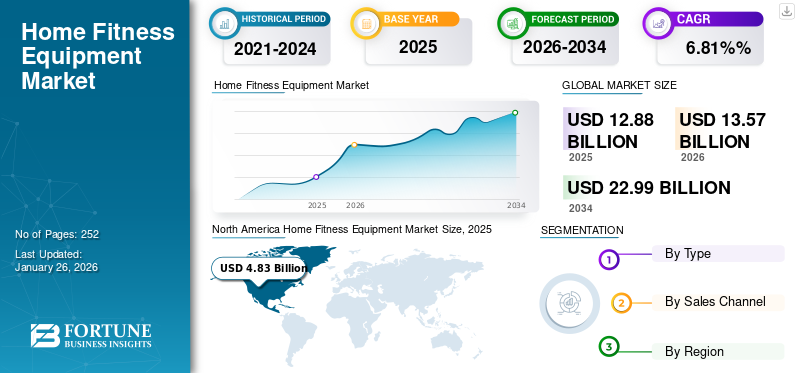
The global home fitness equipment market size was valued at USD 12.88 billion in 2025. The market is projected to grow from USD 13.57 billion in 2026 to USD 22.99 billion by 2034, exhibiting a CAGR of 6.81% during the forecast period. North America dominated the home fitness equipment market with a market share of 37.46% in 2025.
Home fitness equipment are instruments or apparatus designed for exercising at home. They are available in a wide range including cardiovascular equipment, flexibility equipment, and strength training equipment. Numerous individuals globally emphasize adopting healthy habits and being involved in multiple fitness activities, which trigger product sales across countries. Furthermore, various prominent players are operating in the market, including Icon Health & Fitness, Inc., Johnson Health Tech. Co., Ltd., Core Health & Fitness LLC, Technogym S.p.A., and Peloton Interactive, Inc.
Download Free sample to learn more about this report.
Home Fitness Equipment Market Key Takeaways:
 Global Market Size & Forecast
- 2025 Market Size: USD 12.88 Billion
- 2026 Market Size: USD 13.57 Billion
- 2034 Forecast Market Size: USD 22.99 Billion
- CAGR: 6.81% from 2026–2034
 Market Share
- North America dominated the home fitness equipment market with a 37.46% share in 2025.
- The cardiovascular training equipment segment accounted for the largest 58.72% market share in 2026.
- The offline sales channel segment is expected to hold a dominant 64.69% market share in 2026.
 Key Regional Highlights
North America
North America accounted for 37.46% of the global market in 2025, reaching USD 4.83 billion, and is projected to grow to USD 5.11 billion in 2026.
Europe
Europe represented 28.11% of the global market in 2025, generating USD 3.62 billion, and is expected to reach USD 3.84 billion in 2026.
Asia Pacific
Asia Pacific captured 19.69% of the global market in 2025, reaching USD 2.54 billion, and is projected to grow to USD 2.66 billion in 2026.
U.S.
The market is projected to reach USD 4.32 billion by 2026, driven by rising adoption of home gym equipment and growing health awareness.
Japan
The market is projected to reach USD 0.87 billion by 2026, supported by increasing demand for at-home fitness solutions and digital workout programs.
Read More

MARKET DYNAMICS
Market Drivers
High Obesity Rate to Drive Product Sales
The high prevalence of obesity throughout countries boosts adoption of home fitness equipment as obese individuals focus on losing weight by using home fitness equipment. For instance, according to the data presented by the Trust for America’s Health Organization (TFAH), a U.S based non-profit organization, as of 2020, 39.10% of the West Virginia U.S. adults suffered from obesity issues, followed by 39.00% in Alabama, 37.90% in Mississippi, and 24.20% in Colorado states. The growing knowledge regarding the health advantages of maintaining the body through workout routines further accelerates product sales. In addition, individuals with work-from-home options prefer to have gym facilities at home. Furthermore, key players emphasize acquiring other potential companies to expand their global home fitness equipment market share. For instance, in June 2021, Cult. Fit, an India-based fitness and health company, acquired Treatfit Technologies Pvt Ltd., a Bengaluru, India-based home exercise equipment manufacturer, to enter the fitness equipment business.
Increasing Consumers’ Inclination Toward Smart Fitness Equipment to Drive Market Growth
Market players are focusing on introducing various innovative home fitness instruments, such as treadmills, ab rollers, and others globally. For instance, in September 2020, Peloton Interactive Inc., a U.S.-based fitness equipment manufacturer, introduced a smart home gym line-up, including a premium-quality stationary bike and a treadmill. Peloton bike comprises a 23.8" rotating and HD resolution touchscreen display. Home fitness equipment with advanced capabilities appeals to numerous health-conscious individuals. Smart fitness equipment also includes other interactive features, such as touchscreens, virtual coaching, and real-time feedback. These features make workouts more engaging and motivating.
In addition, rising consumer preferences for IoT-based fitness equipment will lead to market expansion in coming years. Moreover, advanced smart equipment can customize workout plans based on individual fitness goals and preferences, offering a more tailored and effective fitness experience. They can monitor a range of health metrics, including heart rate, calories burned, and distance covered. This data assists users in tracking their progress, staying motivated, and surging market growth.
Market Restraints
High Cost of Digital Fitness Equipment to Limit Product Adoption
The high cost of digital fitness equipment and subscription-based fitness courses restrains product demand among the middle and lower-income groups. Therefore, expensive home exercise equipment is less affordable for a significant portion of the population. For instance, according to the data presented by the Global Health & Fitness Association, a U.S-based organization, as of February 2021, ~43% of Californians are earning less than USD 75,000 per year and reported having not been able to exercise at home due to the higher home exercise equipment cost. Easy availability of other products and services that assist in maintaining health and fitness, such as gym memberships, outdoor activities, and wellness centers, also hamper product sales.
Moreover, increasing incidences of injuries due to the improper usage of equipment, such as stationary bikes, treadmills, ropes, and others, coupled with the evolving equipment-free workout trends, is also restraining global home fitness equipment market growth.
Home Fitness Equipment Market Trends
Escalating Demand for Sustainable Products to Boost Market Growth
The increasing demand for sustainable products is positively impacting the growth of the home exercise equipment market. Numerous consumers prioritize sustainability and environmental responsibility in their purchasing decisions. By offering eco-friendly fitness equipment, manufacturers can attract these consumers, thereby expanding their market base. In addition, younger generations, particularly Millennials and Gen Z, are more environmentally conscious and inclined toward sustainable products. Therefore, catering to their preferences can drive market growth significantly, as these demographics make up a significant portion of the consumer fitness equipment market.
Industry participants that prioritize eco-friendly materials and sustainable production processes can also differentiate themselves from competitors. Moreover, consumers who value sustainability are more likely to remain loyal to companies that align with their values. This can lead to repeat purchases and positive referrals, enhancing long-term market growth.
Download Free sample to learn more about this report.
Impact of COVID-19
The COVID-19 pandemic positively influenced the expansion of the global home fitness instruments market owing to the provisional closure of gyms and fitness centers throughout countries in 2020, which resulted in numerous individuals exercising and working at home, increasing demand for home exercise equipment. Even after the opening of these facilities in 2021, several consumers prevented them due to the risk of virus and cleanliness issues. Moreover, increased awareness regarding the significance of fitness accelerated product sales during the pandemic.
SEGMENTATION ANALYSIS
By Type
Cardiovascular Training Equipment Segment Led the Market Due to Increasing Awareness Regarding Their Benefits
Based on type, the global market is divided into cardiovascular training equipment and strength training equipment. The cardiovascular training equipment segment dominated the market in 2026 with 58.72%. Cardiovascular training assists individuals in maintaining their sugar and blood pressure levels and improving cardiovascular health. Moreover, the increasing prevalence of cardiovascular diseases and growing awareness of the health benefits of cardio training among adults drive the segment’s growth. For instance, according to the American Heart Association, Inc., a U.S.-based non-profit organization, from 2011 to 2021, the annual death rate due to coronary heart disease (CHD) in the U.S. increased by 0.05%. In 2021, CHD caused 375,476 deaths in the U.S.
The strength training equipment segment will grow at the highest CAGR in the coming years. High consumers' focus on muscle-building and strength-enhancing activities drives demand for muscle-building equipment, such as dumbbells, barbells, and free weights. For instance, according to the U.S. Centers for Disease Control and Prevention, a U.S.-based government agency, in 2021, 31% of U.S. adults performed at least two muscle-building workouts in a week.
To know how our report can help streamline your business, Speak to Analyst
By Sales Channel
Sales Representatives & After Sales Support to Boost Offline Segment’s Expansion
Based on sales channel, the global market is bifurcated into online and offline. The offline segment is expected to hold the largest market share 64.69% in 2026. Consumers can better understand the features and functionalities of the fitness equipment from the sales representatives at offline stores. Specialty shop salespeople can also better suggest products based on customers' fitness goals. In addition, the provision of after-sales support, including repairing and maintenance of fitness equipment by offline stores, positively influences the segment’s growth.
The online segment will grow at a higher rate of 3.02%, backed by the rising adoption of online shopping for fitness products. Numerous companies also prefer selling fitness equipment from e-commerce platforms to avoid making heavy investments in developing physical retail outlets, increasing segmental growth.
Home Fitness Equipment Market Regional Outlook
Geographically, the global market is segmented into North America, Europe, Asia Pacific, South America, and Middle East & Africa.
North America
North America Home Fitness Equipment Market Size, 2025 (USD Billion)
To get more information on the regional analysis of this market, Download Free sample
The North America region captured 37.46% of the global market in 2025, generating USD 4.83 billion in revenue, and is projected to reach USD 5.11 billion in 2026, driven by the growing consumer awareness regarding the benefits of various fitness equipment, such as treadmills, dumbbells, and stationary bikes. Consistent BODYCRAFT, LIFE FITNESS, and other North American fitness equipment manufacturers' emphasis on offering innovative technology-based fitness equipment further positively influences North America’s market growth. In addition, gym settings and fitness equipment manufacturers are collaboratively introducing body workout-related campaigns to spread awareness regarding the health benefits of physical activity routines in the region The U.S. market is projected to reach USD 4.32 billion by 2026.
The rising residential infrastructural facilities increase the consumer demand for home gym facilities, driving fitness equipment sales in the U.S. The U.S. home fitness equipment’s market size is anticipated to hit USD 4.07 billion in 2025. For instance, according to the U.S. Census Bureau, a government agency providing data regarding the American economy, in 2021, U.S. residential construction spending reached USD 774.9 billion, 23.2% up over the previous year.
Europe
Europe maintained a strong presence in the global market, reaching USD 3.62 billion in 2025, accounting for 28.11% share, and is expected to reach USD 3.84 billion in 2026. Manufacturers across Europe are introducing innovative features and services, such as touchscreen display-based workout machines, virtual training sessions, interactive workout programs, and fitness tracking capabilities to offer a holistic fitness training solution to consumers. The market size of U.K. is anticipated to hit USD 1.02 billion in 2025, followed by Germany and France to hit USD 0.93 billion and USD 0.51 billion in 2025 respectively. Furthermore, increasing emphasis on a healthy lifestyle, awareness about the benefits of home workouts and consumer preference for advanced technology-based fitness training solutions accelerate European market growth. Increasing environmental consciousness and manufacturers' focus on producing fitness equipment from sustainable materials that reduce energy consumption also favors regional expansion. The UK market is projected to reach USD 1.08 billion by 2026, and the Germany market is projected to reach USD 1.00 billion by 2026.
Asia Pacific
In 2025, Asia Pacific generated USD 2.54 billion, contributing 19.69% to global market revenue, and is projected to grow to USD 2.66 billion in 2026. The rising number of customers enrolling in at-home fitness training courses increases the demand for home fitness instruments across China, Japan, and South Korea. In addition, factors, such as rising health concerns, an increasing number of fitness-related content creators, and shifting middle-income households' preference toward having an at-home gym facility drive regional growth. China, India, and Japan will reach a market size of USD 0.64 billion, USD 0.24 billion, and USD 0.83 billion respectively in 2025. Numerous manufacturers in the region also focus on expanding their product portfolio to increase product availability to customers. The Japan market is projected to reach USD 0.87 billion by 2026, the China market is projected to reach USD 0.67 billion by 2026
South America
The South America market was valued at USD 1.3 billion in 2025, capturing 10.07% of global revenue, and is estimated to reach USD 1.34 billion in 2026. The increasing number of middle-income households and their spending on fitness products drives South America’s market. Awareness regarding the health benefits of cardio and strength training workouts is increasing among youngsters in the region. Furthermore, demand for weight-loss machines among obese adults is rising due to high obesity rates in Chile, Brazil, and Argentina. For instance, according to the World Obesity Federation’s Global Obesity Observatory report, adult obesity rates in Brazil, Chile, and Argentina reached 25.05%, 34.10%, and 35.53%, respectively, in 2022.
Middle East & Africa
Middle East & Africa recorded a market size of USD 0.6 billion in 2025, capturing 4.67% of the global market share, and is projected to reach USD 0.61 billion in 2026. Rising residential infrastructural facilities in Egypt, Algeria, and Nigeria drive the demand for products. The UAE market will push the region’s growth with a projected market valuation of USD 0.08 billion in 2025. According to the Housing Finance Africa Organization, the total number of housing units provided by the private and public sector operators in Egypt reached 336,300 units in 2020-2021, a 73.1% increase over the previous year. Furthermore, the growing eco-consciousness of Middle Eastern consumers and manufacturers’ preference toward producing fitness equipment from recycled plastic materials effectively contributes to the sustainability development of the Middle Eastern market.
COMPETITIVE LANDSCAPE
Key Industry Players
Focus on Innovative Features and Partnerships to Enhance Growth
The global home exercise equipment market includes numerous manufacturers and retailers across countries, emphasizing expanding their product portfolio, distribution channel, retail presence, and production capacity to increase market share. Developing home exercise equipment with multiple innovative and technologically advanced features that enhance user experience will assist companies in accelerating product sales. In addition, collaboration and partnership with other prominent industry participants will provide lucrative growth opportunities. Understanding regional insights also allows brands to align their products with evolving consumer demands across specific domestic markets.
Major Players in the Global Home Fitness Equipment Market
To know how our report can help streamline your business, Speak to Analyst
Icon Health & Fitness, Inc., Johnson Health Tech. Co., Ltd., Core Health & Fitness LLC, Technogym S.p.A., and Peloton Interactive, Inc. are the prominent players in the market. The market is fragmented, with the top 5 players accounting for around 52.80% of the market share.
List of Key Home Fitness Equipment Companies Profiled:
- Johnson Health Tech. Co., Ltd. (Taiwan)
- Core Health & Fitness LLC (U.S)
- Technogym S.p.A. (Italy)
- Peloton Interactive, Inc. (U.S)
- Fitness World (India)
- Hoist Fitness Systems (U.S)
- Hammer Sport AG (Germany)
- Rogue Fitness (U.S)
- Force USA (U.S)
- Inspire Fitness (U.S)
- Icon health fitness (U.S)
KEY INDUSTRY DEVELOPMENTS:
- August 2023: Technogym SpA, an Italy-based sports equipment manufacturer, launched Technogym Run, a seat-belt technology-based home treadmill, in its Technogym Dubai boutique and experience center.
- June 2023: Speediance, a Shenzhen Speediance Life Technology Co., Ltd.-owned brand, launched Speediance Gym Pal, an innovative strength training machine in the U.S. home fitness products market. The product is equipped with smart features, enabling consumers to track their workout progress and access strength-related information.
- May 2020: Peloton Interactive Inc., a U.S.-based fitness equipment manufacturer, reported a 66% jump in its third-quarter online sales from home fitness equipment.
- September 2021: Hy-Vee, Inc., a U.S.-based supermarket chain, partnered with Johnson Wellness & Fitness, a U.S.-based fitness retailer, to open a new fitness equipment showroom in the U.S. The company supplies various residential and commercial fitness equipment, such as treadmills, ellipticals, and exercise bikes.
- April 2021: Peloton Interactive Inc., a U.S.-based fitness equipment manufacturer, finalized the acquisition of Precor Incorporated, a U.S.-based gym equipment brand, to increase its product portfolio and build its U.S. home and commercial fitness equipment industry position.
Investment Analysis and Opportunities
The report provides comprehensive investment analysis and opportunities in the global market to provide investors and business leaders with actionable insights. The report also highlights potential investment opportunities, including innovations, technology integration, and geographic expansion.
REPORT COVERAGE
The global home fitness equipment market report analyzes the market in-depth and highlights crucial aspects such as prominent companies, types, and sales channels analysis. Besides this, the research report also provides insights into the market and highlights significant industry developments.
Request for Customization to gain extensive market insights.
Report Scope & Segmentation
|
ATTRIBUTE |
DETAILS |
|
Study Period |
2021-2034 |
|
Base Year |
2025 |
|
Estimated Year |
2026 |
|
Forecast Period |
2026-2034 |
|
Historical Period |
2021-2024 |
|
Growth Rate |
CAGR of 6.81% from 2026 to 2034 |
|
Unit |
Value (USD billion) |
|
Segmentation |
By Type
|
|
By Sales Channel
|
|
|
By Region
|
Frequently Asked Questions
Fortune Business Insights says that the global market was USD 13.57 billion in 2026 and is anticipated to reach USD 22.99 billion by 2034.
Ascending at a CAGR of 6.81%, the global market will exhibit steady growth over the forecast period (2026-2034).
By type, the cardiovascular training equipment segment is expected to dominate the market throughout the forecast period (2026-2034).
High obesity rate is a key factor driving the global market.
Icon Health & Fitness, Inc., Johnson Health Tech. Co., Ltd., Core Health & Fitness LLC, Technogym S.p.A., and Peloton Interactive, Inc. are the leading companies in the market.



- 2021-2034
- 2025
- 2021-2024
- 252
-
(Offer valid till 15th Oct 2026)
Get 30-60 hrs Free Customization
Expand Regional and Country Coverage, Segments Analysis, Company Profiles, Competitive Benchmarking, and End-user Insights.



















Related Reports
-
US +1 833 909 2966 ( Toll Free )
-
Get In Touch With Us