Patient Monitoring Devices Market Size, Share & Industry Analysis, By Product Type (Cardiac Monitoring Devices [ECG Devices, Holter Monitors, & Others], Respiratory Monitoring Devices [Capnography Monitors, Pulse Oximeters, & Others], Neurological Monitoring Devices [EEG Monitors, Cerebral Oximeters, & Others], Blood Glucose Monitoring Devices, [Continuous Glucose Monitoring Systems & SMBG Systems] & Others), By Modality (Portable and Tabletop), By Age Group (Adults & Pediatrics), By End User (Hospitals & ASCs, Specialty Clinics, Homecare Settings, & Others), and Regional Forecast, 2026-2034
 Download Free Sample
Patient Monitoring Devices Market Overview
 Listen to Audio Version
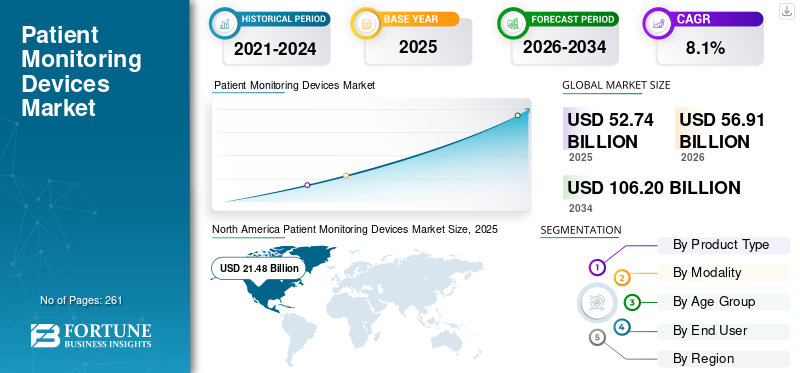
The global patient monitoring devices market size was valued at USD 52.74 billion in 2025 and is projected to grow from USD 56.91 billion in 2026 to USD 106.20 billion by 2034, exhibiting a CAGR of 8.1% during the forecast period. North America dominated the patient monitoring devices market with a market share of 40.73% in 2025.
Patient monitoring devices are medical equipment that continuously measure and display vital signs and health safety among the patient population. The growing prevalence of chronic disorders, increasing number of patient admissions, advancements in connected healthcare technologies, growing demand for remote patient monitoring, and the expansion of healthcare infrastructure are driving the adoption and demand for patient monitoring devices, including pulse oximeters and holter monitors. The growing aging population is further increasing the demand for patient monitoring devices, including EEG devices and others in the market.
- For instance, according to the 2023 data published by the American Lung Association, approximately 11.1 million adults are living with COPD in the U.S.
The rising focus on connected devices, AI integration, and patient-centric healthcare solutions among major players, including Medtronic and GE Healthcare, is further contributing to the demand for these devices.
Download Free sample to learn more about this report.
Patient Monitoring Devices Market Key Takeaways
 Global Market Size & Forecast
- 2025 Market Size: USD 52.74 billion
- 2026 Market Size: USD 56.91 billion
- 2034 Forecast Market Size: USD 106.20 billion
- CAGR: 8.1% from 2026–2034
 Market Share
- North America dominated the patient monitoring devices market with a 40.73% share in 2025.
- Blood glucose monitoring devices held the largest product type segment share in 2025.
- Portable devices dominated the modality segment in 2025.
 Key Regional Highlights
North America
North America reached USD 21.48 billion in 2025 and maintained the largest regional market share.
Europe
Europe is projected to reach USD 15.15 billion in 2026, growing at a 7.7% CAGR during the forecast period.
Asia Pacific was valued at USD 134.05 million in 2025 and is projected to grow at the fastest 8.48% CAGR through 2034.
Asia Pacific is expected to reach USD 13.55 billion in 2026, ranking as the third-largest regional market.
U.S.
The market is projected to reach USD 20.46 billion in 2026, accounting for approximately 36.0% of global sales.
Japan
The market is estimated to reach USD 2.97 billion in 2026, representing approximately 5.2% of global revenues
Read More

Patient Monitoring Devices Market Trends
Incorporation of Artificial Intelligence and Predictive Analytics to Boost Industry Expansion
The incorporation of artificial intelligence and predictive analytics is emerging as a key trend in the market. Artificial intelligence-enabled monitoring systems are shifting healthcare providers from reactive monitoring to predictive and preventive care.
AI algorithms analyze continuous data from wearable sensors, bedside monitors, remote patient monitoring devices, and electronic health records to detect abnormal patterns and predict patient health deterioration, making these systems increasingly important in general wards, ICUs, emergency departments, and home-based chronic disease management. Predictive analytics is helping in improving clinical decision-making, early warning scores, reducing avoidable ICU transfers, improving response time, and assisting clinicians in prioritizing high-risk patients. Additionally, the rising adoption of wearable monitoring systems, cloud-based platforms, IoT-enabled sensors, and remote patient monitoring devices is driving increased R&D activities among key companies to develop and introduce novel devices to the market.
- For instance, in April 2025, BD, a global medical technology company, launched a new advanced hemodynamic monitoring platform with predictive, artificial intelligence (AI) based algorithms that can help clinicians proactively address blood pressure instability and optimize blood flow to help avoid potential life-threatening situations during procedures.
Other Prominent Trends
- Expansion of Remote Patient Monitoring Platforms
Market Dynamics
Market Drivers
Download Free sample to learn more about this report.
Increasing Prevalence of Chronic Conditions to Drive Market Growth
The increasing prevalence of chronic diseases, including cardiovascular disorders and diabetes, is resulting in a growing number of patient admissions in healthcare settings, consequently boosting demand for these products.
- For instance, according to 2024 statistics published by the Centers for Disease Control & Prevention (CDC), approximately 1 in 20 adults were living with coronary artery disease in the U.S.
This, along with a growing aging population, rising healthcare expenditure, the expansion of telehealth and remote care services, and the growing adoption of digital monitoring devices, is further fueling the adoption rate of this equipment in the market. Therefore, these factors, along with the growing focus of key players on introducing R&D activities to launch novel devices, are anticipated to drive the adoption of these products, thereby supporting the global patient monitoring devices market growth.
Market Restraints
High Cost Associated with Advanced Devices to Hinder Market Growth
The high cost of advanced multi-parameter equipment, wearable sensors, and portable monitoring platforms is a major restraint on the global market. Advanced monitoring devices include SpO₂, ECG, temperature, capnography, non-invasive blood pressure, AI-based alerts, and other capabilities. These advancements increase the overall cost associated with procurement, software licensing, installation, maintenance, training, and data integration.
Moreover, remote patient monitoring programs require software platforms, connected devices, patient onboarding, and clinician workflow integration, which further add to the financial burden. The cost burden, along with limited reimbursement policies, makes adoption challenging for ambulatory surgical centers, small hospitals, specialty clinics, and healthcare providers in emerging countries.
- For instance, according to the 2024 statistics published by the Centers for Medicare & Medicaid Services (CMS), out-of-pocket healthcare spending reached USD 556.6 billion in the U.S.
Market Opportunities
Growing Number of Ambulatory Surgical Centers (ASCs) to Boost Industry Growth
There is an ongoing expansion of healthcare facilities in developing countries, including Brazil, Mexico, and others. Rising patient admissions, growing healthcare expenditure, increasing number of ambulatory surgical centers (ASCs) are consequently boosting the adoption of patient monitoring devices in clinical facilities. The preference for ambulatory care centers has increased owing to their advantages, including lower procedural costs, shorter patient stays, faster turnover times, and limited risk of hospital-acquired infections.
- According to 2025 data published by Definitive Healthcare, there were about 10,000 active ambulatory surgical centers in the U.S.
Market Challenges
Limited Healthcare Access in Developing Nations to Hamper Market Growth
There is a growing demand for patient monitoring systems among the patient population. However, limited access to technologically advanced devices, limited healthcare expenditure, along with an inadequate reimbursement framework, especially in emerging countries, are restricting access to healthcare settings.
Moreover, a limited number of healthcare settings, limited healthcare professionals, data privacy and cybersecurity concerns, integration challenges with healthcare IT systems, and stringent regulatory requirements are some of the major factors contributing to delayed patient admissions among the patient population, especially in emerging countries, including India and China.
- For instance, according to 2023 data published by The World Bank Group (WBG), approximately 4.5 billion people lack full access to essential health services.
SEGMENTATION ANALYSIS
By Product Type
New Product Launches and Regulatory Approvals Boosted the Blood Glucose Monitoring Devices Segment Growth
Based on product type, the market is classified into cardiac monitoring devices, respiratory monitoring devices, neurological monitoring devices, blood glucose monitoring devices, and others. Cardiac monitoring devices are classified into ECG devices, holter monitors, and others. Respiratory monitoring devices are divided into capnography monitors, pulse oximeters, and others. Neurological monitoring devices are divided into EEG monitors, cerebral oximeters, and others. Blood glucose monitoring devices are divided into continuous glucose monitoring systems and self-monitoring blood glucose (SMBG) systems.
In terms of revenue, the blood glucose monitoring devices segment held the largest share in 2025. The growth is due to the rising number of patient admissions globally, resulting in a growing emphasis by key companies on launching blood pressure monitors, which is anticipated to contribute to the segment’s growth.
- For instance, in September 2024, Senseonics Holdings, Inc., and Ascensia Diabetes Care, a global diabetes care company, received FDA approval for the next-generation Eversense 365 CGM system for people with Type 1 and Type 2 diabetes aged 18 years and older.
To know how our report can help streamline your business, Speak to Analyst
The cardiac monitoring devices segment is expected to grow at a CAGR of 7.5% over the forecast period.
By Modality
Increasing Product Launches Led to the Dominance of the Portable Segment
Based on modality, the market is segmented into portable and tabletop.
The portable segment dominated the global market in 2025. The growth is due to the increasing advantages of home care settings, including improved patient outcomes and others, which are resulting in growing product launches and rising demand for portable devices, thereby contributing to the adoption of these devices in the market.
- For instance, in December 2025, Smart Meter, the company in cellular-enabled remote patient monitoring (RPM) solutions, launched the handheld, fully cellular-enabled thermometer iDigiTemp.
The tabletop segment is set to flourish with a growth rate of 7.7% during the forecast period.
By Age Group
Growing Prevalence of Chronic Disorders Among Adults Led to the Dominance of the Segment
Based on age group, the market is segmented into adults and pediatrics.
The adults segment dominated the global market in 2025. The growth is due to the increasing prevalence of chronic disorders such as diabetes and COPD, resulting in a rising patient pool worldwide, thereby contributing to the adoption rate of this equipment in the market.
- For instance, according to the 2025 data published by the International Diabetes Federation (IDF), 1 in 9 adults aged 20-79 years is living with diabetes globally.
The pediatrics segment is set to flourish with a growth rate of 7.7% during the forecast period.
By End-user
Increasing Number of Patient Pool Encouraged the Hospitals & ASCs Segment Growth
Based on end user, the market is fragmented into hospitals & ASCs, specialty clinics, homecare settings, and others.
The hospitals & ASCs segment dominated the market in 2025. The increasing adoption of technologically advanced patient monitoring devices in hospitals, the increasing number of patients in hospitals and ASCs, and the rising number of hospitals are some of the key factors contributing to the growth of the segment in the market. Furthermore, the segment is set to hold a 52.3% share in 2026.
- For instance, according to 2026 data published by the American Hospital Association (AHA), there are about 6,100 hospitals in the U.S.
The specialty clinics segment is projected to grow at a CAGR of 8.3% during the forecast period.
Patient Monitoring Devices Market Regional Outlook
Based on region, the market has been studied across North America, Europe, Asia Pacific, Latin America, and the Middle East & Africa.
North America
North America Patient Monitoring Devices Market Size, 2025 (USD Billion)
To get more information on the regional analysis of this market, Download Free sample
The North America market held the dominant patient monitoring devices market share in 2024, valued at USD 20.09 billion, and maintained its leading share in 2025 with USD 21.48 billion. The high patient admissions, developed hospital infrastructure, rising healthcare expenditure, and increasing technological advancements in these devices are some of the major factors contributing to the growth of the region in the market.
- For instance, according to 2026 data published by the Centers for Medicare & Medicaid Services (CMS), healthcare spending is about USD 5.3 trillion in the U.S.
U.S. Patient Monitoring Devices Market
Based on North America’s strong contribution and the U.S. dominance within the region, the U.S. market is expected to reach around USD 20.46 billion in 2026, accounting for roughly 36.0% of global sales.
Europe
Europe is projected to record a growth rate of 7.7% during the forecast period, which is the second-highest among all regions. The market is expected to reach a valuation of USD 15.15 billion in 2026. The growing prevalence of chronic conditions and the rising adoption rate of the product are likely to support market growth.
U.K. Patient Monitoring Devices Market
The U.K.’s market in 2026 is estimated to reach around USD 2.56 billion, representing roughly 4.5% of global revenues.
Germany Patient Monitoring Devices Market
Germany’s market is projected to reach approximately USD 2.80 billion in 2026, equivalent to around 4.9% of global sales.
Asia Pacific
Asia Pacific is estimated to reach USD 13.55 billion in 2026 and secure the position of the third-largest region in the market. Growth in patient admissions, expanding hospital capacity, and rising healthcare access are likely to support the growth of the market.
Japan Patient Monitoring Devices Market
The Japanese market is estimated to touch around USD 2.97 billion in 2026, accounting for roughly 5.2% of global revenues. Japan has historically reported a relatively high prevalence of chronic diseases, with high demand for remote patient monitoring devices globally.
China Patient Monitoring Devices Market
China’s market is projected to be one of the largest worldwide, with 2026 revenues standing at around USD 4.61 billion, representing roughly 8.1% of global sales.
India Patient Monitoring Devices Market
The Indian market is estimated to reach around USD 2.17 billion in 2026, accounting for roughly 3.8% of global revenues.
Latin America and Middle East & Africa
The Latin America and Middle East & Africa regions are expected to witness moderate growth in this market during the forecast period. The Latin American market is set to reach a valuation of USD 2.95 billion in 2026. The growth is due to gradual public healthcare investment and increasing demand for wireless monitoring devices in the region. The Middle East & Africa region is also expected to witness considerable growth owing to rising R&D activities among key companies aimed at introducing novel devices in the market. In the Middle East & Africa, the GCC is set to reach USD 1.12 billion in 2026.
South Africa Patient Monitoring Devices Market
The South African market is projected to reach around USD 0.34 billion in 2026, representing roughly 0.6% of global revenues.
Competitive Landscape
Key Industry Players
Increasing Focus on Distribution Agreements Among Companies to Support Their Market Positions
A broad product portfolio, coupled with a robust focus on strategic initiatives globally, is one of the major factors contributing to the dominance of leading companies in the market. Medtronic and GE Healthcare were among the major companies in the market in 2025. Additionally, the rising focus of key companies on distribution agreements with other companies is likely to strengthen companies’ market presence, which is likely to contribute to the global patient monitoring devices market.
- For instance, in May 2025, Medtronic partnered with Corsano Health B.V., a MedTech company specializing in advanced real-time remote patient monitoring devices, to distribute Corsano Health’s cutting-edge solution in Western Europe for hospital and hospital-at-home use.
Other key players, including Koninklijke and Philips N.V., are also expanding their presence in the market, primarily due to their increasing focus on research and development activities to launch, develop, and introduce innovative devices to strengthen their brand presence.
List of Key Patient Monitoring Devices Companies Profiled
- Koninklijke Philips N.V. (Netherlands)
- GE Healthcare (U.S.)
- Medtronic (Ireland)
- Masimo (U.S.)
- NIHON KOHDEN CORPORATION (Japan)
- Drägerwerk AG & Co. KGaA (Germany)
- Baxter (U.S.)
- Shenzhen Mindray Bio-Medical Electronics Co., Ltd. (China)
- OMRON Healthcare, Inc. (Japan)
- Abbott (U.S.)
KEY INDUSTRY DEVELOPMENTS
- April 2026: AliveCor, Inc., the global company in AI-powered cardiology, received CE Mark for the Kardia 12L electrocardiogram (ECG) System powered by KAI 12L AI technology.
- February 2026: Abbott received FDA approval for the CardioMEMS HERO device, a next-generation pulmonary artery (PA) pressure reader to support the care of people living with heart failure. The reader contains advanced features to help empower heart failure patients and their clinicians with the daily insights needed to detect and combat heart failure progression.
- February 2026: Dexcom, Inc., the global company in glucose biosensing, announced the provision of advanced AI-enabled enhancement to Stelo, a CGM that transforms how users understand their glucose health and take steps in achieving their long-term health goals.
- September 2025: Masimo announced a multi-year renewal and expansion of its strategic partnership with Koninklijke Philips N.V. to accelerate the integration of Masimo’s monitoring technologies, including SET pulse oximetry, into a variety of Philips multi-parameter patient monitors.
- June 2025: Koninklijke Philips N.V. expanded its partnership with Medtronic to strengthen access to advanced patient monitoring technologies and deliver high-quality care.
- April 2025: Medtronic partnered with Retia Medical, an innovative digital health company that develops advanced hemodynamic solutions, to distribute the Argos cardiac output monitor.
- April 2025: DexCom, Inc., the global company in glucose biosensing, received FDA approval for Dexcom G7 15 Day Continuous Glucose Monitoring System for people over the age of 18 with diabetes in the U.S.
REPORT COVERAGE
The report provides a detailed global patient monitoring devices market analysis and focuses on key aspects such as leading companies and market segmentation, including product type, modality, age group, and end user. Besides this, the global report offers insights into the market growth trends and highlights key industry developments. In addition to the aforementioned factors, the report encompasses several factors that have contributed to the growth and advancement of the market over recent years.
Request for Customization to gain extensive market insights.
Report Scope & Segmentation
| ATTRIBUTE | DETAILS |
| Study Period | 2021-2034 |
| Base Year | 2025 |
| Estimated Year | 2026 |
| Forecast Period | 2026-2034 |
| Historical Period | 2021-2024 |
| Growth Rate | CAGR of 8.1% from 2026 to 2034 |
| Unit | Value (USD Billion) |
| Segmentation | By Product Type, Modality, Age Group, End User, and Region |
| By Product Type |
|
| By Modality |
|
| By Age Group |
|
| By End User |
|
| By Region |
|
Frequently Asked Questions
Fortune Business Insights says that the global market size was valued at USD 52.74 billion in 2025 and is projected to reach USD 106.20 billion by 2034.
In 2025, the North America regional market value stood at USD 21.48 billion.
Growing at a CAGR of 8.1%, the market will exhibit steady growth over the forecast period (2026-2034).
By product type, the blood glucose monitoring devices segment led the market.
Increasing prevalence of chronic conditions is the key factor driving the market.
Medtronic and GE Healthcare are the major players in the global market.
North America dominated the market in 2025.
The growing prevalence of chronic diseases, increasing patient admissions, growing introduction of novel devices are some of the key factors anticipated to drive the adoption of these products.



- 2021-2034
- 2025
- 2021-2024
- 261
Get 30-60 hrs Free Customization
Expand Regional and Country Coverage, Segments Analysis, Company Profiles, Competitive Benchmarking, and End-user Insights.













.webp)






Related Reports
-
US +1 833 909 2966 ( Toll Free )
-
Get In Touch With Us