Electroencephalography (EEG) Devices Market Size, Share & Industry Analysis, By Product Type (EEG Systems and EEG Accessories & Consumables), By Application (Epilepsy Diagnosis & Monitoring, Sleep Disorder Diagnosis, Critical Care & Emergency Monitoring, Intraoperative Monitoring, and Others), By End-user (Hospitals & Clinics, Diagnostic Centers & EEG Labs, Academic & Research Institutes, and Others), and Regional Forecast, 2026-2034
 Download Free Sample
Electroencephalography (EEG) Devices Market Size and Future Outlook
 Listen to Audio Version
The global electroencephalography (EEG) devices market size was valued at USD 1.53 billion in 2025 and is projected to grow from USD 1.64 billion in 2026 to USD 3.17 billion by 2034, exhibiting a CAGR of 8.4% during the forecast period. North America dominated the electroencephalography (EEG) devices market with a market share of 33.33% in 2025.
Electroencephalography (EEG) devices are non-invasive diagnostic systems used to record the electrical activity of the brain, primarily for detecting neurological disorders such as epilepsy, brain tumors, sleep disorders, and encephalopathies. The market is witnessing significant growth due to the increasing prevalence of neurological disorders, increasing awareness regarding early diagnosis, and advancements in portable and wearable EEG technologies.
Natus Medical, Inc., Nihon Kohden Corporation, and Compumedics Limited held the highest market share in 2025 due to their strong global distribution and new product launches.
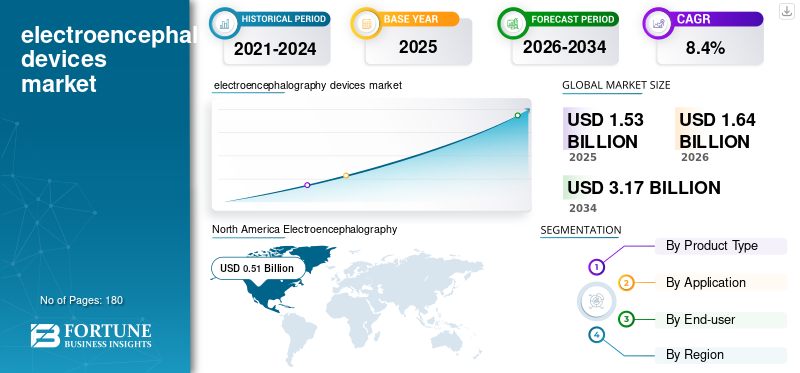
Download Free sample to learn more about this report.
Electroencephalography Devices Market Key Takeaways
 Market Size & Forecast
- 2025 Market Size: USD 1.53 Billion
- 2026 Market Size: USD 1.64 Billion
- 2034 Forecast Market Size: USD 3.17 Billion
- CAGR: 8.40% from 2026–2034
 Market Share
- North America dominated the electroencephalography (EEG) devices market with a 33.33% share in 2025.
- The epilepsy diagnosis & monitoring segment is projected to hold a 41.40% share in 2026.
- The EEG systems segment is projected to grow at a CAGR of 7.50% during the forecast period.
 Key Regional Highlights
Asia Pacific
Asia Pacific is projected to reach USD 0.43 billion in 2026.
North America
North America generated USD 0.51 billion in 2025.
Europe
Europe is projected to reach USD 0.45 billion in 2026, growing at a 7.80% CAGR.
U.S.
The electroencephalography (EEG) devices market is projected to reach USD 0.47 billion in 2026.
Japan
The electroencephalography (EEG) devices market is projected to reach USD 0.12 billion in 2026.
Read More

ELECTROENCEPHALOGRAPHY (EEG) DEVICES MARKET TRENDS
Integration of AI and Cloud-Based EEG Analytics to Emerge as a Key Trend
Currently, there has been an increase in the integration of artificial intelligence (AI) and cloud-based platforms in electroencephalography (EEG) devices. These systems enhance diagnostic accuracy by automating seizure detection and reducing interpretation time. As a result, prominent companies are pursuing strategic initiatives, such as acquisitions and partnerships, to build expertise in EEG systems.
- For instance, in November 2024, Nihon Kohden Corporation acquired a 71.4% stake in NeuroAdvanced Corp., parent of Ad-Tech Medical, to enhance epilepsy diagnostics by integrating its EEG systems with Ad-Tech's specialized intracranial electrodes.
MARKET DYNAMICS
MARKET DRIVERS
Download Free sample to learn more about this report.
Rising Incidence of Neurological Disorders to Fuel Market Expansion
Over the past few years, there have been an increasing number of cases of epilepsy, Alzheimer’s disease, and sleep disorders, and EEG remains a gold standard for diagnosis and monitoring of such diseases, supporting its widespread adoption. Additionally, the growing population of aged individuals, who are more prone to neurological conditions, is further expected to accelerate the demand for EEG diagnostics in both hospital and outpatient settings. This is anticipated to drive the global electroencephalography (EEG) devices market growth.
- For instance, in February 2024, the World Health Organization (WHO) mentioned that an estimated 5.0 million people are diagnosed with epilepsy each year.
MARKET RESTRAINTS
High Cost and Skilled Workforce Requirement to Restrict Market Growth
Despite technological advancements, sophisticated EEG devices with AI integration and high-channel capabilities involve significant capital investment, which is expected to limit adoption in smaller healthcare facilities. Additionally, interpreting EEG data requires specialized neurologists, and the shortage in emerging countries is expected to hinder market expansion.
- For instance, according to LabXNew data from March 2026, EEG and EMG systems typically cost between USD 20,000 and USD 150,000, varying by factors such as channel count, complexity, and extras such as software compatibility or portability.
MARKET OPPORTUNITIES
Growth of Portable and Wearable EEG Devices to Create Significant Growth Opportunities
In recent years, the emergence of portable and wearable EEG devices has enabled continuous monitoring outside traditional clinical settings, supporting telemedicine and home-based care models. Also, the shift toward remote patient monitoring and increasing demand for point-of-care diagnostics are encouraging manufacturers and researchers to develop compact, user-friendly EEG systems.
- For instance, according to the article published by Springer Nature Limited in May 2022, a group of researchers at Sungkyunkwan University created a wireless, earbud-style EEG device. It integrates tattoo-like electrodes and connectors for continuous, high-quality EEG signal recording.
MARKET CHALLENGES
Data Complexity and Standardization Issues to Challenge Market Expansion
EEG data is complex and requires standardized protocols for accurate interpretation, which is expected to pose a significant challenge. Variability in electrode placement and lack of uniform data formats impact diagnostic consistency. Moreover, managing large volumes of EEG data requires a robust IT infrastructure, which several healthcare facilities often lack. This is also expected to challenge the market expansion in the coming years.
Segmentation Analysis
By Product Type
Advances in Wireless and Home-Use EEG Systems Boosted Demand for EEG Accessories & Consumables
Based on product type, the market is segmented into EEG systems and EEG accessories & consumables.
The EEG accessories & consumables systems segment accounted for the largest global electroencephalography (EEG) devices market share in 2025. The segment’s growth is attributed to advances in wireless and home-use EEG systems, which are expected to increase demand for accessories to enhance convenience and hygiene.
The EEG systems segment is projected to grow at a 7.5% CAGR during the forecast period.
To know how our report can help streamline your business, Speak to Analyst
By Application
Growing Prevalence of Epilepsy Fueled Epilepsy Diagnosis & Monitoring Segment Growth
By application, the market is classified into epilepsy diagnosis & monitoring, sleep disorder diagnosis, critical care & emergency monitoring, intraoperative monitoring, and others.
The epilepsy diagnosis & monitoring segment accounted for the largest market share in 2025. The growth is attributed to the growing prevalence of epilepsy, the EEG’s critical role in detecting abnormal brain activity associated with seizures. Moreover, the segment is projected to hold a 41.4% share in 2026.
- For instance, according to the data from the World Health Organization (WHO) in February 2024, around 50.0 million individuals were living with epilepsy globally.
The sleep disorder diagnosis segment is expected to grow at a CAGR of 7.8% during the forecast period.
By End-user
Increasing Launches of Neurology Departments by Hospitals & Clinics Propelled Segment Growth
On the basis of end-user, the market is segmented into hospitals & clinics, diagnostic centers & EEG labs, academic & research institutes, and others.
In 2025, hospitals & clinics dominated the market. The growth is attributed to the rising number of neurology hospitals, which require effective brain-monitoring solutions such as EEG devices. In response, major players are likely to increase the supply of advanced products to boost penetration in these facilities. This is expected to fuel the segment’s growth. Furthermore, the segment is set to hold 65.0% share in 2026.
- For instance, in June 2025, KEM Hospital launched its Comprehensive Department of Neurosciences as a centralized hub for neurological, mental health, and neurosurgical care.
The diagnostic centers & EEG labs segment is projected to grow at a CAGR of 9.2% during the forecast period.
Electroencephalography (EEG) Devices Market Regional Outlook
Based on geography, the market is divided into Europe, Asia Pacific, Latin America, North America, and the Middle East & Africa.
North America
North America Electroencephalography (EEG) Devices Market Size, 2025 (USD Billion)
To get more information on the regional analysis of this market, Download Free sample
North America accounted for the largest share of revenues in 2024, valued at USD 0.48 billion, and touched USD 0.51 billion by 2025. Rising healthcare spending is fueling growth by driving the adoption of advanced diagnostics, such as EEG devices. Moreover, favorable reimbursement policies for non-invasive monitoring in epilepsy and brain injury are expected to accelerate EEG utilization in the region further.
- For instance, Medicare in the U.S. covers ambulatory EEG via CPT codes 95812, 95813, 95816, 95819, or 95822, supporting reimbursement for monitoring neurological disorders.
U.S. Electroencephalography (EEG) Devices Market
In 2026, the U.S. is expected to attain a valuation of USD 0.47 billion, representing roughly 28.6% of the global market share.
Europe
Europe is predicted to rise at a CAGR of 7.8% in the coming years, ranking as the third-fastest growing region. The market size is projected to reach USD 0.45 billion in 2026, driven by increased research activities, demographic aging, and supportive regulatory policies.
U.K. Electroencephalography (EEG) Devices Market
The U.K. market is anticipated to reach USD 0.08 billion in 2026, holding an estimated 5.1% of global revenues.
Germany Electroencephalography (EEG) Devices Market
The Germany market is set to reach a valuation of USD 0.09 billion in 2026, accounting for approximately 5.6% of global revenue.
Asia Pacific
In 2026, the Asia Pacific market is expected to attain a valuation of USD 0.43 billion, making it the second-largest market across the globe. The growth is driven by improving healthcare infrastructure, rising awareness of neurological conditions, and increasing investments in countries such as China, India, and Japan in neurology research, which support the adoption of EEG devices.
Japan Electroencephalography (EEG) Devices Market
Japan is anticipated to reach USD 0.12 billion in 2026, representing nearly 7.1% of the global market.
China Electroencephalography (EEG) Devices Market
The Chinese market is expected to attain a valuation of USD 0.14 billion in 2026, accounting for nearly 8.7% of global revenues.
India Electroencephalography (EEG) Devices Market
The market in India is expected to reach approximately USD 0.08 billion in 2026, accounting for around 4.9% of global market revenue.
Latin America and Middle East & Africa
Latin America and the Middle East & Africa are expected to register moderate growth. The Latin America market is projected to reach around USD 0.34 billion in 2026. The growth of these regions is supported by greater access to diagnostic care facilities and by key players entering these regions to meet the growing demand.
GCC Electroencephalography (EEG) Devices Market
In 2026, the GCC market is estimated to reach approximately USD 0.05 billion, representing around 2.8% of global revenues.
COMPETITIVE LANDSCAPE
Key Industry Players
Strong Distribution Network and Extensive Product Portfolio to Improve Market Positions of Prominent Players
In 2025, Natus Medical, Inc., Nihon Kohden Corporation, and Compumedics Limited held the largest market share. This share is attributed to their strong distribution network, widespread product portfolio, and integration with hospital IT systems. Moreover, other major players are advancing AI-based diagnostics, cloud connectivity, and wearable technologies. Also, they are focusing on FDA approvals and collaborations with healthcare providers, which are expected to enhance their market share.
LIST OF KEY ELECTROENCEPHALOGRAPHY (EEG) DEVICE COMPANIES PROFILED
- Natus Medical, Inc. (U.S.)
- Medtronic (Ireland)
- Nihon Kohden Corporation (Japan)
- Brain Products GmbH (Germany)
- Neurosoft (Russia)
- Compumedics Limited (Australia)
- Mitsar Co., LTD. (Russia)
- Micromed (Italy)
- Cadwell Laboratories, Inc. (U.S.)
- ANT Neuro (Netherlands)
KEY INDUSTRY DEVELOPMENTS
- November 2025: Ceribell, Inc. received FDA 510(k) clearance for its Clarity algorithm to detect electrographic seizures in patients from preterm neonates to adults, making the Ceribell System the first AI-powered point-of-care EEG solution cleared for all age groups.
- September 2025: Natus Medical, Inc. acquired a minority stake in Holberg EEG, thereby achieving full ownership of the Norwegian AI pioneer.
- May 2025: Natus Medical, Inc. introduced BrainWatch, a point-of-care EEG solution designed for use in emergency rooms and ICUs.
- May 2025: Emotiv launched the MW20 EEG Active Noise-Cancelling Earphones at CES 2025, integrating dual-channel EEG sensors, AI-driven cognitive tracking, and BCI capabilities into premium machined-aluminum earphones with Qualcomm chipset audio.
- October 2024: Natus Medical, Inc. launched autoSCORE AI, an innovative tool for efficient and consistent clinical EEG analysis.
- April 2024: Soterix Medical Inc. launched MxN-GO EEG, a research-oriented system combining high-definition transcranial electrical stimulation (HD-tES) with electroencephalography (EEG) for applications involving electrical stimulation.
- April 2023: Cadwell Industries Inc. launched Arc Voyager, a wireless remote monitoring system for in-home EEG with synchronized HD video.
REPORT COVERAGE
The report provides a comprehensive analysis of all market segments, highlighting key drivers, emerging trends, growth opportunities, major restraints, and challenges shaping the market landscape. It further examines technological innovations, prevalence of key diseases, recent product launches, notable industry developments, market share insights, and detailed profiles of leading companies.
Request for Customization to gain extensive market insights.
Report Scope & Segmentation
| ATTRIBUTE | DETAILS |
| Study Period | 2021-2034 |
| Base Year | 2025 |
| Estimated Year | 2026 |
| Forecast Period | 2026-2034 |
| Historical Period | 2021-2024 |
| Growth Rate | CAGR of 8.4% from 2026-2034 |
| Unit | Value (USD Billion) |
| Segmentation | By Product Type, Application, End-user, and Region |
| By Product Type |
|
| By Application |
|
| By End-user |
|
| By Region |
|
Frequently Asked Questions
Fortune Business Insights says that the global market value stood at USD 1.53 billion in 2025 and is projected to reach USD 3.17 billion by 2034.
In 2025, the market value in North America stood at USD 0.51 billion.
The market is expected to exhibit a CAGR of 8.4% during the forecast period of 2026-2034.
The EEG accessories & consumables segment led the market by product type.
The key factor driving the market is the rising incidence of neurological disorders globally.
Natus Medical, Inc., Nihon Kohden Corporation, and Compumedics Limited are among the prominent players in the market.
North America dominated the market in 2025.



- 2021-2034
- 2025
- 2021-2024
- 180
Get 30-60 hrs Free Customization
Expand Regional and Country Coverage, Segments Analysis, Company Profiles, Competitive Benchmarking, and End-user Insights.













.webp)






Related Reports
-
US +1 833 909 2966 ( Toll Free )
-
Get In Touch With Us