Surfactants Market Size, Share & Industry Analysis, By Type (Anionic, Nonionic, Cationic, and Amphoteric), By Application (Home Care, Personal Care, Textile, Food & Beverages, Industrial & Institutional Cleaning, Plastics, and Others), and Regional Forecast, 2026-2034
 Download Free Sample
KEY MARKET INSIGHTS
 Listen to Audio Version
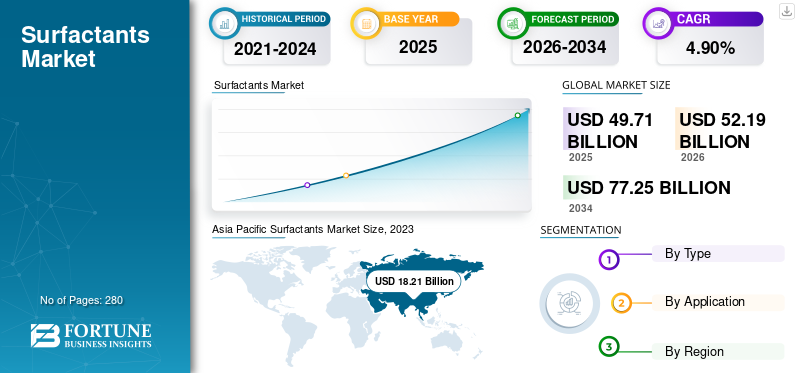
The global surfactants market size was USD 49.71 billion in 2025 and is projected to grow from USD 52.19 billion in 2026 to USD 77.25 billion by 2034 at a CAGR of 4.90% during the forecast period. Asia Pacific dominated the surfactants market with a market share of 40.50% in 2025. Moreover, the surfactants market size in the U.S. is projected to grow significantly, reaching an estimated value of USD 12.82 billion by 2032, driven by increasing demand from the personal care, household cleaning, and industrial sectors for efficient and eco-friendly products.
Surfactants are termed as chemical compounds with low surface tension, gas and liquid, liquid and solid, or two particles liquid. Surging usage in home as well as personal care, textile, and food & beverage industries are probable to have an affirmative effect on the market growth. Nonstop development within these sectors is anticipated to optimistically impact the market during the forecast period. It plays a vital role in cleaning applications. It is further added to cleaning agents, such as detergent, owing to particular properties permitting them as dispersing agents, wetting, washing, and emulsifying. They are also utilized as an ingredient in lubricants such as shaving creams for the effortless eradication of hair. Moreover, growing consciousness in terms of personal hygiene and living style is progressively developing the product's demand, thereby, driving the surfactants market growth.
The COVID-19 pandemic expanded of the household care industry due to concerns about cleanliness and hygiene, which positively impacted the market growth. According to the Household and Commercial Products Association (HCPA), the market value is around USD 180 billion per annum for home care products such as cleaner, and disinfectants for homes and commercial environments. Increasing consumption of the aforementioned products will surge the demand for the product and boost market growth subsequently. In addition, growing awareness about products such as hand sanitizer due to the pandemic is also a factor driving market size. However, the pandemic's outbreak resulted in declined product demand from plastics and textile applications, negatively impacting the market growth.
Download Free sample to learn more about this report.
Surfactants Market KEY TAKEAWAYS
 Global Market Size & Forecast
- 2025 Market Size: USD 49.71 billion
- 2026 Market Size: USD 52.19 billion
- 2034 Forecast Market Size: USD 77.25 billion
- CAGR: 4.90% from 2026–2034
 Market Share
- Asia Pacific dominated the surfactants market with a 40.50% share in 2025.
- The Anionic segment is projected to account for the largest market share of 45.18% in 2026.
- The Home Care segment is expected to hold a 46.58% share in 2026.
 Key Regional Highlights
Asia Pacific
Asia Pacific reached USD 20.15 billion in 2025, driven by rising demand for home and personal care products.
North America
North America accounted for USD 13.94 billion in 2025, supported by strong industrial demand and bio-based surfactant production.
Europe
Europe captured 18.90% of the global market in 2025, fueled by demand from the home care and personal care industries.
U.S.
U.S. is projected to reach USD 12.82 billion by 2032, driven by rising demand for eco-friendly surfactant products.
Japan
Japan is projected to reach USD 3.63 billion by 2026, supported by growing demand for personal care products.
Read More

Surfactants Market Trends
Increasing Demand for Green and Bio-based Surfactant Products to Favor Market Growth
The growing demand for sustainable technologies has led to the adoption of substitutes in petroleum-based synthetic products. Bio-surfactants have several potential applications across the products, such as emulsifying agents, biocides for sulfate-reducing bacteria, anticorrosive, and many other innovative applications. Due to versatility and efficiency, they are used in the industries such as home care, industrial cleaning, food & beverages, and others.
Bio-based agents are expected to become known as multifunctional materials derived from microorganism substrates miscible hydrophilic and oily/hydrocarbon type carbon sources in the culture medium. Biotechnology serves as a significant factor in developing bio-based products that can substitute petroleum-based products and are also environmentally-friendly. Rising concerns over the environment and resource preservation are further propelling product demand.
Download Free sample to learn more about this report.
Surfactants Market Growth Factors
Increasing Demand for Various Applications to Aid Market Growth
The escalating demand for surfactants across diverse sectors, including home care, personal care, textiles, food & beverages, industrial & institutional cleaning, and plastics, catalyzes market growth due to their versatile properties and applications. Surfactants serve as a key ingredient in home care products, such as detergents and cleaners, facilitating the removal of dirt and grease from various surfaces. Their ability to reduce surface tension enables effective wetting and emulsification, enhancing cleaning efficacy.
In personal care products, the product acts as foaming agents, emulsifiers, and solubilizers, contributing to the formulation of shampoos, body washes, and skincare products. Their ability to stabilize formulations and enhance product performance drives their widespread use in the personal care industry. Textile manufacturing relies on the product for processes such as dying, finishing, and fabric softening.
In the food and beverages industry, the product finds applications as emulsifiers, dispersants, and foaming agents in food processing, beverage production, and packaging. They enable the creation of stable emulsions, uniform dispersions, and desirable foam characteristics in various food products.
Industrial and institutional cleaning operations utilize products for degreasing, sanitizing, and disinfecting surfaces in commercial settings. Their ability to lower surface tension enhances soil penetration and removal, ensuring thorough cleaning and hygiene. Furthermore, the product plays a crucial role in the plastics industry, serving as dispersants, lubricants, and anti-static agents during polymer processing and compounding. They improve the flow properties of the molten polymers, enhance filler dispersion, and mitigate surface defects in plastic products.
The increasing product demand across these diverse sectors reflects their indispensable role in facilitating numerous manufacturing processes, enhancing product performance, and meeting evolving consumer preferences, thereby driving market growth.
RESTRAINING FACTORS
Volatility in Raw Material Prices to Hinder Market Growth
The price of raw materials is volatile owing to the environmental concerns coupled with crude oil prices. The ill-effects of surfactants over the environment such as degradability and toxicity affect the prices of raw material. Various regional governments have mandated regulations for environmental protection and use of resources. Low raw material prices and technological constraints in the commercial production of petroleum products are expected to hinder the market growth during the forecast period.
Surfactants Market Segmentation Analysis
By Type Analysis
Anionic Segment to Hold Major Share in Market
On the basis of type, the market is segmented into anionic, nonionic, cationic, and amphoteric. The anionic surfactants dominated the market due to the growing demand for linear alkyl benzene used in cleaning products and detergents. Anionic creates a high amount of foam when mixed with the base, making it a highly used additive for detergent and cleaning products. Non-ionic are usually low-foaming and non-foaming agents, making them ideal for use in emulsifying oils. The advantageous characteristics of low foaming are estimated to boost market growth. The anionic segment will account for 45.18% market share in 2026.
Cationic have a positive charge that makes them useful in anti-static products, such as fabric softeners. It also serves as an antimicrobial agent, having major use in disinfectants. Furthermore, amphoteric have dual charges on the hydrophilic end and are often applied as additives in shampoo and cosmetic products. The improving lifestyles of consumers and rise in disposable income are likely to drive the cosmetic industry.
By Application Analysis
To know how our report can help streamline your business, Speak to Analyst
Home Care Segment to Hold Major Share in Market during Forecast Period
On the basis of application, the market is segmented into home care, personal care, textile, food & beverages, industrial & institutional cleaning, plastics, and others. The home care segment will account for 46.58% market share in 2026 due to growing consumer demand for detergent, cleaners, sanitizers, hand wash, and other products. The pandemic has resulted in high awareness about hygiene among consumers, which has caused increased consumption of consumer goods, thus driving the demand.
Food & beverages applications surfactants are primarily used for food additives/ingredients and treating agents for food contact surfaces. Moreover, the product is also used as emulsifiers and antioxidants during food formulations. In some cases, the product has also shown antimicrobial properties for protecting against food pathogens.
REGIONAL INSIGHTS
Asia Pacific Surfactants Market Size, 2025 (USD Billion)
To get more information on the regional analysis of this market, Download Free sample
Asia Pacific
Asia Pacific recorded a market size of USD 20.15 billion in 2025, capturing 40.50% of the global market share, and is projected to reach USD 21.17 billion in 2026. The growth can be attributed to the increasing demand for home care and personal care products from developing countries such as China, Japan, and India. Economic development has led to the improvement in the lifestyle of consumers, causing high demand for personal care products such as shampoo, shaving cream, and hand wash. Low labor and manufacturing costs in these emerging economies propel many industry players to shift towards this region to achieve global presence and growth. China is the major consumer and net importer of nonionic products resulting in growth potential. The Japan market is projected to reach USD 3.63 billion by 2026, the China market is projected to reach USD 7.8 billion by 2026, and the India market is projected to reach USD 4.5 billion by 2026.
To know how our report can help streamline your business, Speak to Analyst
North America
In 2025, North America generated USD 13.94 billion, contributing 28.00% to global market revenue, and is projected to grow to USD 14.66 billion in 2026. North America is expected to hold a significant share in the global market attributed to the region’s rapid industrialization and rising disposable income. The increasing number of manufacturers of bio-based surfactants due to the feasible economic status of countries in the region is driving the market. Growing demand for homecare and cosmetics products, and changes in consumer lifestyle, shall drive the market size in this region. Many producers such as Chevron, Dow, and Formosa Plastics have increased their production of ethylene oxide, among which 23% of purified ethylene grade is used to produce surfactants. The U.S. market is projected to reach USD 9.47 billion by 2026.
Europe
The Europe market accounted for USD 9.37 billion in 2025, representing 18.90% of the global industry, and is expected to reach USD 9.83 billion in 2026. The European market is experiencing significant market growth for the past few years due to the increased demand from home care, and personal care industries. As Europe is a major region for the fashion industry, the rising cosmetic and textile industries shall augment the market growth. Germany is a major producer of detergents, cleaners, and other products that uses surfactants as raw material. Growing economy and product availability has resulted in the presence of constituents in products from renewable natural materials accounting for about 50% of total market shares in Europe. The UK market is projected to reach USD 1.49 billion by 2026, while the Germany market is projected to reach USD 2.64 billion by 2026.
Middle East & Africa
The Middle East & Africa market generated USD 2.44 billion in 2025, representing 4.90% of the global market landscape, and is expected to reach USD 2.55 billion in 2026. Middle East & Africa are expected to experience substantial growth during the forecast period. This growth can be attributed to the abundance of petroleum and crude oil present in the region. Rapid industrialization and urbanization are further supporting market growth. Whereas, in Latin America, the rise of the plastic and textile industry supports market growth.
Latin America
Latin America accounted for USD 3.81 billion in 2025, representing 7.70% of the global market share, and is projected to reach USD 3.98 billion in 2026.
List of Key Companies in Surfactants Market
Joint Ventures and Capacity Expansion Are Key Strategic Initiatives Implemented by Companies
Key players operating in the industry are Akzonobel N.V, Clariant AG, BASF SE, Kao Corporation, and others. Companies profiled are involved in capacity enlargement, with new product development, acquisition, and joint venture, thus gaining a competitive edge globally. For example, Lion Corporation is developing environment-friendly ways to manufacture bio-based anionic surfactants. The company uses anionic surfactant methyl ester sulfonate (MES) that is derived from palm oil as washing ingredients for the laundry detergents
Solvay has expanded the company footprint in India for the personal care market by making deals with local producers. This benefits the company in gaining market position and improving its global presence.
LIST OF KEY COMPANIES PROFILED:
- Akzonobel N.V (Netherlands)
- Clariant AG (Switzerland)
- BASF SE (Germany)
- Kao Corporation (Japan)
- Evonik Industries AG (Germany)
- Lion Corporation (Japan)
- Solvay (Belgium)
- Indorama Ventures Public Company Limited (Thailand)
- Ashland Global Holdings Inc. (U.S.)
- Croda International Plc (U.K.)
- Stepan Company (U.S.)
- Dow Chemical Company (U.S.)
KEY INDUSTRY DEVELOPMENTS:
- September 2022 – Stepan Company announced that it has agreed to acquire the surfactant business of PerformanX Specialty Chemicals, LLC. The company also acquired the assets associated with the surfactants business. The move is anticipated to strengthen the company's position in the global market.
- April 2021 – Unilever partnered with LanzaTech and India Glycols to produce a surfactant made from industrial carbon emissions. The innovative shift in production utilizes biotechnologies and a newly configured supply chain between the three partners, who are working together for the first time. The new surfactant will be used in an OMO (Persil) laundry capsule, which will launch in China on April 22nd, World Earth Day.
- July 2020 –Pilot Chemical launched Aspire Surfactant Blends highly versatile and processable concentrated blends of powerful anionic, nonionic, and cationic surfactants. With this launch, the company will serve its products in home care, industrial and institutional markets.
REPORT COVERAGE
The global market report provides a detailed analysis of the market and focuses on crucial aspects such as competitive landscape, sources, application, and products. Also, the report offers insights into key market trends and highlights vital industry developments. In addition to the factors mentioned above, the report encompasses various factors that have contributed to the growth of the market over recent years.
Request for Customization to gain extensive market insights.
Report Scope & Segmentation
|
ATTRIBUTE |
DETAILS |
|
Study Period |
2021-2034 |
|
Base Year |
2025 |
|
Estimated Year |
2026 |
|
Forecast Period |
2026-2034 |
|
Historical Period |
2021-2024 |
|
Growth Rate |
CAGR of 4.90% from 2026 to 2034 |
|
Unit |
Value (USD Billion); Volume (Million Ton) |
|
Segmentation
|
By Type
|
|
By Application
|
|
|
By Geography
|
Frequently Asked Questions
Fortune Business Insights says that the global market worth was USD 52.19 billion in 2026 and is projected to reach USD 77.25 billion by 2034.
In 2025, the Asia Pacific market size stood at USD 20.15 billion.
Growing at a CAGR of 4.9%, the market will exhibit steady growth during the forecast period (2026-2034).
The anionic surfactants segment is expected to be the leading material.
The rising consumer goods industry in developing countries is expected to drive market growth.
AkzoNobel N.V, Clariant AG, BASF SE, and Kao Corporation are the top players in the market.
Asia Pacific dominated the global market in 2034.
Growing demand for cleaning products is the key factor driving the adoption of surfactants.



- 2021-2034
- 2025
- 2021-2024
- 280
Get 30-60 hrs Free Customization
Expand Regional and Country Coverage, Segments Analysis, Company Profiles, Competitive Benchmarking, and End-user Insights.


















Related Reports
-
US +1 833 909 2966 ( Toll Free )
-
Get In Touch With Us