Plasticizers Market Size, Share & Industry Analysis, By Type (Phthalates and Non-Phthalates), By Application (Wire & Cable, Flooring & Wall Covering, Film & Sheet, Consumer Goods, Coated Fabrics, and Others), and Regional Forecast, 2026-2034
 Download Free Sample
KEY MARKET INSIGHTS
 Listen to Audio Version
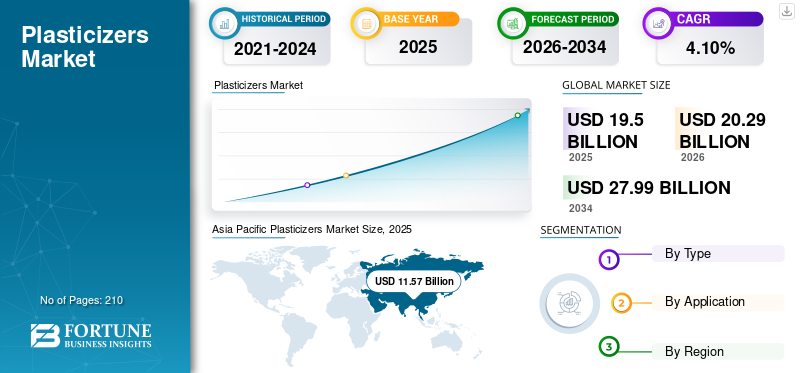
The global plasticizers market size was estimated at USD 19.50 billion in 2025. The market is expected to rise from USD 20.29 billion in 2026 to USD 27.99 billion by 2034, expanding at a CAGR of 4.10% from 2026 to 2034. Asia Pacific dominated the plasticizers market with a market share of 59.37% in 2025.
The plasticizers market is a rapidly growing industry that involves the production of chemicals used to soften and improve the flexibility of various plastic materials. The product demand is driven by its usage in a wide range of applications in industries such as automotive, construction, and packaging. Phthalate esters, adipates, and trimellitates are some of the most commonly used materials in the market. The growing demand for environmentally friendly and bio based plasticizers has also led to the introduction of new products in the market.
The Asia Pacific region is currently the largest consumer of plasticizers, followed by Europe and North America. The market is expected to continue its steady growth in the coming years, driven by the increasing demand for plastic products across various industries.
Download Free sample to learn more about this report.
Plasticizers Market KEY TAKEAWAYS
 Market Size & Forecast
- 2025 Market Size: USD 19.50 billion
- 2026 Market Size: USD 20.29 billion
- 2034 Forecast Market Size: USD 27.99 billion
- CAGR: 4.10% from 2026–2034
 Market Share
- Asia Pacific dominated the global market with a 59.37% share in 2025.
- Phthalates held the largest type share, supported by their widespread use in construction.
- Wire & Cable held the dominant application share, driven by the use of plasticizers in PVC insulation.
 Key Regional Highlights
Asia Pacific
Asia Pacific dominated the market with USD 11.57 billion in 2025.
North America
North America the market is supported by high demand for flexible PVC products in automotive.
Europe
Europe is witnessing a shift toward non-phthalate and bio-based plasticizers.
U.S.
The market is supported by demand for flexible PVC in automotive and healthcare applications.
Japan
The market is supported by demand from automotive, construction, and electrical applications.
Read More

Plasticizers Market Trends
Shift toward Non-Phthalate Plasticizers is Gaining a Sharp Momentum Creating a New Trend
There has been a significant shift toward non-phthalate-based plasticizers in recent years owing to the increasing awareness about the harmful effects of phthalates on human health and the environment. Phthalates are a group of chemicals that are commonly used as plasticizer to make plastics more flexible and durable. However, they have been linked to several health problems, including reproductive and developmental issues. Non-phthalates are considered to be safer and more environmentally friendly alternatives to traditional phthalate-based plasticizer. They are made from renewable resources and are biodegradable, which makes them a more sustainable option. They are also less toxic and have a lower risk of causing health problems.
The shift toward non-phthalate-based plasticizer is driven by various factors such as government regulations, consumer demand, and corporate sustainability initiatives. Many countries have implemented regulations to restrict the use of phthalates in consumer products, which has forced companies to look for safer alternatives. In addition, consumers are becoming more aware of the environmental and health impacts of the products they buy and are choosing products that are safer and more sustainable. The shift toward non-phthalate-based plasticizer is expected to continue in the coming years as more and more companies adopt sustainable practices. This trend is expected to create new opportunities for the development of innovative and eco-friendly plasticizer, which can further drive the global plasticizers industry growth. Asia Pacific witnessed a growth from USD 9.86 Billion in 2021 to USD 13.26 Billion in 2022.
Download Free sample to learn more about this report.
Plasticizers Market Growth Factors
Growing Demand from Various End-Use Industries Especially Construction and Automotive to Surge the Product Adoption
Plasticizers are chemical additives used to improve the flexibility, durability, and workability of plastics. They are widely used in various end-use industries such as construction, automotive, and packaging. The growing product demand in these industries can be attributed to their ability to enhance the performance and properties of plastics. In the construction industry, plasticizer are mainly used in the production of concrete and mortar to improve their workability and durability. They help in reducing the water content required for mixing, which results in stronger and denser concrete. Moreover, the product can also help in reducing the energy consumption required for the mixing and transportation of concrete.
In the automotive industry, plasticizer is used in the production of various interior and exterior components such as dashboards, door panels, and bumpers. The products help in improving the flexibility, impact resistance, and thermal stability of these components, making them more durable and long-lasting. In the packaging industry, plasticizer is used in the production of flexible films and sheets that are used for wrapping and protecting food and other consumer goods. They help in improving the flexibility and durability of these films, making them more resistant to tearing and puncturing.
The growing demand for plasticizer in various end-use industries is expected to continue in the coming years to enhance the properties and performance of plastics. Moreover, the development of eco-friendly and sustainable plasticizer is expected to create new opportunities for growth in the industry.
RESTRAINING FACTORS
Stringent Regulations on using Phthalate-Based Plasticizers May Hinder the Market Growth
Phthalate-based plasticizer have been widely used in various plastic products, including toys, food packaging, flooring, and medical devices, due to their ability to enhance the physical properties of plastics such as flexibility, durability, and transparency. However, the increasing concerns over their potential health and environmental risks have led to the implementation of strict regulations on their use. Phthalate-based plasticizer has been linked to various adverse health effects, including developmental and reproductive toxicity, endocrine disruption, and carcinogenicity. Moreover, these plasticizers are not biodegradable and can persist in the environment for a long time, posing a threat to wildlife and ecosystems.
To address these concerns, regulatory authorities around the world have imposed restrictions on the use of phthalate-based plasticizer in various products, especially those intended for children and infants. For instance, the European Union has banned the use of certain phthalates in toys and childcare articles, while the U.S. has restricted the use of some phthalates in children's toys and child care articles. As a result of these regulations, manufacturers are increasingly looking for alternative plasticizer that are safer and more environmentally friendly. This trend may lead to a decline in the phthalate-based plasticizers market share in the future.
Plasticizers Market Segmentation Analysis
By Type Analysis
Phthalates Segment Holds a Dominant Share Due to their Effectiveness as a Plasticizer in Various Industries
On the basis of type, the market is categorized into phthalates and non-phthalates.
The phthalates segment dominates the market. Phthalates are a type of chemical additives commonly used in the production of plastics. They play a crucial role in making plastics more flexible, durable, and resistant to wear and tear. This makes them highly sought after in various industries, including construction, automotive, packaging, and medical. Moreover, Phthalate based type are used in many applications due to their low cost and versatility. They are used in producing PVC products, such as pipes, cables, and flooring, and in manufacturing medical devices, such as IV bags and tubing. They provide flexibility and durability to these products, making them safe and effective for use in medical settings.
Non-phthalate plasticizer is used in a wide range of industries due to their versatility and safety. These plasticizers provide flexibility and durability to these products, making them safe and effective for use in various settings. In the automotive industry, non-phthalates are used in the production of vehicle interiors, including dashboards and seat covers. They are also used in the packaging industry to create flexible packaging materials, such as food packaging. In addition, non-phthalate materials are used in the medical industry to manufacture medical devices, such as tubing and elastic bags. This exhibits the fastest growth of the product over the forecast period.
By Application Analysis
To know how our report can help streamline your business, Speak to Analyst
Wire & Cable Segment Held a Major Share Owing to the Safety and Effectiveness
By application, the market is fragmented into wire & cable, flooring & wall covering, film & sheet, consumer goods, coated fabrics, and others.
Wire and cable segment accounted for a dominant share and have a significant demand for plasticizer. PVC-based wires and cables require plasticizer solutions to provide flexibility and durability to the products. Non-phthalate plasticizer is a popular choice in this industry due to their safety and effectiveness. They are used to create high-quality PVC insulation and jacketing for wires and cables, making them suitable for a wide range of applications, including power transmission, telecommunications, and automotive industries. This plays a crucial role in ensuring the safety and reliability of wires and cables, making them an essential component for various industries.
- The flooring & wall covering segment is expected to hold a 20.37% share in 2026.
Flooring & wall covering segment accounted for prominent market share and it is expected to grow at a prominent growth rate during the forecast period. Plasticizers are commonly used in the flooring and wall covering industries as they are added to vinyl flooring, wall coverings, and other types of plastic materials to enhance their performance and appearance. Phthalate-free plasticizer are often preferred in this industry due to their safety. They are used to create high-quality flooring and wall covering products that are suitable for a wide range of applications, including residential, commercial, and industrial spaces. This ensures that these products can withstand heavy foot traffic, moisture, and other environmental factors, making them a reliable and long-lasting option for a variety of settings, which helps to boosts up the market in the upcoming years.
REGIONAL ANALYSIS
By region, the market has been studied across North America, Europe, Asia Pacific, Latin America, and the Middle East & Africa.
Asia Pacific Plasticizers Market Size, 2025 (USD Billion)
To get more information on the regional analysis of this market, Download Free sample
Asia Pacific
Asia Pacific dominated the market with a valuation of USD 11.57 billion in 2025 and USD 12.05 billion in 2026. The Asia Pacific region is a major consumer of plasticizer, accounting for a dominant share of the global market. The product demand in the region is driven by the growing construction industry, increasing urbanization, and rising disposable income of the population. The region is also a home to several emerging economies, such as China and India, which are witnessing a surge in demand for PVC-based products, thereby driving the demand for plasticizer.
North America
The North America market is expected to witness significant growth in the coming years. The U.S. is a key contributor to the North America market, holding a significant share. The increasing demand for flexible PVC in various end-use industries, such as construction, automotive, and healthcare, is cited as a key factor driving the growth of the market in North America.
- In U.S., the flooring & wall covering segment is estimated to hold a 20.41% market share in 2022.
To know how our report can help streamline your business, Speak to Analyst
Europe
In the last decade, Europe has recorded a significant industrial development. The increasing demand for eco-friendly and non-phthalate plasticizer is considered as a major trend in the Europe market. Manufacturers in the region are focusing on the development of non-phthalate and bio-based plasticizer, owing to the increasing concerns over the environmental and health hazards associated with traditional phthalate-based products.
Latin America
The product demand is surging in Latin America, especially in industries such as wire & cable, flooring & wall covering, and consumer goods which helps to drive the market growth in the region. Countries such as Mexico, Brazil, and Argentina are the key contributors to the Latin America market.
Middle East & Africa market
The Middle East & Africa market is anticipated to record significant growth driven by Saudi Arabia owing to increased investment in the development of infrastructure and rapid growth in plastics industry. The growth of the automotive and construction activities in the region is also poised to fuel the demand for the material in the coming years.
List of Key Companies in Plasticizers Market
New Product Development and Capacity Expansion are the Key Strategic Initiatives Deployed by Industry Players to Boost Market Presence
Prominent players operating in the market are BASF SE, Exxon Mobil Corporation, Eastman Chemical Company, Evonik Industries AG, Avient Corporation, and others. Companies are involved in capacity expansion, joint ventures, new product launches, partnerships, and acquisitions to secure a competitive edge in the market.
BASF SE has a strong presence in Europe and North America. The company is the region's biggest supplier of specialty solution of industry petrochemicals and specialty chemicals. Similarly, the other major market players have established robust distribution channels, a strong regional presence, and varied product offerings.
LIST OF KEY COMPANIES PROFILED:
- BASF SE (Germany)
- Exxon Mobil Corporation (U.S.)
- Eastman Chemical Company (U.S.)
- Evonik Industries AG (Germany)
- Nan Ya Plastics Corporation (Taiwan)
- UPC Technology Corporation (Taiwan)
- LG Chem Ltd. (South Korea)
- Aekyung Chemical (South Korea)
- Kao Corporation (Japan)
- Avient Corporation (U.S.)
KEY INDUSTRY DEVELOPMENTS:
- August 2023 – Lanxess, the German specialty chemicals company, launched a new plasticizer called adipic acid dihydrazide-2-ethylhexyl ester (ADH), as part of its sustainability push. The new plasticizer is made from renewable raw materials and is free from phthalates and heavy metals, making it an eco-friendly alternative to traditional plasticizer.
- June 2023 – KLJ Group invested USD 145.0 million to commission a new production facility for plasticizer and phthalic anhydride. The new facility, located in Bharuch, Gujarat, is one of the largest of its kind in India and has a capacity to produce 100,000 tonnes of plasticizer and 50,000 tonnes of phthalic anhydride annually. The commissioning of the new facility is part of KLJ Group's efforts to expand its portfolio of specialty chemicals and strengthen its position as a leading producer of plasticizer and other chemicals.
- November 2022 – Evonik signed a memorandum of understanding with DEZA, a Czech chemical company, for the production of tri-isononyl trimellitate (TINTM), a low viscosity plasticizer. Under this agreement, Evonik would provide DEZA with the technology to produce TINTM, which is used in a variety of applications such as automotive interiors, food packaging, and medical devices. The partnership would enable both companies to expand their product portfolios and meet the growing demand for specialty chemicals in Europe.
REPORT COVERAGE
Request for Customization to gain extensive market insights.
The market report provides a detailed analysis of the market and focuses on crucial aspects such as leading companies, products, and applications. The report also offers insights into market trends and highlights vital industry developments. This report includes historical data & forecasts revenue growth at the global, regional, and country levels, and analyzes the industry's latest market dynamics and opportunities. In addition to the factors mentioned above, the report encompasses various factors contributing to the market growth in recent years.
Report Scope & Segmentation
|
ATTRIBUTE |
DETAILS |
|
Study Period |
2021-2034 |
|
Base Year |
2025 |
|
Estimated Year |
2026 |
|
Forecast Period |
2026-2034 |
|
Historical Period |
2021-2024 |
|
Growth Rate |
CAGR of 4.10% from 2026 to 2034 |
|
Unit |
Value (USD Billion); Volume (Million Ton) |
|
Segmentation |
By Type
|
|
By Application
|
|
|
By Geography
|
Frequently Asked Questions
According to Fortune Business Insights, the global plasticizers market size is valued at USD 20.29 billion in 2026 and is expected to grow to USD 27.99 billion by 2034, registering a CAGR of 4.10% during 2026–2034.
Growing at a CAGR of 4.10%, the market will exhibit steady growth over the forecast period (2026-2034).
The growth of the plasticizers market is primarily driven by increasing demand from end-use industries such as construction, automotive, and packaging. Their ability to enhance plastic flexibility and durability, along with the growing use of PVC-based products, significantly boosts market demand.
Asia Pacific dominated the plasticizers market with a market share of 59.37% in 2025. Rapid industrialization, infrastructure growth, and rising disposable incomes in countries like China and India contribute to the regions leadership position.
A major trend in the plasticizers market is the shift toward non-phthalate and bio-based plasticizers, driven by stricter regulations, increasing environmental concerns, and rising consumer demand for safer, sustainable alternatives to phthalate-based plasticizers.
Stringent global regulations, particularly in Europe and North America, are restricting the use of phthalate-based plasticizers due to their potential health and environmental risks. This is encouraging manufacturers to adopt non-phthalate alternatives, impacting traditional plasticizer demand.
The wire and cable segment holds a dominant share in the plasticizers market. Plasticizers, especially non-phthalate types, are widely used in PVC insulation and jacketing for electrical wires and cables due to their flexibility, safety, and thermal stability.
Major companies operating in the global plasticizers market include BASF SE, Exxon Mobil Corporation, Eastman Chemical Company, Evonik Industries AG, LG Chem Ltd., and Avient Corporation. These players focus on product innovation, capacity expansion, and strategic partnerships to enhance their market share.



- 2021-2034
- 2025
- 2021-2024
- 210
Get 30-60 hrs Free Customization
Expand Regional and Country Coverage, Segments Analysis, Company Profiles, Competitive Benchmarking, and End-user Insights.


















Related Reports
-
US +1 833 909 2966 ( Toll Free )
-
Get In Touch With Us