Meal Kit Delivery Services Market Size, Share & Industry Analysis, By Meal Type (Vegetarian & Vegan, Non-Vegetarian, and Health-Focused), By Offering (Ready-to-Cook and Ready-to-Eat), By Subscription Model (One-time/Single and Subscription), By Demographic Type (Individuals, Households, and Others), By Distribution Channel (Direct-to-Consumers, Online, and Offline), and Regional Forecast, 2026-2034
 Download Free Sample
(Offer valid till 15th Oct 2026)

KEY MARKET INSIGHTS
 Listen to Audio Version
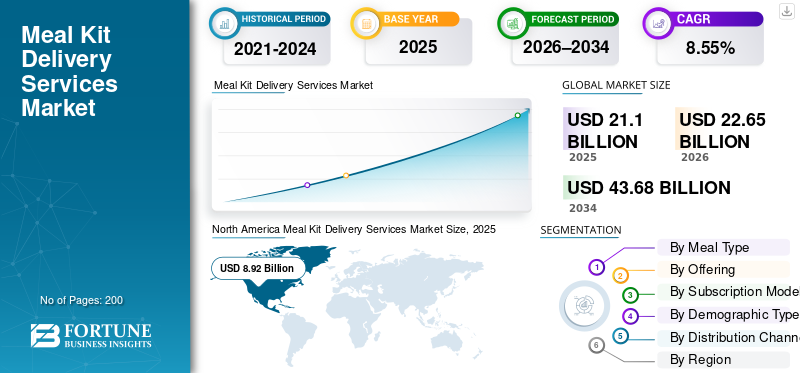
The global meal kit delivery services market size was valued at USD 21.10 billion in 2025 and is projected to grow from USD 22.65 billion in 2026 to USD 43.68 billion by 2034, exhibiting a CAGR of 8.55% during the forecast period. North America dominated the meal kit delivery services market with a market share of 42.27% in 2025.
Meal kit delivery services provide pre-portioned ingredients or fully prepared meals delivered directly to consumers, enabling convenient, time-efficient, and nutritionally balanced home dining. The market encompasses both ready-to-cook meal kits and ready-to-eat meals, distributed primarily through direct-to-consumer subscription platforms and digital ordering channels. The market growth is supported by urbanization, rising dual-income households, changing food consumption patterns, and increasing demand for convenient, portion-controlled, and diet-specific meal solutions.
Major players in the global market comprise HelloFresh SE, Blue Apron Holdings, Inc., Marley Spoon AG, Gousto Group Ltd., and Home Chef (Kroger Co.). These five players collectively account for a significant global market share, driven by scale, logistics capabilities, flexible subscription plans, retention, and continuous menu innovation.
Download Free sample to learn more about this report.
MEAL KIT DELIVERY SERVICES MARKET KEY TAKEAWAYS
 Global Market Size & Forecast
- 2025 Market Size: USD 21.10 billion
- 2026 Market Size: USD 22.65 billion
- 2034 Forecast Market Size: USD 43.68 billion
- CAGR: 8.55% from 2026–2034
 Market Share
- North America dominated the meal kit delivery services market with a market share of 42.27% in 2025.
- The health-focused segment, valued at USD 4.61 billion in 2025, is slated to witness steady growth at a CAGR of 9.31% over the forecast period.
- The ready-to-eat segment is projected to grow at the fastest CAGR of 9.83% over the forecast period.
 Key Regional Highlights
North America
Dominated the market with USD 8.92 billion in 2025, driven by high subscription adoption, digital infrastructure, and demand for health-focused meal kits.
Europe
Reached USD 6.45 billion in 2025, supported by sustainability-focused food policies and rising vegetarian meal preferences.
Asia Pacific
Valued at USD 3.88 billion in 2025 and projected to grow fastest with a CAGR of 12.22%, driven by urbanization and digital food delivery adoption.
U.S.
Reached USD 7.66 billion in 2025, supported by strong consumer spending on convenience foods and subscription services.
Japan
Growth is supported by increasing adoption of digital food services and rising demand for convenient meal solutions.
Read More

Meal Kit Delivery Services Market Trends
Rising Adoption of Ready-to-Eat and Heat-and-Serve Meal Formats
While ready-to-cook kits remain dominant, the demand for ready-to-eat and minimal meals preparation is rising rapidly, particularly among single-person households and time-constrained professionals. These formats reduce preparation time to under five minutes, aligning with evolving urban lifestyles. The USDA highlights a steady increase in the demand for convenience-oriented food solutions, with prepared meal consumption growing faster than traditional grocery categories. Meal kit providers are responding by investing in centralized kitchens, shelf-life extension technologies, and chilled meal logistics.
- According to the U.S. Department of Agriculture (USDA), food-away-from-home expenditures in the U.S. reached USD 1.45 trillion in 2023 and increased further to USD 1.52 trillion in 2024.
Download Free sample to learn more about this report.
MARKET DYNAMICS
Market Drivers
Growing Food Convenience Demand and Household Time Constraints to Support Market Expansion
The rising demand for food convenience and household time constraints are key drivers propelling the meal kit delivery services market growth. Busy lifestyles, particularly among dual-income households and professionals, limit the time for grocery shopping, meal planning, and cooking, making pre-portioned ingredients and simple recipes delivered to doorsteps highly appealing.
- According to recent data from the USDA Economic Research Service (ERS), in 2023, consumers in the U.S. spent an average of 11.2% of their disposable personal income on food, the same percentage as 2022.
Market Restraints
Price Sensitivity and Premium Perception to Limit Mass-Market Penetration
Despite convenience benefits, meal kits serve as a premium-priced food option compared to home cooking or conventional grocery purchases. The Food and Agriculture Organization highlights that food affordability remains a critical issue globally, with over 3 billion people unable to afford a healthy diet. In price-sensitive markets, particularly across parts of Asia, South America, and the Middle East & Africa, the relatively higher per-meal cost of meal kits restricts broader consumer adoption, especially among lower-income households.
Market Opportunities
Expansion of Vegan, Organic, Gluten-Free, and Functional Meal Kits to Create New Revenue Streams
The expanding adoption of vegan, organic, and functional meal kits is significantly reshaping the global market by tapping into the surging consumer demand for health-focused, sustainable, and convenient eating options, thereby unlocking diverse new revenue streams for providers. The rising health consciousness, environmental awareness, and dietary shifts, particularly among millennials and Gen Z in urban areas are opening doors to new expansion opportunities for industry players.
- According to recent data from the USDA Economic Research Service (ERS), the total organic retail sales in the U.S. reached approximately USD 69.7 billion in 2023. This demonstrates a sustained consumer shift toward organic products, which supports the demand for organic meal kits and ingredients.
SEGMENTATION ANALYSIS
By Meal Type
Non-Vegetarian Segment Led the Market with Sustained Consumer Demand for Meat and Poultry
Based on meal type, the global market is segmented into vegetarian & vegan, non-vegetarian, and health-focused meal kits.
The non-vegetarian segment dominated the global meal kit delivery services market share with a value of USD 11.30 billion in 2025, supported by the sustained consumer demand for poultry, meat, and seafood-based meal kits, particularly in North America and Europe. This segment benefits from menu familiarity, protein-centric dietary preferences, and strong repeat subscription behavior among households.
The health-focused segment, valued at USD 4.61 billion in 2025, is slated to witness steady growth at a CAGR of 9.31% over the forecast period. The demand for calorie-controlled, low-carb, high-protein, keto, and allergen-free meal kits bolsters segment growth.
To know how our report can help streamline your business, Speak to Analyst
By Offering
Ready-to-Cook Segment Led the Market Owing to Consumer Demand for Home-cooked Meals
Based on offering, the market is segmented into ready-to-cook and ready-to-eat.
The ready-to-cook segment dominated the global market in 2025 with a valuation of USD 14.28 billion. The dominance is driven by the consumer demand for fresh, home-cooked meals without the burden of ingredient sourcing and preparation planning. This segment benefits from a strong appeal among households and food enthusiasts seeking culinary engagement and portion control.
The ready-to-eat segment is projected to grow at the fastest CAGR of 9.83% over the forecast period, driven by time-poor consumers, single-person households, and demand for minimal-effort meal solutions.
By Subscription Model
Subscription Segment Dominated Owing to Predictable Order Volumes and Enhanced Consumer Retention
By subscription model, the market is categorized into one-time/single and subscription.
The subscription model segment accounted for USD 15.64 billion in 2025, representing the core revenue engine in the global market. The segment’s dominance is driven by predictable order volumes, lower per-unit fulfillment costs, and enhanced customer retention through flexible meal customization, skip options, and diet-specific plans. Providers benefit from stable cash flows and improved supply chain planning.
The one-time/single-purchase segment continues to expand gradually with a CAGR of 8.82% over the analysis period. These services cater to specific trial users and occasional consumers but lack the scale efficiencies of subscriptions.
By Demographic Type
Households Segment Remained Dominant Driven by Family-sized Meal Planning
Based on the demographic type, the market is segmented into individuals, households, and others.
The households segment led the market with a valuation of USD 12.59 billion in 2025, supported by family-sized meal planning, cost efficiency per serving, and growing preference for structured weekly food solutions among dual-income households. Meal kits reduce planning fatigue and food waste, making them particularly attractive for families managing time constraints and dietary balance.
The individual segment is projected to grow at the fastest pace, registering a CAGR of 9.60% over the analysis period. The expansion of the segment is driven by the rising number of single-person households, urban professionals, students, and expatriates.
By Distribution Channel
Direct-to-Consumer Segment Dominated Due to Subscription Economics
Based on distribution channel, the market is segmented into direct-to-consumers, online, and offline.
The direct-to-consumer (DTC) segment remained the dominant segment in 2025 with a value of USD 14.55 billion, accounting for the largest share of global revenues. DTC dominance is structurally driven by subscription-based revenue models, direct customer data ownership, predictable demand forecasting, and tighter control over pricing, branding, and customer experience.
The online channel is projected to grow at a CAGR of 7.55% during 2026–2034, driven by rising digital grocery adoption, mobile-first ordering behavior, and integration with last-mile delivery platforms.
Meal Kit Delivery Services Market Regional Outlook
Regionally, the report covers the market analysis across North America, Europe, Asia Pacific, South America, and the Middle East and Africa.
North America
North America Meal Kit Delivery Services Market Size, 2025 (USD Billion)
To get more information on the regional analysis of this market, Download Free sample
North America dominated the global market with a value of USD 8.92 billion in 2025 and is projected to grow at a CAGR of 6.91% over the analysis period. The market growth is supported by high subscription penetration, digital infrastructure, and strong demand for health-focused and vegan meal kits.
U.S. Meal Kit Delivery Services Market
The U.S. accounted for a value of approximately USD 7.66 billion in 2025, driven by high consumer spending on convenience foods, widespread adoption of subscription services, and innovation in plant-based meal kits.
Europe
The Europe market reached a valuation of USD 6.45 billion in 2025. The regional market is slated to expanding at a CAGR of 7.89% during the forecast period, supported by sustainability-driven food policies and strong vegetarian adoption.
Germany Meal Kit Delivery Services Market
Germany was valued at USD 2.10 billion in 2025, supported by high e-commerce grocery penetration and strong demand for organic and plant-based meal solutions.
Asia Pacific
Asia Pacific accounted for a valuation of USD 3.88 billion in 2025 and is the fastest-growing region with a CAGR of 12.22% over the forecast period. The regional market growth is driven by urbanization, rising disposable incomes, and digital food delivery adoption.
India Meal Kit Delivery Services Market
The India market was valued at USD 0.40 billion in 2025, driven by nuclear family growth, rising female workforce participation, and vegetarian-friendly meal kit offerings.
China Meal Kit Delivery Services Market
The China market reached a value of USD 1.31 billion in 2025, supported by dense urban populations and growing demand for convenience foods.
South America and the Middle East & Africa
South America accounted for USD 1.18 billion in 2025. The market is estimated to surge at a CAGR of 10.56% over the forecast period, supported by expanding e-commerce food platforms.
The Middle East & Africa market reached a valuation of USD 0.67 billion in 2025 and is projected to expanding at a CAGR of 6.31% over the analysis period. The market growth in the region is driven by food security initiatives and urban consumer demand.
UAE Meal Kit Delivery Services Market
The UAE market was valued at approximately USD 0.24 billion in 2025 and is projected to grow at a CAGR of 7.26% during the forecast period. The market growth is supported by high digital adoption and premium convenience food demand.
COMPETITIVE LANDSCAPE
Key Industry Players
Key Players Focus on Subscription Optimization to Consolidate Market Foothold
Leading players in the food subscription and meal solutions ecosystem are increasingly prioritizing subscription optimization to stabilize recurring revenues and reduce customer churn. Companies are refining flexible subscription tiers, offering customizable meal frequencies, portion sizes, and dietary preferences (e.g., vegan, keto, allergen-free). Major players in the global meal kit delivery services market are increasingly adopting eco-friendly packaging, such as compostable materials and recyclable boxes, to reduce plastic waste and appeal to environmentally conscious consumers.
Key Players in the Meal Kit Delivery Services Market
|
Rank |
Company Name |
|
1 |
HelloFresh SE |
|
2 |
Blue Apron Holdings, Inc. |
|
3 |
Marley Spoon AG |
|
4 |
Gousto Group Ltd. |
|
5 |
Home Chef (Kroger Co.) |
List of Key Meal Kit Delivery Services Companies Profiled
- HelloFresh SE (Germany)
- Blue Apron Holdings, Inc. (U.S.)
- Marley Spoon AG (Germany)
- Gousto Group Ltd. (U.K.)
- Freshly, Inc. (U.S.)
- Sun Basket, Inc. (U.S.)
- Purple Carrot, Inc. (U.S.)
- Home Chef (Kroger Co.) (U.S.)
- Mindful Chef Ltd. (U.K.)
- Snap Kitchen, LLC (U.S.)
KEY INDUSTRY DEVELOPMENTS
- August 2025: Tasty Bite Eatables launched its CHEFFIN ready-to-cook meal kits on Amazon, marking its entry into India's growing B2C packaged food market. CHEFFIN offers five North Indian-inspired kits comprising Butter Chicken, Kadhai Veg, Chicken Tikka Masala, Dal Makhani, and Shahi Paneer. These are designed for urban households, delivering restaurant-style flavors with home cooking ease in about 10 minutes.
- August 2025: Blue Apron relaunched with a major brand refresh, shifting from rigid subscriptions to flexible, à la carte shopping for busy households. The new model offers over 100 weekly meals, double the previous lineup, with 75% customizable across three categories.
- February 2025: Wonder integrated Blue Apron's meal kit service into its app, marking a key expansion in its "super app for mealtime" strategy. This launch allows users to order kits alongside food from Wonder's 27 restaurant brands without needing a subscription.
- December 2023: Blue Apron launched its Prepared & Ready Meals to expand beyond traditional meal kits into fully pre-made, non-frozen options. These single-serving meals are chef-crafted, nutritionist-approved, and ready to heat in minutes via microwave.
- December 2020: Nestlé acquired Freshly, a eat meal delivery service, in 2020 and has, since then, expanded its offerings under the brand. Freshly, owned by Nestlé, launched its first plant-based meal line called Purely Plant in 2021, featuring six chef-prepared, ready-to-heat dishes such as the Rainbow Harvest Plant-Based Burger and Unwrapped Salsa Verde Burrito, made with pea protein blends and whole foods.
REPORT COVERAGE
The global meal kit delivery services market report analyzes the market in depth and highlights crucial aspects such as global market trends, market dynamics, prominent companies, investment in research and development, and end-use. Besides this, the report also provides insights into the global market analysis and highlights significant industry developments.
Request for Customization to gain extensive market insights.
Report Scope & Segmentation
|
ATTRIBUTE |
DETAILS |
|
Study Period |
2021-2034 |
|
Base Year |
2025 |
|
Estimated Year |
2026 |
|
Forecast Period |
2026-2034 |
|
Historical Period |
2021-2024 |
|
Growth Rate |
CAGR of 8.55% from 2026 to 2034 |
|
Unit |
Value (USD Billion) |
|
Segmentation |
By Meal Type
|
|
By Offering · Ready-to-Cook · Ready-to-Eat |
|
|
By Subscription Model · One-time/Single · Subscription |
|
|
By Demographic Type
|
|
|
By Distribution Channel · Direct-to-Consumers · Online · Offline |
|
|
By Region · North America (By Meal Type, Offering, Subscription Model, Demographic Type, Distribution Channel, and Country) • U.S. (By Distribution Channel) • Canada (By Distribution Channel) • Mexico (By Distribution Channel) · Europe (By Meal Type, Offering, Subscription Model, Demographic Type, Distribution Channel, and Country) • U.K. (By Distribution Channel) • Germany (By Distribution Channel) • France (By Distribution Channel) • Italy (By Distribution Channel) • Spain (By Distribution Channel) • Rest of Europe (By Distribution Channel) · Asia Pacific (By Meal Type, Offering, Subscription Model, Demographic Type, Distribution Channel, and Country) • China (By Distribution Channel) • Japan (By Distribution Channel) • India (By Distribution Channel) • Australia (By Distribution Channel) • Rest of Asia Pacific (By Distribution Channel) · South America (By Meal Type, Offering, Subscription Model, Demographic Type, Distribution Channel, and Country) • Brazil (By Distribution Channel) • Argentina (By Distribution Channel) • Rest of South America (By Distribution Channel) · Middle East & Africa (By Meal Type, Offering, Subscription Model, Demographic Type, Distribution Channel, and Country) • South Africa (By Distribution Channel) • UAE (By Distribution Channel) • Rest of the Middle East & Africa (By Distribution Channel) |
Frequently Asked Questions
Fortune Business Insights says that the global market was USD 21.10 billion in 2025 and is anticipated to reach USD 43.68 billion by 2034.
The global market is projected to exhibit steady growth at a CAGR of 8.55% over the forecast period.
By meal type, the non-vegetarian segment led the market in 2025.
North America held the largest market share in 2025.
Growing food convenience demand and household time constraints are major factors supporting market expansion.
HelloFresh SE, Blue Apron Holdings, Inc., Marley Spoon AG, Gousto Group Ltd., and Home Chef (Kroger Co.) are the leading companies in the market.
Rising adoption of ready-to-eat and heat-and-serve meal formats is a key trend in the market.



- 2021-2034
- 2025
- 2021-2024
- 200
-
(Offer valid till 15th Oct 2026)
Get 30-60 hrs Free Customization
Expand Regional and Country Coverage, Segments Analysis, Company Profiles, Competitive Benchmarking, and End-user Insights.




















Related Reports
-
US +1 833 909 2966 ( Toll Free )
-
Get In Touch With Us