Meal Replacement Market Size, Share & Industry Analysis, By Product Type (Bars, Ready-to-Drink, Powder, and Others), By Source (Animal-Based and Plant-Based), By Distribution Channel (Supermarkets/Hypermarkets, Specialty Stores, Convenience Stores, Online Retail, and Others), and Regional Forecast, 2026–2034
 Download Free Sample
(Offer valid till 15th Oct 2026)

Meal Replacement Market Size and Future Outlook
 Listen to Audio Version
The global meal replacement market size was valued at USD 17.98 billion in 2025. The market is projected to grow from USD 18.95 billion in 2026 to USD 32.08 billion by 2034, exhibiting a CAGR of 6.81% during the forecast period. North America dominated the meal replacement market with a market share of 50.22% in 2025.
Meal replacement products, including ready-to-drink (RTD) shakes, protein bars, powders, and functional blends, are positioned at the intersection of clinical nutrition, weight management, sports nutrition, and convenience food. Rising obesity prevalence, an increasing working population, time-constrained lifestyles, and rising health consciousness structurally support the category. Plant-based protein innovation, fortified micronutrient blends, and functional positioning around satiety, muscle maintenance, and metabolic health further reinforce demand. The global meal replacement market offers a diverse range of milk-based meal-replacement drinks, catering to consumers seeking convenient, nutritionally complete options, such as fortified shakes and protein-enriched lattes from brands such as Soylent and Huel.
Herbalife Ltd., Nestlé S.A., Abbott Laboratories, Glanbia plc, Kellogg Company, and others dominate the market. Competition is driven by increasing consumer demand for balanced nutrition, convenient diets, fitness-focused products, and personalized nutrition solutions. To remain competitive, companies adopt several strategic approaches spanning product innovation, functional nutrition development, digital health integration, and supply chain optimization.
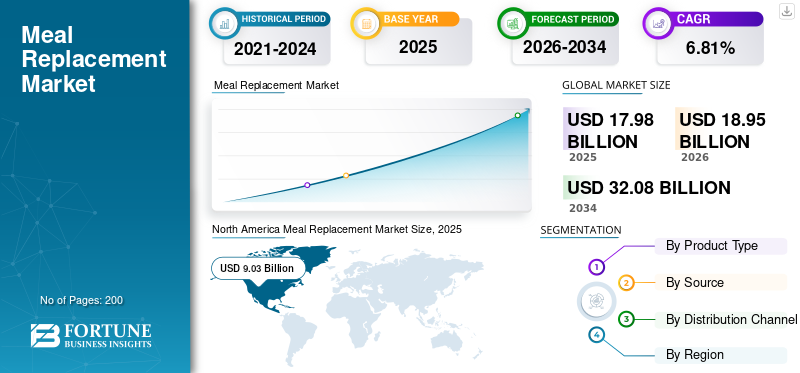
Download Free sample to learn more about this report.
Meal Replacement Market Key Takeaways
 Global Market Size & Forecast
- 2025 Market Size: USD 17.98 billion
- 2026 Market Size: USD 18.95 billion
- 2034 Forecast Market Size: USD 32.08 billion
- CAGR: 6.81% (2026–2034)
 Market Share
- North America dominated the market with a 50.22% share in 2025.
- The powder segment led the market, valued at USD 10.29 billion in 2025.
- The supermarkets/hypermarkets segment dominated the market, generating USD 8.44 billion in 2025.
 Key Regional Highlights
Asia Pacific
Asia Pacific accounted for USD 3.19 billion in 2025 and is expected to register the fastest growth with a 7.56% CAGR.
North America
North America generated USD 9.03 billion in 2025 and is projected to grow at a 6.60% CAGR during 2026–2034.
Europe
Europe held USD 3.96 billion in 2025 and is projected to grow at a 7.01% CAGR during the forecast period.
U.S.
U.S. market was valued at USD 6.73 billion in 2025.
Japan
Japan market is projected to witness steady growth during the forecast period.
Read More

Meal Replacement Market Trends
Premiumization and Functional Protein Fortification to Shape Market Growth
The global meal replacement industry is increasingly transitioning from basic calorie-control products toward premium, function-driven nutritional solutions. Consumers are demanding high-protein, low-sugar, micronutrient-fortified, and clean-label formulations that address specific health goals such as muscle retention, metabolic health, gut health, and sustained energy release.
- In January 2026, Alpro, a Danone-owned plant-based brand, recently launched its "Meal to Go" range of meal replacement drinks, each delivering 20g of plant-based protein in a 500ml bottle. These dairy-free drinks use a soy and oat milk base, offering balanced nutrition with fiber, omega-3s, and 26 vitamins and minerals, without artificial sweeteners.
MARKET DYNAMICS
Market Drivers
Download Free sample to learn more about this report.
Rising Obesity and Structured Weight Management Adoption to Fuel Market Growth
The global rise in overweight and obesity prevalence continues to drive structured calorie-controlled nutrition adoption, directly benefiting meal replacement consumption. These products offer standardized caloric intake, typically 200–400 kcal per serving, with balanced macronutrients, making them suitable for medically supervised weight management programs.
- According to the World Health Organization (WHO), over 1 billion people globally were living with obesity in 2023, including 650 million adults, reinforcing long-term demand for portion-controlled nutrition products.
Market Restraints
Ingredient Cost Volatility and Regulatory Scrutiny to Restrain Market Expansion
Ingredient cost volatility remains a structural restraint in the global meal replacement market growth, as formulations are heavily dependent on dairy proteins (whey, casein), plant protein isolates (soy, pea), cocoa, edible oils, and micronutrient premixes. Fluctuations in agricultural commodity prices directly affect input costs and gross margins, particularly for ready-to-drink (RTD) beverages and high-protein powders, where protein constitutes 35–60% of total formulation cost.
- According to the Food and Agriculture Organization Dairy Price Index, global dairy prices in 2024 were characterized by high volatility, averaging 4.7% higher annually compared to 2023, yet experiencing extreme, sustained, and rapid, month-on-month, rises, particularly for butter.
Market Opportunities
Expansion of the Product in Premium Cosmetics and Nutraceutical Formulations to Unlock Growth Opportunities
The structural shift toward plant-based nutrition is creating substantial long-term growth opportunities in the global market. Consumers are increasingly opting for soy-, pea-, oat-, and almond-based formulations due to lactose intolerance prevalence, vegan and flexitarian dietary adoption, and sustainability considerations. Plant-based meal replacements also align with clean-label positioning and reduced saturated fat content.
- According to the Food and Agriculture Organization, global soybean production reached between 371.17 million and 398.2 million metric tons in 2023, ensuring stable raw material availability for soy protein isolates widely used in powders and RTD formulations.
SEGMENTATION ANALYSIS
By Product Type
Powder Segment Dominated Due to Cost Efficiency and Customizable Protein Density
By product type, the market is segmented into powder, ready-to-drink (RTD), bars, and others.
The powder segment dominated the global meal replacement market share in 2025, valued at USD 10.29 billion, supported by higher protein concentration per serving, extended shelf life, and cost efficiency in bulk packaging. Powder formats are widely adopted by fitness enthusiasts, in sports nutrition and structured weight loss management programs, as they allow flexible serving size customization and lower logistics costs per gram of protein.
The ready-to-drink (RTD) segment is projected to grow at the fastest CAGR of 8.36% in the coming years.
To know how our report can help streamline your business, Speak to Analyst
By Source
Animal-Based Segment Dominated Owing to Whey Protein Preference
By source, the market is segmented into animal-based and plant-based.
The animal-based segment led in 2025 with USD 10.66 billion, supported by whey and milk protein dominance in clinical nutrition and muscle maintenance applications. Whey protein offers superior digestibility and complete amino acid profiles, strengthening its adoption in medically supervised weight programs.
The plant-based segment is projected to expand at a CAGR of 8.09% during the forecast period.
By Distribution Channel
Supermarkets/Hypermarkets Segment Dominated Due to Shelf Visibility and Private Label Expansion
By distribution channel, the market is segmented into supermarkets/hypermarkets, specialty stores, convenience stores, online retail, and others.
The supermarkets/hypermarkets segment dominated in 2025 with USD 8.44 billion, supported by strong in-store visibility, promotional campaigns, and private-label penetration. These channels benefit from one-stop shopping convenience, a wide product variety of meal replacement products, and aggressive promotions that boost impulse buys among health-conscious consumers. End-shelf displays and loyalty programs further enhance visibility for meal replacements such as shakes and bars.
The online retail segment is the fastest-growing channel, registering a CAGR of 8.05% during the forecast period.
Meal Replacement Market Regional Outlook
Regionally, the report covers the global market analysis across North America, Europe, Asia Pacific, South America, and the Middle East & Africa.
North America
North America Meal Replacement Market Size, 2025 (USD Billion)
To get more information on the regional analysis of this market, Download Free sample
North America accounted for USD 9.03 billion in 2025, dominating the global market, and is projected to grow at a CAGR of 6.60% from 2026 to 2034, supported by high obesity prevalence and structured diet program adoption.
U.S. Meal Replacement Market
The U.S. dominated the region with USD 6.73 billion in 2025, driven by strong penetration of RTD protein shakes, gym memberships exceeding 70 million members (industry associations), and advanced nutraceutical manufacturing infrastructure.
Europe
Europe reached USD 3.96 billion in 2025 and is projected to grow at a CAGR of 7.01%, supported by plant-based innovation and regulated weight management frameworks.
U.K. Meal Replacement Market
The U.K. reached approximately USD 0.85 billion in 2025, growing at a CAGR of nearly 8.69%, supported by structured calorie-control diet programs and expanding vegan product launches.
Germany Meal Replacement Market
Germany accounted for USD 0.46 billion in 2025, supported by functional food consumption and high sports nutrition penetration. Busy lifestyles are fueling rapid growth in the market, as consumers seek convenient, nutritious options to fit their on-the-go routines.
Asia Pacific
Asia Pacific accounted for USD 3.19 billion in 2025 and is the fastest-growing region, with a CAGR of 7.56%. Growth is fueled by rising disposable income, expanding fitness awareness, and increasing protein consumption.
China Meal Replacement Market
China was valued at approximately USD 0.37 billion in 2025, growing at robust rates supported by expanding e-commerce nutrition platforms and domestic protein processing capacity.
India Meal Replacement Market
India accounted for roughly USD 0.31 billion in 2025, expanding rapidly due to urbanization, rising gym penetration, and increasing protein deficiency awareness highlighted by FAO dietary intake reports.
South America and Middle East & Africa
South America accounted for USD 1.52 billion in 2025, growing at a CAGR of 6.18%, supported by expanding middle-class consumption and sports nutrition imports.
The Middle East & Africa reached USD 0.28 billion in 2025, expanding at a CAGR of 4.92%, driven by premium supplement imports and increasing health awareness.
UAE Meal Replacement Market
The UAE market was valued at approximately USD 0.06 billion in 2025 and is projected to grow at a CAGR of 5.63% during 2026–2034, positioning the country as one of the most developed and premiumized markets in the Middle East.
COMPETITIVE LANDSCAPE
Key Industry Players
Key Players are Focused on Protein Innovation and Portfolio Diversification
Leading companies in the global meal replacement market are increasingly focusing on premiumizing their portfolios and upgrading scientific formulations to sustain competitive differentiation. High-protein innovation remains central, with manufacturers reformulating products to deliver 20–30 grams of protein per serving using whey isolates, milk protein concentrates, and increasingly pea and soy protein blends. Plant-based expansion is a key structural priority, as companies diversify sourcing networks for pea and soy protein to mitigate supply volatility and align with global meal-replacement market demand trends for vegan and flexitarian diets. Strengthening backward integration and long-term procurement contracts for oilseeds and plant protein isolates helps stabilize input costs and protect margins in a volatile agricultural commodity environment.
Key Players in the Global Meal Replacement Market
|
Rank |
Company Name |
|
1 |
Herbalife Ltd. |
|
2 |
Nestlé S.A. |
|
3 |
Abbott Laboratories |
|
4 |
Glanbia plc |
|
5 |
Kellogg Company |
List of Key Meal Replacement Companies Profiled
- Herbalife Ltd. (U.S.)
- Nestlé S.A. (Switzerland)
- Abbott Laboratories (U.S.)
- Glanbia plc (Ireland)
- Kellogg Company (U.S.)
- Amway Corp. (U.S.)
- Orgain Inc. (U.S.)
- SlimFast (U.S.)
- Huel Ltd. (U.K.)
- Arla Foods amba (Denmark)
KEY INDUSTRY DEVELOPMENTS
- January 2026: Danone launched Alpro Meal to Go, a new line of plant-based meal-replacement drinks targeting the fast-growing on-the-go nutrition segment in Europe. These functional beverages address common increasing consumer complaints by offering smooth textures and balanced nutrition to ensure satiety.
- November 2025: Zantus Lifesciences, an Indian startup, introduced a targeted low-carb meal replacement to address the growing pre-diabetic population in India.
- June 2025: Sur Nutrition launched its Organic Meal Replacement Shake in June 2025 as a certified-organic, plant-based product aimed at athletes and wellness enthusiasts. This Chicago-based company's offering stands out for its chef-crafted chocolate flavor and clean, sustainable ingredients.
- August 2024: Drink Wholesome launched vegan meal replacement powders featuring black walnuts, targeting consumers with sensitive stomachs. These plant-based products use whole foods such as almonds, oats, coconut, black walnuts, and monk fruit for better digestibility.
- June 2022: CTRL launched Meal On-The-Go Bars alongside its first funding round. The event marked the brand's expansion into functional foods from its core meal replacement shakes.
REPORT COVERAGE
The global meal replacement market industry report analyzes the market in depth and highlights crucial aspects such as global market trends, supply chains, market dynamics, prominent companies, investment in research and development, and end-use. Besides this, the research report also provides insights into the global market analysis and highlights significant industry developments.
Request for Customization to gain extensive market insights.
Report Scope & Segmentation
| ATTRIBUTE | DETAILS |
| Study Period | 2021-2034 |
| Base Year | 2025 |
| Estimated Year | 2026 |
| Forecast Period | 2026-2034 |
| Historical Period | 2021-2024 |
| Growth Rate | CAGR of 6.81% from 2026 to 2034 |
| Unit | Value (USD Billion) |
| Segmentation | By Product Type, Source, Distribution Channel, and by Region |
|
Segmentation |
By Product Type
|
|
By Source
|
|
|
By Distribution Channel
|
|
|
By Region
|
Frequently Asked Questions
Fortune Business Insights says that the global market was valued at USD 17.98 billion in 2025 and is anticipated to reach USD 32.08 billion by 2034.
At a CAGR of 6.81%, the global market will exhibit steady growth over the forecast period.
By source, the animal-based segment led the market.
North America held the largest market share in 2025.
Rising obesity and structured weight management adoption are driving the market.
Herbalife Ltd., Nestlé S.A., Abbott Laboratories, Glanbia plc, and Kellogg Company are the leading companies in the market.
Premiumization and functional protein fortification are the key market trends.



- 2021-2034
- 2025
- 2021-2024
- 200
-
(Offer valid till 15th Oct 2026)
Get 30-60 hrs Free Customization
Expand Regional and Country Coverage, Segments Analysis, Company Profiles, Competitive Benchmarking, and End-user Insights.




















Related Reports
-
US +1 833 909 2966 ( Toll Free )
-
Get In Touch With Us