 Download Free Sample



Get a Quote
Receive a tailored pricing based on your needs.
- Choose license type
- Multiple user options
- Custom scope & coverage
- Fast turnaround
"Designing Growth Strategies is in our DNA"
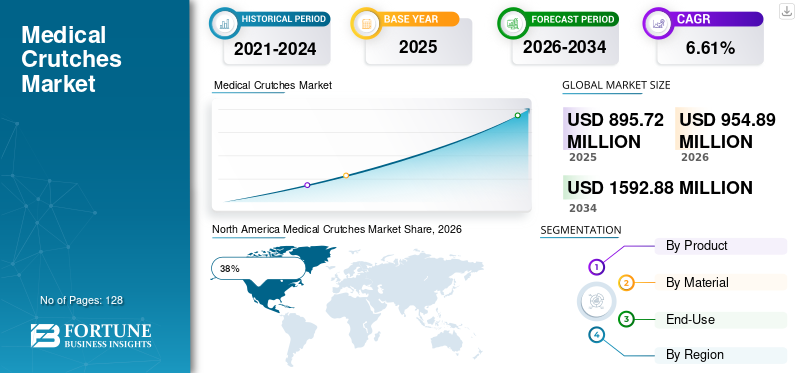
The medical crutches market size was valued at USD 895.72 Million in 2025. The market is projected to grow from USD 954.89 Million in 2026 to USD 1592.88 Million by 2034, exhibiting a CAGR of 6.61% during the forecast period.

The medical crutches market is an important segment of the global mobility assistance and rehabilitation industry. Medical crutches are widely used for post-surgical recovery, orthopedic rehabilitation, sports injury treatment, trauma care, and long-term mobility support. Growing cases of fractures, musculoskeletal disorders, road accidents, and age-related mobility limitations are increasing demand for advanced crutch solutions. Manufacturers are focusing on lightweight materials, ergonomic grips, adjustable height mechanisms, shock absorption systems, and patient comfort features. The medical crutches market Report indicates that healthcare institutions, rehabilitation centers, and homecare providers continue to expand procurement activities to improve patient mobility outcomes. Increasing awareness regarding mobility assistance and rehabilitation support is strengthening medical crutches market Growth across developed and developing economies.
The United States remains one of the most established markets for medical crutches due to high orthopedic procedure volumes, widespread rehabilitation services, and strong healthcare infrastructure. Sports injuries, knee replacement surgeries, hip replacement procedures, and trauma-related cases contribute significantly to product demand. Healthcare providers increasingly prefer durable aluminum and carbon-fiber crutches that improve patient mobility and reduce recovery complications. Home healthcare expansion and growing outpatient rehabilitation programs are also supporting market penetration. The Medical Crutches Industry Analysis for the United States highlights strong adoption of technologically enhanced mobility devices that provide improved balance, comfort, and weight distribution. Hospitals, clinics, and rehabilitation centers continue to invest in upgraded mobility solutions for better patient outcomes.
Download Free sample to learn more about this report.
 Global Market Size & Forecast
 Market Share
 Key Regional Highlights
North America
North America led the market with a 38% share in 2025, supported by strong healthcare infrastructure and rehabilitation demand.
Europe
Europe accounted for 29% of the market, driven by rising mobility support needs and established healthcare systems.
Asia-Pacific
Asia-Pacific held a 24% share, supported by increasing healthcare access and growing rehabilitation services.
U.S
The U.S. market benefits from high demand for mobility aids, orthopedic rehabilitation, and advanced crutch designs.
Japan
Japan accounted for 22% of the Asia-Pacific market, supported by its aging population and growing demand for mobility assistance.
Read More

The medical crutches market Trends indicate a major transition from traditional wooden mobility aids toward lightweight and ergonomic alternatives. Manufacturers are increasingly introducing aluminum alloy and carbon-fiber products that reduce user fatigue while improving durability. Adjustable crutches with enhanced grip designs, shock-absorbing tips, and foldable configurations are gaining popularity among healthcare providers and patients. Smart mobility support technologies are also entering the industry, including sensor-enabled crutches that assist in monitoring patient movement and rehabilitation progress.
Download Free sample to learn more about this report.
Another significant trend within the medical crutches market Research Report is the growing preference for customized mobility solutions. Patients recovering from surgeries and sports injuries increasingly seek products designed for comfort and long-term use. Forearm crutches are witnessing wider acceptance among younger and active users due to their flexibility and improved mobility characteristics. Healthcare organizations are emphasizing patient-centered rehabilitation programs, encouraging the adoption of advanced mobility aids. E-commerce distribution channels are further improving product accessibility, allowing manufacturers to reach hospitals, rehabilitation facilities, and homecare consumers more efficiently. Sustainability initiatives involving recyclable materials and environmentally responsible manufacturing practices are also influencing purchasing decisions within the Medical Crutches Industry Report.
Rising Incidence of Orthopedic Injuries and Rehabilitation Procedures
The primary growth driver for the medical crutches market is the increasing prevalence of orthopedic disorders, sports injuries, fractures, and post-operative rehabilitation requirements. Rising participation in sports activities and growing numbers of road traffic accidents continue to create demand for mobility support devices. Medical crutches remain among the most cost-effective and accessible rehabilitation tools available in healthcare systems globally. Hospitals frequently prescribe crutches after surgeries involving knees, hips, ankles, and lower extremities to support patient recovery.
An aging population further strengthens market demand because elderly individuals are more susceptible to mobility limitations and bone-related conditions. Rehabilitation centers increasingly rely on modern crutch systems designed to improve patient independence and reduce recovery times. The medical crutches market Analysis shows that growing awareness regarding rehabilitation outcomes is encouraging healthcare providers to invest in advanced mobility assistance products. Continuous improvements in ergonomics and lightweight materials are also expanding product adoption across various patient groups.
Availability of Alternative Mobility Assistance Devices
The medical crutches market faces restraints from the availability of alternative mobility devices such as walkers, wheelchairs, mobility scooters, and knee support systems. Patients with severe mobility limitations may prefer these alternatives because they often provide greater stability and lower physical exertion. Long-term crutch usage can result in discomfort, wrist strain, shoulder fatigue, and underarm pressure, reducing patient preference in certain clinical situations.
Another limiting factor involves reimbursement challenges in some healthcare systems where advanced mobility devices may not receive full insurance support. Price sensitivity remains a concern among consumers in developing regions, affecting adoption of premium ergonomic crutches. The medical crutches market Outlook indicates that some patients choose refurbished or rental mobility equipment rather than purchasing new products. Competition from substitute rehabilitation solutions continues to create pressure on manufacturers seeking sustained market expansion and product differentiation.
Expansion of Advanced Ergonomic ond Smart Crutch Technologies
One of the strongest opportunities within the medical crutches market lies in technological innovation. Manufacturers are increasingly developing lightweight, foldable, shock-absorbing, and sensor-integrated crutches that improve patient comfort and rehabilitation outcomes. Carbon-fiber materials, enhanced grip systems, and pressure-distribution technologies are creating opportunities for premium product segments. Healthcare providers are actively seeking solutions that reduce patient fatigue and encourage faster recovery.
The growth of home healthcare services also creates favorable conditions for market expansion. Patients recovering outside traditional hospital environments require reliable mobility assistance devices. The medical crutches market Opportunities segment is benefiting from increased investment in rehabilitation technology and patient-centered care models. Emerging economies present substantial potential due to improving healthcare access, rising orthopedic treatment rates, and expanding awareness regarding rehabilitation support. Digital healthcare integration may further enable manufacturers to develop connected mobility products capable of tracking rehabilitation progress and mobility performance.
Product Standardization and User Compliance Issues
A major challenge affecting the medical crutches market is ensuring proper product usage and patient compliance. Incorrect crutch sizing and improper walking techniques can lead to discomfort, secondary injuries, and delayed recovery. Healthcare providers must devote additional resources to patient education and mobility training to maximize treatment effectiveness.
Manufacturers also face challenges related to regulatory compliance, quality standards, and product safety requirements across different regions. Competitive pricing pressure makes it difficult for companies to balance innovation investments with profitability objectives. The Medical Crutches Industry Analysis highlights ongoing concerns regarding durability testing, material certification, and product customization. Furthermore, varying patient preferences and physical requirements necessitate diverse product portfolios, increasing production complexity and supply chain management challenges for industry participants.
Underarm crutches remain one of the most widely used products in the medical crutches market due to their accessibility, affordability, and widespread clinical acceptance. These crutches are frequently prescribed for short-term recovery following fractures, orthopedic surgeries, and sports-related injuries. Healthcare providers prefer underarm crutches because they offer strong support during early rehabilitation phases and are suitable for patients with limited upper-body strength. Their adjustable height mechanisms and durable construction contribute to consistent demand across hospitals and rehabilitation facilities.
The medical crutches market Share for underarm crutches is estimated at approximately 31%. Demand remains strong in emergency care settings where immediate mobility assistance is required. Manufacturers continue to improve product comfort through enhanced padding, lightweight materials, and ergonomic designs. The medical crutches market Forecast indicates continued utilization of underarm crutches across both developed and emerging healthcare markets due to their practicality and broad patient applicability.
Forearm crutches are increasingly gaining popularity among patients requiring long-term mobility support. These products provide greater flexibility, improved posture control, and reduced underarm pressure compared to traditional alternatives. Forearm crutches are commonly used by individuals with chronic mobility conditions, neurological disorders, and extended rehabilitation needs. Their lightweight design supports active lifestyles while promoting better balance and movement efficiency.
The medical crutches market Research Report identifies forearm crutches as the leading product category with an estimated market share of 34%. Demand is particularly strong among younger patients and physically active users seeking improved mobility. Product innovations involving carbon-fiber materials and ergonomic handle systems continue to drive adoption. Healthcare professionals increasingly recommend forearm crutches due to their enhanced comfort and long-term usability advantages.
Tetrapod crutches are designed to provide superior stability and weight distribution for users with significant mobility challenges. Featuring four-point support systems, these crutches help reduce fall risks and improve balance during rehabilitation. They are frequently utilized by elderly patients and individuals recovering from severe orthopedic conditions. Healthcare institutions often prescribe tetrapod crutches for patients requiring additional confidence during walking and movement activities.
The tetrapod crutch segment accounts for an estimated 18% share of the medical crutches market. Demand is supported by increasing geriatric populations and growing awareness regarding fall prevention strategies. Manufacturers are introducing lightweight tetrapod designs that enhance maneuverability without compromising stability. The medical crutches market Insights indicate that this segment will continue benefiting from demographic trends and increasing rehabilitation service utilization.
To know how our report can help streamline your business, Speak to Analyst
Metal alloy crutches represent the most commonly used material category within the medical crutches market. Aluminum-based products dominate due to their lightweight structure, durability, corrosion resistance, and cost efficiency. Hospitals and rehabilitation centers favor metal alloy crutches because they provide reliable performance across diverse patient populations. Adjustable configurations and ease of maintenance further strengthen their market position.
The metal alloy segment holds approximately 38% of the medical crutches market Share. Ongoing product enhancements focus on reducing weight while improving structural strength. medical crutches market Trends reveal increasing demand for premium aluminum designs equipped with ergonomic handles, advanced grip technology, and improved shock absorption capabilities. The segment remains highly attractive for healthcare procurement departments seeking cost-effective mobility solutions.
Carbon-fiber and reinforced composite crutches represent a rapidly expanding material category. These products offer superior strength-to-weight ratios, making them attractive for active users and long-term rehabilitation patients. Carbon-fiber crutches significantly reduce user fatigue while maintaining excellent durability. Professional athletes and patients requiring extended mobility support increasingly prefer advanced composite solutions.
The carbon and composite material segment accounts for nearly 24% of the medical crutches market. Manufacturers continue investing in material innovation to improve performance and patient comfort. The medical crutches market Growth outlook for this category remains positive due to rising consumer willingness to adopt premium mobility products. Enhanced aesthetics and customization options further contribute to expanding adoption rates among healthcare providers and individual consumers.
Adult users represent the largest end-use category in the medical crutches market. Orthopedic surgeries, sports injuries, workplace accidents, and age-related mobility disorders contribute significantly to demand. Adults often require temporary or long-term rehabilitation support, creating consistent purchasing activity across hospitals, clinics, and homecare environments.
The adult segment commands approximately 52% of the medical crutches market Share. Demand remains particularly strong among individuals recovering from knee replacement, hip replacement, and lower-limb surgical procedures. The Medical Crutches Industry Report highlights increasing adoption of ergonomic and lightweight crutches designed specifically for adult rehabilitation requirements. Product customization and comfort enhancements remain important purchasing considerations within this segment.
North America Medical Crutches Market Share, 2025 (%)
To get more information on the regional analysis of this market, Download Free sample
North America remains the dominant regional market due to advanced healthcare infrastructure, extensive rehabilitation services, and strong adoption of mobility assistance technologies. The region benefits from a large patient population requiring post-operative rehabilitation and orthopedic support. Hospitals and rehabilitation facilities continue to upgrade mobility equipment inventories to improve patient care standards. Strong awareness regarding rehabilitation outcomes further supports demand across healthcare settings.
The region accounts for approximately 38% of the global medical crutches market Share. Growing numbers of orthopedic surgeries, sports injuries, and age-related mobility disorders contribute to sustained demand. Manufacturers actively introduce advanced ergonomic products throughout the region, while healthcare providers emphasize patient comfort and rehabilitation efficiency. Home healthcare growth and increased outpatient treatment services continue strengthening regional market opportunities.
Europe represents a mature and technologically advanced medical crutches market supported by strong healthcare systems and increasing mobility assistance requirements. Demand is driven by aging populations, orthopedic treatment volumes, and rehabilitation program expansion. Healthcare providers increasingly focus on patient-centered recovery approaches that encourage the use of advanced mobility devices.
Europe holds nearly 29% of the global medical crutches market Share. Product innovation remains a key competitive factor, with manufacturers emphasizing lightweight materials and ergonomic features. Rehabilitation clinics and community healthcare organizations contribute significantly to product adoption. Increasing investments in mobility support infrastructure and accessibility programs continue supporting market development throughout the region.
Germany is one of the leading contributors to the European medical crutches market due to its advanced healthcare network and strong orthopedic treatment capacity. The country experiences substantial demand from rehabilitation centers, hospitals, and homecare providers serving patients recovering from surgeries and mobility-related conditions. Healthcare professionals increasingly recommend ergonomic crutches that improve patient comfort and mobility outcomes.
Germany accounts for approximately 24% of the European medical crutches market. The market benefits from strong medical device manufacturing capabilities and consistent investment in rehabilitation technologies. Growing elderly populations and rising orthopedic procedure volumes continue driving procurement activity. Product innovation, quality standards, and patient-focused design remain major factors influencing purchasing decisions across healthcare institutions.
The United Kingdom medical crutches market demonstrates stable growth supported by public healthcare services, rehabilitation programs, and increasing awareness regarding mobility assistance solutions. Demand is generated by orthopedic procedures, sports injuries, and chronic mobility conditions requiring rehabilitation support. Healthcare providers prioritize durable and user-friendly crutches that facilitate effective patient recovery.
The United Kingdom represents approximately 19% of the European medical crutches market. Expanding homecare services and outpatient rehabilitation programs are creating additional opportunities for manufacturers. Hospitals continue replacing traditional mobility devices with advanced ergonomic alternatives designed to improve patient experiences. Product accessibility and rehabilitation effectiveness remain key market priorities.
Asia-Pacific is emerging as one of the most dynamic regions within the medical crutches market due to expanding healthcare access and increasing awareness regarding rehabilitation care. Rising urbanization, growing healthcare expenditure, and increasing orthopedic treatment volumes contribute to market expansion. Regional manufacturers are introducing affordable mobility products that meet diverse consumer requirements.
The region accounts for approximately 24% of the global medical crutches market Share. Demand is accelerating across major economies due to aging populations and increasing injury incidence. Healthcare infrastructure development and government initiatives aimed at improving rehabilitation services continue supporting market growth. Manufacturers increasingly view Asia-Pacific as a strategic investment destination.
Japan's medical crutches market is strongly influenced by its aging demographic profile and advanced healthcare system. The country experiences significant demand for rehabilitation products used in orthopedic recovery and mobility management. Healthcare providers emphasize patient safety, comfort, and long-term mobility support, encouraging adoption of advanced crutch technologies.
Japan contributes approximately 22% of the Asia-Pacific medical crutches market. Product demand is supported by rising surgical procedure volumes and increasing utilization of rehabilitation services. Manufacturers focus on lightweight designs and ergonomic enhancements that align with patient preferences. The country's emphasis on healthcare quality and innovation continues creating opportunities for premium mobility products.
China represents one of the largest growth opportunities within the medical crutches market. Expanding healthcare infrastructure, rising healthcare awareness, and increasing orthopedic treatment rates are strengthening demand for mobility support devices. Hospitals and rehabilitation centers are investing in modern mobility equipment to improve patient outcomes and rehabilitation efficiency.
China accounts for approximately 34% of the Asia-Pacific medical crutches market. Growing urban populations and increasing access to healthcare services continue supporting product adoption. Domestic manufacturers are expanding production capacity while international companies pursue regional expansion strategies. Demand for lightweight, durable, and affordable mobility solutions remains particularly strong throughout the country.
The Rest of World region includes Latin America, the Middle East, and Africa, where healthcare modernization and rehabilitation service development are supporting medical crutches market expansion. Rising awareness regarding mobility assistance and increasing incidence of orthopedic conditions contribute to growing demand. Healthcare providers continue investing in basic and advanced rehabilitation equipment to improve patient care standards.
The region represents approximately 9% of the global medical crutches market Share. Government healthcare initiatives, hospital infrastructure projects, and increasing accessibility to medical devices are strengthening market prospects. Manufacturers are expanding distribution networks and forming partnerships with healthcare institutions to improve market penetration across developing economies.
Investment activity in the medical crutches market is increasingly focused on product innovation, material advancements, and rehabilitation technology integration. Investors are showing strong interest in companies developing lightweight mobility devices with improved ergonomics and patient comfort. Carbon-fiber technologies, smart sensors, and digitally connected rehabilitation products are attracting funding from medical device investors seeking long-term growth opportunities.
The medical crutches market Opportunities landscape is also supported by expansion within emerging healthcare markets. Healthcare infrastructure improvements, rising orthopedic treatment volumes, and growing awareness regarding rehabilitation support continue creating favorable investment conditions. Strategic partnerships between mobility device manufacturers and healthcare institutions are becoming more common. Companies expanding manufacturing capabilities and distribution networks in Asia-Pacific, Latin America, and the Middle East are expected to benefit from increasing demand for mobility assistance products. Rehabilitation-focused healthcare models and homecare service expansion further strengthen the investment outlook.
New product development remains a central focus within the medical crutches market as manufacturers compete through innovation and patient-centered design. Companies are introducing advanced crutches featuring ergonomic handles, shock-absorbing mechanisms, anti-slip tips, and adjustable support systems. Lightweight aluminum and carbon-fiber materials are becoming increasingly common due to their ability to improve mobility while reducing user fatigue.
Manufacturers are also exploring sensor-enabled crutches capable of monitoring rehabilitation progress and providing mobility data to healthcare professionals. Foldable and travel-friendly designs are gaining popularity among active users seeking convenience and portability. The medical crutches market Forecast suggests continued emphasis on personalized rehabilitation solutions that enhance comfort and usability. Product differentiation through advanced materials, improved aesthetics, and digital integration is expected to remain a key competitive strategy among leading market participants.
The medical crutches market Report provides comprehensive analysis of industry structure, product categories, material segments, end-use applications, competitive landscape, and regional performance. The report evaluates key market drivers, restraints, opportunities, challenges, and technological developments influencing industry expansion. It examines purchasing trends among hospitals, rehabilitation centers, homecare providers, and individual consumers.
Request for Customization to gain extensive market insights.
The medical crutches market Research Report also includes detailed assessment of product innovations, distribution strategies, and investment activities across major regions. Competitive analysis highlights leading manufacturers and their strategic initiatives related to product development, geographic expansion, and operational improvements. The report scope covers regional outlooks, market share assessments, emerging opportunities, and industry trends influencing future demand. Stakeholders can utilize these insights to support strategic planning, market entry decisions, product positioning, and long-term business development initiatives within the global Medical Crutches Industry.
Fortune Business Insights says that the global market value stood at USD 895.72 million in 2025 and is projected to reach USD 1,592.88 million by 2034.
The market is expected to exhibit a CAGR of 6.61% during the forecast period of 2026-2034.
Forearm crutches was the leading product segment, with an estimated 34% market share, driven by their flexibility, improved posture control, and suitability for long-term mobility support.
Key players include Sunrise Medical, Nova Medical Products, Millennial Medical, Chinesport, IWALKFree, and Cardinal Health.
Major trends include the shift toward lightweight, ergonomic aluminum and carbon-fiber crutches and growing adoption of smart, sensor-enabled mobility solutions. North America led the market with a 38% share.


(Offer valid till 31st Oct 2026)
Get 30-60 hrs Free Customization
Expand Regional and Country Coverage, Segments Analysis, Company Profiles, Competitive Benchmarking, and End-user Insights.













.webp)






Get In Touch With Us
US +1 833 909 2966 ( Toll Free )
Receive a tailored pricing based on your needs.
Discuss your questions with our industry experts.
Have questions? Get quick answers before you purchase.

