Medical Device Contract Manufacturing Market Size, Share & Industry Analysis, By Device Class (Class I, Class II, and Class III), By Service Type (Component & Accessories Manufacturing, Device Manufacturing, Packaging and Labeling, and Others), By Device Type (Cardiovascular Devices, Orthopedic Devices, Drug Delivery Devices, Diagnostic Imaging Devices, Respiratory Devices, and Others), By End-user (Original Equipment Manufacturers (OEMs), Pharmaceutical & Biopharmaceutical Companies, and Others), and Regional Forecast, 2026-2034
 Download Free Sample
Medical Device Contract Manufacturing Market [2026-2034]
 Listen to Audio Version
The global medical device contract manufacturing market size was valued at USD 87.43 billion in 2025 and is projected to grow from USD 92.86 billion in 2026 to USD 153.13 billion by 2034, exhibiting a CAGR of 6.5% during the forecast period. North America dominated the medical device contract manufacturing market with a market share of 35.80% in 2025.
The global medical device contract manufacturing market is becoming a strategic extension of medical technology companies’ product development and commercialization models. Device original equipment manufacturers (OEMs) increasingly outsource manufacturing activities to specialized partners to reduce fixed costs, accelerate scale-up, and access capabilities that would be difficult to build internally. Outsourcing is expanding beyond assembly toward design transfer, component fabrication, sterilization coordination, packaging, validation, and regulatory support.
The medical device contract manufacturing market size is supported by demand across the ecosystem. Aging populations, chronic disease prevalence, minimally invasive procedures, and rising expenditure are increasing device volumes across cardiovascular, orthopedic, drug delivery, respiratory, and diagnostic applications. At the same time, device complexity is increasing. Connected devices, combination products, miniaturized components, and materials require specialized processes and tighter quality controls.
The market is also being reshaped by supply-chain strategy. Medical device manufacturers increasingly evaluate contract manufacturing organizations on quality systems, geographic redundancy, traceability, engineering depth, and capacity flexibility. Cost remains important, but procurement decisions increasingly reflect lifecycle economics, regulatory execution, and the supplier’s ability to support launches without compromising quality.
North America remains a revenue center because of its large medical device ecosystem, established regulatory infrastructure, and concentration of sophisticated OEMs. Europe retains strong demand through its medtech base and specialized manufacturing capabilities. Asia-Pacific is gaining strategic importance as manufacturers seek scalable production, market access, and supply-chain diversification.
Competitive advantage is shifting toward integrated partners that combine engineering, component manufacturing, assembly, packaging, testing, and quality management. Larger providers benefit from scale, while specialized firms compete through technical expertise and responsiveness.
Medical device contract manufacturing market trends indicate continued movement toward integrated outsourcing, automation, manufacturing, and earlier supplier involvement in product development. These factors should support sustained Medical device contract manufacturing market growth, although regulatory complexity, qualification costs, and customer concentration remain constraints for investors.
The medical device contract manufacturing services include outsourced design support, component manufacturing, device assembly, packaging, testing, sterilization support, and full-scale manufacturing services for medical device OEMs. Moreover, the market is witnessing significant growth as OEMs are increasingly preferring specialized partners to reduce capital investment in tooling, automation, cleanrooms, regulatory systems, and skilled manufacturing teams.
Furthermore, Jabil Inc., Integer Holdings Corporation, and TE Connectivity held the highest market share in 2025, driven by strong global footprints in specialized manufacturing services and an emphasis on service expansions.
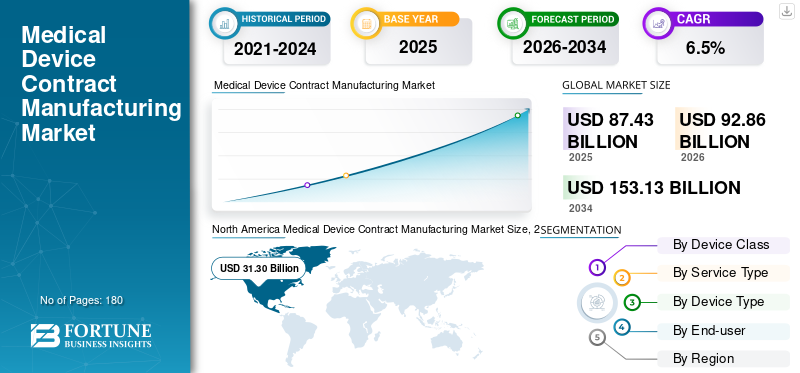
Download Free sample to learn more about this report.
Medical Device Contract Manufacturing Market Key Takeaways
 Global Market Size & Forecast
- 2025 Market Size: USD 87.43 billion
- 2026 Market Size: USD 92.86 billion
- 2034 Forecast Market Size: USD 153.13 billion
- CAGR: 6.5% from 2026–2034
 Market Share
- North America dominated the medical device contract manufacturing market with a 35.8% share in 2025.
- Device manufacturing held a 45.2% market share in 2026 due to increasing outsourcing by OEMs.
- Cardiovascular devices accounted for a 26.7% market share in 2026, supported by rising demand for cardiac care devices.
 Key Regional Highlights
Asia Pacific
Asia Pacific reached USD 24.16 billion in 2026, fueled by cost-efficient manufacturing and growing healthcare demand.
North America
North America held a 35.8% market share, driven by leading medical device OEMs and advanced healthcare infrastructure.
Europe
Europe reached USD 23.97 billion in 2026, supported by strong medtech manufacturing and outsourcing capabilities.
U.K.
The United Kingdom reached USD 3.03 billion in 2026, supported by a strong medical device manufacturing ecosystem.
Japan
Japan reached USD 5.57 billion in 2026, driven by advanced manufacturing capabilities and increasing medical device production.
Read More

Key Market Dynamics
Market Trends
Consolidation and Capability Expansion across Global Manufacturing Network to Emerge as a Key Trend
Currently, many CDMOs and strategic investors are acquiring specialized manufacturers to expand capabilities, geographies, and technology depth in their services. This expansion is the most common across micro-molding, metal processing, catheter assembly, additive manufacturing, coatings, and cardiovascular device manufacturing.
- For instance, in June 2024, DuPont announced the acquisition of Donatelle Plastics to deepen healthcare offerings in medical device solutions.
Moreover, contract manufacturers are moving from single-capability suppliers toward vertically integrated platforms that can serve complex OEM requirements across components, subassemblies, and finished devices.
The Medical device contract manufacturing market is shifting from transactional production toward integrated outsourcing partnerships. OEMs increasingly involve contract manufacturers earlier in product development to assess manufacturability, material selection, process capability, and scale-up requirements. This approach can reduce redesign cycles and improve the transition from prototype production to commercial manufacturing.
Automation is becoming a stronger competitive differentiator. Contract manufacturers are investing in automated assembly, machine vision, robotics, digital quality systems, and real-time process monitoring. These technologies improve production consistency while reducing dependence on manual inspection and repetitive assembly activities. Automation is particularly relevant for high-volume devices with demanding tolerance and traceability requirements.
Nearshoring and regional manufacturing are also influencing Medical device contract manufacturing market trends. OEMs increasingly seek production footprints closer to major healthcare markets to reduce logistics exposure and improve supply continuity. This does not eliminate global sourcing, but it is encouraging manufacturers to develop multi-region capacity and qualified supplier networks.
Another trend is the expansion of vertically integrated services. Leading providers increasingly combine design support, prototyping, component manufacturing, assembly, testing, packaging, and sterilization coordination. Customers can therefore consolidate suppliers and reduce handoffs across the product lifecycle.
Market Drivers
Download Free sample to learn more about this report.
OEMs Focus on Cost Reduction and Faster Time-To-Market to Fuel the Market Expansion
In recent years, OEMs have increasingly outsourced to reduce manufacturing costs and accelerate commercialization. Contract manufacturers possess capabilities such as building in-house capacity, validation, cleanrooms, regulatory documentation, supply-chain systems, and trained operators. As a result, outsourcing to contract manufacturers allows OEMs to focus on R&D, branding, clinical strategy, and commercialization. Such a scenario is anticipated to drive the global medical device contract manufacturing market growth.
The Medical device contract manufacturing market is primarily driven by increasing outsourcing among medical technology companies seeking flexible production capacity and specialized manufacturing expertise. OEMs increasingly prioritize asset-light operating models, particularly when product demand is uncertain or production volumes fluctuate across launch and maturity stages. Contract manufacturers can absorb selected capital requirements while providing validated processes and established quality systems.
Product complexity is another structural driver. Modern medical devices increasingly combine electronics, precision components, software, sensors, advanced materials, and drug-delivery functionality. OEMs often require specialized capabilities in molding, machining, microfabrication, electronics assembly, sterilization, and final device integration. External manufacturing partners can provide these capabilities without requiring parallel internal investments.
The expansion of minimally invasive procedures is also supporting demand. Cardiovascular, orthopedic, surgical, respiratory, and diagnostic devices increasingly require precision manufacturing and tight dimensional control. As procedural volumes rise, manufacturers require scalable production platforms that can maintain consistency across larger output levels.
Regulatory expectations further encourage outsourcing to established specialists. Contract manufacturers with mature quality management systems, validation expertise, traceability infrastructure, and regulatory experience can reduce execution risks during commercialization.
Market Restraints
Stringent Regulatory and Quality Compliance Requirements to Restrict Market Growth
Although the demand for medical device contract manufacturing services has been increasing, the market growth is constrained by stringent regulatory and quality requirements. This is particularly true for Class II and Class III devices, where documentation, biocompatibility, traceability, process validation, risk management, and post-market quality controls are critical. For instance, Class II devices are subject to special controls, and many require 510(k) premarket notification in the U.S., which increases the compliance burden for both OEMs and contract manufacturers.
Moreover, any deviation in component quality, packaging, sterilization, or process validation delays approvals, triggers recalls, or damages OEM-CMO relationships, which is anticipated to hinder market growth during the forecast period.
The Medical device contract manufacturing market faces significant barriers arising from regulatory complexity, qualification requirements, and customer concentration. Medical devices require rigorous quality controls, process validation, documentation, traceability, and change management. Contract manufacturers must maintain systems capable of satisfying customer requirements and applicable regulatory standards across multiple jurisdictions.
Qualification cycles can also constrain market expansion. OEMs typically require extensive supplier audits, technical validation, process qualification, and production verification before transferring meaningful volumes. Switching suppliers after commercialization can be costly because manufacturing changes may require additional validation or regulatory assessment. This creates high entry barriers but can lengthen sales cycles for new contract manufacturers.
Capital intensity remains material for providers serving complex devices. Advanced machining, injection molding, cleanroom assembly, automated inspection, electronics integration, sterilization coordination, and specialized testing can require substantial upfront investment. Smaller suppliers may therefore struggle to compete for large programs without sufficient financing and utilization.
Market Opportunities
End-to-End CDMO Partnerships and Specialized Technology Platforms to Create Significant Growth Opportunities
In recent years, there has been an increase in end-to-end partnerships and acquisitions to support OEMs from concept through prototyping, design, validation, manufacturing, regulatory support, assembly, and packaging, and into scale-up. This has become the most attractive to start-ups and large OEMs seeking faster design transfer, fewer suppliers, and better supply-chain control, which is expected to create significant opportunities for key players.
- For instance, in June 2022, Resonetics acquired Agile MV, a Montreal-based product development and turnkey device assembly leader focused on electrophysiology and interventional cardiology catheters. The move is centered on expanding Resonetics’ development and finished-device assembly capabilities.
The Medical device contract manufacturing market offers significant opportunities as OEMs increase outsourcing across complex and regulated product categories. One of the most attractive areas is integrated manufacturing for advanced devices combining mechanical, electronic, and software components. These products require coordinated engineering and production capabilities that many OEMs prefer to access through specialized external partners.
Combination products represent another opportunity. Drug delivery systems, connected therapeutic devices, and implantable technologies require expertise spanning device engineering, precision manufacturing, assembly, packaging, and regulatory controls. Contract manufacturers with cross-disciplinary capabilities can capture greater value by supporting multiple stages of commercialization.
Emerging medical technology companies also provide an attractive customer pool. Startups often lack manufacturing infrastructure and quality systems required for commercial production. A capable contract manufacturer can provide prototyping, design-for-manufacturing support, process validation, pilot production, and scalable manufacturing, allowing startups to conserve capital while progressing toward regulatory and commercial milestones.
Geographic diversification creates additional opportunities. OEMs increasingly seek qualified production alternatives across North America, Europe, and Asia-Pacific to improve supply resilience. Providers that establish complementary regional capacity can become strategic suppliers rather than transactional vendors.
Market Challenges
Supply-Chain Complexity and Capacity Balancing to Challenge Market Expansion
Managing global supply chain complexity while protecting OEM intellectual property and maintaining consistent quality across multiple manufacturing locations is a major challenge for service providers. Moreover, capacity planning poses a significant challenge given that the medical device demand can fluctuate due to product approvals, hospital purchasing cycles, regulatory delays, and component shortages.
In such a scenario, contract manufacturers need to balance automation investments, material sourcing, labor availability, and regionalization strategies. This is expected to limit market expansion over the forecast period. Furthermore, recent challenges have prompted medical device manufacturers to reassess their outsourcing strategies and strengthen collaborations with strategic partners.
Segmentation Analysis
By Device Class
More Regulations for Class II Devices over Other Classes to Boost the Segment Growth
Based on device class, the market is segmented into class I, class II, and class III.
To know how our report can help streamline your business, Speak to Analyst
Class I
Class I devices generally involve lower regulatory complexity and comparatively straightforward manufacturing requirements. Contract manufacturing demand is influenced by high production volumes, cost sensitivity, and the need for reliable component sourcing. OEMs often outsource standardized fabrication, assembly, packaging, and labeling to reduce internal manufacturing overhead.
The segment is attractive to contract manufacturers with scalable processes and efficient procurement systems. However, lower technical barriers can increase supplier competition and pricing pressure. As a result, market share tends to favor providers capable of achieving consistent quality at competitive unit economics.
For startups, Class I programs can provide an accessible entry point for outsourcing relationships. Larger OEMs may use these programs to evaluate supplier performance before expanding relationships into more complex products.
Class II
The Class II segment accounted for the largest global market share in 2025. Class II covers a broad range of moderate-risk medical devices widely used in diagnostics, cardiovascular care, surgical procedures, monitoring, and drug delivery, and typically require more controls. As a result, this is driving the demand for their outsourcing, contributing to segment growth.
Class II devices represent a broader outsourcing opportunity because they combine meaningful regulatory requirements with greater manufacturing complexity. Examples include monitoring equipment, infusion-related products, surgical instruments, and numerous diagnostic devices.
OEMs increasingly seek contract manufacturers capable of process validation, quality documentation, inspection, assembly, and regulatory support. Manufacturing partners with established quality systems can reduce commercialization risk while supporting production scale-up.
Class II programs often provide an attractive balance between volume potential and technical differentiation. Contract manufacturers can strengthen customer relationships by supporting design transfer, engineering changes, process optimization, and production validation.
- For instance, as of May 2026, Class II devices are subject to special controls and often follow the 510(k) pathway in the U.S. This creates the demand for contract manufacturers with validated quality systems, documentation expertise, and repeatable production capabilities.
Class III
Additionally, the class III segment is projected to grow at a CAGR of 7.3% during the forecast period. Class III devices represent the highest-value opportunity within many outsourcing portfolios because they involve greater patient risk, stringent regulatory oversight, and demanding manufacturing controls. Cardiovascular implants, sophisticated drug delivery systems, and certain implantable therapeutic devices require rigorous process validation and traceability.
Contract manufacturers serving this segment must demonstrate strong quality management, technical documentation, specialized manufacturing capabilities, and consistent process control. Qualification periods can be lengthy, but successful suppliers may benefit from high switching costs and longer program lifecycles.
The strategic attractiveness of Class III manufacturing is therefore linked less to production volume alone and more to technical barriers, regulatory expertise, and customer integration.
By Service Type
Higher Need for Device Manufacturing with Expertise to Drive the Segment’s Growth
By service type, the market is segmented into component & accessories manufacturing, device manufacturing, packaging and labeling, and others.
Component & Accessories Manufacturing
Component manufacturing represents a foundational service within the Medical device contract manufacturing market. Suppliers produce precision components, housings, machined parts, molded components, connectors, and other assemblies used within finished medical devices.
Demand is increasing as OEMs seek specialized capabilities without investing in every manufacturing process internally. Precision machining, injection molding, micro molding, metal forming, and advanced surface treatment are particularly important for complex devices.
The competitive advantage lies in process capability and repeatability. Suppliers with validated equipment, automated inspection, material traceability, and strong engineering support can secure longer-term programs.
Device Manufacturing
The device manufacturing segment accounted for the largest market share in 2025. Device manufacturing is the core outsourcing need for OEMs, encompassing the production of components, subassemblies, and finished devices. This outsourcing is mainly due to the need to reduce fixed costs, improve flexibility, and access specialized equipment. Moreover, the segment is estimated to hold a share of 45.2% in 2026.
Device manufacturing represents a higher-value outsourcing model because the contract manufacturer manages multiple production stages. Activities may include subassembly, final assembly, testing, process validation, and production release.
OEMs increasingly prefer integrated manufacturing partners to reduce supplier complexity and improve accountability. This model is particularly attractive for startups and expanding medical technology companies that lack commercial-scale infrastructure.
Additionally, the component & accessories manufacturing segment is anticipated to grow at a CAGR of 5.9% over the forecast period.
Packaging and Labeling
Packaging and labeling services are increasingly integrated into outsourcing contracts because regulatory compliance depends on accurate product identification, traceability, and controlled packaging processes. Sterile and sensitive devices require packaging systems that preserve product integrity throughout transportation and storage.
By Device Type
High Burden of Heart Conditions to Boost Cardiovascular Devices Segment Growth
By device type, the market is classified into cardiovascular devices, orthopedic devices, drug delivery devices, diagnostic imaging devices, respiratory devices, and others.
Cardiovascular Devices
The cardiovascular devices segment accounted for the largest medical device contract manufacturing market share in 2025. The segment growth is attributed to the rising burden of heart conditions, which is driving the sustained demand for stents, catheters, guidewires, heart valves, electrophysiology devices, and structural heart devices, as well as the outsourcing of medical devices due to greater need. Moreover, the segment is projected to hold a 26.7% share in 2026.
- For instance, according to data from the British Heart Foundation in January 2024, around 2.3 million people in the U.K. are living with coronary heart disease.
Cardiovascular devices represent an important outsourcing segment because manufacturing requires precision, biocompatibility, and stringent quality controls. Contract manufacturers support components and finished products including catheter-based systems, structural heart devices, vascular products, and associated delivery systems.
Growing procedural volumes and increasing device complexity support demand for specialized manufacturing. Suppliers with expertise in precision machining, polymer processing, catheter assembly, coating, and cleanroom production are positioned to capture higher-value programs.
Orthopedic Devices
The orthopedic devices segment is expected to grow at a CAGR of 6.0% during the forecast period. Orthopedic manufacturing benefits from increasing demand for joint reconstruction, trauma products, spinal systems, and surgical instruments. Contract manufacturers increasingly provide precision machining, additive manufacturing, surface finishing, cleaning, and assembly services.
Material expertise is particularly important because titanium, cobalt-chromium alloys, polymers, and advanced surface treatments must meet demanding performance requirements. Suppliers capable of supporting both prototyping and scaled production can strengthen OEM relationships.
Drug Delivery Devices
Drug delivery is one of the fastest-evolving device categories within the outsourcing market. Autoinjectors, infusion systems, wearable delivery platforms, and connected injection devices combine mechanical, electronic, and pharmaceutical requirements.
OEMs increasingly outsource specialized manufacturing to reduce development timelines and access validated production infrastructure. Contract manufacturers with expertise in precision molding, miniature assembly, electronics integration, and device testing can capture significant value.
Diagnostic Imaging Devices
Diagnostic imaging equipment requires sophisticated electronics, mechanical assemblies, sensors, shielding, and precision components. Contract manufacturers increasingly support subsystem production and specialized component manufacturing rather than complete system outsourcing.
Respiratory Devices
Respiratory devices include ventilators, oxygen delivery equipment, inhalation systems, and related components. Manufacturing requirements emphasize reliability, airflow control, materials compatibility, and quality assurance.
By End-user
Key Capabilities of Contract Manufacturers to Increase OEMs’ Outsourcing Propelling Segment Growth
By end-user, the market is segmented into original equipment manufacturers (OEMs), pharmaceutical & biopharmaceutical companies, and others.
Original Equipment Manufacturers (OEMs)
In 2025, the original equipment manufacturers (OEMs) segment dominated the market by end-user. OEMs own product design, regulatory submissions, brand strategy, and commercial channels. Further, they outsource their products to CDMOs for cost efficiency, capacity flexibility, and specialized technical capabilities, helping them meet global demand and avoid delays in the product’s market entry. This is expected to fuel the segment’s growth. Furthermore, the segment is set to hold a 75.3% share in 2026.
OEMs represent the dominant customer group within the Medical device contract manufacturing market. Established manufacturers increasingly outsource selected production activities to improve capital efficiency, gain technical expertise, and increase manufacturing flexibility.
Large OEMs generally demand global capacity, rigorous quality systems, supply continuity, and engineering support. Smaller OEMs and startups place greater emphasis on development assistance, regulatory readiness, pilot production, and scalable commercialization.
Pharmaceutical & Biopharmaceutical Companies
The pharmaceutical & biopharmaceutical companies segment is projected to grow at a CAGR of 8.3% during the forecast period. Pharmaceutical and biopharmaceutical companies increasingly require contract manufacturing support as drug-device combination products become more prevalent. Autoinjectors, wearable delivery systems, infusion devices, and connected administration platforms require integrated device manufacturing capabilities.
These customers typically demand strong quality systems, supply-chain control, validation expertise, and coordination between pharmaceutical and device requirements. Contract manufacturers capable of managing these interfaces can access higher-value outsourcing opportunities.
Regional Insights
Based on geography, the market is classified into North America, Europe, Asia Pacific, Latin America, and the Middle East & Africa.
North America Medical Device Contract Manufacturing Market Analysis
North America Medical Device Contract Manufacturing Market Size, 2025 (USD Billion)
To get more information on the regional analysis of this market, Download Free sample
North America accounted for the largest share of revenues in 2024, valued at USD 29.57 billion, and reached USD 31.30 billion in 2025. The strong presence of major medical device OEMs, advanced healthcare infrastructure, high R&D spending, and the early adoption of complex medical technologies are expected to support the regional market growth.
North America maintains the largest Medical device contract manufacturing market share due to its concentration of medical technology companies, advanced healthcare infrastructure, and mature regulatory environment. Outsourcing demand is driven by increasing device complexity, commercialization requirements, and supply-chain resilience initiatives. Contract manufacturers benefit from proximity to OEM decision-makers, strong engineering ecosystems, and sustained investment in high-value cardiovascular, orthopedic, and diagnostic technologies.
United States Medical Device Contract Manufacturing Market
In 2026, the U.S. is anticipated to reach USD 31.43 billion, accounting for approximately 33.8% of the global market. The United States represents the dominant national market, supported by extensive medical device innovation, strong venture capital activity, and a large OEM base. Manufacturers increasingly outsource production to improve flexibility, reduce capital requirements, and accelerate product launches. Demand remains particularly strong for complex devices requiring advanced assembly, cleanroom manufacturing, electronics integration, validation support, and stringent quality management capabilities across regulated healthcare applications.
Europe Medical Device Contract Manufacturing Market Analysis
The Europe market is projected to record a growth rate of 5.8% during the forecast period, the third-highest globally, reaching USD 23.97 billion by 2026. The region benefits from the higher concentration of medtech contract manufacturing sites in Germany, Ireland, Switzerland, France, and the U.K.
Europe remains a strategically important market supported by established medtech clusters, advanced manufacturing expertise, and strong regulatory compliance capabilities. Demand is reinforced by increasing outsourcing among device manufacturers seeking specialized engineering, production scalability, and access to regional markets. Contract manufacturers benefit from expertise in precision machining, orthopedic manufacturing, catheter technologies, and advanced materials processing across diverse medical device categories.
Germany Medical Device Contract Manufacturing Market
The Germany market is expected to reach around USD 5.70 billion by 2026, accounting for approximately 6.1% of the global revenue. Germany serves as a leading European manufacturing hub because of its engineering excellence, industrial infrastructure, and strong medical technology sector.
Sophisticated OEM requirements, high-quality production standards, and increasing investment in advanced medical technologies support demand for contract manufacturing. Suppliers with precision manufacturing, automation, electronics integration, and regulatory expertise continue strengthening their position within the German medical device ecosystem.
United Kingdom Medical Device Contract Manufacturing Market
The U.K. market is projected to reach USD 3.03 billion by 2026, representing approximately 3.3% of global revenues. The United Kingdom continues expanding its contract manufacturing capabilities through investment in medical technology innovation, life sciences, and advanced manufacturing.
Outsourcing demand is supported by growing activity among startups, specialized OEMs, and healthcare technology developers. Manufacturers increasingly seek partners capable of providing design transfer, pilot production, quality management, and commercial-scale manufacturing while supporting regulatory compliance and market expansion objectives.
Asia-Pacific Medical Device Contract Manufacturing Market Analysis
Asia-Pacific represents the fastest-growing regional opportunity within the Medical device contract manufacturing market. Growth is supported by expanding healthcare expenditure, manufacturing investment, favorable production economics, and increasing medical device consumption. Global OEMs continue diversifying supply chains across the region while leveraging engineering talent and scalable production capacity. These dynamics are strengthening Asia-Pacific’s role within global medical device manufacturing networks.
By 2026, the Asia-Pacific market is projected to reach approximately USD 24.16 billion, making it the second-largest market worldwide. The growth is driven by cost-efficient manufacturing, expanding healthcare infrastructure, increasing domestic medical device demand, and growing outsourcing by global OEMs from contract manufacturers in China, India, Japan, South Korea, Malaysia, and Singapore.
Japan Medical Device Contract Manufacturing Market
The Japan market is projected to generate approximately USD 5.57 billion in revenue by 2026, representing nearly 6.0% of the global market. Japan maintains a strong position within the contract manufacturing landscape through advanced engineering capabilities, precision manufacturing expertise, and high-quality production standards. Demand is supported by increasing medical technology innovation, aging demographics, and healthcare modernization initiatives. Manufacturers specializing in miniaturized devices, diagnostic technologies, and precision components benefit from strong domestic demand while supporting international OEM requirements across specialized applications.
China Medical Device Contract Manufacturing Market
The China market is anticipated to reach around USD 8.42 billion by 2026, accounting for nearly 9.1% of global revenues. China continues strengthening its role within global medical device production through expanding manufacturing infrastructure, increasing healthcare investment, and growing domestic innovation capabilities. OEMs increasingly utilize Chinese manufacturing partners to achieve scale, improve cost competitiveness, and support regional market access. Quality improvements, regulatory modernization, and investment in advanced production technologies are enhancing the country’s competitiveness within higher-value device categories.
India Medical Device Contract Manufacturing Market
The India market is expected to reach approximately USD 2.91 billion by 2026, accounting for around 3.1% of the global market revenue.
Latin America and Middle East & Africa Medical Device Contract Manufacturing Market Analysis
Latin America is gradually increasing its participation in medical device contract manufacturing as healthcare systems expand and regional production capabilities improve. Demand is supported by rising healthcare expenditure, medical device imports, and localized manufacturing initiatives. Although the region remains smaller than established markets, investment in healthcare infrastructure and regulatory development is expected to create selective long-term outsourcing opportunities.
The Middle East and Africa market remains at an earlier stage of development but presents emerging opportunities as healthcare infrastructure expands and governments prioritize local manufacturing capabilities. Demand is supported by increasing healthcare investment, growing medical device consumption, and modernization initiatives. Long-term growth will depend on regulatory advancement, industrial development, and continued healthcare sector investment.
Both Latin America and the Middle East & Africa markets are anticipated to witness moderate growth. The Latin America market is estimated to reach approximately USD 6.22 billion by 2026. The growth is attributed to the expansion of contract manufacturers in Mexico, Brazil, the GCC countries, and other countries/sub-regions, driven by the growing demand for cardiovascular, diagnostic, orthopedic, and minimally invasive devices.
GCC Medical Device Contract Manufacturing Market
By 2026, the GCC market is estimated to reach approximately USD 2.88 billion, representing around 3.1% of global revenues.
Medical Device Contract Manufacturing Industry Competitive Landscape
Strong Manufacturing Footprint and Key Strategic Initiatives to Strengthen the Market Position of Key Players
In 2025, Jabil Inc., Integer Holdings Corporation, and TE Connectivity held the majority of the global medical device contract manufacturing market share. This share is due to global manufacturing footprints, regulatory expertise, cleanroom infrastructure, and the ability to support OEMs from design transfer to commercial production.
Moreover, other major players are focusing on specialized areas such as catheter assembly, nitinol processing, micro-molding, coatings, orthopedic implants, and others. Furthermore, their involvement in acquisitions and collaborations is expected to help them gain significant market share.
The Medical device contract manufacturing market remains fragmented across global integrated manufacturers, specialized component suppliers, precision engineering firms, and regional production specialists. Competitive positioning increasingly depends on regulatory execution, manufacturing depth, engineering capabilities, geographic coverage, and the ability to manage complex programs from design transfer through commercial production.
Major global participants include Jabil, Flex, Sanmina, Integer Holdings, TE Connectivity, Phillips Medisize, Viant Medical, Nortech Systems, and Cirtec Medical, alongside numerous specialized regional manufacturers. Their positioning varies considerably. Large diversified providers emphasize global capacity and integrated supply chains, while specialized firms compete through technical expertise and application-specific manufacturing.
Partnerships are becoming increasingly important as device complexity rises. OEMs increasingly engage contract manufacturers during product development rather than after design completion. This allows suppliers to influence manufacturability, tooling, materials, automation, and process validation before commercial launch.
Established providers can expand capabilities by acquiring specialized manufacturing technologies, geographic capacity, or customer relationships. At the same time, smaller specialists can defend margins by focusing on high-complexity products where qualification requirements create meaningful switching costs. The competitive outlook therefore favors manufacturers combining engineering expertise, validated production systems, automation, regulatory capability, and geographic flexibility. Scale remains valuable, but differentiated technical capability increasingly determines access to higher-value medical device programs.
Key Companies Studied
- Jabil Inc. (U.S.)
- Sanmina Corporation (U.S.)
- Celestica LLC (Canada)
- Integer Holdings Corporation (U.S.)
- TE Connectivity (Ireland)
- Phillips Medisize (U.S.)
- Gerresheimer AG (Germany)
- Freudenberg Medical (U.S.)
- Viant (U.S.)
- SMC Ltd (U.S.)
Latest Medical Device Contract Manufacturing Industry Developments
- February 2025: Jabil Inc. acquired Pharmaceutics International, Inc. (Pii) to expand its healthcare contract development and manufacturing capabilities. The strategic purpose was to strengthen Jabil’s support for pharmaceutical and combination-product customers across development and commercial manufacturing. Capabilities involved included aseptic filling, lyophilization, oral solid-dose manufacturing, formulation development, and clinical-to-commercial production support.
- February 2025: Integer Holdings Corporation acquired Precision Coating Inc. for approximately $152 million, expanding its advanced surface-treatment capabilities for medical-device components. The strategic purpose was to strengthen Integer’s position in complex, high-performance device manufacturing. Capabilities involved included fluoropolymer coatings, anodic coatings, surface engineering, and specialized component processing for cardiovascular and other high-growth device applications.
- March 2025: Flex Ltd. opened a new healthcare-focused Product Introduction Center near Boston, Massachusetts, extending its end-to-end medical technology development and manufacturing offering. The strategic purpose was to help healthcare customers shorten commercialization timelines and transition products more efficiently into scaled production. Capabilities involved included prototyping, preclinical builds, design verification, product introduction, engineering, and production transfer.
- November 2025: Sanmina Corporation expanded its Fermoy, Ireland medical manufacturing facility, adding advanced automation lines, an ISO 8 cleanroom, and high-volume production capabilities for wearable medical devices. The strategic purpose was to increase European manufacturing capacity and support customers requiring scalable production closer to end markets. Capabilities involved included automated assembly, cleanroom manufacturing, wearable-device production, and high-volume manufacturing.
- May 2026: ViCentra began commercial-scale production of Kaleido insulin-pump consumables at Phillips Medisize, more than tripling manufacturing capacity and establishing initial capacity to support more than 17,000 users. The strategic purpose was to transition the Kaleido platform into larger-scale commercial production while improving manufacturing economics. Capabilities involved included contract manufacturing of infusion sets and insulin cartridges, production scale-up, and high-volume medical-device manufacturing.
Report Coverage
The report offers a comprehensive analysis of all market segments, outlining the key drivers, emerging trends, growth opportunities, major restraints, and potential challenges influencing the market landscape. It also examines advanced technological developments, regulatory requirements for medical device manufacturing, notable industry updates, company market share analysis, and the profiles of leading market participants.
Request for Customization to gain extensive market insights.
Report Scope & Segmentation
| ATTRIBUTE | DETAILS |
| Study Period | 2021-2034 |
| Base Year | 2025 |
| Estimated Year | 2026 |
| Forecast Period | 2026-2034 |
| Historical Period | 2021-2024 |
| Growth Rate | CAGR of 6.5% from 2026 to 2034 |
| Unit | Value (USD Billion) |
| Segmentation | By Device Class, Service Type, Device Type, End-user, and Region |
| By Device Class |
|
| By Service Type |
|
| By Device Type |
|
| By End-user |
|
| By Region |
|
Frequently Asked Questions
Fortune Business Insights says that the global market value stood at USD 87.43 billion in 2025 and is projected to reach USD 153.13 billion by 2034.
In 2025, the North America market value stood at USD 31.30 billion.
The market is expected to exhibit a CAGR of 6.5% during the forecast period of 2026-2034.
The class II segment led the market by device class in 2025.
A key factor driving the market is the expansion of OEM focus on cost reduction and faster time-to-market.
Jabil Inc., Integer Holdings Corporation, and TE Connectivity are the prominent players in the market.
North America is the dominant region in the market.



- 2021-2034
- 2025
- 2021-2024
- 180
Get 30-60 hrs Free Customization
Expand Regional and Country Coverage, Segments Analysis, Company Profiles, Competitive Benchmarking, and End-user Insights.













.webp)






Related Reports
-
US +1 833 909 2966 ( Toll Free )
-
Get In Touch With Us