Medical Device Security Market Size, Share & Industry Analysis, By Offering (Solutions {Encryption, Antivirus, Identity and Access Management, Disaster Recovery Solutions, Compliance Management, and Others} and Services {Managed and Professional}), By Type (Network & IoMT Security, End Point Security, Application Security, Cloud Security, and Others), By End User (Healthcare Providers, Healthcare Payers, Medical Device Manufacturers (MDMs), and Others), and Regional Forecast, 2026-2034
 Download Free Sample
Medical Device Security Market Size & Industry Overview
 Listen to Audio Version
The global medical device security market size was valued at USD 7.29 billion in 2025 and is projected to grow from USD 8.30 billion in 2026 to USD 22.69 billion by 2034, exhibiting a CAGR of 13.39% during the forecast period. North America dominated the global medical device security market with a market share of 44.0% in 2025.
The market for medical device security comprises integrated solutions used to protect medical devices from cyberattacks and ransomware, thereby driving the demand for effective cybersecurity solutions for medical devices. The global market is witnessing steady and significant growth, driven by the increasing adoption of EHR, telehealth records, and interconnected medical devices. The increasing adoption of these systems has expanded due to attack surface for healthcare systems, underscoring the importance of cybersecurity for patient safety and clinical operations.
Furthermore, this increasing demand is encouraging key companies to invest and direct their resources towards new product development and capitalize on the growing market.
- For instance, in May 2025, MedCrypt launched its new cybersecurity platform for medical devices. The medical device intelligence platform complies with the requirements of regulatory authorities and ensures that its devices adhere to security, compliance, and future-focused criteria.
Many key industry players, such as Medcrypt, Forescout, and ORD, operating in the market, are focusing on developing various innovative solutions to support the rising demand and diversify product offerings.
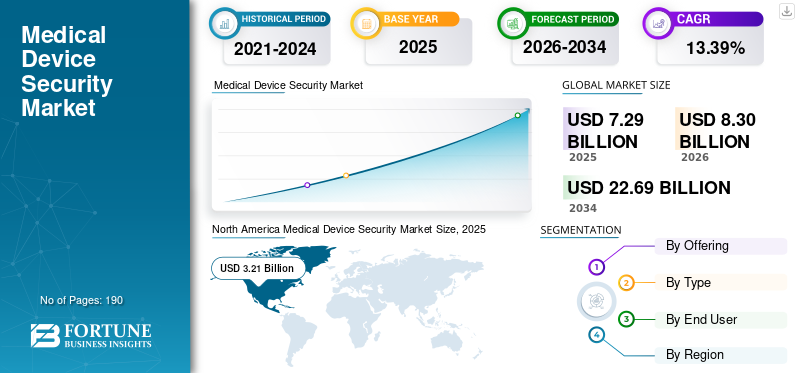
Download Free sample to learn more about this report.
Medical Device Security Market Key Takeaways
 Market Size & Forecast
- 2025 Market Size: USD 7.29 Billion
- 2026 Market Size: USD 8.30 Billion
- 2034 Forecast Market Size: USD 22.69 Billion
- CAGR: 13.39% from 2026–2034
 Market Share
- North America dominated the medical device security market with a 44.0% share in 2025.
- The services segment is expected to grow at a CAGR of 16.14% during the forecast period.
- The application security segment is projected to grow at a CAGR of 14.90% over the forecast period.
 Key Regional Highlights
North America
North America remained the leading market, reaching USD 3.21 billion in 2026.
Europe
Europe is projected to be the second-largest regional market, reaching USD 2.08 billion in 2026.
Asia Pacific
Asia Pacific is expected to become the third-largest regional market, reaching USD 1.89 billion in 2026.
U.S.
The market is estimated to reach approximately USD 3.34 billion in 2026.
Japan
The market is estimated at around USD 0.46 billion in 2026, accounting for roughly 5.5% of the global market.
Read More

MEDICAL DEVICE SECURITY MARKET TRENDS
Integration of Artificial Intelligence to Safeguard Medical Devices Is a Prominent Trend Observed in the Market
The integration of artificial intelligence (AI) to safeguard medical devices has emerged as a prominent trend in the global market. AI enables continuous traffic analysis, anomaly detection, and behavioral profiling of devices to assist security teams in identifying abnormal patterns that may indicate malware, misconfigurations, at larger scales. As hospitals expand IoMT networks, AI-driven security also supports automated risk prioritization. These large scale operations support the market's growth encouraging key companies to invest in technological advancements highlighting its importance.
- For instance, in May 2024, Palo Alto Networks launched new security solutions to help enterprises prevent AI-generated attacks and effectively secure AI systems designed from the ground up. The platform uses machine learning (ML) and deep learning (DL) and proactively protect networks and infrastructure. Such developments support the growth of the global market.
Download Free sample to learn more about this report.
MARKET DYNAMICS
MARKET DRIVERS
Rising Ransomware and Cyberattacks On Healthcare Networks to Drive Market Growth
The primary factor driving market growth is the increasing threat of cyberattacks on various healthcare networks. With the broader adoption of connected medical devices and the Internet of Medical Things (IoMT) ecosystem, the importance of cybersecurity has heightened. The healthcare sector faces an escalating threat from ransomware attacks targeting medical devices. These attacks not only compromise patient data but also pose direct risks to patient safety by potentially disrupting critical care equipment. These factors drive demand in the global market and boost the medical device security market growth.
For instance, in October 2024, the American Hospital Association reports that healthcare cybersecurity threats continued unabated last year, with more than 386 documented attacks against medical facilities and critical service providers.
MARKET RESTRAINTS
Data Breaches and PHI Exposure to Impede Market Growth
Data breaches and the exposure of protected health information act as a significant market restraint. Frequent data breaches erode trust, making healthcare providers more cautious about new digital and connected device initiatives, which in turn hampers their productivity. These factors also slow down the overall market's adoption, posing a significant challenge to growth.
- For example, in August 2025, CPAP Medical Supplies and Services Inc. (CPAP Medical) reported a major data breach, potentially involving unauthorized access to the personal and protected health information of up to 90,133 patients. Such factors can restrict the market growth.
MARKET OPPORTUNITIES
Expansion of Remote Patient Monitoring and Cloud-Connected Medical Technologies To Offer Market Growth Opportunities
The expansion of remote patient monitoring (RPM) and cloud-connected medical technologies creates a significant growth opportunity, as it extends the user base beyond hospitals. With the increasing trend of telehealth consultations, adoption of remote patient monitoring, smart wearables, and the expansion of medical device applications in remote settings, the demand for medical device security solutions also rises.
- For instance, in April 2025, the American Hospital Association (AHA) Center for Health Innovation reported that the FDA cleared an Apple Watch–powered platform for seizure monitoring. Such developments underscore how consumer wearables and cloud-connected monitoring software are expanding remote monitoring beyond hospitals, creating new opportunities for providers and digital health vendors.
MARKET CHALLENGES
Long Replacement Cycle to Pose as a Critical Challenge to Market Growth
A long replacement cycle is a critical challenge in the market. Hospitals often retain high-cost equipment, such as imaging systems, patient monitors, infusion pumps, and lab analyzers, for extended periods. The software used by these systems is old and does not have security patches. That creates a growing pool of old medical devices that are difficult to replace. These factors can result in vulnerabilities in medical devices that can linger for years.
- For instance, in October 2025, the director of the Rotherham NHS Foundation Trust stated that 2% of the trust’s devices have not been upgraded because the current version of the software used by medical device suppliers does not work on Windows 11. These factors pose a significant challenge to the market.
Medical Device Security Market Segmentation Analysis
By Offering
Adoption of Medical Device Security Solutions Due to Importance of Advanced Technology for Protection to Propel Segmental Growth
Based on the offering, the market is divided into solutions and services.
The solutions segment is expected to account for the largest share of the market. The high segmental share is due to large volume utilization by healthcare enterprises and the critical importance of advanced technology for protection. The adoption of solutions such as IoMT visibility platforms, network segmentation, firewalls, NAC, SIEM/SOC, and identity and access solutions, among others, is increasing. These solutions are used to monitor behavior and enforce policies. Such advantages will further strengthen this segment’s market position.
Furthermore, numerous innovative launches in these solutions by key companies will support the market growth.
- For instance, in December 2022, Palo Alto Networks launched a spin-off from its IoT product, which previously covered other related areas such as IoMT (Internet of Medical Things) and OT (Operational Technology), focusing on medical devices. Such developments are anticipated to drive the market growth.
The services segment is expected to grow at a CAGR of 16.14% over the forecast period.
To know how our report can help streamline your business, Speak to Analyst
By Type
Advantages of Network Security Over Other Types Boosted Segment Growth of Network & IoMT Security
Based on type, the market is segmented into network & IoMT security, endpoint security, application security, cloud security, and others.
In 2025, the network & IoMT security segment dominated the global market. The dominance of this segment is attributed to the increasing number of connected devices, which makes them vulnerable to sophisticated threats. Unlike closed legacy systems, such as endpoints, where frequent agent or patch updates are deployed, securing the network layer is a most feasible alternative to protect numerous devices through automatic discovery, traffic profiling, segmentation, and anomaly detection. These factors highlight the advantages of network security over other security solutions and reinforce the segment's dominance.
- For instance, in October 2024, Forescout Technologies, Inc., published the report titled “Unveiling the Persistent Risks of Connected Medical Devices”. The report analyzed more than 2 million devices across 45 healthcare delivery organizations (HDOs) during the last week of May 2024 and reported 52% of IoMT devices were running Windows software, while only 10% of all IoMT devices were actively running anti-malware. A single weak point can lead to a sensitive patient data breach. Such factors make endpoint protection more challenging and highlight the need for stronger network security.
The application security segment is projected to grow at a CAGR of 14.90% during the forecast period for the market.
By End User
Strategic Collaboration of Hospital Pharmacies with Key Market Players Have Kept Healthcare Providers Them in the Leading Position
Based on end user, the market is segmented into healthcare providers, healthcare payers, Medical Device Manufacturers (MDMs), and others.
The healthcare providers dominated the global market. Their dominance in the end-user segment is due to the availability of large volumes of medical devices in these settings. Healthcare providers, such as hospitals and health systems, have diverse fleets of connected equipment and their own networks, which are used for patient safety, the uptime of critical services, and the protection of public health information. These factors result in providers being the primary customers for IoMT platforms, network security, and managed detection services, giving them the largest revenue share in the market. Furthermore, the segment is set to hold a 76.99% share in 2026.
- For instance, in June 2023, Franciscan Health collaborated with Fortinet Security Fabric Solutions to protect its IoT medical devices from the rising threat of cyberattacks. Such collaborations and partnerships are needed to drive the growth of the segment.
In addition, the healthcare payers segment is projected to grow at a CAGR of 15.93% during the study period.
Medical Device Security Market Regional Outlook
By geography, the market is categorized into Europe, North America, Asia Pacific, Latin America, and the Middle East & Africa.
North America
North America Medical Device Security Market Size, 2025 (USD Billion)
To get more information on the regional analysis of this market, Download Free sample
North America held the dominant medical device security market share in 2024, valued at USD 2.81 billion, and maintained its leading position in 2025, with a value of USD 3.21 billion. The market in North America is expected to increase. North America represents a leading region for medical device security, driven by high adoption of connected medical technologies, increasing cyber threats, and strong regulatory and industry guidance on healthcare cybersecurity. Healthcare providers and device manufacturers in the U.S. and Canada are investing in dedicated IoMT security platforms and services. These factors, coupled with robust healthcare and substantial investment in research and development, are enabling market growth.
U.S Medical Device Security Market
Based on North America’s strong contribution and the U.S. dominance within the region, the U.S. market can be approximated to be valued around USD 3.34 billion in 2026, accounting for roughly 40.3% of the global market.
Europe
Europe is projected to record a growth rate of 11.85% in the coming years, the second-highest among all regions, and reach a valuation of USD 2.08 billion by 2026. The region is estimated to have robust demand along with support from regulatory bodies for data protection regulations, medical device regulations, and national cybersecurity strategies.
U.K Medical Device Security Market
The U.K. market in 2026 is estimated to be around USD 0.32 billion, representing roughly 3.9% of the global market in 2026.
Germany Medical Device Security Market
Germany’s market is projected to reach approximately USD 0.54 billion in 2026, equivalent to be around 6.5% of the global market.
Asia Pacific
Asia Pacific is estimated to reach USD 1.89 billion in 2026 and secure the position of the third-largest region in the market.
Japan Medical Device Security Market
The Japan market in 2026 is estimated at around USD 0.46 billion, accounting for roughly 5.5% of the global market.
China Medical Device Security Market
China’s market is projected to be one of the largest globally, with 2026 revenues estimated at around USD 0.63 billion, representing roughly 7.6% of global medical device security sales.
India Medical Device Security Market
The Indian market in 2026 is estimated to be around USD 0.15 billion, accounting for roughly 1.9% of the global market revenue.
Latin America and the Middle East & Africa
The Latin America and Middle East & Africa regions are expected to witness moderate growth in this market space during the forecast period. The Latin America market is set to reach a valuation of USD 0.36 billion in 2026. The region is experiencing an increase in security investment, largely concentrated in larger private hospitals and health systems. In the Middle East & Africa, the GCC is set to reach a value of USD 0.17 billion in 2026.
Saudi Africa Medical Device Security Market
The Saudi Arabia market is projected to reach approximately USD 0.07 billion by 2026, accounting for roughly 0.8% of the global market revenue.
COMPETITIVE LANDSCAPE
Key Industry Players
Focus on Expanding Clinical Trials by Key Players to Propel Market Progress
The global medical device security market has a semi-consolidated market structure, comprising prominent players such as Palo Alto Networks, MedCrypt, and Forescout. The significant market share of these companies is due to numerous strategic activities, including collaboration among various organizations to diversify new product launches through various mergers and acquisitions.
- For instance, in March 2025, Armis acquired OTORIO, a leading provider of OT (Operational Technology) and CPS (Cyber Physical Systems) security. The development resulted in the integration of this technology into Armis’ Centrix cloud-based cyber exposure management platform. Such acquisitions aim to expand the product offering and drive market growth.
Other notable players in the global market include ORDR, Armis Inc., and Check Point Software Technologies Ltd. These companies are expected to prioritize new product launches and collaborations to increase their global market share during the forecast period.
LIST OF KEY MEDICAL DEVICE SECURITY COMPANIES PROFILED
- Palo Alto Networks (U.S.)
- Medcrypt (U.S.)
- Forescout (U.S.)
- ORDR (U.S.)
- Armis Inc (U.S.)
- Check Point Software Technologies Ltd. (Israel)
- Axonius (U.S.)
- Koninklijke Philips N.V., (Netherlands)
- GE HealthCare (U.S.)
KEY INDUSTRY DEVELOPMENTS
- December 2025: SEALSQ Corp entered the healthcare industry through its subsidiary IC’Alps, delivering custom integrated chip solutions and post-quantum protection for next-generation medical devices.
- October 2025: Thirdwayv Inc. collaborated with Medcrypt Inc., a premier provider of medical device cybersecurity and vulnerability management solutions, to advance cybersecurity and interoperability standards and solutions across the connected medical device ecosystem.
- July 2025: Axonius acquired Cynerio, a pioneer in medical device security, for over USD 100 million. The acquisition aimed to address a challenge for healthcare providers, where the proliferation of connected medical devices created a vast and unprotected attack surface.
- April 2024: Check Point Software Technologies Ltd. Partnered with Tuttnauer to develop an advanced software, T-Connect, used in medical and laboratory sterilization devices. Tuttnauer appointed Check Point Quantum IoT Nano Agent as its software security agent, integrating it into the device software for embedded protection, ensuring end-to-end protection against the latest cyber threats.
- July 2023: Cynerio partnered with Check Point Software Technologies to provide healthcare organizations with comprehensive security for their medical IoT devices. The company platform aimed to provide functionality critical to securing healthcare IoT devices, including device discovery, patch guidance, microsegmentation, and attack detection.
REPORT COVERAGE
Request for Customization to gain extensive market insights.
Report Scope & Segmentation
|
ATTRIBUTE |
DETAILS |
|
Study Period |
2021-2034 |
|
Base Year |
2025 |
|
Estimated Year |
2026 |
|
Forecast Period |
2026-2034 |
|
Historical Period |
2021-2024 |
|
Growth Rate |
CAGR of 13.39% from 2026-2034 |
|
Unit |
Value (USD Billion) |
|
Segmentation |
By Offering, Type, End User, and Region |
|
By Offering |
· Solutions o Encryption o Antivirus o Identity and Access Management o Disaster Recovery Solutions o Compliance Management o Others · Services o Managed o Professional |
|
By Type |
· Network & IoMT Security · End Point Security · Application Security · Cloud Security · Others |
|
By End User |
· Healthcare Providers · Healthcare Payers · Medical Device Manufacturers (MDMs) · Others |
|
By Region |
· North America (By Offering, Type, End User, and Country) o U.S. o Canada · Europe (By Offering, Type, End User, and Country/Sub-region) o Germany o U.K. o France o Spain o Italy o Scandinavia o Rest of Europe · Asia Pacific (By Offering, Type, End User, and Country/Sub-region) o China o Japan o India o Australia o Southeast Asia o Rest of Asia Pacific · Latin America (By Offering, Type, End User, and Country/Sub-region) o Brazil o Mexico o Rest of Latin America · Middle East & Africa (By Offering, Type, End User, and Country/Sub-region) o GCC o South Africa o Rest of Middle East & Africa |
Frequently Asked Questions
According to Fortune Business Insights, the global market value stood at USD 7.29 billion in 2025 and is projected to reach USD 22.69 billion by 2034.
In 2025, the market value stood at USD 3.21 billion.
The market is expected to exhibit a CAGR of 13.39% during the forecast period.
By offering, solutions segment is expected to lead the market.
The increasing threat of cyberattacks on medical devices is expected to drive demand and boost market expansion.
Palo Alto Networks, Medcrypt, Forescout, and ORDR are the major players in the global market.
North America dominated the market in 2025.



- 2021-2034
- 2025
- 2021-2024
- 190
Get 30-60 hrs Free Customization
Expand Regional and Country Coverage, Segments Analysis, Company Profiles, Competitive Benchmarking, and End-user Insights.













.webp)






Related Reports
-
US +1 833 909 2966 ( Toll Free )
-
Get In Touch With Us